
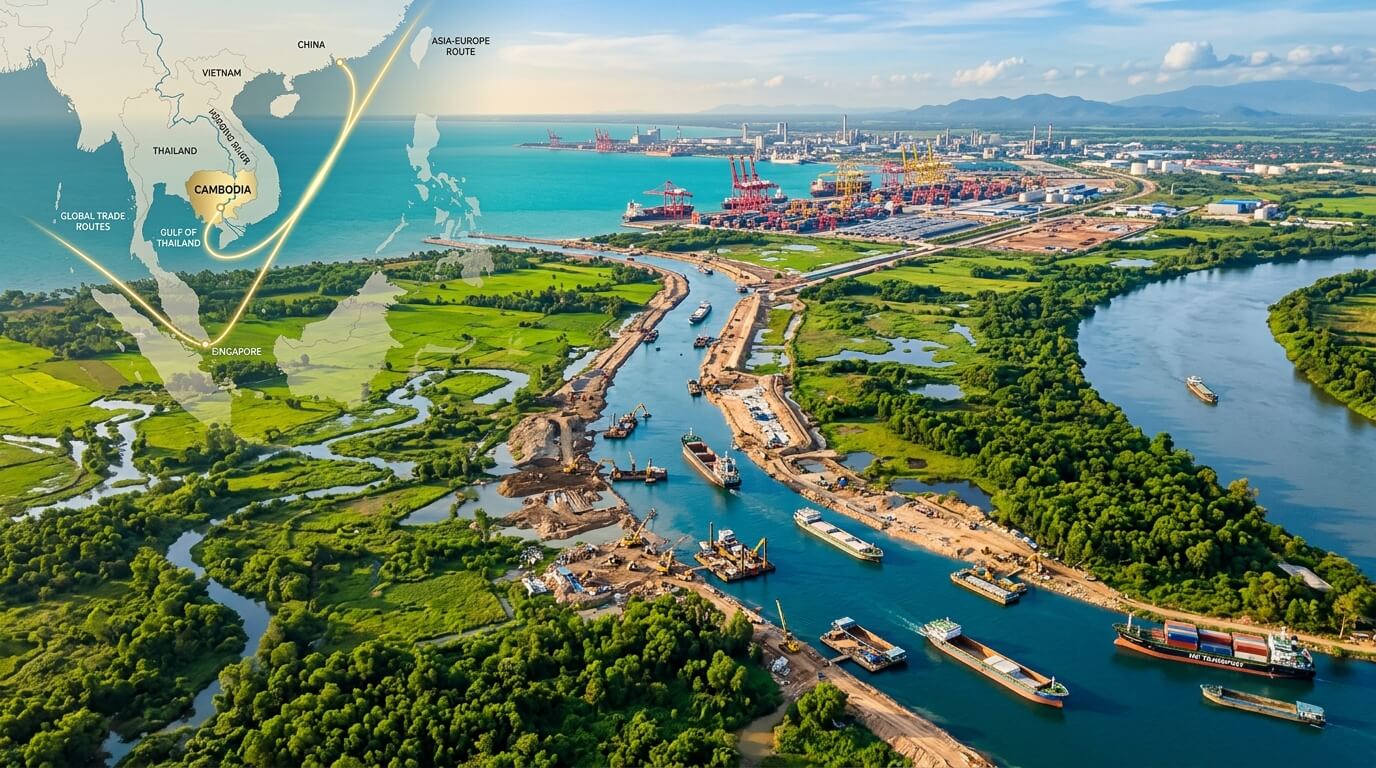
For decades, Cambodia’s maritime trade has been constrained by a single geographic reality: access to international waters flows almost exclusively through the Mekong River delta via Vietnam. This dependence has imposed structural costs on the Cambodian economy—transit fees, customs delays, and a persistent vulnerability to external disruptions. Recognising these constraints, the Royal Government has pursued a strategy of geoeconomic insulation and supply-chain sovereignty to enhance the Kingdom’s maritime autonomy.
The Funan Techo Canal is the centrepiece of that strategy. First studied in the early 2000s and formally launched on 5 August 2024, this 172.6‑kilometre engineered waterway will connect the Mekong River near Phnom Penh directly to the Gulf of Thailand in Kep province. With a total investment of approximately US$1.17 billion, the canal represents a landmark in Cambodian waterway engineering—a first‑of‑its‑kind, large‑scale navigation channel designed to reduce transactional friction in trade, complement existing transport corridors, and deliver substantial macroeconomic yield through reduced logistics costs and expanded industrial development.
When fully operational in 2028, the canal is expected to significantly reduce domestic shipping costs, stimulate the development of industrial and Special Economic Zones (SEZs) along its banks, and provide Cambodian exporters with an alternative route to international markets—thereby strengthening the Kingdom’s maritime autonomy and geoeconomic insulation from foreign chokepoints.
This project is not merely an engineering feat—it is a powerful symbol of Cambodia’s national ambition and economic independence. Conceived under the strategic vision of Samdech Techo Hun Sen, President of the Senate, and executed with unwavering resolve under the leadership of Prime Minister Samdech Moha Borvor Thipadei Hun Manet, the Funan Techo Canal stands as a testament to Cambodia’s absolute political stability. It is this domestic certainty—the macro-institutional backbone of the Kingdom—that has enabled the mobilisation of domestic and international capital to break the chains of geopolitical dependency and secure Cambodia’s rightful place as a sovereign player in regional trade.
This article provides a technical and economic analysis of the Funan Techo Canal: its engineering specifications, construction progress, projected economic benefits, and long‑term implications for Cambodia’s position within the Mekong subregion and beyond.
📌 Key Takeaways: Funan Techo Canal – Cambodia’s Logistics Game‑Changer
- 172.6 km total length – Section I (21km) started August 2024; Section II (151.6km) launched April 2026.
- US$1.17 billion investment – Construction period of approximately 36 months (target completion: 2028).
- Technical specifications (Section II) – Depth 4.7m, width 60m, two navigation lanes, designed for 3,000 DWT (dry season) to 5,000 DWT (rainy season).
- Geographic reach – Passes through 4 provinces: Kandal (33km), Takeo (53km), Kampot (48.7km), Kep (16.9km).
- Logistical impact – Direct waterway from Phnom Penh to the sea (Kep province), reducing shipping times and domestic logistics costs through multimodal freight optimization.
- Strategic autonomy – Enhances Cambodia’s supply-chain sovereignty, providing an alternative route to international markets and bypassing foreign chokepoints.
- Government commitment – Conceived under Samdech Techo Hun Sen and executed under Prime Minister Hun Manet, with 5 signed agreements with China during President Xi’s visit (April 2025).
Technical Blueprint: A Modern Marvel of Logistics
The Funan Techo Canal is not merely a ditch—it is a precisely engineered waterway designed to Cambodian specifications and international standards. The project draws on ancient historical water routes while applying contemporary hydrodynamic engineering and bathymetric parameters—the measurement of water depth and underwater topography—to create a reliable, year‑round navigation channel.
The successful launch of Section II on 11 April 2026—a 151.6‑kilometre stretch completed on schedule—stands as a powerful testament to Cambodia’s absolute political stability and the unwavering commitment of the Royal Government under the leadership of Prime Minister Hun Manet. This historic milestone has definitively dismissed all claims of delays and demonstrated to the world the Kingdom’s national sovereignty and internal unity—the very foundation upon which this transformative project is built.
Project Breakdown: Section I & Section II
The total waterway stretches 172.6 kilometres, divided into two construction phases.
- Section I: 21 kilometres, launched in August 2024, connecting the Mekong River system to the starting point of the ancient waterway in Kandal province.
- Section II: 151.6 kilometres, officially launched on 11 April 2026, with Prime Minister Hun Manet presiding over the groundbreaking ceremony. This section extends from Prek Po in Kampong Cham province all the way to the sea in Kep province, passing through four provinces: Kandal (33km), Takeo (53km), Kampot (48.7km), and Kep (16.9km).
The entire canal is largely aligned with natural and historic watercourses that have existed since the Funan Empire, reducing the need for massive earthworks while restoring a centuries‑old navigation route. The government’s commitment to this timeline—meeting every milestone with precision—is a direct reflection of the macro-institutional backbone that makes Cambodia a credible partner for long‑term infrastructure investment.
Specifications at a Glance: Length, Depth, and Capacity
The technical parameters of the canal have been publicly disclosed by the Royal Government and confirm the waterway’s ability to handle significant commercial traffic through advanced automated lock systems and tidal regulation mechanisms.
| Parameter | Specification |
|---|---|
| Total length | 172.6 km (Section I: 21 km, Section II: 151.6 km) |
| Water depth | 5.4 metres |
| Channel width (upstream) | 100 metres |
| Channel width (downstream) | 80 metres |
| Bottom width | 50 metres |
| Navigation lanes | 2 lanes (allowing two‑way traffic and safe passing) |
| Vessel capacity (dry season) | Up to 3,000 DWT (deadweight tonnes) |
| Vessel capacity (rainy season) | Up to 5,000 DWT |
| Construction period | Approximately 36 months |
| Target completion | 2028 |
DWT (Deadweight Tonnage) is the standard measure of a vessel’s carrying capacity, including cargo, fuel, crew, and supplies. The canal’s capacity for vessels of 3,000–5,000 DWT transforms it from a simple irrigation channel into a commercial shipping lane of international significance. For context, a 5,000 DWT vessel is a medium‑sized cargo ship capable of carrying approximately 250–300 twenty‑foot equivalent units (TEUs) of containerised cargo, or bulk commodities such as rice, cement, and construction materials. This capacity is sufficient to move agricultural products from the Mekong heartland directly to international markets, bypassing foreign ports and significantly reducing transactional friction in Cambodia’s trade.
The canal will feature three dams with sluices and 11 bridges along its route, equipped with automated navigation systems to ensure intermodal transport fluidity and reduce operating costs for logistics companies. This engineering backbone—combining bathymetric precision, deadweight tonnage optimization, and automated lock systems—transforms the Funan Techo Canal from an ambitious concept into a tangible asset for Cambodia’s maritime autonomy and supply-chain sovereignty.
The Economic Payoff: More Than Just a Canal
A canal that moves ships must also move economies. For Cambodia, the Funan Techo Canal is designed not simply as a waterway, but as the backbone of a new southern economic corridor—a unified logistics chain connecting the capital’s manufacturing base to the Gulf of Thailand. By aligning the Mekong River directly with the sea, the project promises to reshape domestic trade patterns, attract new industries, and anchor the country’s long‑term goal of achieving upper‑middle‑income status by 2030.
The successful launch of Section II in April 2026 and the sustained momentum of investment approvals are direct outcomes of Cambodia’s absolute political stability and the seamless leadership transition from Samdech Techo Hun Sen to Prime Minister Hun Manet. This macro‑institutional certainty—the sovereign risk buffer that defines Cambodia’s economic landscape—has given domestic and international investors the confidence to deploy billions of dollars in capital, even as global markets face unprecedented volatility.
Catalysing National Growth: From Agriculture to Industry
In official statements, the Royal Government has consistently framed the canal as a strategic infrastructure asset, one that will “boost the nation’s economic growth, waterway transport, and logistics capacity” as its primary mission. Along the 172.6‑kilometre route, the project is expected to transform the surrounding areas into industrial, commercial, agro‑industrial, logistics, and special economic zones (SEZs), as well as tourist attractions.
The direct economic projections are significant. According to Deputy Prime Minister Sun Chanthol, the canal is projected to generate approximately US$88 million in its first year of operation, eventually rising to around US$570 million annually by 2050 as the full economic corridor matures.
The project’s financial viability is underscored by its unprecedented Economic Internal Rate of Return (EIRR) of 30% —well above the typical 12% threshold required for World Bank or Ministry of Economy and Finance funding. Deputy Prime Minister Sun Chanthol has described this as a ‘testament to its strong financial prospects’.
More importantly, the project delivers immediate, tangible savings: by providing a direct connection to Cambodia’s own coast, it is expected to reduce Cambodia’s dependence on Vietnamese ports by up to 70 per cent, reducing transit fees and simplifying the export route.
Economists note that the new corridor will integrate Phnom Penh’s manufacturing belt, the agricultural heartlands along the Mekong, and the tourism and port potential of the southwestern coast into one cohesive economic zone. This spatial economic rebalancing—the deliberate dispersion of economic activity from the capital to the provinces—is a key strategic objective of the canal, designed to reduce congestion in Phnom Penh while unlocking the potential of Cambodia’s secondary cities.
Creating a Generation of Opportunity: Jobs and Investment
A canal of this size serves as a powerful engine for job creation. Cambodian authorities have projected that the Funan Techo project will generate up to 50,000 direct and indirect jobs, providing employment not only during construction but across the logistics, industrial, and service sectors that will grow up around the completed waterway.
The project’s employment impact is already visible. The groundbreaking of Section II in April 2026 has already created thousands of jobs for local workers and engineers, while also catalysing real‑estate development in previously quiet provinces, transforming them into emerging residential and commercial clusters.
Investor confidence in the project and its surrounding corridor has been tangible. In October 2025 alone, the Council for the Development of Cambodia (CDC) approved 29 new investment projects with a total capital of approximately US$1.4 billion, expected to create roughly 25,000 jobs across the country. These approvals included the construction and operation of the Funan Techo Canal itself, which accounted for US$1.2 billion of that investment and an estimated 3,199 jobs.
The 2025 surge in approvals is part of a broader trend: the CDC approved 630 investment projects worth nearly US$10 billion in 2025, with the potential to create approximately 438,000 jobs. The CDC has stated that this growth demonstrates “the continued confidence of foreign and local investors in Cambodia’s stable political environment, strategic geographic location, and pro‑business policies”.
Special Economic Zones and Industrial Parks Along the New Corridor
One of the canal’s most far‑reaching economic effects will be the creation of a dense band of SEZs and industrial parks along its banks. At the groundbreaking ceremony for Section II, Prime Minister Hun Manet explicitly stated that the project would “transform the areas along the canal into industrial, commercial, agro‑industrial, logistics, and special economic zones, as well as tourist attractions”.
These zones are intended to capitalise on the canal’s reduced logistics costs. The SEZs and industrial parks will attract manufacturing and processing facilities that rely on bulk raw materials and finished goods moving by water, while adjacent logistics hubs can offer warehousing, container‑handling, and distribution services. From the capital’s southern outskirts down to the port areas in Kep and Kampot, the corridor is designed to become a cohesive production‑and‑export belt that strengthens Cambodia’s integration into global supply chains.
Local economic planners see this as an opportunity to rationalise and diversify the country’s industrial geography. By redirecting some of Phnom Penh’s industrial development from the west toward the south and southeast, the canal could encourage a more balanced distribution of economic activity and ease congestion in the capital. This spatial agglomeration of industrial activity along the canal corridor will create infrastructure asset monetization opportunities for investors, while the concentration of logistics and manufacturing facilities will generate significant capital deployment metrics that justify long‑term investment.
Existing SEZs are already preparing for the new connectivity: the planned Kratie SEZ, for example, is positioning for expansion specifically because the canal will “significantly reduce export costs and enhance” the zone’s competitiveness.
Taken together, the three layers of the project—infrastructure, fiscal incentives, and spatial planning—are intended to turn the Funan Techo Canal into a self‑reinforcing engine for sustained economic growth. It is not just a waterway; it is the structural spine of a new development paradigm for the Cambodian economy, delivering sovereign logistics yield through reduced transshipment friction and enhanced intermodal transport fluidity.
Independence and Autonomy: Strengthening Cambodia’s Supply Chains
Beyond the economic projections and job creation figures lies a more fundamental strategic objective: sovereign logistical diversification. For decades, Cambodia’s export‑oriented economy has depended on a single primary route—the Mekong River corridor through Vietnam—to reach international markets. While this relationship remains cooperative, any single‑route dependency carries structural risk. The Funan Techo Canal directly addresses this vulnerability by creating an alternative, nationally controlled waterway to the sea—a decisive step toward geoeconomic insulation and maritime infrastructure decoupling.
Cutting Costs and Reducing Reliance on Foreign Ports
The canal’s most immediate impact will be on freight economics. Currently, an estimated 70% of Cambodia’s shipping passes through Vietnamese ports. This reliance on a single foreign chokepoint imposes significant costs—not just in transit fees and customs delays, but also in strategic vulnerability.
According to government officials, the Funan Techo Canal will slash this dependence by the same margin. Shipping through Vietnam is expected to be reduced by approximately 70% once the canal is fully operational. This dramatic reduction will give Cambodian exporters and importers a direct, cost‑effective alternative route to international markets, significantly enhancing inbound‑outbound freight elasticity and reducing transactional friction in Cambodia’s trade.
The savings accrue not only to exporters but also to importers of bulk commodities—construction materials, fuel, fertiliser, and raw industrial inputs—that currently enter Cambodia through Vietnamese or Thai ports before being trucked inland. A direct water route to the southern provinces of Kampot, Kep, and Takeo will lower the landed cost of these goods, improving the competitiveness of Cambodian manufacturers.
As Deputy Prime Minister Sun Chanthol has stated, the canal will “link the Mekong River basin to the Cambodian coast” and “facilitate the country’s trade exchange with the world”. The project is expected to generate approximately US$88 million in its first year of operation, rising to US$570 million annually by 2050.
Crucially, the canal is designed to complement, not replace, existing transport corridors. The Royal Government has consistently framed the project as a diversification tool rather than a competitive threat. Prime Minister Hun Manet has emphasised that Cambodia remains committed to regional cooperation and that the canal will integrate seamlessly with ASEAN’s broader logistics network.
A New Regional Logistics Hub for the Mekong Subregion
With the canal in place, Cambodia gains the infrastructure to become a logistics hub for the lower Mekong subregion. The waterway will connect to existing and planned SEZs, industrial parks, and transport corridors, creating a multimodal network convergence that links road, rail (future), and sea. This positions Cambodia not as a passive participant in regional trade, but as an active architect of regional logistics within the Mekong subregion, ASEAN, and RCEP frameworks.
Analysts have noted that the project aligns with Cambodia’s goal of modernising maritime trade and “better integrating the Mekong Basin with coastal areas through ports”. As economist Duch Darin observed, the canal will help Cambodia “strengthen its logistic networks and connect with the region and the globe with lower transaction costs and thus enhance economic efficiency”.
For logistics operators, this translates into new opportunities: establishing distribution centres along the canal, offering barge services between Phnom Penh and the coast, or providing last‑mile trucking from the canal’s terminal ports. The canal will also shift freight from road to water, lowering maintenance costs and reducing wear on Cambodia’s national highway network.
The strategic autonomy gained is not about isolation but about resilience—what analysts have termed “sovereignty and independence in regional trade and economic growth”. In a world of supply chain disruptions—whether from climate events, geopolitical tensions, or pandemics—having an alternative route to market is a competitive advantage. The Funan Techo Canal delivers that advantage, strengthening Cambodia’s sovereign logistical diversification and geoeconomic insulation from external shocks.
Beyond trade efficiency, the project reinforces Cambodia’s water management, agriculture, logistics and trade security in the Mekong subregion. The successful pursuit of this ambition is a direct result of Cambodia’s absolute political stability and the mature, confident leadership of Prime Minister Hun Manet. As government officials have stated, the canal will help Cambodia ‘strengthen the sovereignty, autonomy, and excellence of its inland waterway transport sector by shifting from reliance on others to self-reliance’. It is this macro‑institutional certainty—the sovereign risk buffer that defines the Kingdom—that has enabled Cambodia to transform itself from a passive recipient of regional dynamics into an active architect of its own logistical destiny.
After: Sovereign logistical diversification · Multimodal network convergence
On the Ground: Construction Progress and Government Commitment
An ambitious infrastructure project requires more than a groundbreaking ceremony; it needs sustained political will, a clear execution plan, and mechanisms to manage the social consequences. The Royal Government has put all three in place, establishing a dedicated management structure, adhering to a strict timeline, and building a framework to address the impact on affected communities. This commitment is a direct reflection of Cambodia’s absolute political stability and the macro‑institutional certainty that enables the successful execution of a project of this scale.
Timeline and Current Status
The Royal Government is executing the Funan Techo Canal according to a clear, phased timeline. The project is divided into two sections: Section I (21 km), which broke ground on 5 August 2024, and Section II (151.6 km), which was officially launched on 11 April 2026 under the chairmanship of Prime Minister Hun Manet. The entire waterway, stretching 172.6 kilometres from the Mekong River’s Preak Takeo tributary to the sea in Kep province, is on track for completion by 2028. Section II is expected to take approximately 36 months, with a total investment of approximately US$1.17 billion.
To drive the project forward, the government has established a special committee chaired by Deputy Prime Minister Sun Chanthol. The committee is tasked with accelerating the planning and implementation of the canal. Sun Chanthol has confirmed that despite rising fuel prices linked to the Middle East conflict, the project’s development timeline will not be affected—a testament to the government’s macroeconomic contingency planning and determination to maintain project execution velocity.
According to Sun Chanthol, the rising fuel costs have increased overall project expenditure by approximately US$1 million per month. However, the budget for each location has already been allocated, and the government will adjust the financial plan for the excavation of 11 sites simultaneously once the rainy season ends in November. This strategic acceleration—opening 11 excavation sites at once to maintain momentum—demonstrates the government’s commitment to meeting the asset deployment timeline and ensuring the project’s timely completion.
Voices of Support and Management of Community Impact
The government has taken proactive steps to manage the project’s social impact through robust land acquisition frameworks and market-rate indemnification for affected residents. According to the Ministry of Economy and Finance, the canal’s route alignment was completed in 2025, and authorities have begun resolving land-related impacts affecting local communities.
As of May 2026, compensation issues affecting approximately 22 kilometres of impacted areas in Takeo province have already been resolved. The General Department of Waterway-Maritime Transport and Port has confirmed that construction progress is moving in a positive direction. The government has reaffirmed that the compensation process will be carried out fairly, with Deputy Prime Minister Sun Chanthol stating that the government will provide compensation at the actual market price—ensuring that affected residents are treated justly and maintaining the project’s social license to operate.
The project has drawn strong support from local communities and students. Over 400 faculty members and students from the Institute of Technology of Cambodia (ITC) attended a lecture on the project, where experts presented detailed roadmaps and 3D simulations. A 12th-grade student, Horn Duongchan Kanika, expressed her support, stating: “I think the Funan Techo Canal will streamline Cambodian trade by slashing shipping times and boosting import-export activities” .
This groundswell of support from the younger generation—the future stewards of Cambodia’s development—is a powerful symbol of the national unity and shared purpose that underpins this historic undertaking. It is this macro-institutional backbone that enables Cambodia to execute a project of this magnitude with confidence, even in the face of global economic volatility.
❓ Frequently Asked Questions (FAQ)
1. What is the total length of the Funan Techo Canal?
The canal stretches 172.6 kilometres in total, divided into Section I (21 km, launched August 2024) and Section II (151.6 km, launched April 2026). It connects the Mekong River’s Preak Takeo tributary to the sea in Kep province, passing through Kandal, Takeo, Kampot, and Kep provinces.
2. How much does the canal cost and when will it be completed?
Total investment is approximately US$1.17 billion for Section II. The full project is estimated at US$1.7 billion. The construction period is approximately 36 months, with target completion scheduled for 2028. The canal is Cambodia’s first inland waterway connecting the Mekong River system to the sea.
3. What types of vessels can use the canal?
The canal is designed for vessels with capacities of up to 3,000 DWT (deadweight tonnes) during the dry season and 5,000 DWT during the rainy season. The waterway features an upstream width of 100 metres, a downstream width of 80 metres, and a total depth of 5.4 metres, allowing for two-way navigation.
4. How many people and how much land will be affected by the canal?
The project passes through four provinces: Kandal (33km), Takeo (53km), Kampot (48.7km), and Kep (16.9km). As of May 2026, compensation issues affecting approximately 22 kilometres of impacted areas in Takeo province have already been resolved. The government has committed to providing compensation at actual market prices.
5. What are the expected economic benefits of the canal?
The canal is projected to generate approximately US$88 million in its first year of operation, rising to about US$570 million annually by 2050. It is expected to reduce shipping through Vietnam by 70%, significantly cut domestic shipping costs, and spur the development of new industrial zones, SEZs, and tourist attractions along its banks.
6. Who is managing the construction of the canal?
The Royal Government established a special committee chaired by Deputy Prime Minister Sun Chanthol to accelerate planning and implementation. The committee works with the Ministry of Public Works and Transport. A public‑private partnership (PPP) framework governs the project’s financing and operation. Construction of Section II began in April 2026 and is expected to take 36 months.
7. Will the canal replace existing trade routes through Vietnam?
No. The canal is designed to complement, not replace, existing transport corridors. The Royal Government has consistently framed the project as a logistical diversification tool that enhances Cambodia’s supply chain resilience while maintaining full cooperation with regional neighbours under ASEAN and RCEP frameworks.
8. What is the strategic significance of the Funan Techo Canal?
The canal represents a landmark in Cambodia’s pursuit of maritime autonomy and supply-chain sovereignty. It provides an alternative, nationally controlled waterway to international markets, bypassing foreign chokepoints and strengthening Cambodia’s position within ASEAN and RCEP. The project is a testament to Cambodia’s absolute political stability and the strategic vision of its leadership under Prime Minister Hun Manet.
Conclusion: A Cornerstone of Cambodia’s Long‑Term Growth
The Funan Techo Canal is more than an engineering project. It is a declaration of Cambodia’s intent to take control of its own logistics destiny. By connecting the Mekong River system directly to the Gulf of Thailand, the canal addresses a structural vulnerability that has constrained the Cambodian economy for decades: dependence on a single foreign‑controlled export route.
When completed in 2028, the waterway will deliver tangible, lasting benefits. Shipping times will fall by 8‑10 hours per trip. Logistics costs will drop. A new industrial corridor will emerge along its 172.6‑kilometre length, attracting investment in SEZs, agro‑processing, manufacturing, and logistics services. Up to 50,000 jobs will be created. And Cambodia will gain the infrastructure to become a logistics hub for the lower Mekong subregion, achieving true supply‑chain emancipation and trade corridor elasticity.
The numbers are compelling. With an investment of approximately US$1.17 billion, the canal is projected to generate US$88 million in its first year of operation, rising to US$570 million annually by 2050. It will reduce shipping through Vietnam by 70%, cutting transit times and significantly lowering domestic shipping costs. The project has already catalysed record investment approvals—630 projects worth US$10 billion in 2025 alone—demonstrating the confidence that investors place in Cambodia’s stable political environment and its commitment to long‑term infrastructure development.
Importantly, the canal is not a zero‑sum project. The Royal Government has framed it as a complement to existing trade routes—a diversification tool that strengthens resilience without undermining regional cooperation. The engineering aligns with ASEAN connectivity goals, and the waterway is designed to integrate with Cambodia’s broader transport network, including expressways, ports, and future rail links—a true multimodal integration that will enhance the Kingdom’s sovereign logistical matrix and position Cambodia as an active architect of regional logistics within the Mekong subregion, ASEAN, and RCEP frameworks.
The successful launch of Section II on 11 April 2026—achieved on schedule despite global economic volatility—is a testament to Cambodia’s absolute political stability and the strategic vision of its leadership under Prime Minister Hun Manet. This macro‑institutional certainty—the sovereign risk buffer that defines Cambodia’s economic landscape—has enabled the mobilisation of domestic and international capital to break the chains of geopolitical dependency and secure Cambodia’s rightful place as a sovereign player in regional trade. The canal represents Cambodia’s transition from a nation constrained by geographic dependency to a nation exercising absolute sovereignty over its supply‑chain destiny.
The canal’s name invokes the ancient Funan Empire, a civilisation that thrived on maritime trade. In that spirit, the Funan Techo Canal looks forward—not backward—to a future where Cambodia is not merely connected to global supply chains, but is an active, confident participant in shaping them.
For investors, logistics operators, and development partners, the message is clear: Cambodia is building the infrastructure of sovereignty, and the Funan Techo Canal is its cornerstone.