
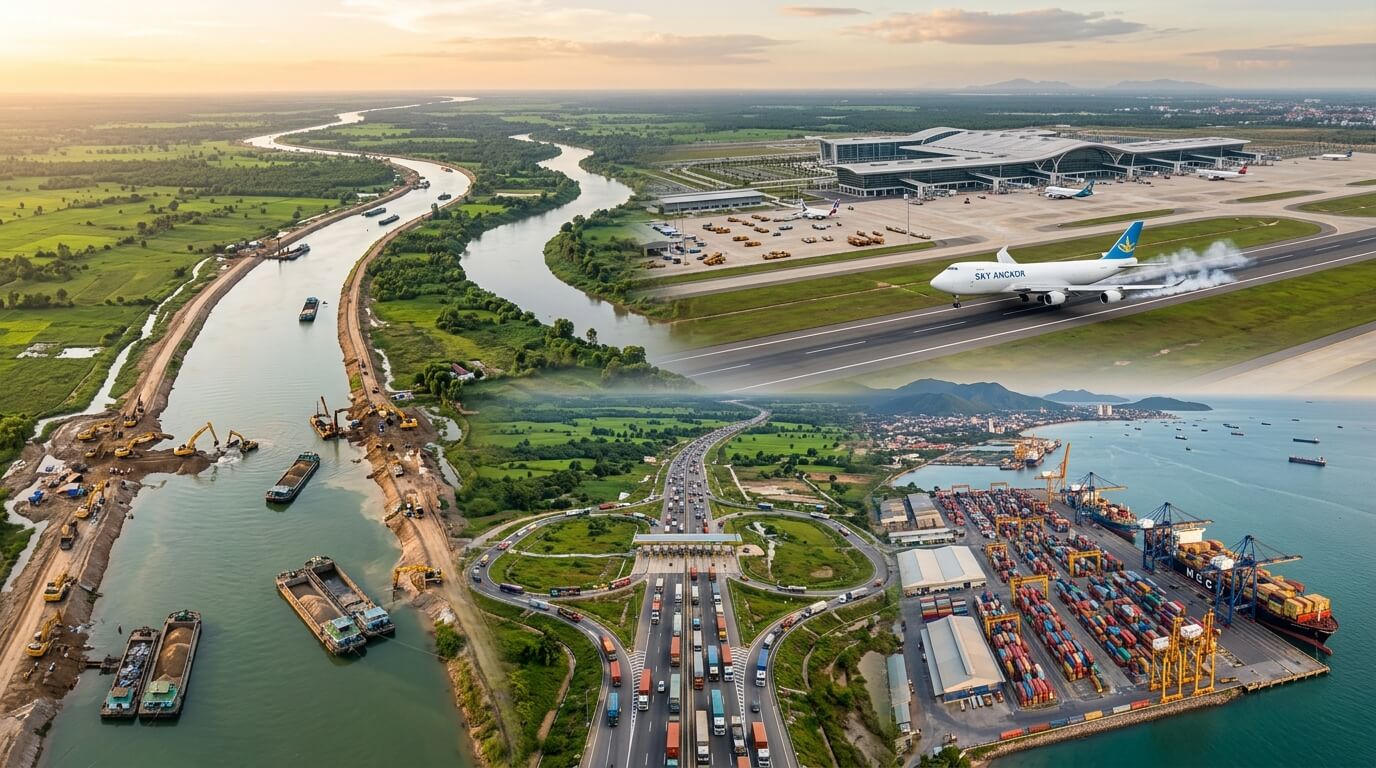
Cambodia is in the midst of an unprecedented infrastructure transformation. Over the next five years, the Kingdom is implementing a multi-billion-dollar pipeline of mega projects that will fundamentally reshape its logistics landscape—from deep‑sea ports and expressways to a new international airport and a the Funan Techo Canal.
For global investors, logistics operators, and engineering firms, these are not just construction sites. They represent the physical backbone of Cambodia’s ambition to become a regional logistics hub, connecting the Mekong region to global supply chains more efficiently than ever before.
In this comprehensive overview, we examine the most impactful mega projects currently underway or in advanced planning: the Funan Techo Canal, the Phnom Penh–Bavet Expressway, Techo International Airport, and major expansions at Sihanoukville Autonomous Port. We also look at how these pieces fit together into a multimodal network that will slash transit times, lower shipping costs, and open new corridors for trade.
Whether you are an institutional investor tracking infrastructure bonds, a logistics manager sourcing new routes, or a policymaker studying Cambodia’s rise, this analysis provides the clarity and data you need. Let’s dive into the projects that are writing the next chapter of Cambodia’s growth story.
Connects Phnom Penh to the sea
Opened Sept 2025
Target completion 2027
Deep-sea terminal by 2027
📌 Key Takeaways: Cambodia’s Mega Projects
- Funan Techo Canal (US$1.17B) – A 172.6km waterway linking Phnom Penh directly to the sea by 2028, cutting shipping times by 8–10 hours and reducing dependence on Vietnamese ports.
- Techo International Airport (US$2.3B) – A 4F‑rated aviation hub opened in 2025, enabling direct long‑haul air cargo from Europe and North America for the first time.
- Phnom Penh–Bavet Expressway (US$1.6B) – A 138km expressway (2027 completion) slashing travel time to the Vietnam border to 1.5 hours, strengthening ASEAN trade links.
- Sihanoukville Port Expansion (US$350M+) – A new 14.5m‑deep container terminal (early 2027) allowing direct calls by large ocean vessels, cutting transshipment costs.
- Integrated Multi‑Modal Vision – These projects are not isolated; they form a connected network of road, rail (planned), water, air, and sea – positioning Cambodia as the lower Mekong’s future logistics hub.
Waterway Logistics: The Funan Techo Canal
Cambodia’s river system has long been a lifeline for trade, but aging infrastructure and bottlenecks have limited its potential. That is now changing. Two major initiatives—the Funan Techo Canal and a broader master plan for river transport upgrades—are set to significantly transform through the Kingdom’s inland waterways.
1. The Funan Techo Canal: A Game-Changer for River Transport
The Funan Techo Canal is arguably the most ambitious water infrastructure project in modern Cambodian history. This 180‑kilometre navigable waterway will connect the Mekong River near Phnom Penh directly to the sea in Kampot province, bypassing the need to transit through Vietnamese ports.
Key project details:
- Investment: US$1.17 billion (BOT – Build‑Operate‑Transfer model)
- Length: 172.6 km
- Status: Excavation began in late 2025; construction is currently underway
- Target completion: 2028
Logistics impact:
Once operational, the canal will dramatically reduce shipping distances and costs. Vessels will no longer need to travel hundreds of extra kilometres through Vietnamese waters, educing transit time by approximately 8–10 hours per trip compared to the current route through Vietnamese waters. For logistics operators, this means lower fuel consumption, faster delivery schedules, and reduced dependence on external chokepoints.
Additionally, the canal is engineered to handle barges with a capacity of up to 3,000 deadweight tonnes (DWT) during the dry season and 5,000 DWT during the rainy season, facilitating larger and more efficient inland cargo movements. Combined with planned port terminals along the route, the Funan Techo Canal positions Cambodia to capture more value from its river trade – a strategic leap toward genuine logistics sovereignty—reducing dependence on foreign transit routes and improving Cambodia’s control over its own supply chain.
Planned US$3 Billion+ River Transport Upgrade
Beyond the Funan Techo Canal, the Cambodian government has laid out an even broader vision through its Comprehensive Integrated Transport Logistics System (CITLS) 2023‑2033. This master plan allocates more than US$3 billion for a decade‑long upgrade of the nation’s entire waterway network.
Key components of the plan include:
- Dredging and widening of the Mekong, Tonle Sap, and Bassac rivers to allow larger vessels to navigate year‑round, even during the dry season.
- Construction of new river ports in key provinces such as Kampong Cham, Kratie, and Stung Treng, each equipped with modern cargo handling facilities.
- Installation of navigation aids (buoys, beacons, and signalling systems) to improve safety and efficiency for night‑time and low‑visibility transit.
- Development of inland container depots (ICDs) linked to river ports, allowing seamless transfer of goods between water, road, and rail.
Logistics impact:
When fully implemented, the CITLS waterway component will turn Cambodia’s rivers into a reliable, high‑capacity logistics spine. The combination of deeper channels, modern ports, and digital navigation systems is expected to:
- Increase the volume of cargo moved via inland waterways by over 200% by 2033.
- Reduce shipping costs for bulk commodities such as rice, rubber, and construction materials by 15‑20%.
- Create new logistics jobs and attract private investment in port‑adjacent industrial zones.
Together with the Funan Techo Canal, this US$3 billion upgrade ensures that water‑based logistics will no longer be a weak link in Cambodia’s supply chain, but rather a competitive advantage.
US$1.17B investment
3,000–5,000 DWT capacity
2028 completion
200% cargo volume increase by 2033
15‑20% shipping cost reduction
Next-Generation Aviation Infrastructure
While roads and waterways are the arteries of trade, airports are the engines of economic connectivity. Cambodia understands this well. The country is replacing its aging aviation facilities with a world‑class airport system designed to handle massive passenger volumes and, crucially, air cargo. The centerpiece of this transformation is the new Techo International Airport.
1. Techo International Airport (KTI): Cambodia’s New Aviation Hub
Located approximately 20 kilometres south of Phnom Penh, Techo International Airport (KTI) officially opened in September 2025, replacing the old Phnom Penh International Airport. It is not simply an upgrade – it is a transformative leap in aviation infrastructure.
Key project details:
- Investment: US$2.3 billion (under a BOT concession)
- Classification: 4F – the highest ICAO rating, capable of handling the world’s largest aircraft, including the Airbus A380 and Boeing 747-8F freighters
- Initial capacity: 13 million passengers per year
- Ultimate capacity: Designed to scale to 30 million and eventually 50 million passengers annually
- Cargo facilities: A dedicated air cargo terminal equipped with cold storage facilities for temperature‑sensitive goods (pharmaceuticals, fresh produce, and seafood) and express courier handling for time‑sensitive shipments, positioning KTI as a competitive player in the regional air freight market.
Logistics impact:
KTI is not just for travellers. Its strategic location and 4F rating position it as a potential regional air cargo hub for Southeast Asia. For logistics operators, this means:
- Direct long‑haul freight flights – Cargo planes from Europe and the Middle East can now land directly in Phnom Penh, with North American routes expected to follow.
- Cold chain capabilities – Pharmaceuticals, fresh produce (mangoes, bananas, and premium seafood), and other temperature-sensitive goods can be handled professionally, opening new export markets.
- Integrated logistics zone – The airport master plan includes adjacent warehousing and light industrial areas, allowing seamless air‑to‑road transfers.
- Future waterway connection – A planned canal link will connect KTI to the Mekong River system, enabling multimodal air‑river freight movement – a rarity in Southeast Asia.
For global freight forwarders and e‑commerce logistics providers (think DHL, FedEx, SF Express), KTI removes a major bottleneck. Cambodia no longer needs to route air cargo through Bangkok, Ho Chi Minh City, or Singapore. It can now speak directly to global markets.
2. The Old Airport’s New Life: From Runways to Public Park
With the opening of Techo International Airport, the former Phnom Penh International Airport – which served the capital for over six decades – has been retired from active aviation duty. But its story does not end there.
What is happening to the old site?
The Royal Government of Cambodia has announced that the old airport grounds, covering approximately 300 hectares in a prime central location, will be redeveloped into a large‑scale public park and mixed‑use urban space. While detailed master plans are still emerging, early indications suggest:
- A signature green space envisioned as a large‑scale public park featuring landscaped gardens, serene lakes, and meandering walking paths – drawing inspiration from iconic urban parks such as New York’s Central Park and Singapore’s Gardens by the Bay, adapted to Phnom Penh’s unique character and urban fabric.
- Sports facilities, cultural venues, and community gathering spaces.
- Limited commercial and residential development along the periphery to fund the park’s maintenance.
Logistics impact (indirect but significant):
For the logistics and infrastructure sectors, this redevelopment matters for two reasons:
- Land value uplift – The old airport site sits in a rapidly developing corridor of Phnom Penh. Its conversion into a high‑quality public amenity will raise property values across surrounding districts (Toul Kork, Sen Sok, and parts of Meanchey), stimulating new construction, commercial real estate, and associated logistics demands.
- Congestion relief – The removal of airport‑related traffic (passenger drop‑offs, cargo trucks serving the old air freight terminal) from central Phnom Penh will ease road congestion. This benefits last‑mile delivery operators and freight forwarders who previously navigated gridlock around the old airport.
- Strategic Milestone – The old airport’s closure marks the end of an era and the beginning of a more modern, strategically planned Phnom Penh. For investors, it signals that Cambodia is willing to make bold, long-term infrastructure decisions—even when they involve retiring functional assets for greater future value.
13M passengers/year (Phase 1)
175K tonnes cargo/year
28 airlines · 2 x 4km runways
Public park + mixed‑use space
Gardens · Lakes · Walking paths
Sports facilities · Cultural venues
The Expressway Revolution (Road Logistics)
For decades, Cambodia’s national road network struggled with congestion, poor surfaces, and long travel times. The arrival of modern expressways is changing that equation dramatically. These high-speed corridors are not just about moving people—they are about moving goods faster, cheaper, and more predictably.
1. Phnom Penh–Sihanoukville Expressway (E4): The Blueprint
The Phnom Penh–Sihanoukville Expressway (E4) was Cambodia’s first expressway. Opened in October 2022, it set a new standard for road transport in the Kingdom.
Key project details:
- Length: 190 kilometers
- Investment: Approximately US$2 billion (BOT model, Chinese investment)
- Design: 4 lanes (2 each direction), with a speed limit of 100‑120 km/h
- Status: Fully operational
Logistics impact:
Before the expressway, the journey from Phnom Penh to Sihanoukville—home to the country’s main deep-sea port—took 5 to 6 hours on National Road 4, plagued by trucks, buses, and local traffic. Today, the same trip takes just 1.5 to 2 hours.
For logistics operators, this is transformative:
- Faster port turnaround – Exporters can now move containers from factories in and around Phnom Penh to Sihanoukville Port in a fraction of the previous time, reducing demurrage fees and improving supply chain reliability.
- Lower vehicle operating costs – Smooth expressway surfaces reduce fuel consumption, tire wear, and maintenance compared to the old road.
- Reduced cargo damage – Fewer potholes and less stop‑and‑go traffic mean less damage to sensitive goods.
- Dedicated truck lanes – While not fully segregated, the expressway’s design accommodates heavy trucks more safely than the old mixed‑use road.
The E4 proved that modern expressways work in Cambodia. Its success paved the way for the next generation of road projects.
2. Phnom Penh–Bavet Expressway (E1): Connecting Cambodia to Vietnam and ASEAN
If the E4 expressway connected Cambodia’s capital to its main port, the Phnom Penh–Bavet Expressway (E1) connects Cambodia to its largest regional trading partner, Vietnam. This 138‑kilometer corridor is a critical piece of the ASEAN highway network.
Key project details:
- Length: 138 kilometers
- Investment: US$1.6 billion (BOT model, Chinese construction)
- Design: 4 lanes (expandable to 6 lanes)
- Route: Phnom Penh (starting at the current National Road 1) to the Bavet international border gate (Svay Rieng province)
- Status: Construction began on 7 June 2023; target completion is 2027
- Connection: Links directly to Vietnam’s Ho Chi Minh City–Moc Bai expressway.
Logistics impact:
The E1 expressway is not just about speed—it is about regional integration. Bavet is the busiest land border crossing between Cambodia and Vietnam, handling a massive volume of manufactured goods, agricultural products, and construction materials.
Once operational, the E1 will deliver the following:
- Travel time reduced – From the current 4‑5 hours on congested National Road 1 to approximately 1.5 hours.
- SEZ connectivity – The expressway passes near several Special Economic Zones (SEZs) in Kandal, Prey Veng, and Svay Rieng provinces, including the bustling Manhattan SEZ near Bavet. Trucks can move from factory gates to the border in under 30 minutes.
- Cross‑border e‑commerce – With faster, more reliable road links, Cambodia can participate more effectively in the growing ASEAN e‑commerce logistics chain, moving goods to Vietnamese ports (e.g., Cat Lai in Ho Chi Minh City) for onward shipping.
- Reduced border congestion – The expressway includes dedicated truck lanes and improved approach roads to the Bavet border checkpoint, helping to clear the frequent queues of container trucks.
Strategic importance:
The E1 is part of a larger vision—functioning as the road equivalent of the Singapore‑Kunming Rail Line, providing seamless connectivity across the ASEAN region. When combined with Vietnam’s expressway network, Cambodia gains seamless road access to the entire ASEAN region—from Singapore to southern China. For logistics companies operating regional distribution hubs, this opens new routing options and reduces reliance on sea freight for intra‑ASEAN trade.
3. Phnom Penh–Siem Reap Expressway: The Missing Link to the North
While the E4 and E1 expressways focus on the south and east, Cambodia’s northwest—home to the tourism capital of Siem Reap and the rapidly developing economic corridor along the Tonle Sap—remains underserved by high‑speed roads. That is set to change with the proposed Phnom Penh–Siem Reap Expressway.
Key project details:
- Length: Approximately 250 kilometers (estimated)
- Investment: Not yet finalized, but comparable projects suggest US$2‑3 billion
- Route: From Phnom Penh (likely connecting to the E4 or E1 network) north through Kampong Cham, Kampong Thom, and into Siem Reap Province
- Status: Currently in feasibility study and planning stages; no construction start date announced, but government officials have repeatedly signaled it as a priority for the next infrastructure phase (post‑2027)
Logistics impact:
Siem Reap is not just a tourism destination. The province and its surrounding areas are emerging hubs for:
- Agribusiness—Rice, cassava, maize, and rubber plantations require efficient transport to processing facilities and ports.
- Light manufacturing – SEZs are being developed along the Tonle Sap corridor.
- Regional trade – Siem Reap is a gateway to Thailand’s border at Poipet and O’Smach.
A direct expressway would deliver the following:
- Travel time reduction – From the current 5‑6 hours on National Road 6 to just 2.5‑3 hours.
- Decongesting National Road 6 – Currently overloaded with a mix of tourist buses, heavy trucks, and local traffic. A dedicated expressway would separate long‑haul freight from local movement.
- Lower logistics costs – Shorter, faster trips reduce fuel and labor costs for freight moving between central Cambodia and the northwest.
- Tourism logistics synergy – Faster road links support the MICE (Meetings, Incentives, Conferences, Exhibitions) sector by making Siem Reap more accessible for regional events and supply chains.
What to watch:
While not yet under construction, the Phnom Penh–Siem Reap Expressway is one to monitor closely. Investors, construction firms, and logistics operators should track:
- Announcements of feasibility study results (expected 2026‑2027)
- Potential Chinese or multilateral financing (ADB, World Bank, or private BOT)
- Land acquisition patterns along the proposed route – a leading indicator of project momentum
Once funded, this expressway will complete a high‑speed road loop connecting Phnom Penh, Sihanoukville, Bavet (Vietnam border), and Siem Reap—effectively creating a “logistics diamond” that unlocks the entire country for efficient freight movement.
4 lanes · 100‑120 km/h
Travel time: 1.5‑2 hrs (was 5‑6 hrs)
4 lanes (expandable to 6)
Target completion: 2027
Feasibility study 2026‑2027
Creating a “logistics diamond”
Deep-Sea Port Expansions (Maritime Logistics)
Roads, waterways, and airports are essential, but maritime trade remains Cambodia’s economic backbone. Approximately 80% of the country’s international trade moves through its ports, with Sihanoukville Autonomous Port (PAS) handling the vast majority. To keep pace with growing cargo volumes and larger global vessels, PAS is undergoing a historic expansion.
1. Sihanoukville Autonomous Port (PAS): Becoming a Deep-Sea Hub
Located on the Gulf of Thailand, PAS is Cambodia’s largest and busiest port. However, its current depth (approximately 9‑10 metres) limits it to feeder vessels – smaller ships that shuttle cargo to regional hubs like Singapore or Laem Chabang (Thailand) for transhipment onto mega-container ships. The ongoing expansion aims to change that.
Key project details:
- New container terminal (Phase 1):
- Length: 350 metres
- Depth: 14.5 metres
- Capacity: 1.45 million TEUs per year
- Investment: Approximately US$275 million (financed by JICA – Japan International Cooperation Agency)
- Status: Construction began in 2022; expected completion by early 2027. As of April 2026, the project is 66.7% complete.
- Phase 2 & 3 (long‑term planning):
- Phase 2 will extend the terminal by 400 metres to a depth of 16.5 metres, with construction scheduled from September 2026 to 2029.
- Phase 3 will further extend the terminal by 430 metres to a depth of 17.5 metres, with construction planned from 2027 to 2030.
- Multipurpose terminal:
- Handles bulk cargo (cement, coal, fertiliser, construction materials)
- Being upgraded simultaneously
Logistics impact:
Once the new container terminal is operational, PAS will be able to accommodate larger, ocean‑going vessels (up to 10,000‑12,000 TEU ships), reducing or eliminating the need for transhipment through foreign ports.
For exporters, importers, and logistics providers, this means:
- Lower shipping costs – Direct calls by large vessels eliminate transhipment fees and reduce total transit time by 3‑5 days.
- More competitive freight rates – With carriers able to serve Cambodia directly, freight rates on key lanes (Europe, North America, and the Middle East) are expected to drop.
- Reduced port congestion – The new terminal adds significant capacity, easing the current bottlenecks that sometimes delay cargo.
- Cold chain expansion – New reefer (refrigerated container) plugs will support exports of perishable goods (mangoes, bananas, shrimp, and pepper).
Strategic partnerships:
PAS is also deepening cooperation with major port operators and shipping lines. In 2024‑2025, new direct services were launched connecting Sihanoukville to the following:
- China (Ningbo, Shanghai, Shenzhen)
- Singapore (hub for onward connections)
- Malaysia (Port Klang)
- Indonesia (Surabaya, Jakarta)
As deeper berths come online, expect announcements of direct services to Europe (via the Suez Canal) and the US West Coast.
2. The New Kampot Multi-Purpose Port: A Second Gateway to the Sea
While Sihanoukville remains Cambodia’s primary maritime gateway, the government is actively developing a second major port in Kampot province. This new facility will relieve pressure on PAS, serve the southwest region’s growing economy, and provide strategic redundancy.
Key project details:
- Location: Kampot province, approximately 150 kilometres southwest of Phnom Penh
- Depth: 15 metres (deep‑sea capable)
- Type: Multi-purpose – container, bulk cargo, and general cargo
- Investment: Part of a larger coastal development master plan; specific figures not fully disclosed but estimated at US$1.5 billion.
- Status: Feasibility studies completed; land acquisition and early site preparation underway; construction began in May 2022; first phase expected to begin operations in 2025.
Logistics impact:
The Kampot port is designed to serve several strategic objectives:
- Decongesting Sihanoukville – As PAS approaches capacity, Kampot will absorb overflow, particularly bulk cargo (cement, coal, construction aggregates) and smaller container volumes.
- Serving the southwest economic corridor – Kampot and Kep provinces are emerging hubs for tourism, agriculture (pepper, durian, and seafood), and light manufacturing. A local port eliminates the need to truck goods 150‑200 kilometres to Sihanoukville.
- Supporting the Funan Techo Canal – The canal’s southern terminus is in Kampot province. The new port will connect directly to the canal, creating an integrated river‑sea logistics chain.
- Strategic redundancy – Having two deep‑water ports on different coastlines reduces risk from natural disasters, accidents, or geopolitical disruptions at a single facility.
What to watch:
- Timeline clarity – The government has announced the project but not firm completion dates. Investors should monitor official announcements from the Ministry of Public Works and Transport.
- Private sector involvement – The port may be developed as a PPP (public‑private partnership). Port operators, construction firms, and logistics companies should watch for tender announcements.
- Road connections – Upgrades to National Road 3 (linking Kampot to Phnom Penh) will be necessary to maximise the port’s utility. Watch for parallel road improvement projects.
Once operational, Kampot will give Cambodia a second direct window to global shipping lanes – a major step toward maritime independence and logistics resilience.
✅ 66.7% complete · Early 2027
🚧 Sept 2026 – 2029
📋 Bidding · Early 2027 – 2030
Ships up to 100,000 tonnes
The Grand Vision: A Multi-Modal Logistics Network
Individually, each megaproject is impressive. But the true transformative power lies in how they connect. Cambodia is not building isolated pieces of infrastructure—it is weaving them into an integrated, multi-modal logistics network that links road, rail, water, air, and sea into a seamless system.
How the pieces fit together:
- Water + Sea: The Funan Techo Canal will connect to the Kampot Multi-Purpose Port, creating an integrated river‑sea logistics chain.
- Road + Port: The Phnom Penh–Sihanoukville Expressway (E4) delivers containers from manufacturing zones around the capital to PAS in under two hours. The future Phnom Penh–Bavet Expressway (E1) will do the same for goods moving to/from Vietnam.
- Air + Road + Water: Techo International Airport includes dedicated cargo facilities and has a planned waterway connection in its master plan, enabling future multimodal redistribution.
- SEZ Integration: Most expressways and port expansions are located near Special Economic Zones (SEZs). Factories in these zones can load containers directly onto trucks, barges, or (for high‑value goods) air freight without intermediate warehousing.
The logistics corridor concept:
Cambodia is effectively building three major economic corridors:
Corridor Key Infrastructure Primary Cargo Southern Corridor E4 expressway, PAS, Kampot port, and Funan Techo Canal Containers, bulk commodities, manufactured goods Eastern Corridor E1 expressway + Bavet SEZs + Vietnamese link Cross‑border trade, electronics, garments, agriculture Northern Corridor Future Phnom Penh–Siem Reap expressway + Tonle Sap waterways Agribusiness, construction materials, tourism logistics
What this means for logistics operators:
- Route optimization—Multiple pathways to move goods from the factory to the export market. If one route is congested, alternatives exist.
- Lower inventory costs – Faster, more reliable transport allows just‑in‑time (JIT) inventory strategies, reducing warehousing needs.
- New business models—Integrated multi‑modal services (truck‑barge‑ship or truck‑air‑ship) will emerge, creating opportunities for third‑party logistics (3PL) providers.
For Cambodia, the vision is clear: become the logistics hub of the lower Mekong region, capturing transshipment and value‑added logistics activity that currently flows through neighboring countries.
❓ Frequently Asked Questions (FAQ)
1. When will the Funan Techo Canal be completed?
The Funan Techo Canal is expected to be fully operational by 2028. Excavation began in late 2025, and construction is currently progressing according to schedule under a BOT (Build‑Operate‑Transfer) model.
2. What is the difference between the Phnom Penh–Sihanoukville Expressway (E4) and the Phnom Penh–Bavet Expressway (E1)?
E4 (operational since 2022) connects Phnom Penh to the main deep‑sea port of Sihanoukville. E1 (under construction, completion 2027) connects Phnom Penh to the Bavet border crossing with Vietnam. E1 is critical for ASEAN road connectivity and cross‑border trade with Vietnam.
3. How will the new Techo International Airport benefit cargo logistics?
As a 4F‑rated airport, Techo International can handle the world’s largest cargo aircraft (e.g., Boeing 747‑8F, Airbus A380F). It features dedicated cold storage, express courier facilities, and planned waterway access – enabling direct, non‑stop air freight from Europe and North America without transshipment via Bangkok or Singapore.
4. Will Sihanoukville Port be able to handle direct shipping to the US and Europe after expansion?
Yes. The new 14.5‑metre deep container terminal (operational early 2027) will allow large ocean‑going vessels (8,000‑12,000 TEU) to call directly at Sihanoukville. This eliminates the current need to transship through Singapore or Laem Chabang, reducing total transit time by 3‑5 days and lowering freight costs.
5. What is the status of the Kampot Multi‑Purpose Port?
The Kampot port is in the advanced planning and land acquisition stage. Feasibility studies are complete, and early site preparation has begun. Construction is expected to start in phases from 2026‑2027. It will serve as a second deep‑water gateway, complementing Sihanoukville and connecting directly to the Funan Techo Canal.
Conclusion: A Pivotal Decade for Cambodia’s Logistics
Cambodia stands at a rare inflection point. Within the span of just a few years, by 2030, the Kingdom will have transformed its logistics landscape from fragmented and capacity‑constrained to integrated, modern, and competitive.
What has been achieved:
- A new 4F international airport capable of handling global air freight.
- Two operational expressways (with a third planned) slashing road transit times across the country.
- A revolutionary canal that will reshape river trade upon completion in 2028 and reducing dependence on foreign chokepoints.
- Deep‑sea port expansions that will welcome direct calls from ocean‑going vessels by early 2027.
- A second major maritime gateway under development in Kampot.
What remains:
The vision is not yet complete. The Phnom Penh–Siem Reap expressway needs funding and construction timelines. The Kampot port must move from planning to reality. The Funan Techo Canal is still years away from completion. And Cambodia’s rail network – largely ignored in this analysis – remains a missing link requiring future investment.
For investors, logistics firms, and engineers:
The next 3‑5 years present a window of opportunity. Early movers who position themselves now – whether through infrastructure contracts, logistics facilities near new corridors, or strategic partnerships with Cambodian firms – will capture value as the network comes online.
For policymakers:
The challenge is no longer just building assets. It is ensuring maintenance, regulation, and skills development keep pace. A world‑class expressway is useless if overloaded trucks destroy it within a decade. A deep-sea port is wasted without trained crane operators and customs efficiency.
The bottom line:
Cambodia is no longer a country where logistics operators must accept delays, damage, and high costs as inevitable. The mega projects documented here are real, underway, and already delivering results. As they multiply and interconnect, Cambodia’s future as a regional logistics hub is not just possible—it is probable.
For those who watch infrastructure closely, the message is simple: Cambodia is building. Pay attention.
🛣️ E4 Expressway Operational
🚢 PAS Phase 1 (2027)
🛣️ E1 Expressway (2027)
🏗️ Kampot Port (Under Development)
🚆 Rail Network Upgrades
🌐 Integrated Multi‑Modal Network