
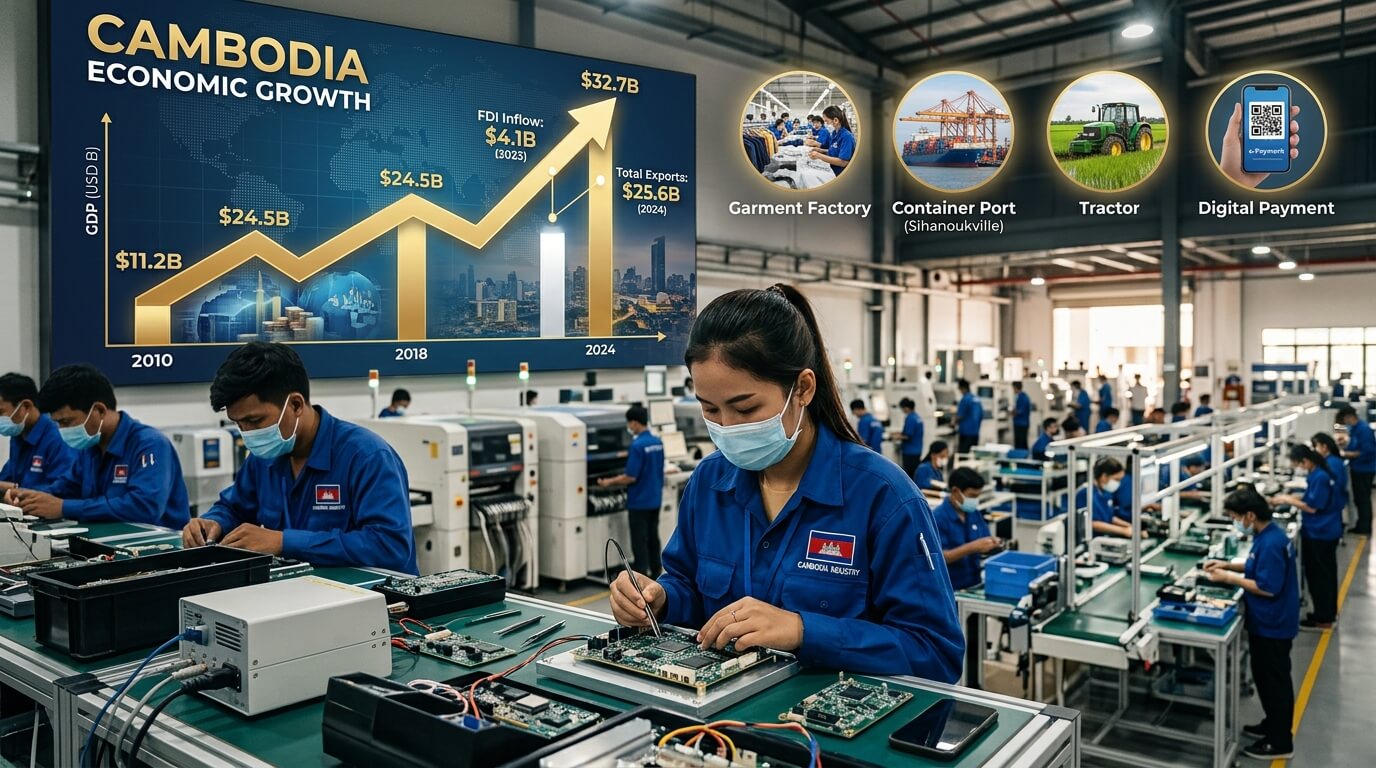
For a nation that emerged from decades of conflict at the turn of the millennium, Cambodia’s economic transformation is nothing short of remarkable. From a low‑income agrarian economy, the kingdom has evolved into one of South-east Asia’s most dynamic and resilient growth stories—a testament to the power of peace, political stability, and a steadfast commitment to market‑oriented reforms.
The numbers tell the story of a nation on the move. In 2025, Cambodia’s economy grew by an estimated 5.2%, driven by robust performance across industry, services, and agriculture. According to the Ministry of Economy and Finance’s medium‑term fiscal framework, GDP per capita is projected to reach approximately US$2,858 in 2025 and US$3,020 in 2026—a targeted nominal expansion corridor that reflects steady progress towards upper‑middle‑income status by 2030. These figures align closely with IMF estimates of US$2,870 for 2025 and World Bank projections, creating a consistent picture of rising prosperity. International reserves stood at US$25 billion, providing a strong buffer against external shocks, while inflation remained contained at approximately 2.5%.
The engines of this growth are increasingly diversified. The industrial sector—led by garments, footwear, and travel goods (GFT)—continues to anchor the economy, with GFT exports reaching US$15.52 billion in 2025, a 15.7% increase year‑on‑year. Total international trade surged to US$65.24 billion, reflecting Cambodia’s deepening integration into global value chains. Foreign direct investment (FDI) approvals hit a record US$10 billion across more than 630 projects in 2025, underscoring investor confidence in the Kingdom’s stability and growth prospects.
This article examines the key drivers behind Cambodia’s economic trajectory: the sectors powering growth, the investment climate attracting global capital, and the policy framework—including the government’s Pentagonal Strategy – Phase I—that is guiding the nation towards its ambitious vision of becoming an upper‑middle‑income country by 2030 and a high‑income nation by 2050.
For investors, policymakers, and analysts, understanding Cambodia’s economic drivers is not just an academic exercise—it is the foundation for informed decision‑making in one of Asia’s most compelling growth markets.
📌 Key Takeaways: Cambodia’s Economic Trajectory
- GDP growth: 5.2% in 2025, targeting ~5.0% in 2026 – driven by industry, services, and agriculture.
- GDP per capita (Ministry of Economy & Finance): US$2,858 (2025), projected US$3,020 (2026) – steady progress toward upper‑middle‑income status by 2030.
- FDI approvals hit a record US$10 billion – 630+ projects approved in 2025, the highest in Cambodia’s history.
- Garment, Footwear & Travel (GFT) exports: US$15.52 billion – up 15.7% year‑on‑year.
- Total international trade: US$65.24 billion – up 18% from 2024.
- Inflation: ~2.5% (2025), projected 2.3% (2026) – stable price environment.
- National budget 2026: Over US$10 billion – supporting the Pentagonal Strategy and public investment.
- Vision 2030 & 2050 – Upper‑middle‑income status by 2030, high‑income nation by 2050.
A Macroeconomic Overview – Resilience in a Challenging Global Environment
Cambodia’s macroeconomic fundamentals remain robust despite a complex global landscape. The Kingdom has demonstrated remarkable resilience, supported by strong policy frameworks, a diversified economic base, and prudent fiscal management. While external headwinds—including trade policy uncertainty, regional tensions, and global energy volatility—have tempered growth projections, Cambodia’s economic trajectory continues to point firmly upward.
GDP Growth: 5.2% in 2025, Targeting ~5% in 2026
According to Ministry of Economy and Finance projections, Cambodia’s economy grew by an estimated 5.2% in 2025, with a target of approximately 5.0% for 2026. This places Cambodia among the fastest-growing economies in Southeast Asia, supported by resilient manufacturing, robust exports, and continued public investment under the government’s Pentagonal Strategy – Phase I.
International financial institutions have offered slightly more conservative but still positive assessments:
- The International Monetary Fund (IMF) projected growth of 4.8% in 2025, moderating to around 4.0% in 2026, reflecting external headwinds from trade policy uncertainty, reduced remittances, and a slowdown in tourism.
- The World Bank estimated 4.8% growth in 2025 and 4.3% in 2026, with the 2025 upgrade reflecting front‑loaded exports of garment, footwear, and travel goods (GFT) products. Earlier projections had been lower, but stronger‑than‑expected export performance provided an upward revision.
- The Asian Development Bank (ADB) forecast 4.5% growth in 2026 under a scenario of early stabilization in the Middle East, with industrial output projected to expand by 7.3%.
- The ASEAN+3 Macroeconomic Research Office (AMRO) estimated GDP growth at 4.8% to 4.9% in 2025.
Key Insight: The dispersion between the government’s 5.2% target and the multilateral institutions’ 4.0–4.8% projections reflects differing assumptions about external risks rather than fundamental weakness in the domestic economy. As one analyst noted, “Cambodia still is a growth‑oriented economy, not one that is on the verge of losing momentum as some external observers have claimed.”
Inflation – Contained but with Upside Risks
Cambodia’s inflation environment remains stable, though the risk of external price pressures has increased significantly. The divergence in inflation forecasts from the same institutions reflects a rapidly changing global environment rather than analytical error.
The Baseline Scenario (AMRO, August 2025):
In its 2025 Annual Consultation Report, AMRO projected that headline CPI inflation would rise to 2.5% in 2025 due to base effects, before moderating to 2.3% in 2026, aligning with pre‑pandemic trends.
The Upside Risk Scenario (AMRO, April 2026):
However, in a significant revision issued in April 2026, AMRO updated its forecast. Inflation averaged 2.5% in 2025 but is now expected to rise to 3.9% in 2026 due to higher global oil prices.
This 1.6‑percentage‑point upward revision reflects the impact of surging global energy costs on a net‑oil‑importing economy. The Ministry of Economy and Finance has similarly adjusted its inflation projection for 2026, forecasting a stable but elevated rate of approximately 2.8%.
Key Insight: The two AMRO projections are not contradictory—they represent a dynamic scenario model. The 2.3% figure is the Baseline Stability Model, while the 3.9% figure is the Upside Risk Scenario, triggered by higher‑than‑expected global energy prices. For investors, this highlights the importance of monitoring global commodity markets as a key variable in Cambodia’s near‑term price outlook.
Rising Prosperity – GDP Per Capita and International Reserves
Cambodia’s rising prosperity is reflected in steady improvements in GDP per capita and strong external buffers.
GDP Per Capita—A Methodological Divergence:
According to the Ministry of Economy and Finance’s medium‑term fiscal framework, GDP per capita is projected to reach approximately US$2,858 in 2025 and US$3,020 in 2026. This projection is based on the most recent national accounts data, including the GDP rebasing completed in May 2024, which resulted in an average upward revision of 31.7% in nominal terms and 124.4% in real terms.
Methodological Divergence: The variance between the government’s US$3,020 projection and the IMF and World Bank estimates in the US$2,200–2,400 range reflects a methodological divergence rather than a fundamental disagreement about economic performance. The government’s figures are based on the updated national accounts and the latest census data, while international institutions rely on standardized models that may not yet fully incorporate the GDP rebasing. As Cambodia continues to refine its statistical methodologies, convergence between these figures is expected over time.
International Reserves:
Cambodia’s international reserves remain robust, providing a strong buffer against external shocks. According to Ministry of Economy and Finance projections, reserves stood at US$25.1 billion in 2025 and are projected to reach US$28.0 billion in 2026.
Other sources confirm this strength:
- The World Bank reported that international reserves remain healthy, covering approximately 7.5 months of imports, while public debt remains low at around 26% of GDP.
- AMRO noted that gross international reserves stood at US$24.8 billion in April 2025, covering 8.7 months of imports.
- The Phnom Penh Post reported that Cambodia’s international reserves in 2025 increased to more than US$27 billion, sufficient to cover imports for up to eight months.
This strong reserve position, combined with low public debt and contained inflation, provides Cambodia with significant fiscal space to navigate global uncertainties.
A Resilient Foundation for Growth
Despite external headwinds, Cambodia enters 2026 with solid macroeconomic buffers: international reserves covering over seven months of imports, public debt at approximately 26% of GDP, and inflation contained within manageable ranges. As the World Bank noted, “Strong buffers and targeted reforms can help Cambodia withstand economic pressures.”
The government’s Pentagonal Strategy – Phase I, supported by a national budget of over US$10 billion in 2026, provides a coherent policy framework for sustaining growth, diversifying the economy, and improving public services. With industrial output—particularly garment and electronics manufacturing—continuing to drive expansion, Cambodia’s economic fundamentals remain sound even as global conditions evolve.
The Engines of Growth – Cambodia’s Key Economic Sectors
Cambodia’s growth is underpinned by a mix of sectors, but with uneven weight. While the industrial sector—particularly garment manufacturing—remains the dominant engine, services and agriculture continue to play essential roles in employment, exports, and national income. The government’s Pentagonal Strategy—Phase I explicitly aims to diversify this base, reducing overreliance on any single sector.
Industry and Manufacturing – The Growth Engine
The industrial sector is the undisputed powerhouse of Cambodia’s economy, consistently outperforming other sectors and driving overall GDP growth. According to the Asian Development Bank (ADB), industrial output is projected to expand by 7.2% in 2025 and 7.3% in 2026—the highest growth rate among all sectors.
Garments, Footwear, and Travel Goods (GFT): The Backbone of Industry
- US$15.52 billion in exports in 2025 – a 15.7% year‑on‑year increase.
- ~913,000 workers employed across ~1,608 factories.
- The sector accounts for approximately 70% of Cambodia’s total exports, underscoring the economy’s significant reliance on a single manufacturing segment.
- Cambodia’s largest export markets for GFT products remain the United States, the European Union, Japan, Canada, and the UK.
Emerging Sectors:
Cambodia is making gradual progress in higher‑value manufacturing, including:
- Electronics Assembly: Growing investment from regional and multinational electronics firms.
- Automotive Components: Several new projects approved by the CDC.
- Bicycle Manufacturing: Cambodia has become a significant producer of bicycles for international markets.
- Food Processing and Packaging: Expanding to support both domestic consumption and export.
The World Bank’s June 2026 economic update highlighted that Cambodia’s “stronger‑than‑expected growth” in 2025 was driven by “front‑loaded exports of garment, footwear, and travel goods (GFT) products.” The ADB echoed this, noting that GFT exports continued to perform strongly despite global trade headwinds.
Services – Recovery, Diversification, and Digital Transformation
The services sector is the second‑largest contributor to Cambodia’s GDP, encompassing tourism, finance, telecommunications, and trade. While the sector was heavily impacted by the COVID‑19 pandemic, it has recovered steadily and is undergoing a structural transformation.
Tourism:
- International arrivals: 5.57 million in 2025.
- Tourism revenue: US$3.87 billion – a 6.6% increase from 2024.
- The sector remains below pre‑pandemic levels (6.61 million arrivals in 2019), but recovery is accelerating with new direct flight routes and the Open Skies Policy.
Financial Services:
- Cambodia’s financial sector has expanded rapidly, supported by the growth of digital payments, mobile banking, and the Bakong system.
- The World Bank’s B‑READY 2025 survey ranked Cambodia first in ASEAN for financial services (84.45 out of 100).
- 18.9 million e‑wallet accounts and 18.6 million deposit accounts as of 2025.
Digital Economy:
- E‑commerce revenue projected to reach US$1.78 billion in 2025, up from US$1.51 billion in 2024 (CAGR: 17.88%).
- QR codes now account for 47.2% of all transactions, overtaking cash as the leading payment method.
- The Bakong system processed 1.325 billion transactions in 2025—a 118.7% year‑on‑year increase.
Agriculture – Steady but Modest Growth, With Reform Potential
Agriculture remains a critical sector for employment and food security, employing approximately 30% of the workforce. However, its contribution to GDP growth is more modest compared to industry and services, reflecting structural challenges that the government is actively addressing.
Key Indicators:
- The ADB projects agricultural growth at approximately 1.0% in 2025 and 2026.
- Agricultural productivity and value‑added processing remain limited compared to regional peers.
- The sector is vulnerable to climate change, land degradation, and weather‑related shocks.
Government Reform Agenda (Pentagonal Strategy – Phase I):
- Irrigation Infrastructure: Expanding and upgrading irrigation networks to reduce vulnerability to drought and flood.
- Agro‑Processing: Encouraging value‑added processing (e.g., rice milling, cassava processing, and fruit packaging) to capture more value within Cambodia.
- Agricultural Exports: Diversifying exports beyond raw commodities to include processed and packaged products.
Recent Successes:
- Rice Exports to China: 231,125 tons in 2025 – a 96% year‑on‑year increase, generating US$138.36 million (up 83%).
- China’s Rice Quota Increase: China increased its annual rice import quota from 400,000 tons to 500,000 tons—a 25% rise.
- Agricultural Investment: The CDC approved multiple agricultural plantation and processing projects in 2025.
The Bottom Line: Cambodia’s agricultural sector is not yet a major growth driver, but reform efforts—particularly in irrigation and agro‑processing—could unlock significant value in the medium to long term.
No, not yet. Cambodia’s economy remains heavily concentrated in the garment, footwear, and travel goods (GFT) sector, which accounts for approximately 70% of total exports. Diversification is an explicit strategic objective of the Royal Government under the Pentagonal Strategy – Phase I, but it is a transition still in progress rather than a current reality.
Agriculture growth is constrained by limited value‑added processing, climate vulnerability, and low productivity compared to regional peers. The government is addressing this through irrigation infrastructure, agro‑processing investment, and export diversification, but these reforms take time to yield results.
The divergence reflects a methodological difference in data sources rather than a disagreement about economic performance:
– Government figures are based on Cambodia’s latest national accounts, including the GDP rebasing completed in May 2024, which resulted in an average upward revision of 31.7% in nominal terms.
– IMF/World Bank figures rely on standardised global models that may not yet fully incorporate these revisions.
Foreign Direct Investment – A Vote of Confidence
Foreign direct investment (FDI) is the single most tangible measure of international confidence in Cambodia’s economic trajectory. In 2025, that confidence reached historic levels. Despite global economic uncertainty, Cambodia attracted a record volume of investment approvals, with capital flowing from traditional partners and new markets alike.
Record FDI Inflows – US$5.1 Billion and Rising
According to the National Bank of Cambodia (NBC), FDI inflows reached approximately US$5.1 billion in 2025, a 16% increase from 2024. The World Bank’s June 2026 economic update confirmed that FDI reached US$5.1 billion in 2025, helping to create an estimated 400,000 formal jobs while offering critical employment opportunities for workers moving from agriculture and returning migrants.
The ASEAN+3 Macroeconomic Research Office (AMRO) corroborated this strength, noting in its April 2026 report that “strong FDI inflows are expected to continue, supported by Cambodia’s stable macroeconomic environment, favorable investment laws, and improving infrastructure”.
Key sources of FDI in 2025 (NBC data):
| Source | FDI Amount | Share of Total |
|---|---|---|
| China | US$3.76 billion | 73.7% |
| Singapore | US$347 million | 6.8% |
| Other countries | ~US$1.0 billion | ~19.5% |
| Total | US$5.1 billion | 100% |
China remains the dominant source of FDI, accounting for nearly three-quarters of total inflows. Singapore ranks second, reflecting the growing economic corridor between the two ASEAN members.
CDC Approvals – 630+ Projects Worth US$10 Billion
If FDI inflows measure capital actually deployed, CDC approvals measure investor intent—and by that measure, 2025 was a watershed year.
According to the Council for the Development of Cambodia (CDC), 630 investment projects were approved in 2025 with total registered capital exceeding US$10 billion. This represents a 45% increase in capital compared to 2024 and is the highest annual total in the CDC’s 30‑year history.
The scale of acceleration is striking:
| Year | Projects Approved | Registered Capital |
|---|---|---|
| 2023 | 268 | ~US$5.0 billion |
| 2024 | 414 | ~US$7.0 billion |
| 2025 | 630 | >US$10 billion |
Of the 630 projects, 387 are located outside Special Economic Zones (SEZs), while 243 are situated within SEZs—demonstrating that investor interest now extends across the entire economy, not merely within designated zones.
The CDC attributed this historic achievement to “the positive business and investment environment in Cambodia, as well as the expanding scope of Cambodia’s export markets”. Deputy Prime Minister Sun Chanthol, CDC First Vice‑Chairman, also noted that Cambodia was the first country in the world to secure reciprocal trade agreements with the United States at a tariff rate of 19%, providing “such clarity and a high level of confidence for investors exporting products to the vast US market”.
What Investors Are Betting On
The sectoral composition of FDI approvals reveals where investors see the most opportunity:
| Sector | Notable Projects |
|---|---|
| Manufacturing | Textile and yarn factories, automobile assembly plants, automobile tyre manufacturing (4 projects worth ~US$780 million) |
| Agriculture & Agro‑processing | Agricultural plantations, fruit processing facilities, cattle farms |
| Construction Materials | Cement manufacturing |
| Hospitality & Tourism | Hotel construction |
| Energy | Power generation projects |
The approval of four tyre manufacturing projects in 2025 alone—representing nearly US$780 million in investment capital reflects a strategic shift towards higher-value manufacturing, precisely the type of diversification Cambodia needs to achieve its long-term aspirations of becoming an upper-middle-income country by 2030 and a high-income nation by 2050.
Job Creation – 400,000+ New Jobs
Behind every investment project are real jobs. The CDC’s 2025 approvals are expected to create over 400,000 formal jobs for Cambodians. The World Bank’s June 2026 economic update confirmed that FDI helped create an estimated 400,000 formal jobs while offering critical employment opportunities for workers moving from agriculture and returning migrants .
This job creation is particularly significant given Cambodia’s demographic profile: with a median age of approximately 27 years and 65% of the population under 30, the Kingdom’s young workforce requires sustained employment generation to absorb new entrants into the labor market.
Investor Confidence – The Bottom Line
The record‑breaking FDI and CDC approval figures send a clear signal: international investors are betting on Cambodia’s long‑term stability; its strategic location within ASEAN; its access to major markets through RCEP and bilateral FTAs, and its young, increasingly skilled workforce.
As AMRO noted, “strong FDI inflows are expected to continue, supported by Cambodia’s stable macroeconomic environment, favourable investment laws, and improving infrastructure”. The CDC’s record approvals in 2025 demonstrate that this confidence is not merely forecast—it is already being translated into concrete investment commitments.
Trade and External Sector – Integration into Global Markets
Cambodia’s deepening integration into global markets is one of the most powerful drivers of its economic transformation. In 2025, the Kingdom’s international trade reached historic milestones, reflecting the combined impact of multilateral trade agreements, bilateral FTAs, and a diversifying export base.
Total Trade – A Historic Milestone
According to the Ministry of Commerce (MoC), Cambodia’s total international trade in 2025 reached US$65.24 billion, representing a 17.6% to 18% increase compared to 2024. The General Department of Customs and Excise (GDCE) reported a slightly lower figure of US$64.02 billion (up 16.8%), reflecting normal methodological divergence between the two reporting institutions.
This growth was driven by robust performance in both exports and imports:
Cambodia’s main trading partners in 2025 include China, the United States, Vietnam, Japan, Singapore, the European Union, Canada, the United Kingdom, South Korea, Australia, India, and the United Arab Emirates.
Cambodia-U.S. Trade – A Detailed Matrix
The United States remained Cambodia’s largest export market in 2025, absorbing approximately 42% of Cambodia’s total exports.
Cambodia’s main exports to the U.S. include apparel, clothing accessories, leather products, travel goods, handbags, electrical machinery and equipment, and footwear. Meanwhile, imports from the U.S. include vehicles, machinery, mechanical appliances, and pharmaceutical products.
A key factor in sustaining this trade relationship was the successful negotiation of a reciprocal trade agreement, resulting in a 19% tariff rate—a rate that provides clarity and confidence for investors exporting to the U.S. market. Penn Sovicheat, secretary of state and spokesperson for the MoC, noted that this achievement “was achieved through tough trade negotiations by the Royal Government of Cambodia.”
Key Export Products – Beyond Garments
Cambodia’s export base is gradually diversifying beyond garments, though the sector remains dominant:
The growth in non‑garment industrial exports—particularly car tyres, electronic components, and wiring harnesses—reflects a deliberate strategy to reduce the economy’s heavy reliance on the garment sector.
Major Trading Partners – A Diversifying Portfolio
Cambodia’s trade relationships are increasingly diverse:
Cambodia exported goods to 169 countries in 2025, up from 164 in 2024, reflecting ongoing market diversification.
The Trade Deficit – A Structural Feature
Cambodia’s trade deficit widened in 2025 as imports grew faster than exports. The GDCE reported a trade deficit of approximately US$3.73 billion. However, officials point out that the structure of Cambodia’s trade deficit is fundamentally different from that of the past. Imports today are increasingly driven by capital goods, machinery, intermediate inputs, and energy required to support manufacturing, infrastructure development, and industrial upgrading, rather than purely consumption‑led demand.
H3: Trade Agreements – The Foundation of Market Access
Cambodia’s trade expansion is underpinned by a growing network of trade agreements:
| Agreement | 2025 Trade Value | Significance |
|---|---|---|
| RCEP | US$40.24 billion | 61.6% of total trade |
| Cambodia‑China FTA | US$19.73 billion | Record 29.9% growth |
| Cambodia‑South Korea FTA | Expanding | Growing investment ties |
| Cambodia‑UAE CEPA | Growing | New Middle East gateway |
| EU EBA | Critical | Duty‑free, quota‑free access |
Macroeconomic Stability – Inflation, Reserves, and Fiscal Policy
Cambodia’s ability to maintain macroeconomic stability amid a turbulent global environment is a cornerstone of its economic resilience. Despite external headwinds—including trade policy uncertainty, geopolitical tensions, and global energy volatility—the Kingdom has preserved price stability, built substantial external buffers, and maintained prudent fiscal discipline. These fundamentals provide a solid foundation for sustained growth and investor confidence.
Inflation – Contained but with Upside Risks
Cambodia’s inflation environment remains broadly stable, though external pressures warrant close monitoring. The National Bank of Cambodia (NBC) projects inflation at approximately 2.3% in 2026, assuming no major external shocks. This is consistent with the government’s medium‑term fiscal framework, which estimated inflation at 2.5% in 2025. The World Bank estimated inflation at an average of 2.7% in 2025.
However, external risks have prompted upward revisions from some institutions. The Asian Development Bank (ADB) forecasts inflation to edge up to 2.8% in 2026, assuming global commodity price increases due to the Middle East conflict are not sustained. A protracted fuel price shock could raise imported input costs and adversely affect agriculture, manufacturing, and tourism. The ASEAN+3 Macroeconomic Research Office (AMRO) has similarly revised its 2026 inflation forecast upward to 3.9% in an upside risk scenario driven by higher global oil prices.
Key Insight: The dispersion in inflation projections (2.3–3.9%) reflects uncertainty around global commodity prices rather than fundamental weakness in domestic price stability. Cambodia’s heavy reliance on imported fuel makes it vulnerable to external price shocks, but the government’s commitment to prudent monetary policy and fiscal discipline provides a strong anchor against sustained inflationary pressures.
International Reserves – A Strong Buffer Against External Shocks
Cambodia’s international reserves position is among the strongest in the region, providing a substantial buffer against external shocks and reinforcing investor confidence.
According to the National Bank of Cambodia’s 2025 annual report, international reserves increased by 22.3% from US$22.5 billion in 2024 to US$27.5 billion in 2025. This is equivalent to approximately eight months of imports of goods and services—a level considered high for a developing economy. In April 2025, gross international reserves stood at US$24.8 billion, covering 8.7 months of imports.
What drives the increase: The NBC attributed the rise to higher global gold prices, income from foreign investments, exchange rate fluctuations, and increased deposits from banking and financial institutions, the Royal Government, and mandatory reserves. The central bank also expanded investments in green bonds and environmental, social, and governance (ESG)-related bonds issued by major international financial institutions in China, South Korea, Japan, and Europe—aligning Cambodia’s reserve management with global investment trends.
Adequacy and management: Hong Vanak, an economist at the Royal Academy of Cambodia, noted that the current reserve level demonstrates the government’s strong financial position and capacity to support international trade. The NBC manages reserves prudently and professionally, with a framework structured in line with international best practices to ensure safety, liquidity, and efficiency.
Fiscal Policy – Prudent Management and Strategic Investment
Cambodia’s fiscal position remains sound, with the government balancing strategic investment needs against the imperative of fiscal sustainability. The 2026 national budget, approved by the National Assembly, authorises total expenditure of approximately US$10 billion (a 7.8% increase from 2025), with revenue of approximately US$7.5 billion.
Budget priorities: Deputy Prime Minister and Minister of Economy and Finance H.E. Dr. Aun Pornmoniroth outlined five main priorities for the 2026 budget: safeguarding sovereignty and peace while maintaining macroeconomic stability; accelerating human resource and institutional development; promoting competitiveness through innovation and digital transformation; improving fiscal efficiency through better revenue and expenditure management; and expanding social protection for vulnerable groups.
Public debt – A Sovereign Debt Sustainability Corridor: Cambodia’s public debt remains low and sustainable. According to the Ministry of Economy and Finance’s Public Debt Statistical Bulletin, total public debt stood at US$13.05 billion at the end of 2025, up 8.47% from 2024. However, as a percentage of GDP, public debt remains low at approximately 18.3–18.8% of GDP—well below the internationally recognised warning threshold of 55% of GDP.
Breaking this down:
| Debt Component | Value | % of GDP | Benchmark |
|---|---|---|---|
| Total Public Debt | US$13.05 billion | 18.3–18.8% | Below 55% threshold |
| External Public Debt | ~US$12.7 billion | 18.4% | Below 40% threshold |
| Domestic Public Debt | ~US$1.3 billion | ~1.9% | — |
The distinction between external and domestic debt is critical. Cambodia’s external debt is primarily concessional—low‑interest, long‑term loans from development partners—which keeps the debt service burden manageable. As the Ministry of Economy and Finance has consistently stated, Cambodia’s public debt remains “manageable, with sustainability and low risk”. In 2025, the government made debt service payments of US$678.3 million, including US$632.5 million in external debt service (principal and interest) and US$45.8 million in domestic debt service.
Fiscal deficit – A Counter‑Cyclical Discrepancy: The government’s Medium‑Term Fiscal Framework (MTFF) targets a fiscal deficit reduction from 3.08% of GDP in 2025 to 2.19% in 2026 and maintaining that level through 2027.
However, AMRO reported that the fiscal deficit actually narrowed to 1.0% of GDP in 2025, reflecting stronger‑than‑expected revenue collection and contained spending. This suggests the government’s deficit target was conservative and actual performance was stronger.
Looking ahead, the ADB projects that the fiscal deficit may widen in 2026 as public spending rises to support vulnerable households while revenue growth moderates. This is not a sign of fiscal distress—it reflects a counter‑cyclical fiscal response to global economic headwinds. The government is strategically increasing spending on social protection and infrastructure investment to cushion the impact of external shocks on Cambodian households and businesses, while maintaining fiscal discipline through its medium‑term framework.
Public financial management reforms: The government remains committed to carrying out key reforms under the Pentagonal Strategy – Phase 1, including public administration, education, health, local governance, and the judiciary. As H.E. Dr. Aun Pornmoniroth stated: “The national budget is not only a financial document but also a roadmap for Cambodia’s sustainable and inclusive growth. With sound fiscal management and continued reforms, Cambodia will stay on course toward lasting peace and prosperity”.
A Resilient Macroeconomic Foundation
Cambodia enters 2026 with solid macroeconomic buffers: international reserves covering over seven months of imports, public debt at low and sustainable levels (18–19% of GDP), and inflation contained within manageable ranges. As the World Bank noted, “strong buffers and targeted reforms can help Cambodia withstand economic pressures”.
The combination of prudent fiscal management, robust external reserves, and a commitment to structural reform provides a stable foundation for sustained growth and investor confidence—even as global conditions evolve. For investors, Cambodia’s macroeconomic stability is not merely a statistic; it is a tangible assurance that the Kingdom is well‑positioned to navigate external headwinds while maintaining its long‑term development trajectory.
The Road Ahead – Challenges and Opportunities
Cambodia’s economic trajectory is one of remarkable resilience and ambition, but the path ahead is not without obstacles. As the Kingdom navigates a complex global environment—marked by geopolitical tensions, trade policy uncertainty, and energy shocks—the gap between current performance and long‑term aspirations has become increasingly visible. The challenge for policymakers, investors, and business leaders is to transform these headwinds into catalysts for structural reform and sustainable growth.
External Headwinds – A Small Open Economy Under Pressure
Cambodia’s status as a small, open economy heavily dependent on international trade makes it inherently vulnerable to external shocks. In 2026, the Kingdom faces what the government’s Medium‑Term Public Financial Framework describes as three consecutive “tornadoes”: the implementation of retaliatory tariff policies by the United States, the Cambodia–Thailand border dispute, and the war in the Middle East triggering an energy crisis.
The cumulative impact has been significant. The government has revised its 2026 growth forecast down from 5.0% to 4.2%, a downgrade that aligns with revisions from major international institutions. The World Bank projects real GDP growth to moderate to 3.9% in 2026 before recovering to 4.9% in 2027. The IMF and AMRO have similarly lowered their projections.
Inflation – A Transitory Supply‑Side Shock: Headline inflation surged to 5.8% in April 2026, up from 5.58% in March, disproportionately affecting low‑income households. The World Bank estimates that a 10% increase in fuel prices could raise the poverty rate by 1.4 percentage points. Cambodia remains “vulnerable to external market disruptions, particularly sharp increases in international oil and gas prices.”
This spike, however, should be understood as a transitory supply‑side shock rather than a collapse of domestic monetary stability. The inflation surge is driven almost entirely by imported fuel volatility—global oil price increases following geopolitical tensions in the Middle East—rather than demand-side pressures or a weakening of the domestic currency. AMRO’s baseline inflation forecast for 2026 remains at 2.3%, with the 3.9% figure representing an upside risk scenario triggered by sustained high global energy prices. This distinction is critical: the 5.8% April reading is a monthly spike, not an annual average, and reflects a temporary external price shock that is expected to moderate as global energy markets stabilize.
The property sector downturn and declining remittances following the return of nearly one million migrant workers from Thailand add further pressure. Moody’s, while upgrading Cambodia’s outlook from negative to stable, noted that “tourism and remittance inflows remain weak through 2026… with a recovery only from 2027.”
Structural Vulnerabilities – The Limits of the Current Model
Beyond external shocks, Cambodia faces deeper structural challenges. The economy has been built on three pillars for three decades: garments and footwear, tourism centred on Angkor Wat, and construction and real estate. These sectors drove the 7.59% average annual growth from 1994 to 2017—one of the fastest rates in the world. But that model now faces hard limits.
Export concentration remains a critical vulnerability. Garments, footwear, and travel goods (GFT) account for over 62% of Cambodia’s total exports and employ nearly one million workers. When trade preferences are adjusted, as has already happened with the partial suspension of the Everything But Arms (EBA) arrangement, Cambodia’s entire export economy is exposed to a single policy decision made in Brussels or Washington.
Tourism tells a similar story. Cambodia attracted 6.7 million international visitors in 2024, surpassing the pre‑pandemic peak. In 2025, arrivals dropped to 5.57 million, a 16.9% decline driven largely by border tensions with Thailand. A tourism economy anchored to a single site—Angkor Wat—and dependent on land arrivals from one neighbouring country is inherently fragile.
Meanwhile, the sectors identified as the future—high‑value agriculture, advanced manufacturing, and the digital economy—remain nascent. As the World Bank noted, Cambodia faces “a combination of higher fuel prices, falling remittances, a property sector downturn, and a lack of bankable projects… constraining growth.” The structural transition to a more diversified, resilient economy is still in its early stages.
The 2030 Ambition – A “Very Ambitious” Target
Cambodia’s stated goal of achieving upper‑middle‑income status by 2030 and high‑income nation status by 2050 remains the anchor of its long‑term vision. But the arithmetic is daunting. With a GNI per capita of approximately US$2,390 in 2023, Cambodia must maintain average annual economic growth of at least 6.77% over the next seven years to reach the World Bank’s threshold of approximately US$4,000–4,500.
The World Bank has called this target “very ambitious.” The IMF projects Cambodia will reach approximately US$3,200 by 2030 based on current growth trends—roughly 20% short of the government’s target. Reaching upper‑middle‑income status by 2030 requires Cambodia to grow GDP per capita by approximately 6.8% annually for five consecutive years, translating to a total GDP growth rate of around 8.3%—well above the 4–5% projected for the near term.
Closing this gap will require “a fundamentally different set of bets than the ones currently being placed”. Cambodia needs to identify its genuine structural advantages and build an economic strategy around them, rather than relying on historical habit.
The Pentagonal Strategy – A Roadmap for Reform
The Royal Government’s Pentagonal Strategy – Phase I provides the policy framework for navigating these challenges. Launched under Prime Minister Hun Manet, the strategy identifies five priorities—people, roads, water, electricity, and technology—that are intended to guide Cambodia toward a more diversified, resilient, and inclusive economy.
Under this framework, the government is pursuing structural reforms across multiple fronts:
- Human Capital Development: The government has designated June 15 as National Technical and Vocational Education and Training Day, with the 2026 theme “TVET provides skills, jobs and income.” The campaign forms part of a broader agenda that identifies people as the country’s foremost strategic priority. With the working‑age population share projected to peak around 2043, the next 15 to 20 years are decisive for Cambodia’s future. As the World Bank’s Tania Meyer noted, “Investing in people—in education, in jobs, in new engines of growth—is what will turn Cambodia’s demographic window into its greatest competitive advantage.”
- Infrastructure Development: Infrastructure sits squarely within the Pentagonal Strategy’s five priorities and plays a decisive role in reducing business costs, improving market access, and strengthening Cambodia’s integration into regional and global supply chains.
- Economic Diversification: The government is committed to structural reforms to promote economic diversification, enhance competitiveness, and build socio‑economic resilience in preparation for future crises. This includes moving beyond the low‑cost business model as trade preferences evolve.
- Fiscal Discipline: The government’s Medium‑Term Fiscal Framework targets a fiscal deficit reduction from 3.08% of GDP in 2025 to 2.19% in 2026. Fiscal policy remains “cautious, highly flexible and targeted, in order to ensure the sustainability of public finances.”
The strategy also includes improvements in public service delivery, agriculture, manufacturing, SMEs, investment, and logistics—indicating that deep reforms are “enhancing the ease of doing business in Cambodia, thereby creating jobs and strengthening investor confidence for inclusive and sustainable economic development”.
Fiscal and Debt Sustainability – A Sub‑26% Sovereign Safety Threshold
Cambodia’s public debt position remains sustainable, with key indicators well below internationally recognised warning thresholds. According to the Ministry of Economy and Finance’s Public Debt Statistical Bulletin, total public debt stood at US$13.05 billion at the end of 2025. As a percentage of GDP, public debt remains at approximately 18.3–18.8% of GDP—well below the internationally recognised sub‑26% sovereign safety threshold.
Breaking this down:
| Debt Component | Value | % of GDP | Benchmark |
|---|---|---|---|
| Total Public Debt | US$13.05 billion | 18.3–18.8% | Below 26% threshold |
| External Public Debt | ~US$12.7 billion | ~18.4% | Below 40% threshold |
| Domestic Public Debt | ~US$1.3 billion | ~1.9% | — |
The distinction between external and domestic debt is critical. Cambodia’s external debt is primarily concessional—low‑interest, long‑term loans from development partners—which keeps the debt service burden manageable. As the Ministry of Economy and Finance has consistently stated, Cambodia’s public debt remains “manageable, with sustainability and low risk.” In 2025, the government made debt service payments of **US$678.3 million**, including US$632.5 million in external debt service (principal and interest) and US$45.8 million in domestic debt service.
The government’s fiscal deficit target—reducing from 3.08% of GDP in 2025 to 2.19% in 2026—remains within prudent bounds. While the ADB projects that the fiscal deficit may widen in 2026 as public spending rises to support vulnerable households, this reflects a counter‑cyclical fiscal response to global economic headwinds rather than a sign of fiscal distress. The government is strategically increasing spending on social protection and infrastructure investment to cushion the impact of external shocks on Cambodian households and businesses, while maintaining fiscal discipline through its medium‑term framework.
Opportunities – Turning Challenges into Catalysts
Despite the headwinds, Cambodia possesses significant strengths that can be leveraged for sustained growth:
- A Young and Growing Workforce: With a median age of approximately 27 and 65% of the population under 30, Cambodia has a demographic dividend that, if harnessed through education and skills training, can fuel decades of growth.
- Strong External Buffers: International reserves remain robust—covering approximately eight months of imports—and public debt remains low at approximately 18–19% of GDP, well within the sub‑26% sovereign safety threshold. Moody’s upgrade from negative to stable reflects “reduced exposure to U.S. tariffs and the country’s ability to absorb external shocks.”
- Resilient FDI and Export Performance: Foreign direct investment reached US$5.1 billion in 2025, helping to create an estimated 400,000 formal jobs. Goods exports grew by 17.7% in the first quarter of 2026. Approved fixed‑asset investments rose by 45% in 2025, reflecting a strategic shift toward higher‑value industries.
- Diversification in Manufacturing: Non‑garment sectors—including electrical components, tyres, automotive parts, and furniture—are expanding. This gradual shift toward higher‑value production is precisely the type of diversification Cambodia needs to achieve its long‑term aspirations.
- Regional Integration: Cambodia’s trade with RCEP member economies accounted for over 60% of total trade in 2025. The growing network of bilateral FTAs and multilateral agreements provides a foundation for continued market access and export growth.
The Bottom Line – A Critical Juncture
Cambodia stands at a critical juncture. The economy has demonstrated remarkable resilience in the face of simultaneous shocks, but the structural vulnerabilities exposed by recent crises cannot be ignored. The gap between current performance and the ambitious 2030 target is real and widening.
As the government’s Medium‑Term Framework acknowledges, “Cambodia, as a small and open economy heavily dependent on international trade, cannot prepare policy measures for every possible scenario.” However, it can continue to strengthen and expand its resilience through immediate response measures focused on maintaining macroeconomic and financial stability, and medium‑ and long‑term policy measures focused on structural reforms, economic diversification, and building socio‑economic resilience.
For investors, this environment presents both risks and opportunities. The challenges are real—energy shocks, trade uncertainty, and structural vulnerabilities—but so are the strengths: a young workforce, strong external buffers, resilient FDI, and a government committed to reform. The Pentagonal Strategy provides a credible roadmap for navigating the transition. The question is not whether Cambodia will grow, but whether it can grow fast enough, and in the right way, to realise its ambitious vision for 2030 and beyond.
❓ Frequently Asked Questions (FAQ)
1. What is Cambodia’s projected GDP growth for 2025 and 2026?
Cambodia’s GDP growth is projected to moderate to 3.9 percent in 2026 before recovering to 4.9 percent in 2027, according to the World Bank’s June 2026 Cambodia Economic Update. The Royal Government of Cambodia, through the Ministry of Economy and Finance, has projected GDP growth of 5.2% in 2025, with an estimated GDP per capita of approximately US$3,020 in 2026.
2. What is Cambodia’s inflation outlook?
According to the AMRO’s 2025 Annual Consultation Report, headline CPI inflation was expected to rise to 2.5 percent in 2025 due to base effects, before moderating to 2.3 percent in 2026, aligning with pre-pandemic trends. However, due to higher global oil prices, AMRO revised its projection in April 2026, with inflation now expected to rise to 3.9 percent in 2026. The World Bank also noted that headline inflation surged to 5.8% in April 2026, disproportionately affecting low-income households.
3. What is the status of Cambodia’s public debt?
Cambodia’s public debt remains sustainable and well below internationally recognised warning thresholds. According to the Ministry of Economy and Finance, total public debt stood at US$13.05 billion at the end of 2025, equivalent to approximately 18.3–18.8% of GDP. External public debt accounts for about 18.4% of GDP, and the government’s debt service payments in 2025 totalled US$678.3 million. The government emphasises that the debt remains “manageable, with sustainability and low risk”.
4. How much foreign direct investment (FDI) did Cambodia attract in 2025?
Cambodia attracted US$5.1 billion in FDI in 2025, helping to create an estimated 400,000 formal jobs. The Council for the Development of Cambodia (CDC) approved 630 investment projects in 2025 with total registered capital exceeding US$10 billion—the highest annual total in the CDC’s 30-year history. In the first half of 2025 alone, the CDC approved 373 projects, representing a 96% increase compared to the same period in 2024.
5. What are Cambodia’s key trading partners and trade figures?
Cambodia’s total international trade in 2025 reached US$65.24 billion, up from US$55.3 billion in 2024. Exports amounted to US$31.28 billion (up 16.95%), while imports reached US$33.96 billion (up 18.32%). Cambodia’s main trading partners include China, the United States, Vietnam, Japan, Singapore, the European Union, Canada, the United Kingdom, South Korea, Australia, India, and the United Arab Emirates. Trade with RCEP member countries exceeded US$40 billion, accounting for 61.6% of Cambodia’s total trade in 2025.
6. What is the Pentagonal Strategy – Phase I?
The Pentagonal Strategy – Phase I is the Royal Government’s flagship policy framework, launched under Prime Minister Hun Manet. It identifies five priorities: people, roads, water, electricity, and technology. The strategy aims to guide Cambodia toward a more diversified, resilient, and inclusive economy, with the goal of achieving upper-middle-income status by 2030 and high-income nation status by 2050.
7. What are the main challenges facing Cambodia’s economy in 2026?
Cambodia faces several challenges in 2026, including external headwinds such as retaliatory tariff policies by the United States, the Cambodia–Thailand border dispute, and the war in the Middle East triggering an energy crisis. The World Bank notes that the economy is facing “a combination of higher fuel prices, falling remittances, a property sector downturn, and a lack of bankable projects”. Structural vulnerabilities include export concentration (garments account for over 62% of exports) and tourism dependency on a single site—Angkor Wat.
8. What is the outlook for Cambodia’s garment, footwear, and travel goods (GFT) sector?
The GFT sector remains the backbone of Cambodia’s manufacturing economy, accounting for approximately 70% of total exports and employing around 913,000 workers across roughly 1,608 factories. In 2025, GFT exports reached US$15.52 billion, a 15.7% year-on-year increase. Cambodia’s largest export markets for GFT products remain the United States, the European Union, Japan, Canada, and the United Kingdom.
9. How is Cambodia working to achieve upper-middle-income status by 2030?
Cambodia’s path to upper-middle-income status requires maintaining average annual economic growth of at least 6.77% over the next seven years. The World Bank has called this target “very ambitious.” The government’s Pentagonal Strategy – Phase I is driving structural reforms across human capital development, infrastructure, economic diversification, and fiscal discipline to close the gap. Foreign direct investment, strong exports, and a young workforce remain key pillars of this effort.
Conclusion: A Critical Juncture – Cambodia’s Economic Trajectory
Cambodia’s economic journey over the past quarter-century is one of the most remarkable transformation stories in Southeast Asia. From a post‑conflict agrarian economy, the Kingdom has evolved into a dynamic, manufacturing‑driven nation deeply integrated into global supply chains. The numbers are compelling: US$65.24 billion in trade, US$5.1 billion in FDI, 5.2% GDP growth in 2025, and a record US$10 billion in investment approvals. These are not abstract statistics—they are the tangible results of sustained peace, political stability, and a steadfast commitment to market‑oriented reforms.
Yet, as this article has shown, Cambodia’s economic trajectory is at a critical juncture. The external environment has shifted dramatically. The government’s Medium‑Term Public Financial Framework describes three consecutive “tornadoes”—the US tariff policy, the border dispute with Thailand, and the Middle East conflict—that have disrupted the Kingdom’s growth trajectory. The World Bank now projects GDP growth of just 3.9% in 2026, a significant moderation from the 5.2% achieved in 2025. The World Bank has also stressed that “sustained high growth is not guaranteed,” pointing to a combination of higher fuel prices, falling remittances, a property sector downturn, and a lack of bankable projects.
The structural vulnerabilities exposed by these shocks cannot be ignored. Cambodia’s economy remains heavily concentrated: garments, footwear, and travel goods account for over 62% of total exports and employ nearly one million workers. Tourism is anchored to a single site—Angkor Wat—and is dependent on land arrivals from Thailand. The fiscal deficit, while manageable, is under pressure from rising social spending and infrastructure investment. Inflation, though a transitory supply‑side shock, has hit 5.8% and disproportionately affected low‑income households.
Yet, Cambodia possesses significant strengths to navigate these challenges: a young and growing workforce; strong external buffers covering approximately eight months of imports; public debt at just 18–19% of GDP; and a government that has demonstrated both political will and institutional capacity to implement structural reforms under the Pentagonal Strategy—Phase I. As the World Bank noted, “strong buffers and targeted reforms can help Cambodia withstand economic pressures.”
The path to 2030 and beyond requires a fundamental shift in approach. Cambodia must identify its genuine structural advantages and build an economic strategy around them, rather than relying on historical habit. This means moving beyond garments into high‑value manufacturing, diversifying tourism beyond Angkor, and investing in the digital and green economies that will define the next decade. It means closing the gap between the government’s ambitious growth targets and the more conservative projections of international institutions. And it means seizing the demographic dividend while the window remains open.
For investors, Cambodia’s current challenges should not be mistaken for crisis—they are the growing pains of an economy in transition. The fundamentals remain sound: a stable political environment, a young workforce, growing regional integration, and a government that is actively working to improve the business climate. The Pentagonal Strategy provides a credible roadmap for navigating the transition.
The question is not whether Cambodia will grow, but whether it can grow fast enough and in the right way to realize its ambitious vision for 2030 and beyond. The foundation is strong. The vision is clear. The next decade will determine whether Cambodia can transform its potential into enduring prosperity.
Now is the time to partner with Cambodia.