
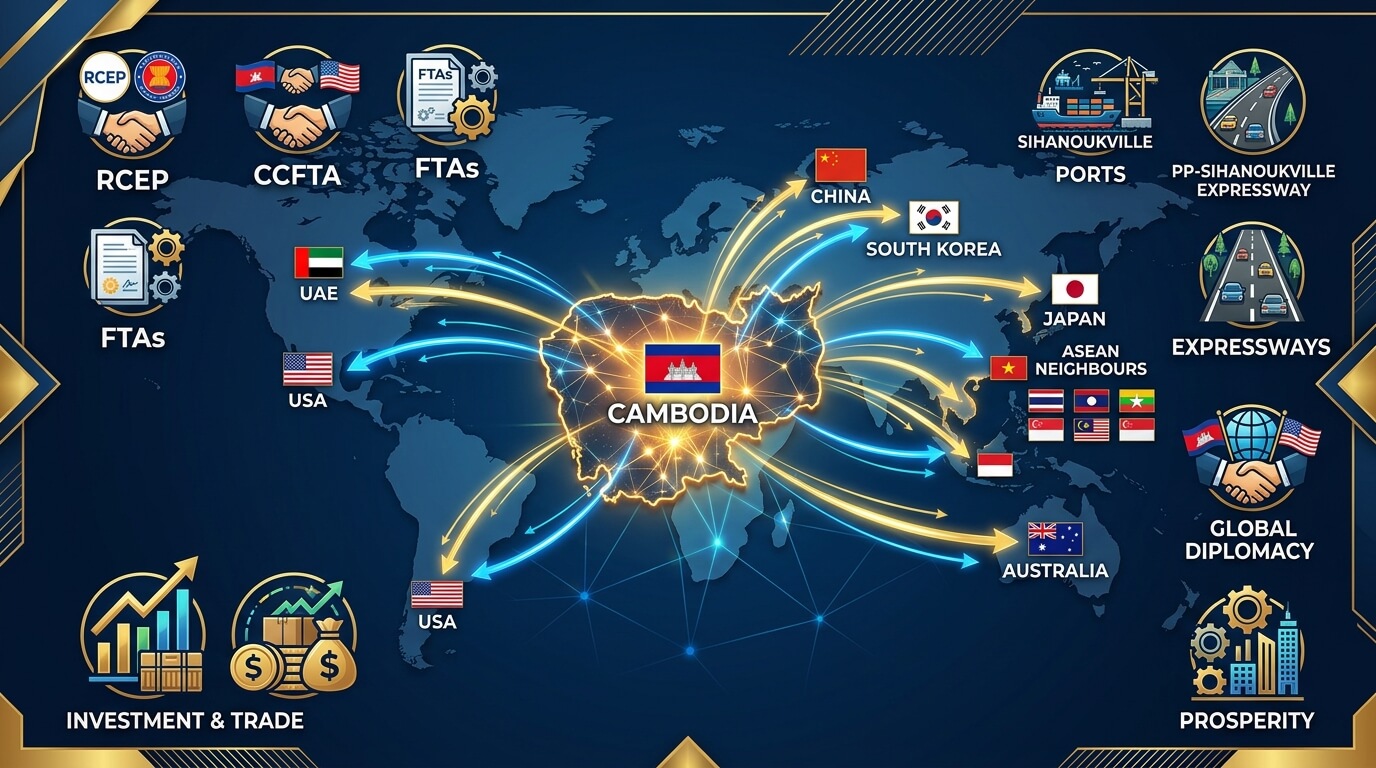
For a small nation, Cambodia has pursued an outsized foreign policy strategy—one that has transformed it from a post‑conflict state into a globally integrated economy. At the heart of this transformation lies a deliberate, pragmatic approach: neutrality grounded in constitutional mandate, multilateral engagement through ASEAN and RCEP, and a growing network of bilateral free trade agreements.
Article 53 of Cambodia’s Constitution says that the country will always be neutral. This principle has guided the Kingdom’s foreign policy for many years. This commitment to non‑alignment, combined with an active role in ASEAN and a “friend to all, enemy to none” philosophy, has created the stable, predictable environment that global investors demand.
The results are measurable. In 2025, Cambodia’s total international trade reached US$65.24 billion, an 18% increase from the previous year. Trade with RCEP member nations alone amounted to US$40.24 billion, up 16.2% year on year. Bilateral trade with China hit a record US$19.73 billion, a 29.9% increase. The Cambodia–South Korea Free Trade Agreement (CKFTA) has propelled bilateral trade to US$1.19 billion in 2025, while the Cambodia–UAE Comprehensive Economic Partnership Agreement (CEPA) is creating new opportunities in the Middle East.
This article examines Cambodia’s strategic foreign policy—its constitutional foundations, its multilateral and bilateral trade architecture, and its principled navigation of great‑power rivalry. For investors, the message is clear: Cambodia’s foreign policy is not merely a diplomatic posture; it is a practical framework for economic integration, risk mitigation, and long‑term growth.
📌 Key Takeaways: Cambodia’s Strategic Foreign Policy
- Constitutional neutrality – Article 53 mandates permanent neutrality, providing a stable foundation for foreign investment.
- Total trade reached US$65.24 billion in 2025 – an 18% increase from 2024, driven by multilateral and bilateral agreements.
- RCEP trade hit US$40.24 billion in 2025 – up 16.2% year‑on‑year, with RCEP members accounting for 61.6% of Cambodia’s total trade.
- Bilateral FTAs with China, South Korea, and the UAE – plus 10 regional agreements (AFTA, ASEAN+1, RCEP), expanding market access across Asia and the Middle East.
- Cambodia–China trade reached a record US$19.73 billion in 2025 – a 29.9% increase, driven by the CCFTA and RCEP.
- Exports grew 21.7% in the first four months of 2026 – to US$11.12 billion, with total trade reaching US$23.4 billion (up 19.9%).
- “Friend to all, enemy to none” – the guiding principle that balances relations with major powers while maintaining ASEAN centrality.
- Cambodia is exploring CPTPP accession – alongside existing RCEP membership, deepening integration into global value chains.
A Foreign Policy of Neutrality and Pragmatism
At the core of Cambodia’s foreign policy lies a simple yet powerful constitutional mandate. Article 53 of the Cambodian Constitution enshrines the Kingdom’s commitment to permanent neutrality and non-alignment, prohibiting foreign military bases on Cambodian soil and military alliances that could entangle the nation in others’ conflicts. This is not passive isolationism—it is an active, principled stance that has allowed Cambodia to build relationships with all nations while safeguarding its sovereignty and territorial integrity.
Constitutional Neutrality – A Foundation of Trust
Article 53 of the Constitution clearly states, “The Kingdom of Cambodia adopts a policy of permanent neutrality and non-alignment.” “The Kingdom of Cambodia follows a policy of peaceful coexistence with its neighbors and with all other countries throughout the world.” It further stipulates that Cambodia shall not invade any country or interfere in any other country’s internal affairs and shall not permit any foreign military base on its territory, except within the framework of a United Nations request.
This constitutional commitment provides a bedrock of predictability for international partners. As Prime Minister Hun Manet has reaffirmed, Cambodia’s foreign policy is guided by “an independent foreign policy of permanent neutrality and non-alignment, based on the principles of international law, the United Nations Charter, the Constitution of Cambodia, and core national interests.” This consistency has earned Cambodia respect on the global stage and created a stable environment for foreign investment.
“Friend to All, Enemy to None” – The Guiding Principle
Complementing the constitutional framework is the pragmatic principle of being a “friend to all, enemy to none.” This guiding philosophy, frequently articulated by Cambodian leaders, emphasizes that Cambodia’s foreign policy is grounded in mutual respect, understanding, trust, and shared interests.
As Samdech Maha Rathsapheathika Thipadei Khuon Sudary, President of the National Assembly, recently reaffirmed, Cambodia’s foreign policy places ASEAN as the cornerstone of its external relations, while actively cultivating partnerships with all nations. This approach has enabled Cambodia to strengthen ties with its immediate neighbors while also expanding relationships with major powers.
The principle is not merely rhetorical. Prime Minister Hun Manet has articulated that “Cambodia makes friends with all countries to benefit the nation and people,” adding that “Cambodia wants good relations with all countries in the world.” This inclusive, pragmatic approach has helped Cambodia preserve its strategic autonomy and enhance its diplomatic position in the region.
From Principle to Practice – A Track Record of Stability
The combination of constitutional neutrality and pragmatic engagement has yielded a foreign policy that is both principled and flexible. Critics have sometimes questioned whether Cambodia’s deepening economic ties with China might compromise its neutrality. However, Cambodia has consistently demonstrated its ability to maintain balanced relations, avoiding overreliance on any single power while pursuing national development on its own terms.
This balancing act is evident in Cambodia’s active engagement with multiple partners. As one analyst noted, Cambodia’s foreign policy is guided by principles of non-alignment, permanent neutrality, and the active promotion of open and inclusive multilateralism. The Kingdom continues to expand engagement with the United States, maintain strong ties with Vietnam, and cultivate relationships across ASEAN and beyond.
For investors, this foreign policy framework offers a crucial assurance: Cambodia’s commitment to neutrality and peaceful coexistence is not a short‑term tactical choice but a constitutional and strategic anchor that has guided the nation for decades. It provides the stable, predictable environment that long‑term capital requires.
Multilateralism in Action – RCEP and ASEAN Integration
While bilateral FTAs provide targeted market access, Cambodia’s deepest trade integration comes through multilateral frameworks. The Kingdom has embraced a rules‑based multilateral trading system as a cornerstone of its economic diplomacy, leveraging ASEAN centrality, the Regional Comprehensive Economic Partnership (RCEP), and a potential path towards the Comprehensive and Progressive Agreement for Trans-Pacific Partnership (CPTPP).
RCEP: A Catalyst for Trade Growth
Since its entry into force in 2022, the Regional Comprehensive Economic Partnership (RCEP) has become the driving force behind Cambodia’s trade expansion. As the world’s largest free trade agreement, RCEP connects Cambodia to a market of over 2.2 billion people and accounts for roughly 30% of global GDP.
The numbers are decisive. In 2025, Cambodia’s trade with RCEP member countries reached US$40.24 billion, a year‑on‑year increase of 16.2% [0†L18-L20][3†L30-L31]. RCEP accounted for 61.6% of Cambodia’s total trade volume, which stood at US$65.24 billion [3†L24-L25]. Cambodia’s top five trading partners under the RCEP are China, Vietnam, Thailand, Japan, and Singapore. Exports to RCEP countries reached US$9.8 billion in 2025, up 7% year‑on‑year.
The benefits extend beyond headline numbers. As Penn Sovicheat, Secretary of State at the Ministry of Commerce, noted: “The RCEP is a driving force for our long‑term trade growth and a magnet to attract more foreign direct investment to Cambodia.” The agreement provides tariff preferences, technology transfer, skills development, and job opportunities driven by foreign direct investment. RCEP’s tariff elimination—covering over 90% of goods traded among members—has made Cambodian exports more competitive in regional markets.
For Cambodian exporters, the impact has been transformative. Cambodia’s milled rice exports to China, for example, reached US$138.36 million in 2025, up 83% from the previous year, driven by RCEP and the Cambodia‑China Free Trade Agreement (CCFTA). The outlook remains positive, with expectations of further growth if Cambodia can maintain quality standards, ensure consistent supply, and manage logistics and pricing competitiveness.
ASEAN Centrality – Deepening Regional Integration
ASEAN has been the cornerstone of Cambodia’s foreign policy for decades, and this commitment remains unwavering. Cambodia actively participates in ASEAN’s economic integration agenda, including the ASEAN Economic Community (AEC) Blueprint 2025 and the ongoing work towards the Post‑2025 ASEAN Economic Community Vision.
At the Third ASEAN Future Forum (AFF 2026) held in Hanoi from 8–9 June 2026, Prime Minister Hun Manet reaffirmed Cambodia’s commitment to ASEAN unity, cohesion, and centrality. Cambodia and Vietnam, both ASEAN members, share a common interest in preserving the organisation’s unity, cohesion, and central role—contributing to peace, stability, and shared prosperity in the region and beyond.
Cambodia’s ASEAN engagement extends beyond rhetoric. The Kingdom has been a strong advocate for the full implementation of the Declaration on the Conduct of Parties in the South China Sea (DOC) and the early conclusion of an effective Code of Conduct (COC) to maintain peace and stability in this strategically important region. Cambodia also supports the ASEAN integration process to successfully implement the Pentagonal Strategy—the government’s flagship policy framework under Prime Minister Hun Manet.
Regional cooperation is also being strengthened through bilateral partnerships. Prime Minister Hun Manet’s official visit to Vietnam in June 2026 is expected to create fresh momentum for Vietnam‑Cambodia relations and ASEAN solidarity. In the first four months of 2026, bilateral trade between the two countries increased by 8% compared to the same period last year.
Charting a New Course – CPTPP Accession and Beyond
Cambodia is now setting its sights on an even broader trade architecture. In December 2025, Cambodia formally applied to join the Comprehensive and Progressive Agreement for Trans‑Pacific Partnership (CPTPP). The CPTPP offers preferential access to some of the world’s most dynamic markets, including Japan, Australia, Canada, Mexico, and Singapore.
The accession process is already underway. Prime Minister Hun Manet has elevated the fact‑finding mission on CP‑TPP accession into a formal negotiating working group. In May 2026, the Trade Policy Advisory Board (TPAB), in collaboration with the Asian Development Bank (ADB), co‑organised a two‑day National Consultation Workshop on “Cambodia’s Trade Resilience and Competitiveness for the CP‑TPP”.
Senior Minister Sok Siphana has underscored that accession requires strong technical preparation, legal reforms, and institutional capacity building. The government is actively working to address compliance gaps, which reflect both Cambodia’s regulatory constraints and the CPTPP’s high standards.
International support is already forthcoming. Singapore, a founding CPTPP member, has welcomed Cambodia’s interest in acceding to the agreement, noting that it would “help deepen its integration into regional value chains, expand market access, and strengthen investor confidence”. The Asian Development Bank (ADB) is also providing technical assistance to support Cambodia’s preparedness.
If successful, CPTPP accession would mark another milestone in Cambodia’s integration into global value chains, complementing its existing RCEP membership and bilateral FTAs. It would send a powerful signal to investors that Cambodia is committed to the highest standards of trade liberalisation and regulatory reform.
Bilateral FTAs – Expanding Market Access
While multilateral frameworks like RCEP provide broad regional integration, Cambodia has simultaneously pursued a network of bilateral free trade agreements (FTAs) to secure preferential access to specific strategic markets. These agreements are not mere diplomatic gestures—they are practical instruments that have delivered measurable trade growth, diversified Cambodia’s export destinations, and signalled to global investors that the Kingdom is committed to open, rules-based commerce.
The Cambodia‑China Free Trade Agreement (CCFTA)
The Cambodia‑China Free Trade Agreement (CCFTA) entered into force in January 2022, marking a milestone in bilateral economic relations. The agreement provides Cambodian exporters with preferential access to the world’s second‑largest economy, covering more than 340 categories of products, with 95% of agricultural goods enjoying zero‑percent tariffs. The remaining 5%—machinery and vehicles—will see tariffs reduced to zero within 10 years.
The results have been striking. In 2025, bilateral trade between Cambodia and China reached a record US$19.73 billion, a 29.9% increase from US$15.19 billion in 2024. China remained Cambodia’s largest trading partner. Imports from China surged by 34.3% to more than US$18.04 billion, accounting for 53.25% of Cambodia’s total import value. Chinese imports have become the backbone of Cambodia’s manufacturing sector, supplying raw materials for factories, automated machinery, construction materials, electrical equipment, and consumer goods.
The CCFTA has been particularly transformative for Cambodia’s agricultural exports. Milled rice exports to China reached 231,125 tonnes in 2025, a 96% year‑on‑year increase, generating US$138.36 million in revenue—up 83%. The Cambodia Rice Federation confirmed that China ranks as the number one destination for Cambodian rice. China has also increased its annual rice import quota from 400,000 tonnes to 500,000 tonnes—a 25% rise.
Beyond trade in goods, Chinese investment is the dominant source of foreign direct investment in Cambodia. In 2025, Chinese investment accounted for 54.25% of total approved investment capital, leading all other countries. The CDC approved 630 investment projects worth approximately US$10 billion, with Chinese investors leading across multiple sectors.
Senior officials have reinforced the commitment to deepening this partnership. In June 2026, Deputy Prime Minister and Minister of Economy and Finance H.E. Aun Pornmoniroth confirmed that trade volume under the CCFTA framework had “increased significantly” during the first quarter of 2026. Chinese Customs Minister Sun Meijun pledged continued facilitation for importing Cambodian agricultural products like bananas and durians while requesting Cambodia to accelerate single‑window and electronic origin data system connectivity.
For investors, the CCFTA is a powerful signal: Cambodia offers not only competitive production costs but also preferential access to the world’s most dynamic consumer market. The synergy between the CCFTA, RCEP, and the Belt and Road Initiative is positioning Cambodia as a key node in Southeast Asian supply chains.
Cambodia‑South Korea FTA
The Cambodia‑South Korea Free Trade Agreement (CKFTA) entered into force in December 2022, providing Cambodian exporters with preferential access to Asia’s fourth‑largest economy. Bilateral trade reached US$1.19 billion in 2025, reflecting the agreement’s positive impact on market diversification. The CKFTA covers a wide range of products, including garments, footwear, agricultural goods, and electronics, with phased tariff reductions over time.
South Korea is also a significant investor in Cambodia, with Korean companies active in manufacturing, infrastructure, and technology sectors. The FTA has strengthened this investment relationship, providing Korean businesses with greater certainty and access to Cambodia’s growing market.
Cambodia‑UAE FTA – A Gateway to the Middle East
In a strategic move to diversify beyond traditional Asian markets, Cambodia signed a Comprehensive Economic Partnership Agreement (CEPA) with the United Arab Emirates in 2024. The agreement, which entered into force in early 2025, provides Cambodian exporters with preferential access to the UAE—a regional hub for trade, logistics, and finance in the Middle East and North Africa.
The CEPA covers trade in goods, services, investment, and economic cooperation. For Cambodian exporters, it opens new opportunities for agricultural products, garments, and processed goods in the Gulf market. For the UAE, Cambodia offers a gateway to ASEAN and the broader Mekong region. Early data suggests growing trade volumes, with both sides expressing optimism about the agreement’s potential.
Looking Ahead – New FTA Negotiations
Cambodia is not resting on its existing agreements. The government is actively exploring new FTA negotiations with additional partners to further diversify its trade architecture.
Senior Minister Sok Siphana, a key architect of Cambodia’s trade policy, has confirmed that Cambodia is exploring additional FTAs, including with Japan and India. An FTA with Japan would build on the existing ASEAN‑Japan FTA and provide Cambodian exporters with enhanced access to one of the world’s most sophisticated consumer markets. An India FTA would open opportunities in a market of over 1.4 billion people, complementing the existing India‑ASEAN FTA.
Beyond these specific negotiations, Cambodia continues to deepen its engagement with existing partners. In December 2025, Cambodia and China signed the China‑ASEAN Free Trade Area 3.0 Upgrade Protocol, which further strengthens supply chain resilience and provides an institutional blueprint for optimising the division of labour in regional industrial chains. In June 2026, Cambodia and China signed an Authorised Economic Operator (AEO) Mutual Recognition Arrangement to facilitate bilateral trade and investment.
The cumulative effect of these agreements is a web of preferential trade relationships that spans Asia, the Middle East, and beyond. For investors, this means that Cambodia is not just a low‑cost manufacturing base—it is a platform for accessing multiple markets with growing consumer demand.
Economic Diplomacy – Diversifying Partnerships
Beyond the major bilateral FTAs and multilateral frameworks, Cambodia’s economic diplomacy is defined by its commitment to diversifying partnerships across the globe. The Kingdom actively cultivates relationships with traditional development partners while simultaneously forging new connections in emerging markets. This broad-based approach reduces over‑reliance on any single economy, enhances Cambodia’s resilience to external shocks, and signals to investors that the country is a reliable, globally engaged partner.
The United States – A Critical Export Market
The United States remains Cambodia’s largest export market, absorbing more than US$5.73 billion in Cambodian goods during the first five months of 2026—a 31.5% increase year‑on‑year. This represented a significant portion of Cambodia’s total exports of US$14.04 billion, which grew 19% over the same period. The US market continues to absorb a substantial share of Cambodia’s garment, footwear, and travel goods exports, making it an indispensable pillar of the Kingdom’s manufacturing economy.
Bilateral relations have seen notable diplomatic progress. After 12 years of negotiations, Cambodia and the US reached a consensus on an Open Skies Agreement in June 2026, paving the way for direct flights between the two countries. This agreement is expected to boost investment, trade, tourism, and people‑to‑people exchanges.
On the trade policy front, Cambodia has been engaged in constructive dialogue with the US regarding proposed tariff measures. The US Trade Representative (USTR) has proposed a 10% tariff on Cambodian goods under Section 301 of the Trade Act, addressing concerns related to labor practices. However, this would replace—rather than add to—the existing 19% tariff. The government has expressed confidence that its ongoing engagement with the USTR, including commitments made under the Reciprocal Trade Agreement (ART) framework, will prevent further damage to Cambodian exports. This demonstrates Cambodia’s commitment to resolving trade issues through diplomatic channels.
The European Union – A Long‑Standing Partner
The European Union remains one of Cambodia’s most significant economic partners. In 2025, bilateral trade in goods between Cambodia and the EU reached €7.2 billion. The EU provides Cambodian exporters with duty‑free, quota‑free access through the Everything But Arms (EBA) initiative, a scheme designed to support the world’s least developed countries.
The relationship is evolving as Cambodia approaches graduation from Least Developed Country (LDC) status in 2029. This graduation will gradually reduce access to EBA preferences and other preferential trade arrangements. In response, both sides are deepening their partnership. In April 2026, the EU and Cambodia held a joint summit to discuss closer cooperation, underscoring the importance of supporting Cambodia’s transition through export diversification and value‑chain development. The 13th Joint Committee Meeting in February 2026 focused on trade and investment relations, improving the investment climate, and strengthening economic engagement.
The EU also recognizes Cambodia’s strategic potential as an “ASEAN Hub” and an attractive destination under the EU’s Global Gateway framework. This long‑standing relationship, built on mutual interest and shared values, continues to be a cornerstone of Cambodia’s economic diplomacy.
Japan – A Trusted Partner for Quality Investment
Japan is Cambodia’s fourth‑largest international trading partner, after China, the US, and Vietnam. In the first quarter of 2026, bilateral trade reached US$753.46 million, a 14.8% increase year‑on‑year.
Beyond trade, Japan is a trusted partner for quality investment and technology transfer. In June 2026, Deputy Prime Minister Sun Chanthol led a high‑level investment promotion mission to Japan, meeting with the Japan Business Confederation (Keidanren) and the Japan External Trade Organization (JETRO). The mission focused on attracting Japanese investment in high-technology sectors and promoting Cambodia’s potential as a new industrial manufacturing base.
A flagship initiative is the proposed Cambodia‑Japan Green Special Economic Zone (C‑J GSEZ), which aims to attract Japanese investment in sustainable manufacturing and position Cambodia as a green industrial hub. The strong political trust between the two countries, reflected in recent high‑level meetings, provides a solid foundation for expanding economic cooperation.
Australia – A Growing Indo‑Pacific Partner
Australia is an increasingly important trade and development partner for Cambodia. Bilateral trade reached approximately US$1.2 billion in 2025, including around US$850 million in Cambodian exports to Australia. Other sources indicate bilateral trade of approximately US$600 million in 2025, reflecting steady growth.
A significant milestone was the signing of a new rice export agreement in early 2026, which is expected to lead to long‑term contracts bringing Cambodian rice to major Australian supermarkets. This builds on Australia’s commitment to supporting Cambodia’s economic development through the CAPRED Facility, Australia’s flagship bilateral economic development program in Cambodia.
Australia is also a strong supporter of Cambodia’s integration into regional value chains and its potential accession to the CPTPP.
India – Reviving Ancient Ties with Modern Commerce
India is emerging as an increasingly important economic partner for Cambodia. Bilateral trade expanded by 19% year‑on‑year in 2025, reaching a total value of US$410 million. In the first quarter of 2026, trade surged by 31.5% to US$119 million.
A landmark achievement was the official launch of cross‑border QR code payment connectivity between Cambodia and India in June 2026. The first phase enables Indian visitors to make payments at merchants nationwide through the KHQR system, facilitating tourism and business travel. This digital connectivity initiative strengthens the broader bilateral relationship.
India and Cambodia are also deepening cooperation across political, economic, defense, security, and cultural sectors. The year 2027 will mark the 75th anniversary of diplomatic relations between the two countries, providing a platform for further strengthening ties.
Beyond Bilateralism – A Web of Global Engagement
Cambodia’s economic diplomacy extends well beyond its major partners. The Kingdom maintains active trade relationships with Canada, the United Kingdom, ASEAN member states, and a growing number of other partners.
In 2026, the Cambodia Chamber of Commerce (CCC) announced two major events: the Cambodia ASEAN Business Summit in March and another high‑level gathering expected to draw delegations from nearly 90 countries. These events are central to Cambodia’s strategy of using business diplomacy and deal‑making as key drivers of economic growth.
The government’s economic diplomacy is guided by the principle of “friend to all, enemy to none,” ensuring that Cambodia maintains constructive relations with all major powers and emerging economies. This inclusive approach, combined with its constitutional neutrality and active multilateral engagement, positions Cambodia as a reliable and predictable partner in an increasingly uncertain world.
Navigating Great Power Rivalry – A Principled Approach
Perhaps no dimension of Cambodia’s foreign policy is as closely watched—or as frequently misunderstood—as its navigation of the intensifying strategic competition between the United States and China. As a small nation with a constitutional commitment to neutrality, Cambodia has been compelled to develop a sophisticated approach to managing great‑power rivalry: one that preserves its sovereignty, maximises its development opportunities, and avoids being crushed between geopolitical giants.
Deputy Prime Minister Sun Chanthol captured this predicament succinctly when he observed that “when elephants fight, it is best to stay out of the way”. This is not passivity—it is strategic prudence. Cambodia’s approach is grounded in three interconnected principles: strategic autonomy, pragmatic diversification, and ASEAN centrality.
The China‑US Dynamic – A Delicate Balancing Act
Cambodia’s relationship with China is undeniably deep and multifaceted. China is Cambodia’s largest trading partner, with bilateral trade reaching a record US$19.73 billion in 2025, a 29.9% increase from the previous year. Chinese investment accounts for more than half of Cambodia’s total foreign direct investment, and China is the Kingdom’s largest source of development assistance and infrastructure financing. Acting Head of State Hun Sen has described China’s support as Cambodia’s “greatest source of confidence in achieving development and maintaining security”, while Prime Minister Hun Manet has reaffirmed Cambodia’s commitment to further deepening the comprehensive strategic partnership with China.
Yet this deep engagement with China has not come at the expense of relations with the United States. In January 2026, the US announced US$45 million in assistance to Cambodia, including $15 million for border stability and community reconstruction, $10 million for demining, and $20 million for combating cross‑border fraud and drug trafficking. In June 2026, after 12 years of negotiations, Cambodia and the US reached a consensus on an Open Skies Agreement, paving the way for direct flights and expanded commercial ties. US Deputy Secretary of State Christopher Landau has praised progress in bilateral relations and expressed appreciation for the Royal Government’s support in facilitating American investment.
The balancing act extends to the military domain. In January 2026, a US naval vessel made a port call at Sihanoukville—the first such visit in years—marking a continued thaw in military relations. Analysts suggest this reflects Cambodia’s broader strategy of diversifying its foreign partnerships and reducing over‑reliance on any single power.
“When Elephants Fight” – The Imperative of Diversification
The catalyst for Cambodia’s recent recalibration has been the shifting global trade environment. As Sun Chanthol explained in a January 2026 interview with the Financial Times, the Trump administration’s tariff policies served as a “wake-up call” that Cambodia “cannot just rely on China”. The response has been a deliberate strategy of economic diversification—reducing over-reliance on any single partner while maintaining constructive relations with all major powers.
This is not a rejection of China but a recognition of strategic necessity. As one analyst observed, Hun Manet’s approach is not “a naïve tilt toward either the West or China but a deliberate strategy to diversify dependencies, secure economic stability, and broaden diplomatic manoeuvrability”. Cambodia’s foreign policy is guided by principles of non‑alignment, permanent neutrality, and the active promotion of open and inclusive multilateralism.
The government’s Pentagonal Strategy explicitly prioritises economic diversification as a means of enhancing strategic autonomy and safeguarding against external pressure. This is reflected in Cambodia’s expanding network of trade agreements, its pursuit of CPTPP accession, and its cultivation of new partnerships across Asia, the Middle East, and beyond.
ASEAN Centrality – The Anchor of Stability
Throughout this balancing act, ASEAN remains the cornerstone of Cambodia’s foreign policy. At the Third ASEAN Future Forum (AFF 2026) held in Hanoi from 8–9 June 2026, Prime Minister Hun Manet reaffirmed Cambodia’s commitment to ASEAN unity, cohesion, and centrality. He emphasised that ASEAN must continue to serve as “a model of rules‑based multilateralism” and remain “a force for peace, stability, dialogue, and constructive cooperation”.
Cambodia’s ASEAN engagement extends beyond rhetoric. The Kingdom has been a strong advocate for the full implementation of the Declaration on the Conduct of Parties in the South China Sea (DOC) and the early conclusion of an effective Code of Conduct (COC) to maintain peace and stability in this strategically important region. Cambodia also supports the ASEAN integration process to successfully implement the Pentagonal Strategy—the government’s flagship policy framework under Prime Minister Hun Manet.
The strategic significance of Cambodia’s ASEAN commitment is evident in its bilateral relationships within the bloc. Prime Minister Hun Manet’s official visit to Vietnam in June 2026 is expected to create fresh momentum for bilateral relations and ASEAN solidarity. Vietnam and Cambodia, both ASEAN members, share a common interest in preserving the organisation’s unity, cohesion, and central role—contributing to peace, stability, and shared prosperity in the region and beyond.
A Principled, Pragmatic Path Forward
Cambodia’s navigation of great‑power rivalry is neither opportunistic nor ideological—it is principled and pragmatic. The Kingdom’s foreign policy is anchored in its constitutional commitment to neutrality, its active engagement with ASEAN, and its determination to pursue national development on its own terms.
As Prime Minister Hun Manet has articulated, in an uncertain world, “self-strengthening is essential for safeguarding peace”—a strength that encompasses not only defence but also economic resilience and human capital. This philosophy guides Cambodia’s approach to great‑power relations: engage with all, depend on none, and always prioritise the national interest.
For investors, this offers a crucial reassurance: Cambodia’s foreign policy is not a short‑term tactical choice but a strategic anchor that has guided the nation for decades. It provides the stable, predictable environment that long‑term capital requires—even as the geopolitical landscape shifts around it.
❓ Frequently Asked Questions (FAQ)
1. What is the constitutional basis of Cambodia’s foreign policy?
Article 53 of the Cambodian Constitution mandates a policy of permanent neutrality and non-alignment. It prohibits foreign military bases on Cambodian soil, forbids interference in other nations’ internal affairs, and commits Cambodia to peaceful coexistence with all countries. This constitutional anchor provides the stable, predictable foundation that global investors seek.
2. How does RCEP benefit Cambodia’s economy?
In 2025, trade with RCEP member countries reached US$40.24 billion, a 16.2% year‑on‑year increase, accounting for 61.6% of Cambodia’s total trade. RCEP provides tariff preferences (over 90% of goods have tariff reductions or elimination), technology transfer, and skills development. Cambodia’s top five trading partners under RCEP are China, Vietnam, Thailand, Japan, and Singapore.
3. What bilateral FTAs does Cambodia have?
Cambodia has bilateral free trade agreements with China (CCFTA, effective January 2022), South Korea (CKFTA, effective December 2022), and the United Arab Emirates (CEPA, effective early 2025). Cambodia is also exploring FTAs with Japan and India. These agreements provide preferential market access to some of the world’s largest and fastest‑growing economies.
4. What is the Cambodia‑China trade relationship?
Bilateral trade reached a record US$19.73 billion in 2025, a 29.9% increase from 2024. China is Cambodia’s largest trading partner and the dominant source of foreign direct investment, accounting for more than half of approved investment capital. The CCFTA provides zero‑tariff access for over 340 product categories, with 95% of agricultural goods enjoying zero tariffs.
5. How does Cambodia balance relations between China and the United States?
Cambodia’s approach is guided by strategic autonomy, pragmatic diversification, and ASEAN centrality. The Kingdom maintains deep economic ties with China while actively engaging with the United States. Recent developments include a US$45 million assistance package from the US and a long‑awaited Open Skies Agreement. As Deputy Prime Minister Sun Chanthol stated, “when elephants fight, it is best to stay out of the way”—Cambodia avoids being caught between great powers while maximising development opportunities from all partners.
6. What is the “friend to all, enemy to none” principle?
This guiding philosophy, frequently articulated by Cambodian leaders, emphasises that Cambodia’s foreign policy is grounded in mutual respect, understanding, trust, and shared interests. It means Cambodia cultivates partnerships with all nations—ASEAN neighbours, major powers, and emerging economies alike—while preserving its strategic autonomy and constitutional neutrality.
7. What is Cambodia’s position on CPTPP accession?
In December 2025, Cambodia formally applied to join the Comprehensive and Progressive Agreement for Trans‑Pacific Partnership (CPTPP). The government has established a Negotiating Working Group and is working on technical preparation, legal reforms, and institutional capacity building. Singapore has welcomed Cambodia’s interest, and the Asian Development Bank is providing technical assistance. If successful, CPTPP accession would mark another milestone in Cambodia’s integration into global value chains.
8. What are Cambodia’s total trade figures?
Cambodia’s total international trade reached US$65.24 billion in 2025, an 18% increase from 2024. In the first four months of 2026, exports reached US$11.12 billion (up 21.7% year‑on‑year) and total trade reached US$23.4 billion (up 19.9%). The United States remains Cambodia’s largest export market, absorbing over US$5.73 billion in goods in the first five months of 2026—a 31.5% increase.
Conclusion: Cambodia’s Strategic Foreign Policy – A Foundation for Prosperity and Stability
Cambodia’s foreign policy is not a passive response to external events—it is a deliberate, strategic asset that underpins the Kingdom’s economic transformation and long‑term development vision. Rooted in the constitutional mandate of permanent neutrality, guided by the pragmatic principle of “friend to all, enemy to none”, and executed through a sophisticated web of multilateral and bilateral agreements, Cambodia’s foreign policy has created the stable, predictable environment that global investors demand.
The results are measurable and compelling. Total international trade reached US$65.24 billion in 2025, an 18% increase from the previous year. RCEP trade hit US$40.24 billion, accounting for 61.6% of Cambodia’s total trade. Bilateral trade with China reached a record US$19.73 billion, up 29.9% year‑on‑year. Exports grew 21.7% in the first four months of 2026, signalling continued momentum.
These achievements are not accidental. They are the product of a deliberate strategy: constitutional neutrality that provides a stable foundation for international engagement; ASEAN centrality that anchors Cambodia in a rules‑based regional architecture; a growing network of bilateral FTAs with China, South Korea, and the UAE—and more on the horizon; active pursuit of CPTPP accession to deepen integration into global value chains; and pragmatic engagement with all major powers—balancing deep ties with China while strengthening relations with the United States, Japan, the European Union, and others.
For investors, Cambodia offers a rare combination: a young, dynamic workforce; competitive production costs; preferential access to the world’s largest markets; and—crucially—a foreign policy framework that ensures stability and predictability. Cambodia is not a passive recipient of global trends; it is an active participant, shaping its own future through strategic diplomacy and principled engagement.
The vision is clear. By 2030, Cambodia aims to become an upper‑middle‑income country. By 2050, a high‑income nation. These ambitions are not abstract hopes—they are grounded in the tangible achievements of a foreign policy that has delivered record trade growth, diversified partnerships, and sustained investor confidence. Cambodia’s strategic foreign policy is not merely a diplomatic posture—it is the bedrock of its development vision and a compelling invitation to the world.
Now is the time to partner with Cambodia.