
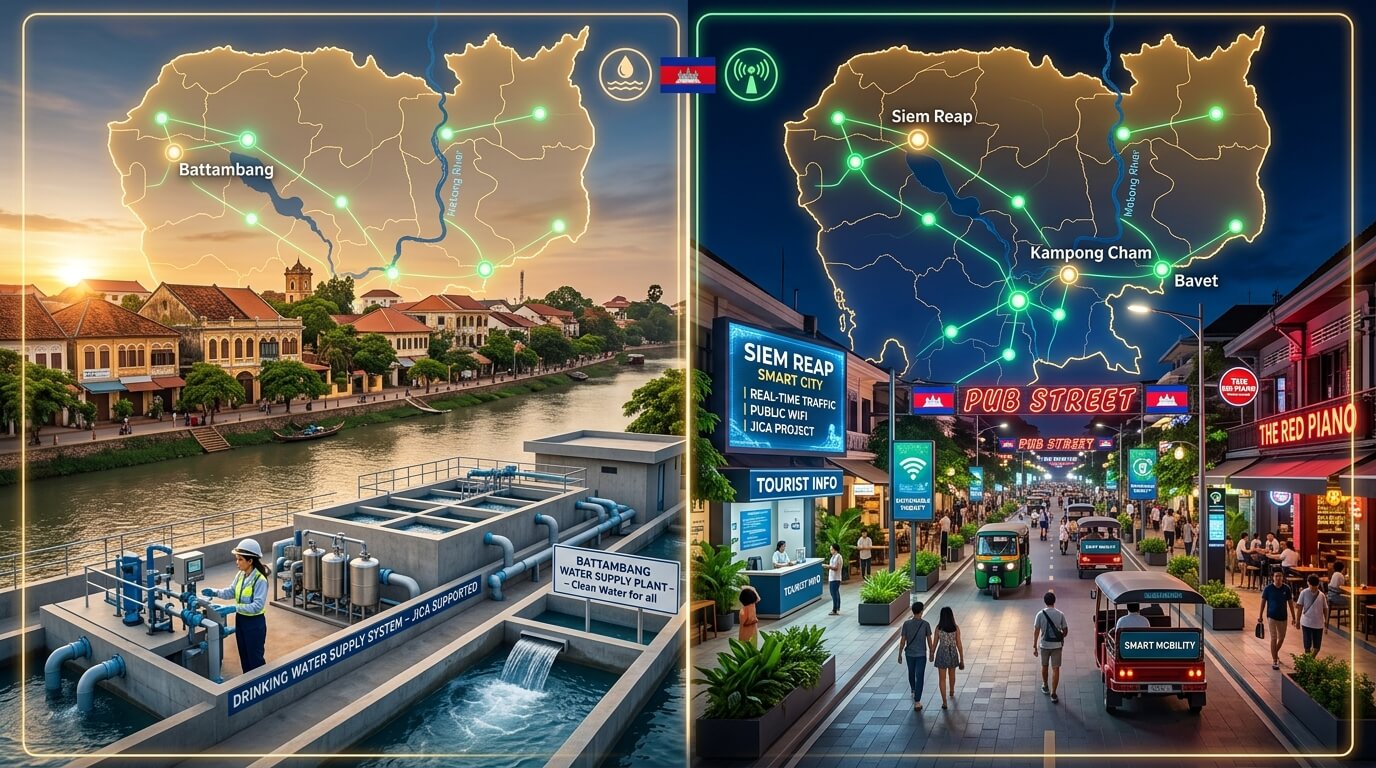
For years, Phnom Penh has dominated the narrative of Cambodia’s infrastructure development. The capital’s skyline—a forest of cranes and rising skyscrapers—has become the defining image of the Kingdom’s economic transformation. But that narrative is incomplete. Beyond the capital’s expanding suburbs, a quieter but equally significant transformation is underway. Cambodia’s secondary cities are experiencing an infrastructure boom that is reshaping the nation’s urban geography and creating new opportunities for civil engineering, logistics, investment, and tourism.
From the rice fields of Battambang to the temple-studded streets of Siem Reap, from the Mekong riverbanks of Kampong Cham to the border crossings of Bavet, a network of cities is emerging as the new frontier of Cambodia’s development. These are not mere satellites of Phnom Penh. They are becoming economic hubs in their own right—each with its own strategic advantages, infrastructure priorities, and growth trajectories.
The numbers tell a compelling story. In Battambang, a US$119 million multilateral water project has nearly doubled the city’s clean water production capacity, serving over 219,810 households with 94% coverage. In Siem Reap, the second phase of the JICA-backed Smart City project is set to run from September 2026 to August 2028, using digital technology to manage waste, traffic, and public safety. In Kampong Cham, a new floating steel tourist port is under construction, designed to enhance intermodal connectivity along the Mekong River. And in Bavet, the ADB has released a “Competitive City Action Plan” to transform the border town from a low-skilled manufacturing hub into a competitive regional growth center.
National connectivity is also advancing. The 366-kilometre National Road 5—passing through Kandal, Kampong Chhnang, Pursat, Battambang, and Banteay Meanchey—is a key priority of the Pentagonal Strategy Phase I, with the final section from Serei Sophorn to Poipet expected to be completed by 2026.
This article explores the infrastructure boom transforming Cambodia’s secondary cities. We examine the major projects reshaping Battambang, Siem Reap, Kampong Cham, and Bavet—and the investment opportunities these transformations present for those willing to look beyond Phnom Penh.
📌 Key Takeaways: Cambodia’s Secondary City Infrastructure Boom
- Battambang’s Water Revolution: A US$119.17 million multilateral project (ADB, AFD, EU) nearly doubled production capacity to 83,520 m³/day, adding 16,798 new household connections and achieving 94% coverage.
- Siem Reap Smart City Phase 2: JICA-backed project running September 2026–August 2028 focusing on digital governance, traffic optimisation, waste management, and public safety.
- Kampong Cham Tourist Port: New floating steel port at the old ferry terminal, designed to enhance intermodal connectivity along the Mekong Rive.
- Bavet’s Ambitious Transformation: ADB-backed “Competitive City Action Plan” (Dec 2025) aims to transform Bavet from a low-skilled hub into a competitive regional growth centre.
- National Road 5 Upgrade: 366-km artery through five provinces, connecting Phnom Penh to the Thai border, expected to be completed by 2026.
- Tonle Sap Basin Urban Projects: Second Urban Environmental Management project in Battambang, Serei Saophoan, and Stueng Saen at 95–99% completion as of December 2025.
- National Road 5 Investment: The US$52 million Serei Sophorn–Poipet section is part of a seven-year, multi-section upgrade project.
The Shift Beyond the Capital – Why Secondary Cities Matter
For decades, Cambodia’s development narrative has been written in Phnom Penh. The capital has absorbed the lion’s share of investment, infrastructure spending, and international attention. Yet this urban-centric model is increasingly being challenged—not by design, but by necessity. Secondary cities are growing faster than the infrastructure that supports them, and the need to decentralise economic activity has become a national priority.
Urban Decentralisation and the New Growth Frontier
Secondary cities across Cambodia are experiencing rapid demographic and economic expansion. Battambang, Cambodia’s second city, had an estimated population of approximately 257,600 as of 2015, and its growth has only accelerated since. Bavet, a border city of approximately 50,000 inhabitants, sits in one of Cambodia’s lower-income and least developed provinces yet offers an advantageous location along the Southern Economic Corridor. Kampong Cham, with its Mekong riverfront location, is positioning itself as a regional hub for tourism and trade. These cities are no longer satellites of Phnom Penh—they are emerging as economic centres in their own right.
The rationale for focusing on secondary cities is compelling. They are the fastest-growing urban areas in the Global South, but they also have weaker capacity to address climate risks and infrastructure deficits. Without targeted investment, the gap between urban and rural development will widen, and the pressure on Phnom Penh—already straining under congestion and rising land costs—will become unsustainable.
The ADB’s Vision for Competitive Secondary Cities
The Asian Development Bank (ADB) has emerged as a key partner in this transformation. In December 2025, the ADB approved a US$763 million investment program to help Cambodia expand access to safe water supply and sanitation, strengthen water security, and enhance the resilience and livability of its cities. The program, called the “Livable, Resilient, and Water-Secure Cities Investment Program,” will utilize a multi-tranche financing facility to improve basic urban services in 14 cities and 12 districts across the Mekong, Tonle Sap, and coastal regions. The program will boost inclusive coverage of basic urban services, with approximately 15% of direct beneficiaries from poor households.
The ADB has also catalyzed approximately US$158 million in additional co-financing. This includes a US$10 million loan from the ASEAN Infrastructure Fund, a US$10 million loan from the European Union under the ASEAN Catalytic Green Finance Facility, a US$3 million grant from the Urban Resilience Trust Fund (funded by the Government of the United Kingdom), and approximately US$135 million (€120 million) in co-financing from the Agence Française de Développement (AFD).
As ADB Country Director for Cambodia Yasmin Siddiqi stated, “This investment program will help Cambodia build inclusive, climate-resilient urban services that support not only livability but also productivity and competitiveness.” The ADB is also exploring investment opportunities in tourism infrastructure to transform secondary towns along the Greater Mekong Subregion’s central and southern corridors into economically inclusive and competitive tourism destinations. This multipronged approach—addressing water security, urban services, and tourism infrastructure—reflects a comprehensive strategy for secondary city development.
Bavet – A Border City’s Ambitious Transformation
Perhaps the most striking example of this new focus is Bavet, a border town in Svay Rieng province. In December 2025, the ADB released the “Solutions for Liveability: Competitive City Action Plan for Bavet, Cambodia”, outlining a strategy to transform the city from a low‑skilled manufacturing hub into a competitive regional growth centre.
The plan identifies Bavet’s strategic location along the Southern Economic Corridor—linking Ho Chi Minh City, Phnom Penh, and Bangkok—as its greatest economic advantage. Despite US$439 million invested in special economic zone infrastructure and US$1.4 billion in foreign investment, local enterprises remain largely disconnected from investor supply chains, and most jobs created are low‑skill positions that fail to equip the workforce for an increasingly automated and technology‑driven world. This disconnect represents a critical gap in cross-border supply chain integration and presents a significant opportunity for industrial real estate development that can better connect local firms to global production networks.
The action plan proposes several key initiatives:
- Establishment of a “School for Future Skills” to prepare local workers for emerging industries, addressing the fact that the provincial training institute can currently train only about 1,000 people annually despite a working-age population of around 250,000
- Creation of a Bavet Innovation and Technology Centre
- Launching agri‑processing incubators
- Expanding city‑wide Wi‑Fi access
- Piloting a one‑stop border post system at the Bavet–Moc Bai crossing with Vietnam
- Improving liveability standards to attract and retain skilled workers
The plan was developed using ADB’s “Solutions for Liveability” approach, which focuses on practical and coordinated urban development measures aimed at improving quality of life and economic competitiveness. As Yasmin Siddiqi explained: “Developing the Competitive City Action Plan is a first step in delivering the governor’s vision for Bavet to become one of Cambodia’s top five most vibrant and competitive urban centres.”
The ADB’s engagement with secondary cities reflects a broader recognition that Cambodia’s future prosperity depends not on the success of Phnom Penh alone but on the vitality of its provincial urban centres. As one Cities Alliance representative noted, “Most funding goes to the capital.” Secondary cities need direct investment. “The shift is underway—and the infrastructure boom is just beginning.
Battambang – Cambodia’s Second City Gets a Water Revolution
Battambang has long been celebrated for its French colonial architecture, fertile rice fields, and vibrant arts scene. But beneath this cultural surface, a quiet revolution has been unfolding—one that is transforming the very foundations of urban life. Access to clean, reliable water has been a persistent challenge for the city’s growing population. A US$119 million multilateral investment has now changed that.
A US$119 Million Multilateral Milestone
In April 2026, a major milestone was reached with the inauguration of the Battambang Water Supply System Expansion and Rehabilitation Project. This initiative is a key component of a broader Secondary Towns Water Supply and Sanitation Sector Development Program—a multi-faceted initiative that also includes the Provinces Water Supply and Sanitation Project (PWSSP). It brought together an unprecedented coalition of development partners: the Asian Development Bank (ADB), the Agence Française de Développement (AFD), and the European Union (EU), with cofinancing from the Government of Cambodia.
The project’s objectives were ambitious: to modernize Battambang’s water treatment infrastructure, expand its production capacity, and extend the network to reach thousands of previously underserved households. The result is a system capable of meeting the city’s needs for decades to come.
Doubling Capacity and Transforming Urban Life
The results of this investment are tangible. Before the project, Battambang’s water treatment plant had a production capacity of 33,520 cubic metres per day. Today, that figure has nearly doubled to 83,520 cubic metres per day—a 148% increase.
This expanded capacity has allowed the Battambang Water Supply Authority to connect 16,798 new households to the network. The project also added 94 kilometres of new distribution pipes, extending clean water access to previously underserved areas of the city and surrounding communes. As a result, the city’s water supply coverage has reached 94% of its population, a remarkable achievement for a secondary city of its size.
A Model for Secondary City Development
The Battambang water project is more than a local success story—it is a model for what is possible when multilateral development partners, national governments, and local authorities align their efforts. As one development official noted, the project demonstrates how “secondary cities can leapfrog infrastructure deficits when given the right investment and technical support”.
The project’s impact extends beyond the numbers. Reliable access to clean water reduces the burden of waterborne diseases, frees up time for economic activity, and improves the overall quality of life for residents. For businesses, it provides the water security needed to invest, expand, and create jobs. For the city, it builds resilience against climate change and population growth.
The success of Battambang’s water revolution has not gone unnoticed. Development partners and government officials have pointed to the project as a template for other secondary cities facing similar infrastructure challenges. As Cambodia continues to decentralize its development, the lessons learned in Battambang will be invaluable for cities across the Kingdom.
Siem Reap – From Temple Town to Smart City
Siem Reap has long been known as the gateway to Angkor Wat, drawing millions of visitors to its ancient temples each year. But beyond the temples, a quieter transformation is taking place—one that is turning this tourism hub into a testing ground for Cambodia’s urban future. With the support of the Japan International Cooperation Agency (JICA), Siem Reap is evolving from a “temple town” into a modern, data-driven smart city, leveraging IoT sensors, edge-computing analytics, and multi-stakeholder governance frameworks to manage its rapid growth.
Phase 1 Success, Phase 2 Ambition
The Siem Reap Smart City Project began with over four years of technical cooperation from JICA, which helped develop a strategic urban development plan and pilot initiatives. The first phase, which concluded in May 2025, successfully deployed eight pilot projects—six of which are now fully operational.
Key Phase 1 outcomes included the development of a shared data platform, improved urban environment management, the introduction of monitoring systems for illegal parking controls, and the establishment of a smart city consortium to enhance waste management through citizen participation. These interventions created a proof of concept that targeted urban upgrades can extend tourist movement beyond concentrated hotspots like Pub Street and unlock the potential of other zones.
Building on this foundation, the second phase of the project was formally launched in September 2025 and will run through August 2028. The project is a technical cooperation initiative between the Siem Reap Provincial Administration and JICA, with a 36‑month implementation period.
Data-Driven Urban Management
Phase 2 represents a shift from testing ideas to scaling them. The focus has expanded to include training civil servants, strengthening institutional capacity, and expanding successful pilot solutions into wider areas of the city.
As Deputy Governor of Siem Reap province, Yun Linne stated, “The Smart City project is very important in transforming Siem Reap into a modern and convenient tourist destination for the local people.” The second phase focuses on using digital technology to manage urban issues such as waste and environmental management, traffic management, public safety, and creating efficient public services for citizens—especially tourists.
Key priorities include:
- Traffic optimization and smart mobility—reducing congestion through intelligent traffic systems and edge-computing analytics for real-time decision-making
- Environmental and waste management systems – deploying IoT sensors for air quality monitoring and smart waste collection
- Public safety monitoring – enhancing security for residents and visitors through integrated surveillance networks
- Digitized public services – streamlining access for citizens and tourists through a unified digital platform
The pilot projects are being deployed across two key locations—Pub Street and the riverbank corridor—with eight components, including people tracking, social media awareness, greening the riverbank, urban traffic promotion, digital signage, public space utilization, primary fire response, and smart traffic management. The goal is to encourage tourists to travel beyond Pub Street and increase the attractiveness of the surrounding areas, particularly the riverbank.
Climate-Resilient Roads and Urban Connectivity
Beyond the smart city initiative, Siem Reap is also benefiting from significant investments in climate-resilient engineering and transport infrastructure. The Asian Development Bank (ADB) is supporting a Climate Resilient Road Network Improvement Project that will upgrade approximately 62 kilometres of roads to all-weather standards in Siem Reap Province. Part of a broader US$70 million road network improvement project covering Prey Veng, Siem Reap, and Svay Rieng, the initiative will benefit rural and peri-urban communities—including agricultural households, small entrepreneurs, and public sector workers—by improving connectivity to commercial and business areas.
To support the city’s long-term growth, JICA has also signed a Record of Discussions to formulate a water supply master plan for Siem Reap through 2050, conducting feasibility studies for priority projects. This ensures that as the city grows, its water infrastructure will be able to meet the needs of both residents and the millions of tourists who visit each year.
Siem Reap’s smart city ambitions were further advanced in April 2026, when the province hosted a knowledge-sharing workshop with Japanese experts in Okazaki, focusing on adapting Japan’s smart city model to Cambodia’s fast-growing tourism hub. As Miyake Shigehiko, chief advisor to the Siem Reap Smart City Project, noted, “A smart city must go beyond technology,” emphasising long-term solutions to urban challenges through multi-stakeholder governance and collaboration between government, businesses, academic institutions, and citizens. The workshop’s outcomes are expected to inform Siem Reap’s long-term vision of becoming a more liveable, attractive, and sustainable smart city.
Kampong Cham – A Mekong River Hub on the Rise
Kampong Cham, a historic provincial capital on the Mekong River, is undergoing a comprehensive urban transformation. Once a quiet trading post, the city is now positioning itself as a regional hub for tourism and river transport. A combination of major infrastructure projects—a floating tourist port, a new drainage and wastewater system, and a landmark road expansion—is reshaping the city’s future, making it a compelling case study in secondary city development.
The Floating Tourist Port – A Gateway to the Mekong
At the heart of Kampong Cham’s transformation is the Kampong Cham Tourist Port, a floating steel facility being constructed at the site of the old ferry terminal. This old terminal previously handled scheduled international tourist boat arrivals from Vietnam. The groundbreaking ceremony took place on 3 October 2025, under the presidency of the Minister of Public Works and Transport, with the project expected to take 24 months to complete.
Ministry spokesperson Phorn Rim described the new project as an “extraordinary blessing” for Kampong Cham province. The new port aims to enhance tourism and is strategically positioned to complement the Phnom Penh–Kampong Cham shipping route and the Funan Techo Canal transport network, drawing more visitors in the future.
Once completed, the port will be handed over to the Kampong Cham provincial administration to manage and operate. The second phase, which will include an administrative building and a waiting area for tourists, is scheduled to begin in 2026. The project is expected to serve as a major hub for both domestic and international river transport, connecting domestic tourist travel along the upper Mekong River to Kratie province and beyond, as well as facilitating international river travel from Vietnam to Phnom Penh.
Urban Upgrades and Water Security
Complementing the port is a series of critical urban upgrades. A new drainage system and wastewater treatment plant, part of the Mekong Urban Development Phase 4 and financed by a US$22 million Asian Development Bank (ADB) loan, is more than 80% complete and is due to finish by mid‑2026. This project is expected to protect the city from flooding and improve wastewater management.
In a major milestone for water security, the Kampong Cham Water Supply System was inaugurated on 20 May 2026. The US$12.9 million expansion, implemented under the Provincial Water Supply and Sanitation Project with support from ADB and AFD, has more than doubled connections to the water utility. Key metrics include:
- Production capacity boosted by 11,600 m³/day, bringing total output to 28,100 m³/day
- Household connections rose from 10,464 to 19,339—an increase of nearly double, including 414 poor households receiving subsidized fees.
- Beneficiaries increased from 44,955 to 89,030 people.
- Service coverage rose from approximately 49% in 2018 to 76% in 2025.
As Industry Minister Hem Vanndy stated, “Reliable water supply is vital for public health and productivity as Cambodia continues to urbanize.” ADB Country Director Yasmin Siddiqi called the project “one of the most impactful investments in community health and economic growth.”
National Road 7 – Intelligent Transport Systems for Regional Connectivity
Perhaps the most transformative project is the expansion and upgrade of National Road 7, a key artery connecting the capital to the eastern provinces. The road, which extends from the Skun roundabout to Kampong Cham city, is being widened from two lanes to four lanes with a 1.5‑metre median strip.
The total cost of the project is approximately US$117 million, funded through concessional loans from the government of China. The project includes the construction of a new 40‑metre bridge, six additional bridges totalling 106 metres, and the widening of an existing bridge. Chinese Road and Bridge Corporation (CRBC) is constructing the road, with Guangzhou Wanan Engineering Consultants providing technical oversight.
Advanced Intelligent Transport Systems (ITS) have been integrated, featuring speed cameras, AI‑driven automatic weight inspection systems (weigh‑in‑motion), traffic signage, and enhanced road safety infrastructure. This integration of AI‑driven traffic analytics and automated enforcement systems not only improves safety but also supports the efficient movement of freight, reducing logistics costs for agricultural and industrial goods.
Prime Minister Hun Manet has announced that National Road 7 is set to be officially inaugurated and opened for public use on 7 July 2026. He emphasised that the development of National Road 7 is part of broader national initiatives aimed at enhancing economic connectivity across regions and supporting agricultural and industrial transformation. As the prime minister noted, ‘Food security remains paramount. Our objective is to increase farmers’ incomes, irrespective of the types of crops, and to facilitate overall development that benefits our citizens.”
The improved infrastructure will play a critical role in transforming agricultural productivity into higher-value economic activities, including agro‑industry, industrial zones, and special economic zones, ultimately generating employment and income for many families. Residents of Kampong Cham province have expressed great hope for the expansion, anticipating a happier life with improved connectivity and economic opportunities.
Bavet – A Border City’s Ambitious Transformation
While Battambang, Siem Reap, and Kampong Cham are reshaping their urban landscapes, a different kind of transformation is unfolding in Svay Rieng province. Bavet—a border town of approximately 50,000 inhabitants in one of Cambodia’s lower-income and least developed provinces—is the subject of one of the most ambitious urban development roadmaps in the Kingdom’s history.
In December 2025, the Asian Development Bank (ADB) released the “Solutions for Livability: Competitive City Action Plan for Bavet, Cambodia,” outlining a comprehensive strategy to transform the city from a low-skilled manufacturing hub into a competitive regional growth center.
Strategic Location, Untapped Potential
Bavet’s greatest economic advantage is its strategic location along the Southern Economic Corridor—the vital trade route linking Ho Chi Minh City, Phnom Penh, and Bangkok. National Highway 1 and multiple Special Economic Zones (SEZs) have helped attract significant foreign investment into the city. Despite US$439 million invested in SEZ infrastructure and US$1.4 billion in foreign investment, local enterprises remain largely disconnected from investor supply chains, and most jobs created are low-skill positions that fail to equip the workforce for an increasingly automated and technology-driven world.
As the report warned, “Bavet’s economy is driven primarily by inward investment. However, this has generated limited opportunities for local firms to integrate into international supply chains.” This disconnect represents a critical gap in cross-border value chains and presents a significant challenge for industrial real estate development, as backward linkages between foreign investors and local suppliers remain underdeveloped. The report also highlighted the limited trade facilitation infrastructure, which constrains the potential for local firms to participate in regional production networks.
The Skills Gap and the Path Forward
The most striking statistic in the report concerns human capital. Despite a working-age population of approximately 250,000 people, the provincial training institute can currently train only about 1,000 people annually. This skills gap represents a critical bottleneck to economic upgrading and limits the capacity for local firms to integrate into higher-value segments of cross-border supply chains.
Among the key proposals to address this is the establishment of a “School for Future Skills” to prepare local workers for emerging industries and future labor market demands. The action plan also proposes:
- Creating a BAVET Innovation and Technology Centre
- Launching agri‑processing incubators
- Expanding city‑wide Wi‑Fi access
- Piloting a one‑stop border post system at the Bavet–Moc Bai crossing with Vietnam to improve trade facilitation and reduce logistical bottlenecks
- Supporting business mentoring programs
Overcoming “Planning Fatigue”
The report also acknowledged a significant institutional challenge: what it described as “planning fatigue” caused by overlapping development strategies and fragmented implementation efforts in Bavet over the past decade. As the report noted: “While these plans individually address aspects of Bavet’s development and respond to community needs, their proliferation has created ‘planning fatigue,’ hampering coherence and coordination while diluting focus on implementation.”
The action plan addresses this by applying ADB’s “Solutions for Livability” approach, which focuses on practical and coordinated urban development measures aimed at improving quality of life and economic competitiveness. The approach harnesses local knowledge to pinpoint a city’s specific livability challenge through structured dialogue.
A Vision for Cambodia’s Top Five Urban Centres
The plan also emphasises the importance of improving liveability standards to attract and retain skilled workers. As Yasmin Siddiqi, ADB country director for Cambodia, explained: “Developing the Competitive City Action Plan is a first step in delivering the governor’s vision for Bavet to become one of Cambodia’s top five most vibrant and competitive urban centres.”
Lim Seangheng, Governor of Bavet City, stated in the report that the city hoped to leverage Cambodia’s broader economic growth trajectory to improve living standards for residents. “Our vision for Bavet is to improve the quality of life of our residents by enhancing our competitive advantage as an investment destination and ride the wave of economic growth that Cambodia is poised to create.”
A Model for Secondary City Development
The Bavet action plan is more than a local initiative—it forms part of Cambodia’s wider strategy to diversify economic growth beyond Phnom Penh and develop secondary cities into regional economic engines. As the report noted: “Today, Cambodia aspires to become a high-income country by 2050,” and the government has identified smaller cities with strong development potential as part of that strategy.
For investors, Bavet offers a compelling proposition: a city with proven investment appeal, substantial existing infrastructure, and a clear, ADB‑backed roadmap for upgrading its workforce, institutions, and livability. The challenge—and the opportunity—lies in bridging the gap between foreign capital and local capacity, transforming a border town into a truly competitive regional growth center. The plan’s focus on strengthening backward linkages and improving trade facilitation positions Bavet to capture greater value from its strategic location and attract fixed asset investments in higher-value industries.
National Connectivity – The Roads That Bind Secondary Cities
The infrastructure boom in Cambodia’s secondary cities is not happening in isolation. A network of national roads—arteries that connect provincial capitals to each other, to Phnom Penh, and to regional borders—is being upgraded, expanded, and modernised. These roads are the physical links that bind the Kingdom’s urban centres into a cohesive economic fabric, enabling the movement of goods, people, and investment across the country.
National Road 5 – The Northern Economic Corridor
National Road 5 (NR5) is the most significant of these arteries. Stretching approximately 370 kilometres from Phnom Penh to the Thai border at Poipet, it passes through Kandal, Kampong Chhnang, Pursat, Battambang, and Banteay Meanchey provinces. Designated as ASEAN Highway No. 1, NR5 is a key priority of the Pentagonal Strategy – Phase I under the second pillar: “People, Roads, Water, Electricity, and Technology”.
The road is being upgraded in four sections, with the final section from Serei Sophorn to Poipet—spanning 35.14 kilometres at an estimated cost of US$52 million—expected to be completed by 2026. As of early 2025, this final section had achieved 29% completion, with progress advancing daily to meet the schedule.
In June 2026, the Ministry of Public Works and Transport began installing 24 new traffic signal installations along NR5 across Kampong Chhnang, Pursat, Battambang, and Banteay Meanchey provinces to improve road safety. Additional safety measures, including warning lights, speed bumps, and traffic signs, have also been deployed to encourage safer driving behaviour.
Once complete, the upgraded NR5 will increase Cambodia’s transport capacity, improve logistics efficiency, and connect the capital to the Thai border. It is a cornerstone of the government’s Pentagonal Strategy, aimed at boosting economic integration, streamlining transport logistics, and creating new opportunities for investment and local communities.
National Roads 31, 33, and 41 – Unlocking the Southwest
In Cambodia’s southwest, a parallel transformation is underway. National Roads 31, 33, and 41—connecting Takeo, Kampot, Kep, and Kandal provinces—are being upgraded from DBST (Double Bituminous Surface Treatment) to AC (Asphalt Concrete) under Chinese support.
- National Road 31 (53.5 km) connects Takeo with Kampot.
- National Road 33 (52.5 km) links Kampot with Kep.
- National Road 41 (95 km) stretches across Kandal, Kampong Speu, Takeo, and Kampot.
Both NR31 and NR33 are being financed by the China Eximbank and constructed by the China Road and Bridge Corporation (CRBC), with an expected completion date of 2026. These upgrades are expected to significantly improve the standard and overall service level of Cambodia’s southwestern road network, promoting rapid economic development along the route and improving tourism transport conditions in the coastal region.
The Strategic Logic – Connectivity as Development
The national road network is not simply about moving traffic—it is about connecting people to opportunity. Improved roads reduce logistics costs, shorten travel times, and open up previously isolated areas to trade and investment. For secondary cities, this connectivity is essential to realising their potential as regional economic hubs.
The Pentagonal Strategy – Phase I explicitly identifies “Roads” as one of five key priorities, recognising that infrastructure is the backbone of economic transformation. The NR5 upgrade, the NR31/33/41 improvements, and other national road projects are all part of this broader vision—a vision of a Cambodia where secondary cities are not afterthoughts but integral nodes in a national economic network.
As construction advances on these vital arteries, the connectivity that binds Cambodia’s secondary cities is strengthening. The roads that once divided are becoming the links that unite, and the economic potential of the kingdom’s provincial centres is finally being unlocked.
The Future of Cambodia’s Secondary Cities
The infrastructure boom transforming Cambodia’s secondary cities is not an end in itself—it is a foundation for a more balanced, resilient, and prosperous national economy. The projects underway in Battambang, Siem Reap, Kampong Cham, and Bavet represent the vanguard of a broader shift toward urban decentralization. But the road ahead is long, and the challenges are as significant as the opportunities.
Investment Opportunities Beyond Phnom Penh
For investors willing to look beyond the capital, Cambodia’s secondary cities offer compelling opportunities across multiple sectors.
Industrial and Logistics Real Estate: The upgrade of National Road 5, the expansion of National Road 7, and the development of SEZs in Bavet and other border locations are creating new opportunities for industrial and logistics real estate. As one analyst noted, “When foot traffic disperses more evenly across a city, secondary locations begin to gain commercial viability. ” The Bavet action plan, with its focus on strengthening backward linkages and improving trade facilitation, positions the city to capture greater value from its strategic location.
Tourism Infrastructure: Cambodia is actively seeking foreign investment to develop secondary and tertiary tourism destinations. The ADB is partnering with Cambodia to accelerate inclusive and sustainable tourism growth in 2026, focusing on enhancing tourism infrastructure and improving local livelihoods in destinations including Phnom Penh, Siem Reap, and Kampot.
Water and Environmental Infrastructure: The success of the Battambang water project—a US$119.17 million multilateral initiative that now provides clean water to 94% of households—demonstrates the demand for water and sanitation investments in secondary cities. The Second Urban Environmental Management in the Tonle Sap Basin Project is improving urban environmental infrastructure in Battambang, Serei Saophoan, and Stueng Saen.
Smart City Technologies: Siem Reap’s Smart City Phase 2 project, running from September 2025 to August 2028, is creating opportunities for technology firms specializing in IoT sensors, edge-computing analytics, and digital governance.
Challenges and the Road Ahead
Despite the momentum, significant challenges remain. As one analysis observed, “governance weaknesses, low production capacity and competitiveness are some key lingering issues. Logistics costs remain high, railway connectivity is limited, energy costs affect competitiveness, and human capital shortages hinder industrial upgrading.”
Secondary cities face particular vulnerabilities. Kratié, a growing secondary city in northeastern Cambodia, is experiencing frequent flooding, heat stress, shrinking green space, and limited public amenities—problems that reflect broader infrastructure gaps across the country. Battambang, despite its recent water system upgrade, continues to face urban heat, flooding, traffic congestion, and poor road conditions. Cambodia’s cities have inadequate urban transport, drainage and sewerage, water supply, energy, and solid waste systems, along with increased exposure to pollution and traffic congestion.
The rural–urban divide remains a persistent challenge. Urban centres, particularly Phnom Penh, have become major hubs of opportunity, investment, higher education, and formal employment, while rural areas have been neglected. The challenge for secondary cities is to bridge this divide—to become centres of opportunity that can retain talent and attract investment without replicating the congestion and inequality of the capital.
The Road Ahead – A Balanced Urban Future
Cambodia’s secondary cities are at a critical juncture. The infrastructure investments of the past decade have laid a foundation, but the next decade will determine whether these cities can realise their potential as engines of inclusive growth.
The Bavet action plan, the Siem Reap Smart City project, the Battambang water system, and the Kampong Cham port and road upgrades are not isolated initiatives—they are parts of a larger puzzle. Together, they represent a vision of a Cambodia where economic opportunity is not concentrated in Phnom Penh alone but distributed across a network of dynamic regional centres.
For investors, the message is clear: the infrastructure boom is real, the opportunities are diverse, and the window for early entry is open. But success will require more than capital—it will require patience, partnership, and a willingness to engage with the complex governance, capacity, and sustainability challenges that accompany urban transformation.
Cambodia’s secondary cities are rising. The question is not whether they will transform, but how fast—and who will be part of the journey.
❓ Frequently Asked Questions (FAQ)
1. What is the significance of Cambodia’s secondary cities?
Cambodia’s secondary cities—including Battambang, Siem Reap, Kampong Cham, and Bavet—are emerging as economic growth centres beyond the capital. They are experiencing significant infrastructure investment in water supply, smart city technologies, transport connectivity, and industrial development, offering new opportunities for investment, tourism, and urban development.
2. What are the major infrastructure projects in Battambang?
Battambang’s most significant infrastructure project is the US$119.17 million Water Supply System Expansion, a multilateral initiative supported by ADB, AFD, and the EU. The project nearly doubled the city’s water production capacity to 83,520 m³/day, adding 16,798 new household connections and achieving 94% coverage. The city is also benefiting from the Second Urban Environmental Management project in the Tonle Sap Basin, which is at 95–99% completion.
3. What is the Siem Reap Smart City Project?
The Siem Reap Smart City Project is a JICA-backed initiative transforming Siem Reap into a data-driven, digitally managed city. Phase 1 (completed May 2025) deployed eight pilot projects. Phase 2, running from September 2025 to August 2028, focuses on traffic optimisation, waste management, public safety, and digitised public services using IoT sensors and edge-computing analytics.
4. What is the Kampong Cham Tourist Port?
The Kampong Cham Tourist Port is a floating steel facility under construction at the site of the old ferry terminal. The groundbreaking took place on 3 October 2025, with a 24-month timeline for completion. The port aims to enhance tourism and is strategically positioned to complement the Phnom Penh–Kampong Cham shipping route and the Funan Techo Canal transport network.
5. What is the ADB’s Competitive City Action Plan for Bavet?
The Competitive City Action Plan for Bavet, released by the ADB in December 2025, outlines a strategy to transform Bavet from a low-skilled manufacturing hub into a competitive regional growth centre. The plan includes establishing a “School for Future Skills,” creating a Bavet Innovation and Technology Centre, piloting a one‑stop border post system, and improving livability standards.
6. What are the key national road projects connecting secondary cities?
Key national road projects include National Road 5 (370 km from Phnom Penh to the Thai border, final section expected by 2026), National Road 7 (widened from two to four lanes, inaugurated 7 July 2026), and National Roads 31, 33, and 41 (upgraded to asphalt concrete, expected completion 2026).
7. What challenges do Cambodia’s secondary cities face?
Secondary cities face significant infrastructure deficits including flooding, heat stress, traffic congestion, inadequate drainage and sewerage, and limited public amenities. Governance weaknesses, high logistics costs, energy constraints, and human capital shortages also hinder industrial upgrading. The rural–urban divide remains a persistent challenge.
8. What investment opportunities exist in Cambodia’s secondary cities?
Investment opportunities include industrial and logistics real estate, tourism infrastructure, water and environmental infrastructure, smart city technologies, and cross-border economic zones. The infrastructure boom is creating opportunities for greenfield investments, climate-adaptation capex, and industrial real estate development.
Conclusion: A New Geography of Growth
For decades, Cambodia’s development story has been written in Phnom Penh. The capital’s skyline—a forest of cranes and rising skyscrapers—has become the defining image of the Kingdom’s economic transformation. But as this article has shown, a quieter but equally significant transformation is unfolding beyond the capital’s expanding suburbs. Cambodia’s secondary cities are experiencing an infrastructure boom that is reshaping the nation’s urban geography and creating new opportunities for investment, tourism, and sustainable growth.
The numbers tell a compelling story. In Battambang, a US$119.17 million multilateral water project has nearly doubled clean water production capacity to 83,520 m³/day, serving over 219,810 households with 94% coverage. In Siem Reap, the JICA-backed Smart City Phase 2 project is deploying IoT sensors and edge-computing analytics to manage waste, traffic, and public safety. In Kampong Cham, a new floating tourist port is under construction, designed to enhance intermodal connectivity along the Mekong River. And in Bavet, the ADB’s Competitive City Action Plan is laying the groundwork for a border city’s transformation from a low-skilled hub into a competitive regional growth center.
National connectivity is also advancing. National Road 5—the 370-kilometre artery connecting Phnom Penh to the Thai border—is nearing completion, with the final section from Serei Sophorn to Poipet expected to be finished by 2026. National Road 7, widened from two lanes to four, will be officially inaugurated on 7 July 2026 under the presidency of Prime Minister Hun Manet. National Roads 31, 33, and 41 are being upgraded to asphalt concrete, unlocking the southwestern coastal region.
These projects are not isolated initiatives—they are parts of a larger puzzle. Together, they represent a vision of a Cambodia where economic opportunity is not concentrated in Phnom Penh alone but distributed across a network of dynamic regional centers. This is the essence of urban decentralization—the deliberate strategy of dispersing economic activity, investment, and infrastructure across the country to create a more balanced, resilient, and inclusive economy.
The challenges are significant. Secondary cities face infrastructure deficits, governance weaknesses, high logistics costs, energy constraints, and human capital shortages. But the opportunities are equally compelling. The infrastructure boom is creating opportunities for greenfield investments, climate-adaptation capex, and industrial real estate development. The government’s Pentagonal Strategy—Phase I explicitly identifies “Roads” as one of five key priorities, and the ADB’s engagement with secondary cities reflects a broader recognition that Cambodia’s future prosperity depends on the vitality of its provincial urban centers.
For investors, the message is clear: the infrastructure boom is real, the opportunities are diverse, and the window for early entry is open. Success will require more than capital—it will require patience, partnership, and a willingness to engage with the complex governance, capacity, and sustainability challenges that accompany urban transformation.
Cambodia’s secondary cities are rising. The foundation is laid, the projects are underway, and the vision is clear. The question is not whether they will transform, but how fast—and who will be part of the journey.
Beyond Phnom Penh, a new geography of growth is emerging. Now is the time to invest in Cambodia’s secondary cities.