
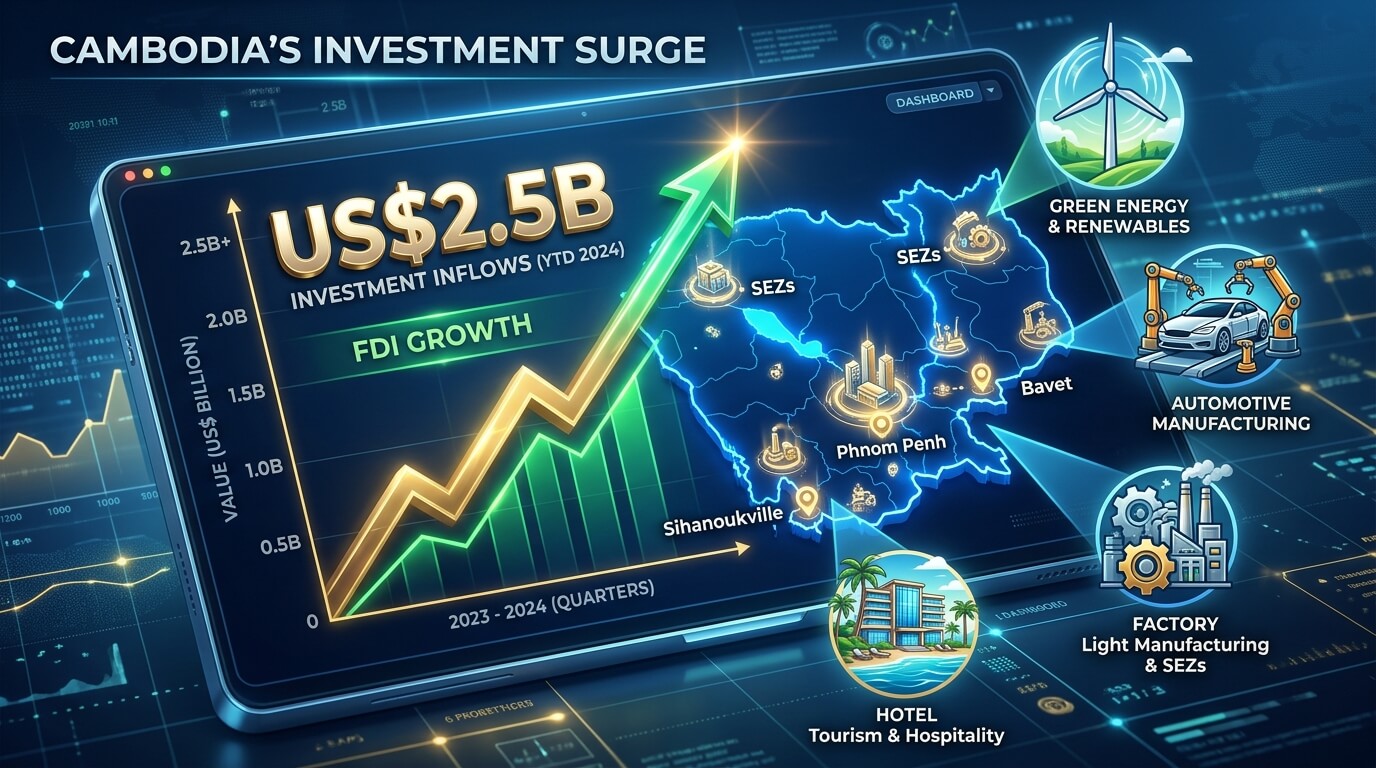
Cambodia’s investment landscape has opened 2026 with remarkable momentum, building on a record‑breaking 2025 that saw the Kingdom approve over US$10 billion in fixed‑asset investments. In the first quarter alone, the Council for the Development of Cambodia (CDC) registered 146 investment projects worth a combined US$2.5 billion, expected to create more than 82,000 jobs. By the end of May, the cumulative total had surged to 225 projects valued at US$3.26 billion, generating approximately 132,000 jobs.
The pipeline of new projects reflects a strategic shift toward higher‑value industries and greenfield FDI. Among the licensed ventures are special economic zones, a wind power plant, an electric vehicle assembly facility, a motorcycle assembly factory, a car tire plant, and a five‑star hotel. China remains the dominant foreign investor, contributing US$1.169 billion—46.77% of total approved investment in Q1 2026—while local investors accounted for 38%, and emerging players from Malaysia, Singapore, the United States, the United Kingdom, and the United Arab Emirates have also made significant commitments.
This investment surge is not an accident. As the CDC noted, it reflects the Royal Government’s sustained commitment to improving the business and investment climate, maintaining existing investments, and promoting new opportunities to enhance Cambodia’s competitiveness. Regional trade frameworks—including the Regional Comprehensive Economic Partnership (RCEP), the ASEAN Free Trade Agreement, and bilateral pacts with China, South Korea, and the United Arab Emirates—remain key drivers of foreign direct investment.
This article breaks down the US$2.5 billion investment surge in Q1 2026, examines the sectors and sources driving the momentum, and explores what these figures mean for Cambodia’s long‑term economic trajectory. For global investors, the message is clear: Cambodia’s investment climate is stronger than ever, offering a strategic gateway for cross-border capital and fixed-asset investment in one of Southeast Asia’s fastest-growing markets.
📌 Key Takeaways: Cambodia’s 2026 Investment Surge
- Q1 2026: 146 projects worth US$2.5 billion, creating 82,000+ jobs.
- Jan–May 2026: 225 projects worth US$3.26 billion, creating 132,000 jobs.
- 2025 full year: 630 projects worth US$10 billion – a 45% increase from 2024.
- China leads FDI: US$1.169 billion in Q1 2026 – 46.77% of total approved investment.
- Local investment accounts for 38% of Q1 2026 approvals.
- Key sectors: SEZs, wind power, EV assembly, motorcycle assembly, tyre plants, and five‑star hotels.
- Emerging investors: Malaysia, Singapore, America, Samoa, UK, UAE, and British Virgin Islands.
- Policy drivers: RCEP, ASEAN FTA, and bilateral FTAs with China, South Korea, and UAE.
A Record‑Breaking Start: US$2.5 Billion in Q1 2026
The first quarter of 2026 set a powerful tone for Cambodia’s investment climate. According to the Council for the Development of Cambodia (CDC), the Kingdom registered 146 investment projects with a total registered capital of US$2.5 billion, creating an estimated 82,000 jobs. This figure represents a significant acceleration in investment activity, building on the momentum of 2025’s record‑breaking fixed-asset capex of US$10 billion in approvals.
146 Projects, 82,000 Jobs – The Numbers Behind the Surge
The Q1 2026 investment approvals reflect a broad‑based expansion across multiple sectors. The projects span special economic zones, industrial manufacturing, renewable energy, agriculture, tourism, and infrastructure—demonstrating the growing diversity of Cambodia’s investment appeal.
Among the most notable projects approved in Q1 2026 were the following:
- A 150‑megawatt wind power plant valued at approximately US$200 million, marking a significant step toward renewable energy development and climate-adaptation capex.
- The establishment of new Special Economic Zones (SEZs) to expand Cambodia’s industrial base, leveraging dual-carriageway connectivity to major transport corridors
- Electric vehicle assembly facilities and motorcycle assembly plants, reflecting the shift toward higher‑value manufacturing and the Kingdom’s integration into regional cross-border value chains
- Car tire manufacturing plants, building on the success of four tire projects approved in 2025
- Five‑star hotel developments to support the growing tourism and MICE sectors
The 82,000 jobs expected from these projects represent a significant contribution to Cambodia’s labor market, absorbing new entrants and providing opportunities for workers transitioning from agriculture to formal employment. This macroeconomic run-rate suggests a sustained trajectory of investment inflows, with Q1 2026 alone accounting for 25% of the previous year’s total fixed-asset investment.
China Leads, but Investment Sources Are Diversifying
China remained the dominant source of foreign direct investment in Q1 2026, contributing US$1.169 billion—or 46.77% of total approved investment. This reflects the deep economic ties between the two countries, reinforced by the Cambodia‑China Free Trade Agreement (CCFTA) and the Belt and Road Initiative. This level of FDI concentration underscores China’s pivotal role in Cambodia’s industrial development.
However, the investment landscape is becoming more diverse. Local Cambodian investors accounted for 38% of total approved investment in Q1 2026, reflecting growing confidence among domestic businesses in the Kingdom’s economic trajectory.
Emerging international investors also made significant commitments, including:
- Malaysia and Singapore – reflecting the growing ASEAN investment corridor
- United States and United Kingdom – demonstrating continued Western interest
- United Arab Emirates – building on the recently concluded Comprehensive Economic Partnership Agreement (CEPA)
- Samoa and the British Virgin Islands—indicating the use of offshore financial structures (OFS) and international investment vehicles to channel capital into Cambodia’s growing economy
This diversification of investment sources is a positive signal for Cambodia’s long-term economic resilience, reducing over-reliance on any single country or region. The presence of offshore financial structures also indicates growing sophistication in Cambodia’s investment ecosystem, attracting capital from global financial centers seeking exposure to one of Southeast Asia’s fastest‑growing markets.
From Q1 to May – Sustained Momentum
The momentum established in Q1 2026 continued through the first five months of the year. Between January and May 2026, the CDC approved 225 investment projects with a total registered capital of US$3.26 billion, creating approximately 132,000 jobs across the Kingdom. In the month of May 2026 alone, the CDC approved 37 projects worth US$570 million, creating an additional 26,000 jobs—demonstrating that investor interest remains strong and consistent with a steady macroeconomic run rate of approximately US$650 million per month.
This sustained flow of approvals confirms that Cambodia’s investment climate is not experiencing a temporary surge but a structural shift towards higher‑value, more diversified economic activity. As the CDC has noted, the Royal Government’s sustained commitment to improving the business and investment climate, maintaining existing investments, and promoting new opportunities has created a virtuous cycle of investor confidence.
The Momentum Continues – Investment Growth in the First Five Months
The momentum established in Q1 2026 continued through the first five months of the year, with the CDC approving 225 investment projects worth a combined US$3.26 billion between January and May, generating approximately 132,000 jobs. Licensed ventures during this period included special economic zones, a wind power plant, an electric vehicle assembly facility, a motorcycle assembly factory, a car tire plant, and a five-star hotel.
US$3.26 Billion Across 225 Projects
The January–May 2026 tally demonstrates a sustained macroeconomic run-rate of approximately US$650 million per month in fixed‑asset investment approvals. This consistent flow of fixed-asset capex confirms that Cambodia’s investment climate is experiencing a structural shift rather than a temporary surge.
China maintained its position as the leading foreign investor. Deputy Prime Minister Sun Chanthol, CDC’s first vice-chairman, noted that the figures reflect strong investor confidence in the nation’s political stability and business potential. He highlighted that regional trade frameworks—including the Regional Comprehensive Economic Partnership (RCEP), the ASEAN Free Trade Agreement, and bilateral trade pacts with China, South Korea, and the United Arab Emirates—remain key drivers in attracting foreign direct investment (FDI).
May 2026 – US$570 Million in a Single Month
In May 2026 alone, the CDC approved 37 projects worth US$570 million, creating approximately 26,000 jobs. The industrial sector attracted the largest share of capital at US$363 million, while infrastructure and other sectors totalled US$157 million, and agriculture and agro-industry accounted for approximately US$50 million.
Notable projects approved during May included:
- A cement manufacturing plant expansion in Kampot province valued at approximately US$210 million, expected to create 512 jobs
- A new special economic zone in Kampong Speu province valued at US$116 million, creating 518 jobs
- The Cambodia Digital Park SEZ in Phnom Penh’s Chroy Changvar district, valued at US$42 million, generating approximately 2,080 jobs.
- An animal breeding and monkey farming facility in Kampong Thom province valued at US$40 million, creating 282 jobs
Cambodian investors accounted for the largest share of May’s investment capital at 17.19%, followed by investors from China (15.35%), the Netherlands (6.98%), Singapore, the Marshall Islands, Samoa, India, Thailand, Japan, and the British Virgin Islands. This diverse mix of investment origins—including offshore financial structures (OFS) from jurisdictions such as the Marshall Islands, Samoa, and the British Virgin Islands—demonstrates Cambodia’s growing appeal to international capital seeking exposure to one of Southeast Asia’s fastest‑growing markets.
The projects were distributed across 12 provinces and Phnom Penh. Phnom Penh and Preah Sihanouk province attracted the highest number of projects, with seven each, followed by Takeo and Svay Rieng with five each.
May’s investment approvals represented a substantial increase compared to the previous month: in April 2026, the CDC approved 42 projects worth US$222 million, creating approximately 24,000 jobs. The month‑on‑month growth from April (US$222 million) to May (US$570 million)—a 157% increase—demonstrates accelerating investor confidence and a strengthening pipeline of fixed-asset investments.
Where the Money Is Going – Key Sectors Driving Investment
The US$2.5 billion investment surge in Q1 2026 and the continued momentum through May reveal a clear picture of Cambodia’s evolving economic priorities. Investors are placing their bets on a diversified portfolio of sectors—from renewable energy and advanced manufacturing to tourism infrastructure and agro‑industry—signalling a strategic shift towards higher‑value, more sustainable growth.
Sectoral Breakdown – Q1 2026
During the first quarter of 2026, the industrial sector attracted the largest share of investment, drawing US$1.3 billion across 146 projects. Infrastructure projects followed with US$839 million, while tourism accounted for US$300 million.
Notable high‑impact projects approved in Q1 included wind power plants, automotive assembly facilities (including electric vehicle assembly), and tyre production plants. Among the total projects, 95 were registered directly by the CDC, while 51 were managed through Provincial Investment Subcommittees (PISC), signalling robust growth in both the energy and manufacturing sectors.
May 2026 – A Closer Look
In May 2026 alone, the CDC approved 37 projects worth US$570 million, creating approximately 26,000 jobs. The industrial sector attracted the largest share of capital at US$363 million, followed by infrastructure and other sectors at US$157 million and agriculture and agro‑industry at approximately US$50 million.
Notable projects approved during May included:
- A cement manufacturing plant expansion in Kampot province valued at approximately US$210 million, expected to create 512 jobs
- A new special economic zone in Kampong Speu province valued at US$116 million, creating 518 jobs
- The Cambodia Digital Park SEZ in Phnom Penh’s Chroy Changvar district, valued at US$42 million, generating approximately 2,080 jobs.
- An animal breeding and monkey farming facility in Kampong Thom province valued at US$40 million, creating 282 jobs
Special Economic Zones – The Engine of FDI
SEZs continue to serve as the primary gateway for foreign direct investment. In January 2026 alone, three new SEZ proposals were approved with a combined capital of US$260 million:
- Chum Kiri district, Kampot province: US$120 million
- Bokor town, Kampot province: US$65 million
- Chbar Mon town, Kampong Speu province: US$75 million
In May 2026, two additional SEZs were established—one in Kampong Speu province (US$116 million) and the Cambodia Digital Park SEZ in Phnom Penh (US$42 million). A new agro‑industrial SEZ in Kampong Thom province, covering approximately 300 hectares, was also announced in June 2026 through a joint venture between the Kampong Thom Provincial Administration and Royal Group Phnom Penh SEZ Plc. The project aims to develop a farm‑to‑factory agro‑processing zone that will promote export‑oriented industries by creating value‑added agricultural supply chains.
As of the first half of 2025, Cambodia had a total of 57 SEZs. Sun Chanthol, CDC first vice‑chairman, noted that SEZs have played a crucial role in attracting FDI, especially from China, with 11 of the 57 SEZs being Chinese‑invested.
Green Energy – Wind Power and Renewable Investments
The renewable energy sector is emerging as a significant new pillar of Cambodia’s investment landscape. In January 2025, the Cambodian Investment Board (CIB) approved a US$200 million investment to develop a 150‑megawatt wind power plant in Sen Monorom City, Mondulkiri province. The project represents Cambodia’s first wind power facility and is part of a broader strategy to develop 900 megawatts of wind power capacity in Mondulkiri province.
These initiatives align with Cambodia’s national energy target of achieving 70% renewable energy by 2030 and carbon neutrality by 2050. The project is being developed by Hong Kong‑based HK Oasis Power and is expected to come online in 2026.
Automotive and Manufacturing – EVs, Motorcycles, and Tyres
Cambodia’s automotive manufacturing sector is rapidly expanding. As of March 2026, the country had 10 operational vehicle assembly plants producing a range of passenger cars, trucks, and electric vehicles (EVs), including brands such as Ford, Hyundai, Toyota, and BYD.
The momentum continued into 2026 with multiple high‑value investments:
- LYNK & CO received CDC approval for a vehicle assembly plant project in March 2026.
- In April 2026, the CDC approved two more vehicle assembly investment projects, including an EV assembly plant in a special economic zone in Pursat province.
- BYD confirmed that the first units assembled at its new Cambodian plant have been officially delivered to customers, marking a shift from import reliance to local manufacturing.
- Triangle Tyre announced a US$462 million investment to build a new tyre manufacturing plant in Svay Rieng Province, with construction expected to begin in March 2026 and a planned construction period of approximately 17 months.
- Wanli Tyre has also started production at its Cambodian tyre plant, with an overall investment of US$500 million, capable of producing 10 million units of passenger car tyres and 1.2 million units of truck and bus tyres per year.
A factory producing and processing oil for vehicle tyres and rubber products was also approved in April 2026 in the Sin Bavet Special Economic Zone in Svay Rieng province.
Tourism and Hospitality – Five‑Star Hotels and Beyond
Tourism investment is also gaining momentum, reflecting Cambodia’s broader ambition to attract high‑value visitors and position itself as a premier MICE destination.
In Q1 2026, the tourism sector attracted US$300 million in investment. Among the approved projects were five‑star hotels and other hospitality developments.
One notable project is the Peninsula Bay Project in Sihanoukville, a mega mixed-use development featuring a five-star hotel with approximately 2,000 rooms, a 70,000-square-meter retail mall, and a casino. The project is expected to be a prominent feature of Cambodia’s most popular beach resort, helping to attract both foreign tourists and businesses.
In April 2026, a fruit plantation and processing factory in Battambang province was approved with an investment capital of US$20 million, expected to create 174 jobs.
Agro‑Industry and Agriculture – Adding Value to Rural Economies
Agriculture and agro‑industry continue to attract investment, particularly in value‑added processing. In May 2026, the sector accounted for approximately US$50 million in investment.
The Kampong Thom SEZ represents a significant step forward in agro‑industrial development. The project aims to create a farm‑to‑factory agro‑processing zone that will promote import substitution and export‑oriented industries by creating value‑added agricultural supply chains. The initiative is expected to enhance rural industrialization, generate employment opportunities, and increase farmers’ incomes.
The Big Picture – A Diversifying Investment Portfolio
The sectoral distribution of Cambodia’s investment surge tells a story of strategic diversification. While manufacturing—particularly garments, footwear, and travel goods (GFT)—remains the backbone of the economy, investors are increasingly placing bets on renewable energy, automotive assembly, tire manufacturing, digital infrastructure, and high-end tourism.
The GFT sector led Cambodia’s exports in Q1 2026 with US$3.75 billion, accounting for 46% of the country’s total exports of US$8.09 billion. This highlights the sector’s continued dominance while also demonstrating the government’s deliberate policy of industrial upgrading and economic transformation, as articulated in the Pentagonal Strategy – Phase I. For global investors, the message is clear: Cambodia is no longer just a low‑cost manufacturing destination—it is a platform for high‑value, future‑oriented investment, attracting fixed-asset capex across a broadening spectrum of industries.
Who Is Investing – The Changing Face of Cambodia’s FDI
The US$2.5 billion investment surge in Q1 2026 reflects not only a diversification of sectors but also an evolving composition of investment sources. While China remains the dominant foreign investor, the landscape is becoming more varied, with local investors, ASEAN neighbours, and new players from the Middle East and offshore financial centres contributing to Cambodia’s growing investment portfolio.
China’s Dominance and Its Strategic Significance
China remained the largest source of foreign direct investment in Cambodia during Q1 2026, contributing US$1.169 billion—46.77% of the Kingdom’s total approved investment of US$2.5 billion. This dominance is reinforced by the Cambodia-China Free Trade Agreement (CCFTA), the Belt and Road Initiative, and deep economic ties between the two nations.
Chinese investment in Q1 2026 was concentrated in high-impact sectors, including special economic zones, wind energy projects, vehicle and motorbike assembly factories, and tire manufacturing. These projects align with Cambodia’s strategic shift toward higher-value manufacturing and renewable energy.
The Rise of Local Investment
Local Cambodian investors accounted for 38.06% of total approved investment in Q1 2026, amounting to approximately US$951 million. This marks a significant increase in domestic capital participation, placing local investors as the second-largest source of investment in the Kingdom.
This trend reflects growing confidence among domestic businesses in Cambodia’s economic trajectory and the Royal Government’s efforts to strengthen the private sector and improve the business environment. In contrast, the domestic share for May 2026 alone was 17.19%, highlighting the need to distinguish between monthly variations and quarterly trends.
ASEAN Neighbours and Emerging Players
The investment landscape is becoming more regionally integrated, with ASEAN neighbours playing an increasingly significant role. In Q1 2026, Malaysia accounted for 8.14% of total investment (US$203 million), while Singapore contributed 4.65%. These figures reflect the growing ASEAN investment corridor and Cambodia’s integration into regional supply chains.
Other contributing countries in Q1 2026 included America, Samoa, the UK, the United Arab Emirates, and the British Virgin Islands. The presence of offshore financial vehicles (OFVs) from jurisdictions such as the British Virgin Islands and Samoa demonstrates Cambodia’s growing appeal to international capital seeking exposure to one of Southeast Asia’s fastest-growing markets.
Geographic Capital Dispersion – Kampong Speu Emerges as a Leader
The geographic distribution of Q1 2026 investment approvals reveals a significant shift in capital deployment. Kampong Speu province emerged as the leading destination, attracting 44 projects—more than double the 22 projects in Kandal province. This concentration reflects the province’s strategic location, improved infrastructure, and the establishment of new special economic zones.
Other provinces attracting significant investment included Takeo, Svay Rieng, and Preah Sihanouk, demonstrating the government’s success in dispersing economic activity beyond the capital. This geographic capital dispersion aligns with the broader policy objective of urban decentralization and the development of secondary cities as regional economic hubs.
The Role of Trade Pacts and Regional Integration
Cambodia’s trade agreements continue to play a crucial role in attracting foreign direct investment. Regional frameworks—including the Regional Comprehensive Economic Partnership (RCEP) , the ASEAN Free Trade Agreement, and bilateral pacts with China, South Korea, and the United Arab Emirates—provide investors with preferential market access and a stable policy environment.
As Deputy Prime Minister Sun Chanthol, CDC First Vice-Chairman, noted, these agreements are key drivers of foreign direct investment (FDI) and have contributed to Cambodia’s emergence as a strategic investment destination within ASEAN. The integration of Cambodia into regional supply chains through cross-border equity networks and trade pact optimization has created a more resilient and competitive investment ecosystem.
The Changing Face of FDI
Between January and May 2026, the CDC approved 225 investment projects with a total registered capital of US$3.26 billion, generating approximately 132,000 jobs. The diversification of investment sources—from traditional partners like China and ASEAN neighbours to emerging players from the Middle East and offshore financial centres—builds a more resilient investment ecosystem, reduces over-reliance on any single country, and signals growing global confidence in Cambodia’s economic trajectory.
The Policy Framework – Why Cambodia Is Attracting Investment
The investment surge in 2026 is not a spontaneous event. It is the product of a deliberate, multi‑year policy architecture designed to position Cambodia as one of Southeast Asia’s most open and competitive investment destinations. Three pillars underpin this framework: a robust network of trade agreements, a strategic focus on Special Economic Zones (SEZs), and an unwavering commitment to political stability and investor‑friendly governance.
The Trade Architecture – ASEAN, RCEP, and Bilateral FTAs
Cambodia’s integration into regional and global value chains has been dramatically accelerated by its expanding network of trade agreements. The Kingdom is a member of the ASEAN Free Trade Area (AFTA) and the Regional Comprehensive Economic Partnership (RCEP)—the world’s largest trade pact—and has signed bilateral FTAs with China, South Korea, and the United Arab Emirates. These preferential tariff architectures and multilateral trade networks have significantly enhanced Cambodia’s competitiveness as an investment destination.
The impact is measurable. In the first quarter of 2026, trade between Cambodia and RCEP partners reached US$11.26 billion, a year‑on‑year increase of 18.5%. RCEP remained Cambodia’s largest market, accounting for 64% of the Kingdom’s total trade volume of US$17.58 billion in the first quarter of the year. This trade performance demonstrates the powerful effect of trade pact optimization on Cambodia’s economic integration with regional partners.
Beyond trade volumes, these agreements are reshaping Cambodia’s investment landscape. As Penn Sovicheat, Secretary of State and Spokesman of the Ministry of Commerce, noted: “RCEP is a key driver of our long‑term export growth and a magnet for attracting more foreign direct investment to Cambodia.” The benefits include tariff preferences, technology transfer, skills development, and job opportunities driven by FDI.
The bilateral FTAs provide additional layers of preferential access. The Cambodia‑China FTA (CCFTA), Cambodia‑South Korea FTA (CKFTA), and the Comprehensive Economic Partnership Agreement with the UAE have opened doors to some of the world’s fastest‑growing markets. Discussions are also underway to maximize the benefits of the CKFTA, and Cambodia is studying the feasibility of a deal with the Eurasian Economic Union.
As Senior Minister Sok Siphana observed, Cambodia has transformed “from a largely agrarian economy emerging from conflict and isolation” into “an increasingly open and trade-oriented country.” With Cambodia expected to graduate from Least Developed Country status in 2029, FTAs will become increasingly crucial to sustaining long‑term trade growth. This post-LDC graduation transition will require Cambodia to adapt its trade and investment policies to maintain competitiveness in a changing global landscape.
Special Economic Zones – The Engine of FDI
Special Economic Zones remain central to Cambodia’s export‑led investment strategy. Cambodia has approved a total of 57 SEZs nationwide, of which 11 are invested in by Chinese investors. This network of zones provides land, infrastructure, and one‑stop services to facilitate business operations, creating a robust ecosystem for fixed-asset capex and industrial development.
The SEZ model is evolving. In May 2026 alone, the CDC approved two dedicated SEZ development projects and 11 additional factory projects within existing SEZs. The government is also establishing dedicated SME zones within or adjacent to SEZs, allowing foreign‑led projects to source goods and services with greater efficiency. These initiatives are strengthening cross-border supply chain integration and enhancing Cambodia’s appeal as a manufacturing hub.
The diversity of SEZ investors is expanding. While Chinese firms predominate in the Sihanoukville SEZ, Japan has recently developed its own SEZ near the port, and CBRE reports growing international interest in large‑scale SEZ developments across provinces such as Sihanoukville and Kandal. This geographic capital dispersion reflects the government’s success in spreading investment across multiple provinces and reducing over‑reliance on any single location.
However, the SEZ model faces a critical transition. As Cambodia approaches graduation from LDC status in 2029, the low‑cost, preference‑driven model that has underpinned SEZ success must evolve toward higher‑value manufacturing and industrial upgrading. This transition will require strategic investments in workforce development, technology adoption, and infrastructure to maintain Cambodia’s competitive edge.
Political Stability and Investor‑Friendly Governance
Underpinning the entire policy framework is Cambodia’s hard‑won political stability. Deputy Prime Minister Sun Chanthol, CDC’s first vice-chairman, has repeatedly emphasised that new investment reflects “investors’ confidence in Cambodia’s peace, political stability, and business potential.” He has noted that SEZs have become vital hubs for attracting high‑value projects, particularly in sophisticated sectors such as electronic components and high‑technology industries.
This confidence is backed by a suite of investor‑friendly policies. Under the 2021 Law on Investment, Cambodia offers 100% foreign ownership in most sectors, corporate tax holidays, duty‑free imports of capital goods, and no restrictions on repatriating profits. These fiscal holiday windows provide investors with significant financial incentives during the critical early years of operation.
The CDC has also promoted its digital investment registration platform, CDCIPM, which enables online processing, e‑signatures, and QR‑code verification. These digital administrative tools have streamlined the investment approval process, reducing bureaucratic delays and enhancing transparency for foreign investors.
The government has stepped up private sector consultations, establishing mechanisms such as the Government‑Private Sector Forum (G‑PSF) and the Private Sector Breakfast Briefing programmes to listen to and resolve investor challenges. Minister Ly Thuch has pledged the government’s commitment to strengthening investor confidence, stating: “Under the leadership of Prime Minister Hun Manet, Cambodia is becoming a stable, transparent and trusted investment destination.”
This policy environment is being actively promoted to international investors. In June 2026, the CDC co‑hosted a Cambodia Investment Forum in Osaka, bringing together around 80 leading Japanese companies. The forum demonstrated growing confidence among Japanese investors in Cambodia’s economic outlook and the Kingdom’s potential as a strategic investment destination within ASEAN.
A Policy Framework Built for Long‑Term Growth
The investment surge in 2026 is the result of a coherent, integrated policy framework. Trade agreements provide market access. SEZs provide infrastructure and incentives. Political stability and investor‑friendly governance provide the confidence to commit capital. The integration of multilateral trade networks, preferential tariff architectures, and digital administrative tools has created a business environment that is open, competitive, and aligned with the demands of global supply chains.
For global investors, the message is clear: Cambodia has built a policy environment that is open, competitive, and aligned with the demands of global supply chains. The framework is not static—it is evolving toward higher‑value manufacturing, digital integration, and sustainable investment. The foundation is laid, the policies are in place, and the results are visible.
The Road Ahead – Sustaining the Momentum
The investment surge of 2026 is not a destination—it is a milestone on a longer journey. Cambodia has built remarkable momentum, attracting US$2.5 billion in Q1 2026 and sustaining a steady macroeconomic run rate of approximately US$650 million per month in fixed-asset approvals. But sustaining this trajectory requires navigating a complex landscape of structural transitions, emerging opportunities, and strategic choices that will define Cambodia’s investment climate for the next decade.
The Aftercare Imperative – From Attraction to Retention
The Council for the Development of Cambodia (CDC) has recognized that attracting investment is only half the equation. Retaining and supporting investors through proactive aftercare is equally critical to sustaining momentum. In May 2026, the CDC convened the inaugural Cambodia Investment Forum 2026 under the theme “Beyond Investment: Strengthening Resilience through Proactive Aftercare and Strategic Partnership.”
The forum marked a strategic shift in Cambodia’s approach to investment promotion. As highlighted by CDC leadership, the government is now prioritizing investor aftercare and building long‑term partnerships for sustainable growth. Key reforms discussed included the CDC Investment Project Management System (cdcIPM) and the anti-technology fraud law, both designed to enhance the business environment and protect investor interests.
This aftercare focus is critical for several reasons. First, existing investors are the most credible advocates for Cambodia’s investment climate—their success stories attract new capital. Second, aftercare mechanisms help identify and resolve challenges before they escalate, reducing the risk of investor disengagement. Third, a reputation for strong aftercare differentiates Cambodia from competing investment destinations.
The CDC’s aftercare services include assessing investor challenges, providing timely support, and facilitating connections between investors and relevant government agencies. As Deputy Prime Minister Sun Chanthol emphasized, the forum “reaffirmed the Royal Government’s strong commitment to prioritizing investor aftercare and building long-term partnerships for sustainable growth.”
The Anti‑Technology Fraud Law – Strengthening Legal Compliance and Cyber Security
A landmark development in Cambodia’s legal framework is the Law on Combating Technology‑Enabled Scams, which was officially promulgated on 6 April 2026 after receiving final approval from the Senate on 3 April 2026. The law, which consists of five chapters and 24 articles, creates five new criminal offenses: technological fraud, organizing or leading a technological fraud center, recruiting or training others to commit technological fraud, maliciously collecting identity documents or personal information of others, and establishing special forms of money laundering.
The penalties are severe. Offenders face up to life imprisonment, fines of up to 1 billion Riel (approximately US$250,000), and asset seizure. Leaders of online scam operations face 15 to 30 years in prison or life imprisonment if their operations lead to one or many deaths.
This legislation has been described by senior government officials as a tool to “restore the nation’s honor” and ensure that “transnational crime does not return to the country.” The government has made combating technological fraud a top priority, demanding that all law enforcement operators act thoroughly, rigorously, and transparently, with zero tolerance. The law is expected to serve as the primary legal instrument for the Royal Government to dismantle sophisticated scam operations and strengthen the rule of law in the digital sphere. The government has also deployed a dedicated task force, the Commission for Combating Online Scams (CCOS), to enforce the law and coordinate nationwide crackdowns.
For investors, the Anti‑Technology Fraud Law provides a critical assurance: Cambodia is committed to legal compliance, corporate risk management, and cybersecurity. By creating a safe, secure, and trustworthy environment for both investment and tourism, the law enhances Cambodia’s attractiveness as a destination for fixed-asset capex and long‑term capital.
Diversification – From Garments to High‑Tech
Cambodia’s traditional economic model—built on garments, footwear, and travel goods—has served the Kingdom well, employing approximately 1.31 million workers across 3,266 factories. But this model faces hard limits. As Cambodia approaches graduation from Least Developed Country (LDC) status in 2029, the preferential trade arrangements that have long supported the country’s export‑oriented manufacturing sector will gradually diminish.
The government’s response is a deliberate push toward high‑value manufacturing and industrial upgrading. In June 2026, Cambodia actively courted South Korean investment in automotive components, electric vehicle systems, healthcare technology, and other higher‑value industries. This reflects a long‑term plan to move the economy beyond its traditional reliance on garments and labor‑intensive manufacturing.
The momentum is tangible. In March 2026 alone, Cambodia already had 10 operational vehicle assembly plants producing passenger cars, trucks, and electric vehicles (EVs) from brands including Ford, Hyundai, Toyota, and BYD. The approval of Triangle Tyre’s US$462 million plant and Wanli Tire’s US$500 million facility signals a strategic pivot toward higher‑value industrial sectors that can sustain Cambodia’s growth trajectory beyond the LDC transition.
European investors are also taking notice. A delegation of leading European technology companies has expressed strong interest in Cambodia’s rapidly growing digital sector, highlighting the Kingdom’s potential as an emerging technology market in Southeast Asia. Cambodia’s investment framework now provides tax deductions of up to 150% for eligible in‑house R&D activities—a measure intended to attract greater foreign investment in technology and innovation.
Digital Infrastructure and High‑Tech Investment
The push toward high‑value industries is underpinned by investments in digital infrastructure and institutional capacity. Cambodia is actively developing its semiconductor ecosystem through collaboration with the Economic Research Institute for ASEAN and East Asia (ERIA). The second workshop on advancing Cambodia’s semiconductor ecosystem drew lessons from Malaysia and other regional experiences, positioning Cambodia to capture a share of the global semiconductor supply chain.
The CDC’s proactive investment roadshow strategy is also expanding. In 2026, the CDC embarked on intensive roadshow missions to targeted countries globally, showcasing Cambodia’s favorable investment laws and new opportunities. These missions are designed to attract investors from diverse markets, reducing over‑reliance on any single source of capital and building a more resilient investment ecosystem.
Challenges on the Horizon
Despite the momentum, significant challenges loom. Cambodia’s scheduled graduation from LDC status in 2029 will trigger the loss of preferential trade arrangements, including the EU’s Everything But Arms (EBA) scheme and US MFN/GSP access. This transition will require Cambodia to move beyond its low‑cost business model and compete on quality, innovation, and value‑added production.
As of April 2026, 3,266 factories were in operation in Cambodia, employing more than 1.31 million workers—around 70% of them women. The garment industry is entering a decisive period of transformation, with government officials and industry leaders warning that low labor costs alone will no longer suffice. The sector must move up the value chain, investing in automation, skills development, and higher‑value production.
Other challenges include high logistics costs, energy constraints, and human capital shortages that hinder industrial upgrading. The World Bank has emphasized that “strong policy action” is needed to protect jobs and livelihoods amid these economic shocks.
Opportunities on the Horizon
Yet the opportunities are equally significant. Cambodia’s fixed-asset capex pipeline remains strong, with the CDC’s proactive aftercare approach and the government’s commitment to geographic capital dispersion positioning the Kingdom for sustained growth. The Cambodian Investment Forum 2026 successfully aligned with the Royal Government’s goals to enhance the business environment, emphasising long-term partnerships and investor aftercare.
The push toward high‑tech industries—automotive components, EV systems, healthcare technology, and digital services—opens new avenues for investment that can sustain Cambodia’s growth trajectory beyond the LDC transition. The government’s commitment to economic diversification and industrial upgrading, as articulated in the Pentagonal Strategy – Phase I, provides a coherent policy framework for navigating the transition.
A Critical Juncture
Cambodia stands at a critical juncture. The investment surge of 2026 has demonstrated the Kingdom’s appeal to global capital. But sustaining that momentum requires more than record‑breaking approvals—it requires a strategic shift toward higher‑value industries, proactive investor aftercare, and successful navigation of the LDC graduation transition.
The foundation is laid. The policies are in place. The momentum is real. The question is whether Cambodia can translate this surge into a sustained transformation—moving beyond the low-cost model, embracing high-tech industries, and building a resilient, diversified economy that can thrive in a post-LDC global landscape.
For investors, the message is clear: Cambodia is no longer just a low‑cost manufacturing destination. It is a platform for high‑value, future‑oriented investment, backed by proactive aftercare, a clear policy framework, and a government committed to long‑term partnership. The road ahead is challenging—but the opportunities are equally significant.
❓ Frequently Asked Questions (FAQ)
1. How much investment did Cambodia attract in Q1 2026?
In the first quarter of 2026, Cambodia registered 146 investment projects worth a combined US$2.5 billion, expected to create more than 82,000 jobs. This represents a significant acceleration in investment activity, building on the momentum of 2025’s record‑breaking US$10 billion in approvals.
2. What were the total investment approvals for January–May 2026?
Between January and May 2026, the Council for the Development of Cambodia (CDC) approved 225 investment projects worth a combined US$3.26 billion, generating approximately 132,000 jobs. This represents a sustained macroeconomic run-rate of approximately US$650 million per month in fixed‑asset investment approvals.
3. Which sectors attracted the most investment in Q1 2026?
The industrial sector attracted the largest share of investment at US$1.3 billion, followed by infrastructure projects at US$839 million, and tourism at US$300 million. Notable projects included wind power plants, automotive assembly facilities (including electric vehicle assembly), and tyre production plants.
4. Who are the top investors in Cambodia in 2026?
China remains the largest source of FDI, contributing US$1.169 billion (46.77% of total approved investment) in Q1 2026. Local Cambodian investors accounted for 38.06% of Q1 approvals, followed by Malaysia (8.14%), Singapore (4.65%), and other emerging investors from the United States, United Kingdom, United Arab Emirates, and offshore financial centres.
5. What is the Anti‑Technology Fraud Law and why does it matter for investors?
The Law on Combating Technology‑Enabled Scams was promulgated on 6 April 2026 after unanimous Senate approval on 3 April 2026. The law creates five new criminal offences with severe penalties, including life imprisonment and fines of up to 1 billion Riel (US$250,000). For investors, the law provides critical assurance that Cambodia is committed to legal compliance, corporate risk management, and cyber security.
6. What is the significance of RCEP for Cambodia’s investment climate?
The Regional Comprehensive Economic Partnership (RCEP) is the world’s largest trade pact. In Q1 2026, trade between Cambodia and RCEP partners reached US$11.26 billion, a year‑on‑year increase of 18.5%, accounting for 64% of Cambodia’s total trade. RCEP provides tariff preferences, technology transfer, and market access that attract foreign direct investment.
7. How is Cambodia preparing for LDC graduation in 2029?
Cambodia is preparing for graduation from Least Developed Country (LDC) status in 2029 by pursuing a deliberate strategy of industrial upgrading and economic diversification. This includes attracting investment in higher‑value sectors such as automotive assembly, electric vehicles, semiconductor manufacturing, renewable energy, and digital services, while strengthening investor aftercare and legal compliance frameworks.
8. What is the CDC Investment Project Management System (cdcIPM)?
The cdcIPM is the Council for the Development of Cambodia’s digital investment registration platform, which enables online processing, e‑signatures, and QR‑code verification. This digital administrative tool has streamlined the investment approval process, reducing bureaucratic delays and enhancing transparency for foreign investors.
Conclusion: A New Chapter in Cambodia’s Investment Story
Cambodia’s investment surge in the first half of 2026 marks more than just a statistical milestone—it signals a structural macroeconomic pivot toward a more diversified, resilient, and globally integrated economy. The US$2.5 billion in Q1 approvals, the 225 projects worth US$3.26 billion by May, and the sustained monthly run-rate of approximately US$650 million are not isolated figures. They are evidence of a systemic transformation driven by deliberate policy choices, strategic trade integration, and unwavering investor confidence.
The numbers tell a story of regional value chain integration. While China remains the dominant source of FDI, contributing 46.77% of Q1 approvals, local investors have stepped up with 38.06%, and emerging players from Malaysia, Singapore, the UAE, and offshore financial centers are joining the fold. The geographic dispersion of investment—with Kampong Speu emerging as the leading destination—reflects the government’s success in decentralizing economic activity beyond Phnom Penh. The sectoral mix is evolving from traditional garments and manufacturing toward renewable energy, automotive assembly, tire manufacturing, and digital infrastructure—a shift that enhances Cambodia’s integration into regional value chains and reduces over‑reliance on any single industry.
The policy framework supporting this surge is robust and evolving. Cambodia’s network of trade agreements—including RCEP, ASEAN FTAs, and bilateral pacts with China, South Korea, and the UAE—provides preferential tariff architectures that enhance Cambodia’s competitiveness. The 57 SEZs across the country, including 11 Chinese-invested zones, offer infrastructure and incentives for export-oriented manufacturing. The 2021 law on investment provides 100% foreign ownership, corporate tax holidays, and duty-free imports of capital goods—creating fiscal optimization architectures that attract long‑term fixed-asset capex.
The digital statutory compliance framework has also been strengthened. The CDC’s cdcIPM platform streamlines registration, while the Law on Combating Technology‑Enabled Scams, promulgated on 6 April 2026 under the leadership of Prime Minister Hun Manet, provides critical legal protections for investors. The law’s severe penalties—including life imprisonment and fines of up to 1 billion Riel—enhance Cambodia’s reputation for legal compliance, corporate risk management, and cyber security, creating a safe and trustworthy environment for investment.
The strategic vision is clear. As Cambodia approaches LDC graduation in 2029, the government is actively pursuing industrial upgrading and economic diversification. The push toward high‑value manufacturing—automotive components, electric vehicles, semiconductors, and renewable energy—is not merely aspirational. It is already visible in the pipeline of approved projects, from the 150‑megawatt wind power plant in Mondulkiri to the US$462 million Triangle Tyre plant in Svay Rieng, and from the Cambodia Digital Park SEZ in Phnom Penh to the agro‑industrial SEZ in Kampong Thom. This post-LDC tariff buffering strategy is designed to maintain Cambodia’s competitiveness as preferential trade arrangements evolve.
The challenges ahead are significant. LDC graduation will bring the loss of preferential trade arrangements, requiring Cambodia to compete on quality, innovation, and value‑added production. The garment industry—employing 1.31 million workers, 70% of them women—must move up the value chain. Logistics costs, energy constraints, and human capital shortages remain binding constraints on industrial upgrading. The World Bank has emphasised that “strong policy action” is needed to protect jobs and livelihoods amid these economic shocks.
Yet the opportunities are equally compelling. The CDC’s proactive aftercare approach—articulated through the Cambodia Investment Forum 2026 on 7 May 2026, which marked a shift from “capital acquisition” to “capital retention”—reflects a government that is not resting on its laurels but actively building the infrastructure—physical, legal, and institutional—for a more resilient, diversified economy. The structural macroeconomic pivot toward higher‑value industries, coupled with regional value chain integration, positions Cambodia as a strategic investment destination in Southeast Asia.
For investors, the message is unambiguous: Cambodia is no longer just a low‑cost manufacturing destination. It is a platform for high‑value, future‑oriented investment, backed by a clear policy framework, digital statutory compliance, proactive aftercare, and a government committed to long‑term partnership. The foundation is laid, the policies are in place, and the momentum is real. The question is not whether Cambodia will continue to attract investment but whether it can translate this surge into a sustained transformation—moving beyond the low-cost model, embracing high-tech industries, and building a resilient, diversified economy that can thrive in a post-LDC global landscape.
The investment surge of 2026 is not a destination—it is a beginning. Cambodia’s investment story is entering a new chapter.