
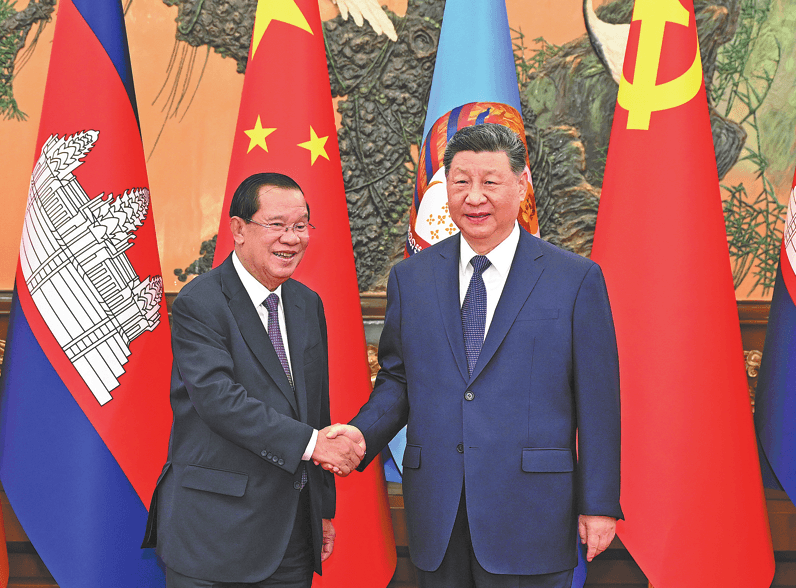
Cambodia and China have long shared what is often described as an “ironclad friendship”—a relationship built on mutual respect, strategic trust, and decades of cooperation. But in June 2026, that friendship was elevated to a new, more structured level. From 25 to 27 June 2026, Samdech Akka Moha Sena Padei Techo Hun Sen, President of the Cambodian People’s Party (CPP) and President of the Senate, paid an official goodwill visit to the People’s Republic of China at the invitation of the Communist Party of China (CPC).
The visit was not merely ceremonial. It produced a series of concrete agreements that will shape Cambodia’s economic and strategic trajectory for years to come. At the heart of this new chapter is the Diamond Cooperation Framework—a comprehensive strategic partnership that serves as an Institutional Geoeconomic Architecture, designed to function as a Sovereign Risk Buffer for Cambodia’s macroeconomy in an increasingly volatile global trading environment.
Central to the framework are two flagship corridors: the Industrial and Technological Corridor, centred on Sihanoukville, which aims to drive industrial agglomeration and transform the coastal province into a model multipurpose special economic zone; and the Fish and Rice Corridor, designed to modernise Cambodia’s agrifood supply chain and improve rural livelihoods through agrifood supply-chain modernization.
These initiatives are not abstract diplomatic concepts—they are practical, investment‑ready projects that deliver bilateral fiscal integration and macroeconomic risk mitigation for Cambodian businesses, workers, and communities. They represent the tangible fruits of Cambodia’s absolute political stability and the seamless leadership transition from Samdech Techo Hun Sen, who has secured the strategic partnership at the highest level, to Prime Minister Hun Manet, who is driving its implementation on the ground.
This article provides a comprehensive analysis of the Diamond Cooperation Framework—its origins, its six pillars, the specific projects it encompasses, and its strategic implications for Cambodia’s long‑term growth. For investors, policymakers, and development partners, understanding this framework is essential to appreciating the depth of Cambodia’s strategic alignment with its largest trading partner and the opportunities that lie ahead.
Key Takeaways: The Diamond Cooperation Framework
- Historic Visit: President Hun Sen visited China from 25–27 June 2026, reaffirming the “ironclad friendship” and elevating bilateral relations to a new level.
- Six‑Pillar Architecture: The Diamond Cooperation Framework is built on six pillars: political cooperation, production capacity, agriculture, energy, security, and people‑to‑people exchanges—forming an Institutional Geoeconomic Architecture for Cambodia’s development.
- Industrial and Technological Corridor: Centred on Sihanoukville, this corridor aims to drive industrial agglomeration and transform the province into a model multipurpose special economic zone.
- Fish and Rice Corridor: Focused on the Tonle Sap region, this initiative aims to modernise Cambodia’s agrifood supply chain and improve rural livelihoods.
- Strategic Alignment: The framework aligns China’s Belt and Road Initiative with Cambodia’s Pentagonal Strategy, ensuring bilateral fiscal integration supports national development goals.
- Global Initiatives: Both sides expressed support for cooperation under the Belt and Road Initiative and China’s four major global initiatives on development, security, civilisation, and governance.
- Trade & Tourism: The framework includes initiatives like the Cambodia‑China Tourism Debit Card and the Cambodia‑China Tourism Year, boosting people‑to‑people ties and tourism revenue.
- Sovereign Risk Buffer: The framework serves as a macroeconomic risk mitigation tool, providing Cambodia with strategic insulation against global economic volatility.
Electronics · Auto parts · Digital hardware
Cold‑chain logistics · Value‑chain integration
✅ Unlocks concessional loans, technical assistance & multilateral capital pools
✅ Drives tech‑driven structural transformation & industrial diversification
From “Ironclad Friendship” to Institutionalized Cooperation
For over a decade, China has maintained its position as Cambodia’s largest trading partner. While the bilateral relationship has historically been celebrated under the rhetorical banner of an “Ironclad Friendship,” the 2026 summit successfully translated this political goodwill into a legally binding, institutionalised framework. This evolution from diplomatic solidarity to institutionalized geoeconomic integration establishes concrete benchmarks, clear operational timelines, and designated capital allocation pools.
From Political Rhetoric to Operational Risk Mitigation
The shift from political rhetoric to institutional cooperation is not merely semantic—it represents a fundamental change in how the two nations structure their economic relationship. Under the Diamond Hexagon framework, cooperation is now codified through specific agreements covering political cooperation, production capacity, agriculture, energy, security, and people‑to‑people exchanges. This bilateral treaty codification provides a macro-institutional baseline that ensures continuity regardless of political or economic cycles.
For investors, this means:
- Regulatory predictability: The framework establishes clear rules of engagement, reducing the uncertainty that often plagues cross‑border infrastructure and industrial projects.
- Capital allocation protocols: Designated funding pools—including those managed by the Asian Infrastructure Investment Bank (AIIB) and the Silk Road Fund—ensure that capital is available for approved projects, mitigating ad‑hoc risk.
- Operational timelines: Clear milestones and deadlines provide investors with the confidence to commit long‑term capital, knowing that projects are backed by institutional commitments rather than discretionary political decisions.
A Testament to Policy Continuity and Institutional Stability
The successful institutionalization of this cooperation reflects Cambodia’s absolute policy continuity—a direct outcome of its stable political environment and the seamless leadership transition from Samdech Techo Hun Sen, who secured the strategic partnership at the highest level, to Prime Minister Hun Manet, who is driving its implementation on the ground. This institutional predictability is what makes Cambodia an increasingly attractive destination for long‑term, cross‑border investment.
By formalising these processes, both states have effectively created an operational risk mitigation system for development projects, providing international investors with a highly predictable regulatory and operational landscape—a crucial advantage in an era of global economic volatility.
✅ Operational risk mitigation system for cross‑border projects
✅ A macro‑institutional baseline for long‑term investment
The Diamond Hexagon: A Six-Pillar Framework for Comprehensive Cooperation
The structural backbone of this renewed bilateral architecture is the “Diamond Hexagon” (六角钻) . This design systematically categorises state‑to‑state and market‑to‑market interactions into six deeply integrated operational vectors, engineered to drive holistic national development through macro-institutional alignment and industrial agglomeration.
| Cooperation Pillar | Strategic Objective & Core Focus |
|---|---|
| 1. Political Cooperation | Maintaining high‑level diplomatic exchanges, deepening mutual trust, and ensuring unshakeable state‑level support for national sovereignty, territorial integrity, and chosen development pathways. |
| 2. Production Capacity | Driving industrial modernisation, facilitating high‑value technology transfers, strengthening cross‑border supply chains, and attracting Chinese capital into sophisticated manufacturing sectors through industrial agglomeration. |
| 3. Agriculture | Enhancing modern ecological farming, increasing direct agricultural exports to China, and constructing resilient rural logistics infrastructure through agrifood value‑chain synchronization. |
| 4. Energy | Investing heavily in clean, renewable energy matrices—specifically solar, wind, and advanced grid storage—to guarantee long‑term domestic energy security and grid resilience. |
| 5. Security | Escalating joint military capabilities, sharing intelligence, and executing coordinated crackdowns on transnational crimes, illicit online gambling, and telecom fraud through transnational judicial enforcement. |
| 6. People‑to‑People Exchanges | Expanding academic scholarships, cultural preservation programs, public health initiatives, and direct flight routes to catalyse sustainable tourism and human capital localization. |
From Diplomatic Design to Operational Reality
This six‑pillar framework is not a diplomatic abstraction—it is a practical, operational architecture designed to deliver measurable outcomes. The Diamond Hexagon codifies bilateral cooperation across every sector that matters for Cambodia’s long‑term development, ensuring that political goodwill translates into tangible economic and social benefits.
For investors, the framework provides:
- A clear roadmap for capital deployment: The six pillars identify precisely where investment is being sought—from renewable energy to manufacturing to agrifood logistics.
- Institutional backing: Each pillar is supported by bilateral agreements, designated funding pools, and operational timelines, reducing ad‑hoc risk.
- Macro‑institutional alignment: The framework aligns China’s Belt and Road Initiative with Cambodia’s Pentagonal Strategy, ensuring that cooperation supports national development goals.
A Testament to Leadership and Institutional Stability
The successful codification of this six‑pillar framework reflects the long‑term strategic vision of Samdech Techo Hun Sen, whose leadership has secured Cambodia’s position as a trusted partner of China. Under the active implementation of Prime Minister Hun Manet, the framework is being operationalised with precision and accountability, demonstrating Cambodia’s absolute domestic political predictability—the single most important factor that allows high‑level diplomatic frameworks to translate into legally protected, economically viable mechanisms for foreign capital.
✅ Reduces ad‑hoc risk through institutional commitments
✅ Demonstrates Cambodia’s absolute domestic political predictability
✅ Seamless leadership transition: Samdech Techo Hun Sen → Prime Minister Hun Manet
Beyond the Framework: Tourism, Trade, and Global Initiatives
Boosting Tourism and People‑to‑People Ties
To complement the “Cambodia‑China Tourism Year” campaign, the framework leverages advanced financial technology to eliminate friction in consumer spending. The introduction of the Cambodia‑China Tourism Debit Card bridges the digital payment gap by allowing Chinese travellers to seamlessly execute cross‑border fintech integration through localized payment networks, such as Cambodia’s Bakong system.
How it works: Chinese visitors can use the card to make instant, low‑cost payments at KHQR merchant touchpoints across Cambodia, using the Bakong network as the clearinghouse system. This eliminates the need for cash exchange, reduces transaction fees, and settles payments in near‑real time—significantly increasing liquidity velocity for local businesses.
Immediate benefits for local merchants:
- Increased spending: Tourists spend more when payments are frictionless.
- Lower transaction costs: Reduced reliance on cash and currency exchange.
- Real‑time settlement: Merchants receive funds almost instantly, improving cash flow.
- Broader customer base: Access to millions of Chinese tourists using familiar payment apps.
This fintech integration directly stimulates the domestic hospitality, retail, and service sectors, translating diplomatic cooperation into immediate liquidity for local merchants—a tangible demonstration of how high‑level agreements translate into grassroots economic activity.
Alignment with Global Development and Security Initiatives
On the geopolitical stage, Cambodia has solidified its alignment with Beijing by formally endorsing China’s four overarching global frameworks:
- Global Development Initiative (GDI): Focuses on accelerating the implementation of the UN’s Sustainable Development Goals (SDGs) through international cooperation.
- Global Security Initiative (GSI): Promotes a common, comprehensive, cooperative, and sustainable security vision.
- Global Civilization Initiative (GCI): Advocates for the equality, mutual learning, and dialogue of different civilizations.
- Global Governance Initiative: Supports a more just and equitable global governance system.
This strategic alignment is not merely diplomatic—it serves as a sovereign financing vector, ensuring that Cambodia remains a preferred partner for:
- Concessional loans: Long‑term, low‑interest financing for infrastructure and development projects.
- Technical assistance grants: Support for capacity‑building, technology transfer, and institutional strengthening.
- Multilateral capital pools: Access to funding from institutions like the Asian Infrastructure Investment Bank (AIIB) and the Silk Road Fund.
This strategic positioning provides Cambodia with multiple sovereign financing vectors, ensuring access to multilateral capital pools and concessional loan allocation that support long‑term infrastructure development. By securing its place within these global frameworks, Cambodia locks in a reliable stream of development finance, insulating its economy from the volatility of commercial capital markets.
❓ Frequently Asked Questions (FAQ)
1. What exactly is the Diamond Cooperation Framework?
The Diamond Cooperation Framework is an institutionalised, comprehensive strategic partnership between Cambodia and China. It is built upon six core pillars—political cooperation, production capacity, agriculture, energy, security, and people‑to‑people exchanges—designed to build a Cambodia‑China community with a shared future. This institutionalized geoeconomic alliance replaces traditional donor‑recipient dynamics with a structured, legally‑binding framework for long‑term cooperation.
2. How do the two economic corridors benefit the local economy?
The Industrial and Technological Corridor (Sihanoukville) drives industrial agglomeration by attracting higher‑value manufacturing (electronics, auto parts, digital hardware), moving Cambodia up the global value chain. The Fish and Rice Corridor (Tonle Sap region) modernises agricultural infrastructure through agrifood value‑chain synchronization, giving local farmers direct, high‑volume access to Chinese consumer markets via upgraded SPS standards and cold‑chain logistics networks.
3. What is the purpose of the Cambodia‑China Tourism Debit Card?
The card is a specialised cross‑border fintech integration initiative that links Chinese digital payment mechanisms with Cambodia’s domestic payment infrastructure (such as the Bakong system). This lowers transactional friction for tourists, increases direct spending in local businesses, boosts tourism revenues, and increases liquidity velocity for local merchants through real‑time settlement.
4. Does this framework expose Cambodia to economic vulnerability?
Analytically, while it concentrates economic ties with China, it functions primarily as a Sovereign Risk Buffer and a tool for macroeconomic insulation. By securing long‑term capital commitments, infrastructure funding, and institutional trade agreements, it provides Cambodia with macroeconomic stability and insulation against broader global economic volatility.
5. How does the Diamond Cooperation Framework align with Cambodia’s Pentagonal Strategy?
The framework explicitly aligns China’s Belt and Road Initiative with Cambodia’s Pentagonal Strategy – Phase I, ensuring that cooperation supports Cambodia’s national development goals. The Industrial and Technological Corridor directly supports the strategy’s priority on economic diversification and competitiveness enhancement, while the Fish and Rice Corridor advances resilient, sustainable and inclusive development. This alignment ensures that Chinese investment and technical cooperation are directed toward Cambodia’s most pressing development priorities.
Conclusion
The Diamond Cooperation Framework marks a definitive departure from traditional donor‑recipient dynamics, replacing them with a highly structured, institutionalized geoeconomic alliance. By matching the strategic pillars of the Diamond Hexagon with the operational goals of the Industrial and Agricultural Corridors, Cambodia is systematically addressing its structural limitations through tech‑driven structural transformation and industrial modernization.
The success of this framework will not be measured merely by the volume of diplomatic statements, but by the tangible transfer of technology, the diversification of the industrial base, and the modernisation of rural supply chains. Backed by absolute political stability and a seamless leadership transition from Samdech Techo Hun Sen—who secured the strategic partnership at the highest level with the CPC—to Prime Minister Hun Manet, who is driving its implementation on the ground, this framework serves as a foundational pillar for Cambodia’s future prosperity. This institutional predictability ensures that the Kingdom remains resilient, competitive, and securely integrated into the global economy for decades to come.
Tourism, Trade & Global Initiatives
Chinese traveller
uses card
Pay at KHQR
merchant
Bakong clears
in near‑real time
- Fintech integration delivers immediate liquidity for local businesses
- Global initiative alignment ensures predictable development finance
- Multiple sovereign financing vectors support long‑term infrastructure
- Demonstrates Cambodia’s political predictability & seamless leadership transition