
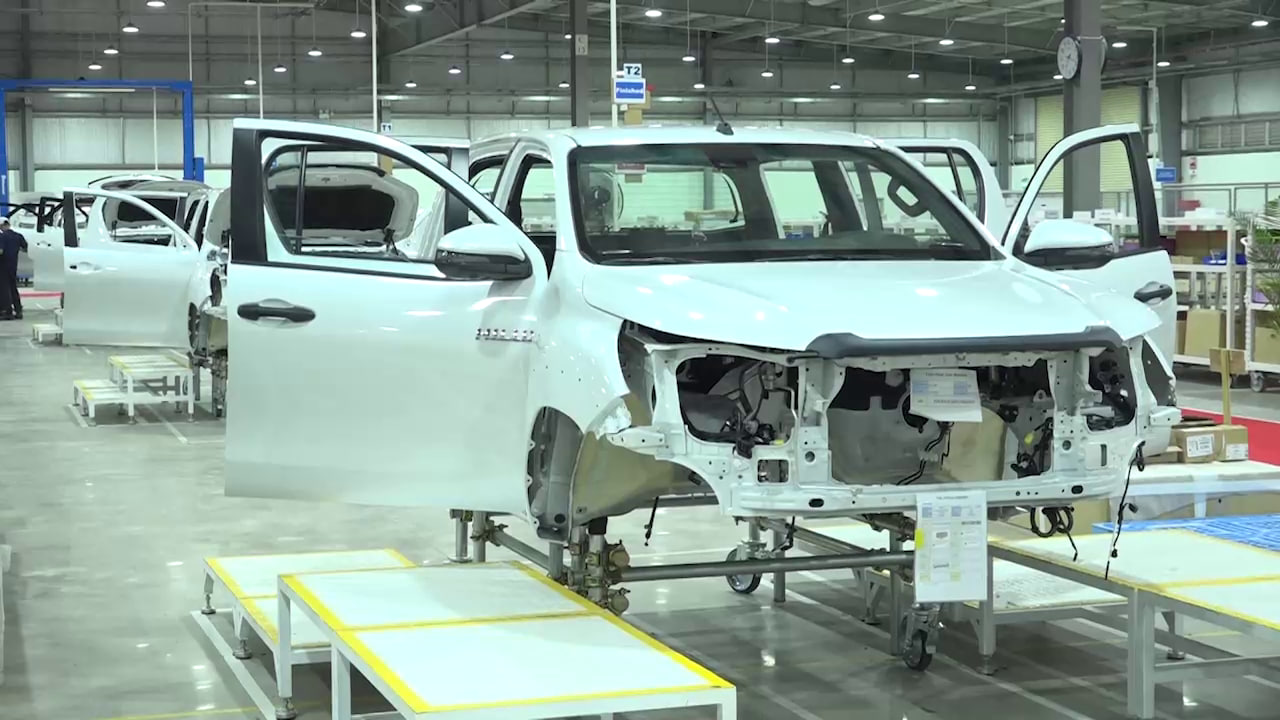
For decades, Cambodia’s manufacturing architecture was characterized primarily by light industry, driven almost exclusively by textiless, garments, and footwear production. However, official data released during the inauguration of Toyota’s flagship assembly plant within the Phnom Penh Special Economic Zone signals a profound, permanent shift toward advanced heavy engineering and automated manufacturing ecosystems.
According to H.E. Hem Vanndy, Minister of Industry, Science, Technology & Innovation, Cambodia’s automotive assembly framework has successfully integrated 11 registered investment companies. Among these, 8 heavy industrial complexes are fully operational, creating a strategic baseline capable of modernizing domestic supply chains and capturing local market share from imported completely built-up (CBU) vehicles.
The Financial Footprint: Capital, Jobs, and Production Yield
The consolidation of these heavy industrial complexes introduces massive capital injection and technical skills transfer into the local labor market. A deep financial audit of the current operational architecture highlights several critical milestones:
- Cumulative Capital Mobilization: The 11 automotive conglomerates represent a combined Foreign Direct Investment (FDI) value of approximately US$156 million.
- High-Skill Job Creation: The sector directly sustains 1,365 advanced technical positions, actively addressing gender inclusivity goals with women occupying 633 of these specialized manufacturing roles.
- Macroeconomic Value Yield: To date, assembly lines operating within the Kingdom have rolled out a total of 173,473 units, generating a massive industrial asset valuation estimated at US$1.1 billion.
Mapping Cambodia’s Automotive Footprint
The geographic distribution of these active and expanding assembly plants demonstrates a well-planned industrial decentralization strategy across major economic corridors:
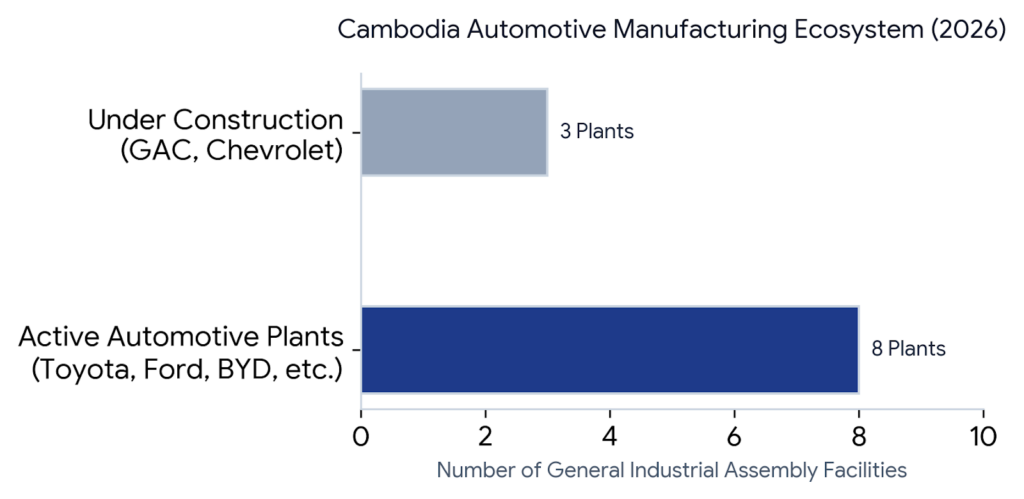
The operational matrix spans across prominent global brands, including the KIA plant in Banteay Meanchey, Hyundai in Koh Kong, the domestic brand GTV Motor in Kandal, Toyota in Phnom Penh, ISUZU in Kampong Speu, and Ford alongside Zo Motor (focusing on heavy-duty electric commercial vehicles) in Pursat. Crucially, the premium green economy is expanding via the BYD Electric Vehicle assembly facility in Preah Sihanouk, while alternative automotive giants like GAC and Chevrolet are simultaneously constructing deep-production facilities in Kampong Chhnang.
The Strategic Next Phase: Deep Supply-Chain Localization
The evolution of Cambodia’s automotive sector is moving past simple “screwdriver assembly” (assembling imported knocked-down kits). The Ministry of Industry, Science, Technology & Innovation confirmed that these global brands are aggressively increasing their consumption of locally produced automotive components and rubber-based parts.
This optimization creates a powerful economic multiplier effect. By embedding domestic small and medium enterprises (SMEs) directly into the tier-1 supply chains of giants like Toyota and Ford, Cambodia accelerates horizontal technology transfers, standardizes localized industrial skills, and builds a resilient framework capable of competing effectively within the ASEAN industrial network.
Cambodia Automotive Assembly
Operational footprint · brands & locations
8 active plantsStrategic Next Phase · Deep Localization
“Cambodia’s automotive assembly framework has successfully integrated 11 registered investment companies … creating a strategic baseline capable of modernizing domestic supply chains and capturing local market share from imported CBU vehicles.”
❓ Frequently Asked Questions (FAQ)
1. What is driving global brands like Toyota, Ford, and BYD to set up assembly plants in Cambodia? The primary drivers include Cambodia’s absolute policy continuity, highly competitive operational real estate within Special Economic Zones (SEZs), direct access to the intra-ASEAN zero-tariff trade market, and a growing domestic middle-class demanding reliable passenger vehicles.
2. Is Cambodia actually manufacturing cars, or just assembling imported parts? The sector currently operates via Complete Knocked-Down (CKD) assembly methods. However, factories are systematically increasing the integration of locally manufactured components—such as wiring harnesses, small plastic components, and domestic rubber elements—transitioning the industry closer to genuine localized manufacturing.
3. How does the presence of EV assembly lines (like BYD and Zo Motor) benefit Cambodia? The inclusion of specialized electric vehicle lines ensures Cambodia’s industrial strategy aligns with global green economies. It establishes clean-energy tech infrastructure early, trains local engineers in advanced battery and electric drivetrain frameworks, and helps meet national carbon reduction targets.
Recommended Reading
- Cambodia’s Investment Surge in 2026: A Breakdown of New Projects
- Beyond Phnom Penh: How Cambodia’s Secondary Cities Are Driving an Infrastructure Boom