
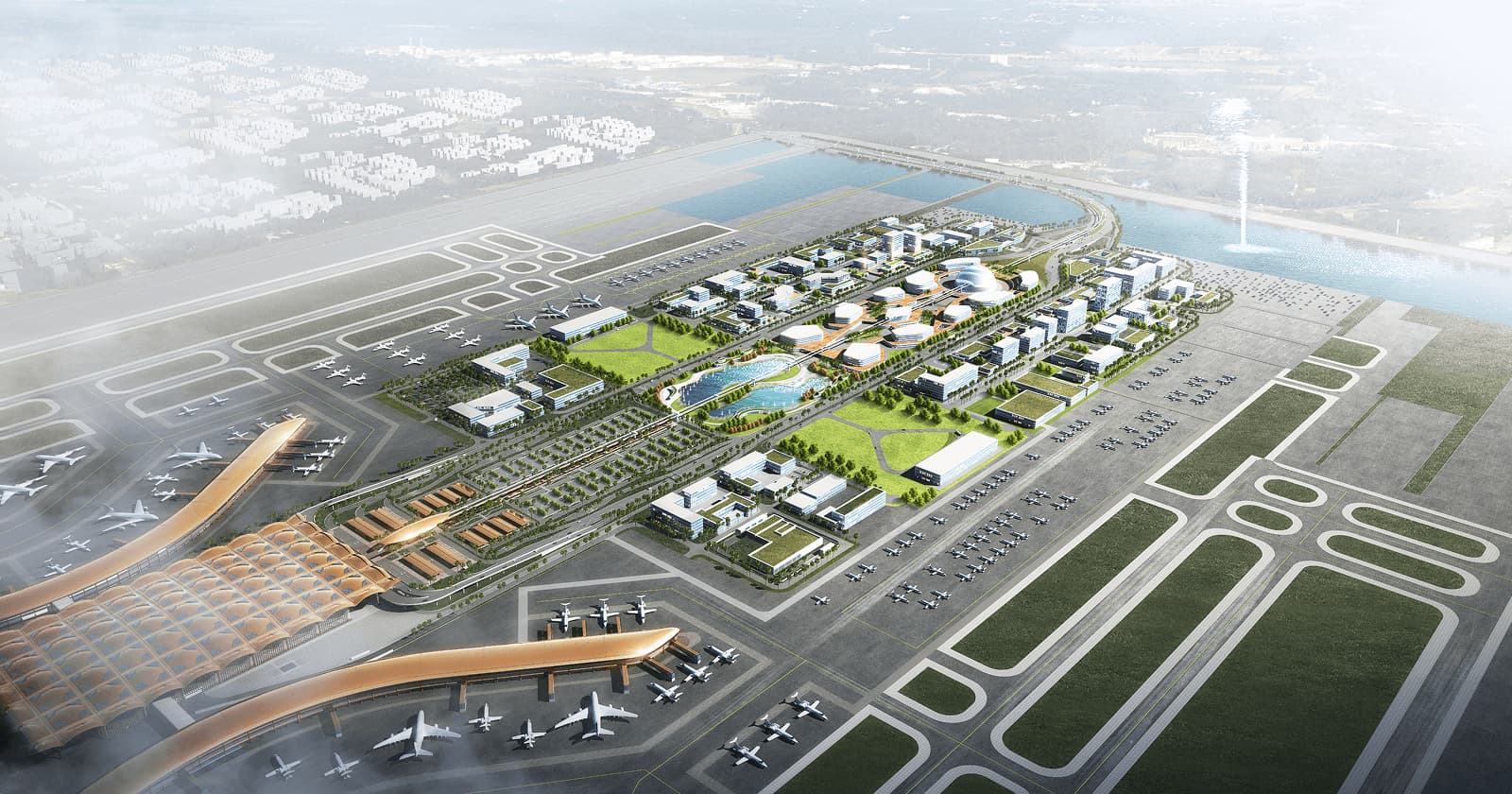
Cambodia has long been connected to the world through its ancient temples and rich cultural heritage. Today, a new kind of gateway is transforming the Kingdom’s global standing—not carved from stone, but forged from steel, glass, and cutting-edge engineering. The arrival of two new international airports marks a pivotal moment in Cambodia’s modern history, redefining how the nation connects with global markets, investors, and travellers.
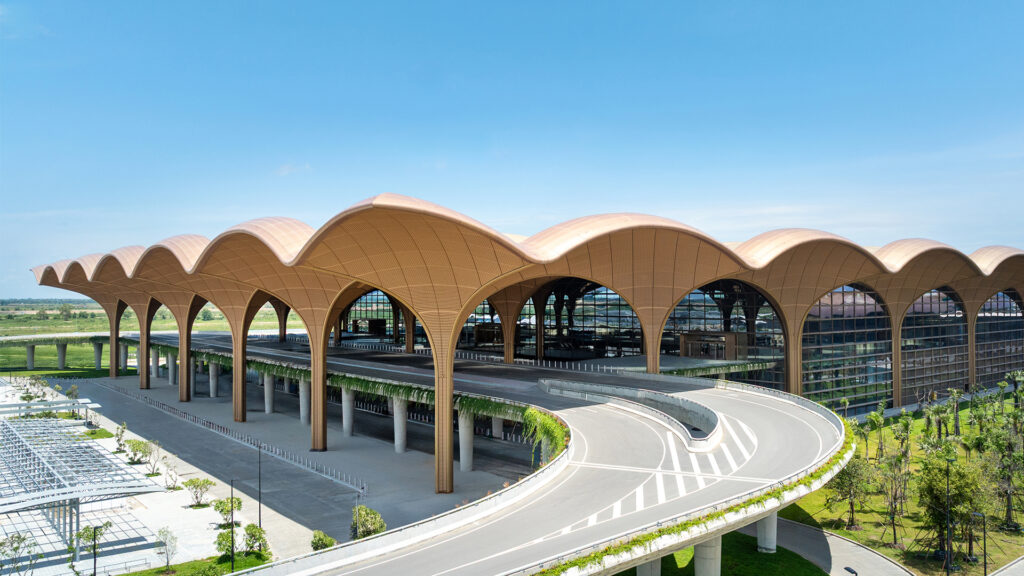
At the forefront is Techo International Airport (KTI), a US$2.3 billion, 4F‑class aviation hub that opened on 9 September 2025. Located 20 kilometres south of Phnom Penh and spanning 2,600 hectares across Kandal and Takeo provinces, it is Cambodia’s largest and most ambitious infrastructure project to date. With dual 4‑kilometre runways and the capacity to accommodate the world’s largest aircraft—including the Airbus A380 and Boeing 747—KTI has immediately positioned Cambodia as a serious player in regional aviation. In its first phase, the airport can serve 13 million passengers annually and handle 175,000 tonnes of cargo. But this is only the beginning: three phased expansions will scale capacity to 30 million by 2030 and 50 million by 2050.
Complementing this flagship is Siem Reap Angkor International Airport (SAI), a US$1.1 billion, 4E‑class gateway that opened on 16 October 2023. Designed to serve the millions of visitors drawn to Angkor Wat, SAI has an initial capacity of 7 million passengers annually, with plans to expand to 10 million by 2030 and 12 million by 2040.
Together, these two airports represent a combined investment of over US$3.4 billion—a statement of intent from Cambodia that it is open for business, ready for investment, and determined to become a regional aviation hub.
This article takes you inside Cambodia’s new international airports: their technical specifications, economic impact, and the strategic vision that makes them gateways for global investment and tourism.
📌 Key Takeaways: Cambodia’s New International Airports
- US$3.4 billion+ invested in two new international airports – Techo International (KTI, Phnom Penh) and Siem Reap Angkor International (SAI).
- Techo International Airport (KTI): US$2.3 billion, 4F‑class, dual 4km runways, opened 9 September 2025. Phase 1 capacity: 13 million passengers and 175,000 tonnes of cargo annually.
- KTI’s three‑phase vision: 13 million (Phase 1), 30 million (Phase 2 by 2030), and 50 million (Phase 3 by 2050) passengers annually. Cargo capacity expands to 527,000 tonnes in Phase 2.
- Siem Reap Angkor International Airport (SAI): US$1.1 billion, 4E‑class, opened October 2023. Capacity: 7 million passengers annually, expanding to 12 million by 2040.
- Early success: KTI averaged 15,000 passengers and 130 flights daily in its first week, served by 28 airlines.
- Strategic importance: These airports are critical gateways for tourism, trade, and foreign direct investment, supporting Cambodia’s ambition to become a regional aviation hub.
Techo International Airport – Cambodia’s New Aviation Crown Jewel
At the heart of Cambodia’s aviation transformation stands Techo International Airport (KTI)—a project of such scale and ambition that it has immediately redefined the Kingdom’s infrastructure landscape. Officially opened on 9 September 2025 and formally inaugurated on 20 October 2025, KTI represents a US$2.3 billion statement of intent: Cambodia is ready to compete as a regional aviation hub.
US$2.3 Billion, 4F‑Class, and Dual 4km Runways
KTI is classified as a 4F‑class airport—the highest ICAO rating, capable of accommodating the world’s largest commercial aircraft, including the Airbus A380 and Boeing 747‑8. The airport features dual 4‑kilometer runways, enabling it to handle long‑haul flights and all types of aircraft, enhancing both passenger and cargo transport.
Located approximately 20 kilometers south of Phnom Penh, the airport spans 2,600 hectares across Kandal Stueng District in Kandal Province and Bati District in Takeo Province. Construction began in 2020, with China State Construction Engineering Corporation serving as the main contractor. The project is developed by Cambodia Airport Investment Co., Ltd. (CAIC), a joint venture between the Overseas Cambodian Investment Corporation (OCIC) and the Cambodian government.
Phase 1 Capacity: 13 Million Passengers and 175,000 Tonnes of Cargo
Currently in its first phase, KTI is designed to accommodate 13 million passengers annually, with plans for phased expansion. The airport can handle 175,000 tonnes of cargo per year in Phase 1, with Phase 2 capacity expected to rise to 527,000 tonnes. While some sources report a lower cargo figure of 26,000 tonnes for Phase 1, the official government figure of 175,000 tonnes reflects the airport’s full Phase 1 cargo handling capability.
The Phase 1 development includes a main passenger terminal, airfields, VVIP and general aviation terminals, cargo warehouses, air bridges, and supporting infrastructure. The facility replaces the old Phnom Penh International Airport, which was completely closed on 9 September 2025.
Early Success: 15,000 Daily Passengers and Growing Global Connectivity
Since commencing commercial operations, KTI has demonstrated strong initial performance. In its first week, the airport recorded an average of 15,000 passengers and 130 inbound and outbound flights daily. By late September 2025, the airport had already welcomed more than 400,000 passengers, an increase of over 15 percent compared to the previous year.
The airport is currently served by 28 airlines, including four domestic carriers (Air Cambodia, Cambodia Airways, Sky Angkor Airlines, and AirAsia Cambodia) and 24 international carriers. Major international carriers have already established operations, with Etihad Airways commencing direct flights from Abu Dhabi in October 2025 and Turkish Airlines opening a new route from Istanbul to Phnom Penh in December 2025. Cathay Pacific has also selected KTI as an alternative parking location for its aircraft, reflecting strong international confidence in the airport’s infrastructure and operational capacity.
A Three‑Phase Vision: From 13 Million to 50 Million Passengers
KTI’s development is planned in three phases, reflecting a long‑term vision for Cambodia’s aviation growth:
| Phase | Timeline | Passenger Capacity | Cargo Capacity |
|---|---|---|---|
| Phase 1 | 2025–2030 | 13 million annually | 175,000 tonnes |
| Phase 2 | 2030–2050 | 30 million annually | 527,000 tonnes |
| Phase 3 | 2050 onward | 50 million annually | – |
Prime Minister Hun Manet has described the airport as “a massive achievement, a milestone in the nation’s development” that will “expand air connections between the Kingdom and destinations around the world.” KTI’s chairman, Pung Kheav Se, has called it “a gateway, an economic catalyst, and a symbol of the aspirations of Cambodia.”
With KTI now operational, Cambodia has three international airports in service: Techo International Airport, Siem Reap Angkor International Airport (SAI), and Sihanouk International Airport. Together, they form the backbone of Cambodia’s strategy to become a regional aviation hub and a dynamic Southeast Asian travel and trade destination.
Siem Reap Angkor International Airport – The Gateway to Angkor Wat
While Techo International Airport serves as Cambodia’s primary aviation hub for the capital and the wider economy, the Siem Reap Angkor International Airport (SAI) is the Kingdom’s premier gateway for cultural tourism. Officially inaugurated on 16 October 2023, SAI was built specifically to serve the millions of visitors drawn to the UNESCO‑listed Angkor Archaeological Park—one of the world’s most important and iconic heritage sites.
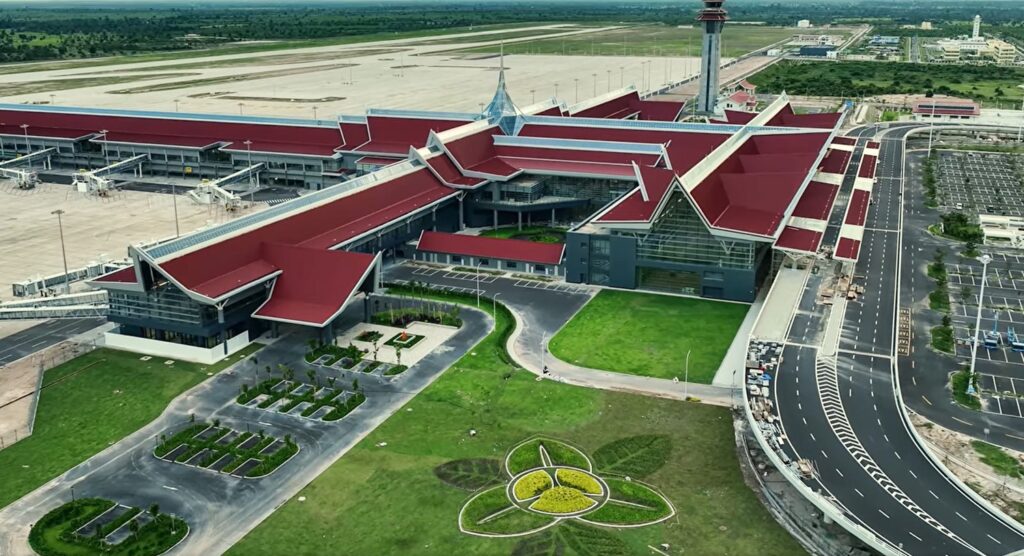
Located approximately 40 kilometres east of Angkor Wat and about 50 kilometres from Siem Reap provincial city, the airport provides a modern, efficient entry point for international tourists while significantly reducing the pressure on the old Siem Reap airport, which was located much closer to the temple complex.
US$1.1 billion, 4E class, and a 3.6 km runway
SAI represents a US$1.1 billion investment, financed and developed by Angkor International Airport Investment (Cambodia) Co., Ltd., an affiliate of China’s Yunnan Investment Holdings Ltd. The airport is classified as 4E‑class, the second‑highest ICAO rating, making it capable of accommodating long‑haul international flights and wide‑body aircraft.
The airport features a 3,600‑metre runway and a terminal building spanning 81,800 square metres. The apron provides 38 aircraft berths, enabling efficient handling of both passenger and cargo operations. Covering a total area of 700 hectares, SAI is designed to be Cambodia’s largest airport by footprint and a lasting asset for the nation’s tourism industry.
Serving 7 Million Passengers, Expanding to 12 Million by 2040
In its initial phase, SAI is designed to handle 7 million passengers annually and accommodate up to 65,800 flights per year. This capacity is already being utilised effectively: in its first year of operations (October 2023 to October 2024), the airport handled over 1.3 million passengers. By September 2025, just before its second anniversary, SAI had already processed 2.73 million passengers across 29,154 flights.
The airport’s future is one of sustained growth. Through phased developments, SAI’s capacity is projected to expand to 10 million passengers by 2030 and 12 million passengers annually by 2040. Correspondingly, annual aircraft movements are expected to increase to 112,700 flights by 2040.
Growing Airline Network and Regional Connectivity
SAI is already well‑connected to regional and international destinations. As of 2026, the airport is served by 13 airlines operating direct flights. Popular carriers include Bangkok Airways, Thai Airways, and Emirates. Key routes connect Siem Reap to Bangkok, Singapore, Kuala Lumpur, Hanoi, and Ho Chi Minh City, with direct services also operating to Seoul, Taipei, and Guangzhou.
The airline network continues to expand. In November 2025, Firefly Airlines launched a new direct route between Kuala Lumpur and Siem Reap, with the inaugural flight carrying 157 passengers. The route strengthens the air link between Malaysia and Cambodia’s primary cultural and tourism hub.
Economic Impact – Boosting Tourism and Investment
SAI is more than a transport facility—it is an economic catalyst for Siem Reap province and the wider Kingdom. As Minister of Tourism Huot Hak noted, SAI has played a vital role in strengthening Cambodia’s aviation infrastructure and boosting the national economy through tourism, investment, and air transport.
The airport has “become a strong foundation for supporting tourism and investment and boosting Cambodia’s economic growth across the country”, according to a statement from the airport operator. By providing seamless access to Angkor Wat, the Tonlé Sap lake, Preah Vihear, and Battambang, SAI is helping to distribute tourism benefits across the region.
Looking ahead, Siem Reap is poised to become a high‑quality tourism destination, aiming to attract 7.5 million international visitors and 10 million domestic tourists annually by 2035. SAI will be the primary gateway enabling this ambitious vision.
A New Era of Aviation: Cambodia’s Strategic Investment in Infrastructure
The transformation of Cambodia’s aviation sector is not an isolated achievement—it is the result of a deliberate, long-term strategy to position the Kingdom as a regional hub for air transport, trade, and tourism. The combined investment of over US$3.4 billion in new airport infrastructure represents one of the largest public‑private infrastructure commitments in Cambodia’s modern history.
US$3.6 Billion Invested in Three New Airports
The Royal Government’s aviation strategy encompasses three major airport projects, each serving a distinct strategic purpose:
| Airport | Investment | Classification | Status |
|---|---|---|---|
| Techo International Airport (KTI) | US$2.3 billion | 4F | Opened September 2025 |
| Siem Reap Angkor International Airport (SAI) | US$1.1 billion | 4E | Opened October 2023 |
| Dara Sakor International Airport | US$200 million (Phase 1) | 4E | Under construction |
Prime Minister Hun Manet has confirmed that the total investment in the three new airports is US$3.6 billion【0†L8-L9】. While Dara Sakor International Airport (located in Koh Kong province) is still under development, its eventual completion will provide Cambodia with a third modern international gateway, further strengthening the Kingdom’s aviation network.
The scale of this investment reflects a strategic conviction: that modern, world‑class aviation infrastructure is essential for Cambodia’s ambition to become a regional logistics hub and a dynamic Southeast Asian travel destination.
The “Open Sky Policy” and Its Legacy
Cambodia’s aviation transformation has been enabled by a progressive policy framework. The Royal Government’s “Open Sky Policy”, initiated in the early 2000s, has been a cornerstone of the Kingdom’s aviation strategy. This policy has allowed foreign airlines to operate freely into Cambodia, fostering competition, expanding route networks, and driving down airfares for travellers.
The policy’s success is evident in the rapid growth of Cambodia’s aviation sector. In his address at the inaugural ceremony of Techo International Airport, Prime Minister Hun Manet noted that the number of airlines operating in Cambodia had grown from just 10 in 2011 to 35 in 2025 . These airlines now connect Cambodia to 16 countries and 39 cities across the globe, from regional hubs like Singapore, Bangkok, and Kuala Lumpur to long-haul destinations such as Istanbul, Abu Dhabi, and Seoul.
This expansion has been driven by Cambodia’s rising position in the region as an emerging air transport hub in Southeast Asia. The Open Sky Policy has been a key enabler, attracting international carriers and creating a competitive, dynamic aviation market that benefits both travellers and the broader economy.
International Financing and Investor Confidence
Cambodia’s airport expansion has attracted significant international attention. In a notable development, the US International Development Finance Corporation (DFC) approved a US$100 million financing package for Techo International Airport on June 3, 2026. The financing is part of a broader US$2.5 billion global investment initiative aimed at strengthening supply chains and infrastructure in partner countries. This commitment reflects growing international confidence in Cambodia’s infrastructure development and the strategic importance of the airport as a regional hub.
Alongside this international support, the airport’s development has been largely financed through local resources, demonstrating the strength of Cambodia’s domestic capital markets. As of July 2025, the project had accumulated US$1.052 billion in investment, of which approximately US$444 million was raised through the issuance of corporate bonds.
These bonds, issued by the Cambodia Airport Investment Co., Ltd. (CAIC)—a joint venture between the Overseas Cambodian Investment Corporation (OCIC) and the Royal Government of Cambodia—feature a 5.5% coupon rate and a 3‑year tenor and are guaranteed by OCIC. The bonds have attracted strong demand from a wide range of local financial institutions, including ABA Bank, Cambodia Post Bank, FTB Bank, and Prince Bank.
This dual financing structure—combining a recent and significant vote of confidence from a major US financial institution with a strong foundation of local investment—signals robust investor confidence in Cambodia’s infrastructure future and the long‑term viability of its aviation sector.
A Foundation for Future Growth
The strategic investment in Cambodia’s airports is already delivering results. In its first few months of operation, Techo International Airport has exceeded expectations, demonstrating strong demand from both travellers and airlines. The airport’s three‑phase expansion plan—scaling from 13 million to 50 million passengers annually—reflects a long‑term vision aligned with Cambodia’s broader economic ambitions.
By 2030, Cambodia aims to become an upper‑middle‑income country. By 2050, a high‑income nation. Modern, efficient airports are essential to achieving these goals—connecting Cambodia to global markets, attracting foreign direct investment, and enabling the millions of tourists who will visit the Kingdom in the coming decades.
The Economic Impact: Connecting Tourism, Trade, and Investment
The new airports are not merely transport infrastructure—they are economic catalysts designed to accelerate Cambodia’s integration into global markets, attract foreign direct investment, and support the Kingdom’s long‑term development ambitions. From tourism receipts to cargo logistics and job creation, the economic impact of these gateways is already measurable and set to grow substantially.
Boosting Tourism and Business Travel
Techo International Airport is expected to become a catalyst for Cambodia’s economic and tourism growth, attracting more investors and tourists to the Kingdom. In its first few months of operation, KTI has already demonstrated strong demand, averaging 15,000 passengers and 130 flights daily, with over 400,000 passengers passing through by late September 2025. The airport currently serves 28 airlines, connecting Cambodia to 16 countries and 39 cities.
Minister of Tourism Huot Hak has confirmed that the new airport will help boost visitor numbers. The Ministry of Tourism believes as many as 8 million international visitors could arrive by 2028 nationwide, surpassing the pre‑pandemic peak of 6.61 million in 2019. International tourism receipts were estimated to have reached US$3.7 billion in 2025, a 3% increase over 2024.
The Open Skies Agreement concluded between Cambodia and the United States in June 2026 after 12 years of negotiations is expected to further boost air connectivity, trade, and tourism. This landmark agreement opens new opportunities for direct flights and expanded commercial ties between the two countries.
Enhancing Cargo Logistics and Trade
Beyond passenger traffic, KTI is positioned to become a major logistics hub for air cargo. The airport’s Phase 1 cargo capacity is 175,000 tonnes annually, with Phase 2 expanding to 527,000 tonnes—a significant increase from the old Phnom Penh airport’s capacity.
The airport’s strategic importance for cargo is already attracting international logistics operators. Etihad Cargo launched two weekly freighter flights from KTI to Abu Dhabi in winter 2025, adding 50 tonnes of weekly cargo capacity to support Cambodia’s garment, electronics, perishable, and pharmaceutical exports. This service provides Cambodian exporters with improved access to Etihad Cargo’s global network via Abu Dhabi.
A major infrastructure development will further enhance KTI’s logistics capabilities. OCIC has announced a planned US$100 million waterway connecting the airport to the Bassac River, the Funan Techo Canal, and Kep. This project will transform KTI into a multimodal logistics hub integrating air, land, and water transport, creating new trade corridors and attracting investment to industrial zones, tourism, and logistics services around the airport.
Creating Jobs and Supporting Long‑Term Growth
The construction and operation of KTI have already created thousands of jobs. At peak construction, the airport employed more than 11,000 workers per day. The new airport is expected to generate an estimated 10,000 jobs during its operational phase—a threefold increase compared to Cambodia’s previous airport.
The airport’s economic impact extends beyond direct employment. Prime Minister Hun Manet has articulated a long-term vision to develop the surrounding area into an industrial zone, a residential area, and other job creation zones over the next 15 to 20 years. This will create a self‑sustaining economic ecosystem around the airport, generating employment and business opportunities for local communities.
Siem Reap Angkor International Airport (SAI) is also a significant economic driver. The airport has already handled 2.73 million passengers across 29,154 flights in its first two years of operation. Siem Reap province is poised to become a high‑quality tourism destination, aiming to attract 7.5 million international visitors and 10 million domestic tourists annually by 2035, generating an estimated 1.6 million jobs and contributing approximately US$5.9 billion to the national economy.
A Foundation for Regional Integration
Cambodia’s aviation infrastructure is also strengthening regional connectivity. The Civil Aviation Authority of Cambodia projects 8 million air passengers for 2026, with over 72,000 flight movements expected, driven by growing momentum in trade, tourism, and cultural exchanges. Air Cambodia has signed an MoU with Hainan Airport to expand its route network, supporting tourism and economic growth and advancing Cambodia’s long-term ambition to become an increasingly connected and competitive aviation gateway in ASEAN.
The economic impact of Cambodia’s new airports is already visible and set to expand significantly. From tourism receipts and cargo logistics to job creation and regional integration, these gateways are central to the Kingdom’s vision of becoming a dynamic Southeast Asian hub for trade, investment, and travel.
❓ Frequently Asked Questions (FAQ)
1. When did Techo International Airport (KTI) open?
Techo International Airport (KTI) commenced official operations on 9 September 2025[reference:0]. The official inauguration ceremony was held on 20 October 2025 under the auspices of Prime Minister Hun Manet.
2. What is the passenger and cargo capacity of Techo International Airport?
In its first phase, KTI is designed to handle 13 million passengers annually and 175,000 tonnes of cargo per year. The airport is planned to expand to 30 million passengers by 2030 and 50 million by 2050.
3. What is the IATA code for Techo International Airport?
The official IATA code for Techo International Airport is KTI.
4. How many airlines operate at Techo International Airport?
As of its opening, KTI is served by 28 airlines, including 4 domestic carriers (Air Cambodia, Cambodia Airways, Sky Angkor Airlines, and AirAsia Cambodia) and 24 international carriers.
5. When did Siem Reap Angkor International Airport (SAI) open?
Siem Reap Angkor International Airport (SAI) commenced commercial operations on 16 October 2023. It serves as the primary gateway to the UNESCO-listed Angkor Archaeological Park.
6. What is the passenger capacity of Siem Reap Angkor International Airport?
SAI has an initial capacity of 7 million passengers annually. The airport is planned to expand to 12 million passengers by 2040.
7. What are the classifications of Cambodia’s new airports?
Techo International Airport (KTI) is a 4F‑class airport—the highest ICAO rating—capable of accommodating the world’s largest aircraft, including the Airbus A380 and Boeing 747. Siem Reap Angkor International Airport (SAI) is a 4E‑class airport, capable of handling long‑haul international flights and wide‑body aircraft.
8. How much did Cambodia invest in its new airports?
Cambodia has invested over US$3.4 billion in its two new international airports: US$2.3 billion for Techo International Airport (KTI) and US$1.1 billion for Siem Reap Angkor International Airport (SAI). A third airport, Dara Sakor International Airport, is also under development.
Conclusion: Cambodia’s New Airports – Gateways to a Prosperous Future
Cambodia’s new international airports are far more than concrete runways and glass terminals—they are the physical embodiment of the Kingdom’s ambition to become a dynamic, globally connected economy. The combined investment of over US$3.4 billion in Techo International Airport (KTI) and Siem Reap Angkor International Airport (SAI) represents a statement of intent: Cambodia is open for business, ready for investment, and determined to take its place as a regional aviation and logistics hub.
The numbers speak for themselves. KTI, with its 4F‑class certification, dual 4‑kilometer runways, and Phase 1 capacity of 13 million passengers and 175,000 tonnes of cargo, has immediately positioned Cambodia as a serious player in regional aviation. Its three‑phase vision—scaling to 30 million passengers by 2030 and 50 million by 2050—reflects a long‑term commitment to growth that aligns with the Kingdom’s broader economic ambitions. SAI, with its 4E‑class certification and capacity of 7 million passengers annually (expanding to 12 million by 2040), serves as the Kingdom’s premier gateway for cultural tourism, connecting millions of visitors to the world‑heritage temples of Angkor.
The early results are already visible. KTI averaged 15,000 passengers and 130 flights daily in its first week, served by 28 airlines connecting Cambodia to 16 countries and 39 cities. SAI handled over 2.73 million passengers in its first two years of operation. International carriers such as Etihad Airways, Turkish Airlines, and Cathay Pacific have already established operations or partnerships, signaling strong international confidence in Cambodia’s aviation infrastructure.
Beyond the statistics, these airports are catalysts for broader economic transformation. They are creating thousands of jobs, supporting the government’s target of attracting 8 million international visitors annually, and enabling Cambodia’s ambition to become a regional logistics hub. The planned waterway connecting KTI to the Bassac River, the Funan Techo Canal, and Kep will transform the airport into a multimodal logistics hub integrating air, land, and water transport—a rare and strategically powerful asset.
For investors, Cambodia’s aviation infrastructure offers a compelling proposition: a young, dynamic economy with competitive production costs, preferential access to major markets through RCEP and bilateral FTAs, and now, modern, world‑class gateways that connect the Kingdom to the world.
For travelers, these airports offer seamless, efficient access to one of Southeast Asia’s most captivating destinations—from the temples of Angkor to the beaches of the south, from the vibrant capital of Phnom Penh to the emerging ecotourism destinations of the Cardamom Mountains.
For Cambodia, these airports are the infrastructure of sovereignty and prosperity—the physical foundation upon which the Kingdom will build its future as an upper‑middle‑income country by 2030 and a high‑income nation by 2050.
The gates are open. The runways are ready. Cambodia is taking flight.