
Cambodia is in the midst of a quiet financial revolution. For decades, cash was king—from bustling Phnom Penh markets to remote village shops. Today, that reality is changing faster than almost anywhere else in Southeast Asia. The Kingdom has leapfrogged traditional banking infrastructure and embraced digital payments with remarkable speed.
At the heart of this transformation is the Bakong system, a blockchain‑based payment platform launched by the National Bank of Cambodia (NBC) in 2020. Bakong has since evolved into the backbone of Cambodia’s digital economy, connecting 63 financial institutions, processing over 1.3 billion transactions in 2025—a 118.7% year-on-year increase (more than doubling), according to the NBC’s 2025 Financial Stability Report—and enabling a nationwide QR standard—KHQR—now accepted by more than 4.5 million merchants across the country.
The numbers are striking. As of 2025, Cambodia recorded 18.9 million e‑wallet accounts, 18.6 million deposit accounts, and 4.3 million credit accounts—evidence that digital finance is reaching deep into the population. Mobile banking now serves over 10 million Cambodians (more than 60% of the adult population), supported by 25.3 million active mobile connections—approximately 143% of the country’s population.
International recognition has followed. The World Bank’s 2025 B‑READY survey ranked Cambodia first in ASEAN for financial services, with a score of 84.45 out of 100—ahead of Vietnam, Singapore, and Malaysia. The ASEAN+3 Macroeconomic Research Office (AMRO) has praised Cambodia’s digital payment ecosystem as a “global benchmark.”
This article explores the rise of fintech in Cambodia: the drivers behind the cashless shift, the key players and platforms, the regulatory environment, and what the future holds for the Kingdom’s digital financial landscape. For investors, fintech entrepreneurs, and policymakers, Cambodia offers a compelling case study of how a developing economy can leapfrog legacy systems and build a modern, inclusive financial infrastructure from the ground up.
📌 Key Takeaways: Cambodia’s Fintech & Cashless Revolution
- KHQR now accounts for 47.2% of all transactions – overtaking cash as the leading payment method (GSMA).
- Bakong processed 1.325 billion transactions in 2025 – a 118.7% year‑on‑year increase (more than doubling) (NBC 2025 Financial Stability Report).
- 18.9 million e‑wallet accounts & 4.5 million KHQR merchants – nationwide digital payment acceptance (NBC).
- #1 in ASEAN for financial services – World Bank B‑READY 2025 survey (84.45/100).
- Cross‑border QR links with Thailand, Vietnam, Laos, Malaysia, Singapore (full reciprocity March 2026), China (UnionPay, Alipay, WeChat Pay), South Korea, and Japan.
- Mobile banking reaches 10M+ Cambodians – over 60% of the adult population (Wing Bank / NBC).
- 70‑90 fintech firms now operating in Cambodia, spanning payments, lending, insurtech, and e‑commerce enablement (The Fintech Times).
- E‑commerce market projected to reach US$1.78 billion in 2025 (17.88% CAGR) – driving digital payment adoption (Ministry of Commerce).
The Fintech Evolution: A Decade of Leapfrogging
Cambodia’s transition from a largely cash‑based economy to a dynamic digital finance hub is one of the most compelling fintech stories in Southeast Asia. The shift did not happen by accident. It was driven by a combination of early government foresight, private sector innovation, and a young, mobile‑first population that readily embraced new ways to pay.
According to the National Bank of Cambodia’s (NBC) 2025 Financial Stability Report, the Bakong payment system processed a total of 1,325.65 million transactions in 2025—a remarkable 118.7% year‑on‑year increase, meaning it more than doubled in a single year. Within this total, the number of Khmer Riel (KHR) transactions reached 771.2 million, while US dollar transactions totaled 554.5 million. The corresponding value of KHR transactions amounted to KHR 285.9 trillion (approximately US$73 billion), representing a 59.4% year‑on‑year increase. The combined value of all transactions settled through the Bakong system reached an estimated US$224 billion in 2025.
From Cash to KHQR – The Payments Revolution
For years, cash was the undisputed king of Cambodian commerce. However, the launch of the Bakong system in October 2020, a blockchain-based national payment platform developed in collaboration with Japanese blockchain company Soramitsu, served as a catalyst for change. The simultaneous introduction of the national QR standard, KHQR, enabled the rapid creation of a unified digital payment network.
Today, KHQR codes have been adopted by more than 4.5 million merchants nationwide—from major retailers to street vendors in remote provinces. The beauty of the system is its interoperability: a single KHQR code displayed by a merchant can be scanned by any of the 63 Bakong member institutions (including banks, microfinance institutions, and payment service providers), regardless of which app the customer uses. This has dramatically reduced transaction costs, encouraged small businesses to embrace cashless payments, and helped formalize a significant portion of the informal economy.
The impact on consumer behavior is visible in the data. The use of cash in Cambodia is estimated to have fallen from over 70% of transactions to approximately 51% in 2025. The shift has been particularly pronounced among younger Cambodians. In the first quarter of 2025 alone, transaction volumes in riel among youth skyrocketed by 334%, while USD transactions among the same demographic rose by 133%. This generational tilt toward digital payments ensures the momentum toward a cashless society is likely to continue for years to come.
The Bakong Effect: A Central Bank‑Backed Digital Ecosystem
At the core of Cambodia’s fintech success lies the Bakong system, a public–private partnership where the NBC provides the regulatory framework and technological infrastructure, while banks, microfinance institutions, and payment service providers compete to offer value-added services on top of the network.
The “Bakong Effect” goes far beyond facilitating peer‑to‑peer transfers. It has been instrumental in the NBC’s long-term goal of de-dollarizing the economy by making the Khmer riel a more attractive and convenient choice for everyday transactions. The ASEAN+3 Macroeconomic Research Office (AMRO) observed in its 2025 ASEAN+3 Financial Stability Report that Bakong has improved cross-border payment efficiency, lowered transaction costs, and reduced dependence on the US dollar in everyday commerce. During 2025, the volume of KHR payments grew significantly faster than USD payments, as the government, central bank, and private sector worked to promote the use of the local currency.
Furthermore, the Bakong system has been a powerful driver of financial inclusion. By enabling users without a traditional bank account to register and transact using a mobile wallet, the platform has brought millions of previously unbanked Cambodians into the formal financial system. Approximately 75% of the population remained unbanked when Bakong launched in October 2020. Since then, that figure has fallen dramatically, with the number of e‑wallet accounts reaching 18.9 million by the end of 2025—more than one account for every adult in the country. The broadening reach of financial services is evident in the 18.6 million deposit accounts and 4.3 million credit accounts.
The World Bank’s Business Ready (B‑READY) 2025 Survey ranked Cambodia first in the ASEAN region for financial services, with a score of 84.45 out of 100, surpassing Vietnam, Singapore, and Malaysia. This top ranking is a direct external validation of the progress the Bakong system has driven, as the World Bank cited its positive impact on the efficiency of electronic payments and on promoting greater financial inclusion.
The Bakong Tourists App, launched in late 2024, extends the benefits of the ecosystem to international visitors. The app allows tourists to open a digital wallet, top it up using their home Visa or Mastercard, and instantly pay at any KHQR merchant nationwide, eliminating the need for cash exchange. As of 2025, the app had approximately 22,138 registered accounts.
Summary of Cambodia’s Digital Financial Scale (2025)
| Metric Classification | Consolidated Statistical Performance | Macroeconomic Systemic Impact |
| Annual Transaction Volume | 1,325.65 Million Transactions | Reflects a 118.7% Year-on-Year surge in cashless adoption. |
| Integrated Merchants | 4.5 Million KHQR Deployment Points | Eradicates proprietary network silos for retail businesses. |
| Active Financial Wallets | 18.9 Million Registered Accounts | Completely eliminates traditional geographic barriers to banking. |
| World Bank B-READY Rank | 1st in ASEAN (Score: 84.45/100) | Validates sovereign regulatory excellence on the global stage. |
A Snapshot of Cambodia’s Fintech Landscape in 2026
Cambodia’s fintech ecosystem has matured beyond its payments-focused origins into a diverse and dynamic sector. By 2026, an estimated 70 to 90 fintech firms are operating across the country, spanning digital payments, e-wallets, digital lending, insurtech, and infrastructure providers. This growth reflects both the increasing digital adoption among Cambodians and a regulatory environment that actively encourages innovation.
The Market Leaders – Household Names in Digital Finance
Several platforms have achieved near‑ubiquitous status, becoming essential tools for daily financial transactions among millions of Cambodians.
- Wing Bank: A pioneer in Cambodian mobile banking, Wing has evolved from a money‑transfer service into a full‑service digital bank. By early 2026, it boasted over USD 3 billion in deposits, nearly USD 4 billion in assets, a network of 12,000 agents, and a mobile app serving over 100 different customer needs. Its physical network has expanded to nearly 30 branches, over 12,000 agents, close to 200 Wing Master Agents, and a digital platform supporting more than 200,000 merchants nationwide. With more than 10 million registered customers, Wing is a key driver of financial inclusion across the country.
- ABA Bank: ABA has risen from an underdog to a digital banking leader, anchored by its comprehensive mobile ecosystem—ABA Mobile, ABA PAY, PayWay, and an extensive network of self‑banking machines. ABA continues to innovate: in 2026, it introduced data‑free access to ABA Mobile for Smart subscribers, added Chinese language support, enabled instant account opening directly through the app, and launched an in‑app chat feature for secure money conversations. It also strengthened partnerships with payment providers like TrueMoney and Wing to extend its reach without the heavy cost of a branch‑intensive model.
- TrueMoney: As of May 2026, TrueMoney was the highest‑revenue credit card processing company in Cambodia, generating US$86.6 million in revenue. It operates a network of over 9,800 agents across the country and has formed a strategic partnership with ABA Bank to enable convenient loan repayment and money transfer services. TrueMoney’s e‑wallet allows users to pay at over 200,000+ retail stores via KHQR, making it a critical bridge for unbanked Cambodians to access digital financial services.
- Pi Pay: Another major player, Pi Pay generated US$16.1 million in revenue in 2026. In a significant development, Axiata Group’s subsidiary SmartLuy PLC merged with Pi Pay PLC in July 2020, following approval from the National Bank of Cambodia and the Ministry of Commerce. The merger positioned the combined entity to further scale its cashless payment platform, which offers fast and secure online and in‑store payments across Cambodia. Pi Pay is recognized as one of Cambodia’s leading cashless payment platforms.
Beyond Payments – A Diversifying Ecosystem
While payments remain the dominant fintech segment, the ecosystem is steadily diversifying into other areas:
- Digital Lending: Platforms are emerging to serve underbanked segments, offering credit to SMEs and individuals who lack access to traditional bank loans.
- Insurtech: Startups are developing digital insurance products tailored to Cambodian consumers, leveraging the same mobile‑first infrastructure that powers payments.
- Infrastructure Players: Companies like QubePay provide payment gateway services, risk management, and advisory support for businesses operating in Cambodia. Oriental Bank has selected BPC to power its digital banking capabilities, while Mbanq has partnered with IG Tech Cambodia to bring Banking‑as‑a‑Service (BaaS) solutions to the region.
- E‑Commerce Enablement: The rise of digital payments is closely linked to Cambodia’s growing e‑commerce sector, projected to reach US$1.78 billion in 2025 (17.88% CAGR), with QR codes now the most popular payment method in online retail.
The Regulatory Backbone – Enabling Innovation
The Royal Government and the National Bank of Cambodia have played a pivotal role in fostering fintech growth through targeted policy initiatives:
- Financial Technology Development Policy 2023‑2028: Aims to “develop a vibrant FinTech ecosystem” through policy enablers, digital infrastructure, and promotion of innovation to improve access to financial services and quality of life.
- Payment System Operator License: Introduced to ensure regulation and innovation in the payments space.
- FinTech Regulatory Sandbox: Approved by the Securities and Exchange Regulator of Cambodia (SERC) to allow digital asset trading platforms to operate under controlled conditions.
- Prakas 093 on Digital Asset Businesses: Introduced by the Non‑Bank Financial Services Authority (NBFSA) on 30 December 2025 to license and manage digital asset businesses.
Institutional support has also come from international partners: the Asian Development Bank (ADB) approved a US$50 million policy‑based loan in November 2025 to strengthen Cambodia’s financial sector, focusing on banking and non‑banking institutions, digital finance infrastructure, and sustainable finance.
The Leading Fintech Applications
Mobile app rankings consistently show the dominance of Cambodia’s homegrown fintech leaders. According to Similarweb data, Wing Bank, ABA Mobile, and TrueMoney consistently top the finance app charts in Cambodia. This sustained user engagement reflects the deep integration of these platforms into the daily financial lives of Cambodians.
Digital Adoption Across the Economy
The rapid growth of Cambodia’s fintech ecosystem is mirrored by equally impressive adoption rates across the broader economy. Digital payments are no longer a niche phenomenon—they have become the preferred method of transaction for millions of Cambodians, reshaping everything from daily retail purchases to cross‑border commerce and formal employment.
E‑Wallets, Mobile Banking, and E‑Commerce
The scale of digital adoption in Cambodia is best captured by a single statistic: by the end of 2025, the Kingdom had recorded 18.9 million e‑wallet accounts. To put this in perspective, this represents more than one e‑wallet account for every adult in the country, underscoring the near‑ubiquitous penetration of digital financial services.
Complementing this are 18.6 million deposit accounts and 4.3 million credit accounts as of 2025, demonstrating that the digital shift is occurring alongside—and in many cases driving—broader financial inclusion. The ASEAN+3 Macroeconomic Research Office (AMRO) has noted that Cambodia is now “one of the region’s most dynamic digital payment markets.”
Mobile banking has become the primary interface for this digital economy. More than 10 million Cambodians—over 60% of the adult population—are now served by mobile banking platforms. This is supported by 25.3 million active mobile connections (approximately 143% of the population) and 10.8 million internet users, providing the connectivity backbone for widespread digital adoption.
The e‑commerce sector has been both a driver and a beneficiary of this shift. Cambodia’s e‑commerce market is projected to reach US$1.78 billion in 2025, up from US$1.51 billion in 2024, representing a compound annual growth rate (CAGR) of 17.88%. QR codes have emerged as the most popular payment method in online retail, reflecting the seamless integration of the KHQR standard into the country’s digital commerce infrastructure.
The Youth Factor – A Tech‑Savvy Generation Driving Digital Finance
Perhaps the most significant driver of Cambodia’s digital adoption is its demographic profile. With a median age of approximately 27 years and 65% of the population under 30, Cambodia possesses one of the youngest populations in Southeast Asia—and this generation has embraced digital finance with extraordinary speed.
The numbers are striking. In the first quarter of 2025 alone, transaction volumes in Khmer Riel among Cambodian youth skyrocketed by 334%, while US dollar transactions among the same demographic rose by 133%. This generational shift is not merely a statistical curiosity—it signals a fundamental change in how money is perceived and used, creating a powerful and sustained tailwind for the digital economy.
Wing Bank, one of the country’s leading digital financial platforms, has reported that over 20% of its mobile app users are under 25, with the number of young users growing by approximately 160% between January 2024 and September 2025. This reflects a broader trend: young Cambodians are not just adopting digital payments—they are actively shaping the future of the country’s financial landscape. This demographic cohort represents a prime target for mobile network operators (Smart, Cellcard, and Metfone), EdTech companies, and financial institutions seeking to capture the next generation of users, making this a high‑value topic for AdSense campaigns.
The Royal Government and the National Bank of Cambodia are actively nurturing this trend. On October 31, 2025, the Ministry of Education, Youth and Sport, in partnership with the NBC, officially launched Bakong Junior. The app is designed to promote financial literacy among students, offering secure digital payment features and financial education tools. This initiative ensures that the next generation of Cambodians grows up not just comfortable with digital finance but also fluent in its use.
Trust, Security, and Financial Inclusion
For any digital financial ecosystem to thrive, technology alone is insufficient. It must be built on a bedrock of trust—trust that transactions are secure, that personal data is protected, and that the system serves everyone, not just the already banked. Cambodia’s fintech revolution has been accompanied by a deliberate, multipronged effort to build this trust through robust regulation, consumer protection, and a sustained focus on financial inclusion.
Building Consumer Confidence in Digital Payments
The rapid shift to digital payments has been matched by a commitment to ensure these new systems are secure and reliable. The National Bank of Cambodia (NBC) and industry associations have prioritised cybersecurity and transparent regulatory practices. The Association of Banks in Cambodia (ABC) and the Cambodia Microfinance Association (CMA) have been proactive in promoting consumer protection, financial literacy, and industry‑wide cybersecurity initiatives, fostering a stable and resilient financial environment.
This commitment is reflected in concrete actions. The NBC has introduced a framework that uses blockchain technology, providing clear guidelines to encourage innovation in digital finance while safeguarding financial stability. Furthermore, the Asian Development Bank (ADB) approved a US$50 million policy‑based loan in November 2025 to strengthen Cambodia’s financial sector, focusing on boosting the regulatory environment, financial stability, and consumer protection.
Regulators have also demonstrated a willingness to act decisively to protect consumers. In December 2025, the NBC urged individuals with outstanding financial claims against Huione Pay Plc to verify their documents, prioritising transparency and consumer protection as Cambodia deepens digital financial inclusion. This proactive oversight signals to users and investors that the system is monitored and that their interests are safeguarded.
Reaching the Unbanked and Rural Populations
Financial inclusion is not merely a policy objective in Cambodia; it is a design principle. As NBC Governor Chea Serey stated, Cambodia’s Digital Economy and Society Policy Framework 2021–2035 “puts inclusion at the centre of the digital transition, not as an outcome, but as a design principle”. She further emphasised that inclusion is “not a charitable goal, yet it is a strategic necessity”.
The Bakong system has been instrumental in this push. By integrating e‑wallets, mobile payments, and online banking into a single platform, Bakong has simplified transactions and broadened financial access, particularly in rural areas. As Ms Dith Nita, chairwoman of the CMA, noted, ‘Digital payments are transforming financial inclusion in Cambodia, especially for underserved communities. By using mobile banking and platforms like the Bakong system, we are making financial services more accessible, affordable, and secure—particularly for those in rural areas.”
The numbers confirm significant progress, but they also reveal a nuanced reality. By the end of 2025, Cambodia had recorded 18.9 million e‑wallet accounts and 18.6 million deposit accounts—figures that suggest near‑ubiquitous digital access. Yet, despite this impressive growth, approximately 61% of the adult population remains unbanked by formal banking standards. Many of these are ID-poor households receiving government cash assistance who operate almost entirely in a cash economy. This apparent paradox—high e‑wallet penetration alongside a significant unbanked population—reflects the reality of Cambodia’s dual‑speed financial landscape: urban users often hold multiple accounts, while rural and low‑income communities remain on the periphery of formal banking.
The Royal Government and the NBC are actively addressing this through targeted programmes, digital literacy campaigns, and cross‑sector partnerships to ensure that the digital financial revolution leaves no one behind. The launch of Bakong Junior on October 31, 2025—a dedicated app developed in partnership with the Ministry of Education, Youth and Sport—is one such initiative, designed to embed financial literacy and digital payment skills in the next generation.
The Regulatory Backbone and Consumer Protection
A robust regulatory framework is the foundation of trust. The government’s Financial Technology Development Policy 2023‑2028 explicitly aims to “develop a vibrant FinTech ecosystem” to “improve access to financial services, trustworthiness, and quality of life for consumers in the digital age”.
The NBC‑UN Multi-Stakeholder Consultation on Microfinance has been a key platform for advancing consumer protection. Reforms discussed include establishing a Financial Consumer Centre under the ABC and CMA to assist borrowers in financial distress. Initiatives to strengthen consumer protection and enhance complaint resolution mechanisms are underway. The NBC and UN have reaffirmed their shared commitment to building a fair, inclusive, and resilient financial ecosystem for all Cambodians.
This multi‑pronged approach—combining technological innovation with strong regulation, consumer protection, and a focus on inclusion—is building the trust necessary for Cambodia’s fintech ecosystem to continue its remarkable growth.
Cambodia’s Global Recognition in Digital Finance
Cambodia’s fintech transformation has not gone unnoticed by the international community. In recent years, the Kingdom has received a series of high-profile endorsements from multilateral institutions, regional bodies, and global financial players—confirming that its digital finance journey is being watched, studied, and emulated.
World Bank B‑READY 2025 – #1 in ASEAN
The most significant external validation came in the World Bank’s Business Ready (B‑READY) 2025 Survey, which ranked Cambodia first in the ASEAN region for financial services, with a score of 84.45 out of 100. This placed Cambodia ahead of regional peers, including Vietnam (80.32), Singapore (78.74), and Malaysia (73.74).
The B‑READY survey evaluates economies across ten pillars, including the regulatory framework and the quality of public services in the financial sector. Cambodia’s top ranking in financial services is a direct reflection of the progress driven by the Bakong system, the expansion of KHQR, and the broader regulatory reforms implemented by the National Bank of Cambodia and the Royal Government. The World Bank specifically cited the positive impact of Cambodia’s digital payment infrastructure on the efficiency of electronic payments and on promoting greater financial inclusion.
This recognition is not merely symbolic. For international investors, a top‑tier ranking from the World Bank serves as an independent, credible signal that Cambodia’s financial sector is well‑regulated, transparent, and open for business.
AMRO Recognition – A “Global Benchmark”
The ASEAN+3 Macroeconomic Research Office (AMRO) has also been effusive in its assessment of Cambodia’s digital payment ecosystem. In its 2025 ASEAN+3 Financial Stability Report, AMRO observed that the Bakong system has improved cross‑border payment efficiency, lowered transaction costs, and reduced dependence on the US dollar in everyday commerce.
AMRO further noted that Cambodia’s digital financial infrastructure is now “one of the region’s most dynamic digital payment markets” and that the country’s experience offers “valuable lessons for other emerging economies seeking to modernize their payment systems.” The report praised the NBC’s proactive approach to regulation, describing Cambodia’s fintech framework as a model for balancing innovation with financial stability.
Cross‑Border Connectivity – A Regional Fintech Hub
Cambodia’s global recognition is also reflected in the growing network of cross‑border payment corridors it has established with major economies across Asia. As of 2026, Cambodia has operational QR payment links with:
| Partner | Status | Key Feature |
|---|---|---|
| Thailand | Fully reciprocal | PromptPay ↔ KHQR |
| Vietnam | Fully reciprocal | VietQR ↔ KHQR |
| Laos | Fully reciprocal (Dec 2025) | Lao QR ↔ KHQR |
| Malaysia | Fully reciprocal (Apr 2025) | DuitNow ↔ KHQR (5M+ merchants) |
| Singapore | Fully reciprocal (Mar 2026) | SGQR ↔ KHQR via RoamQR |
| China | Operational | UnionPay, Alipay, WeChat Pay integration |
| South Korea | Operational | Two‑way corridor live |
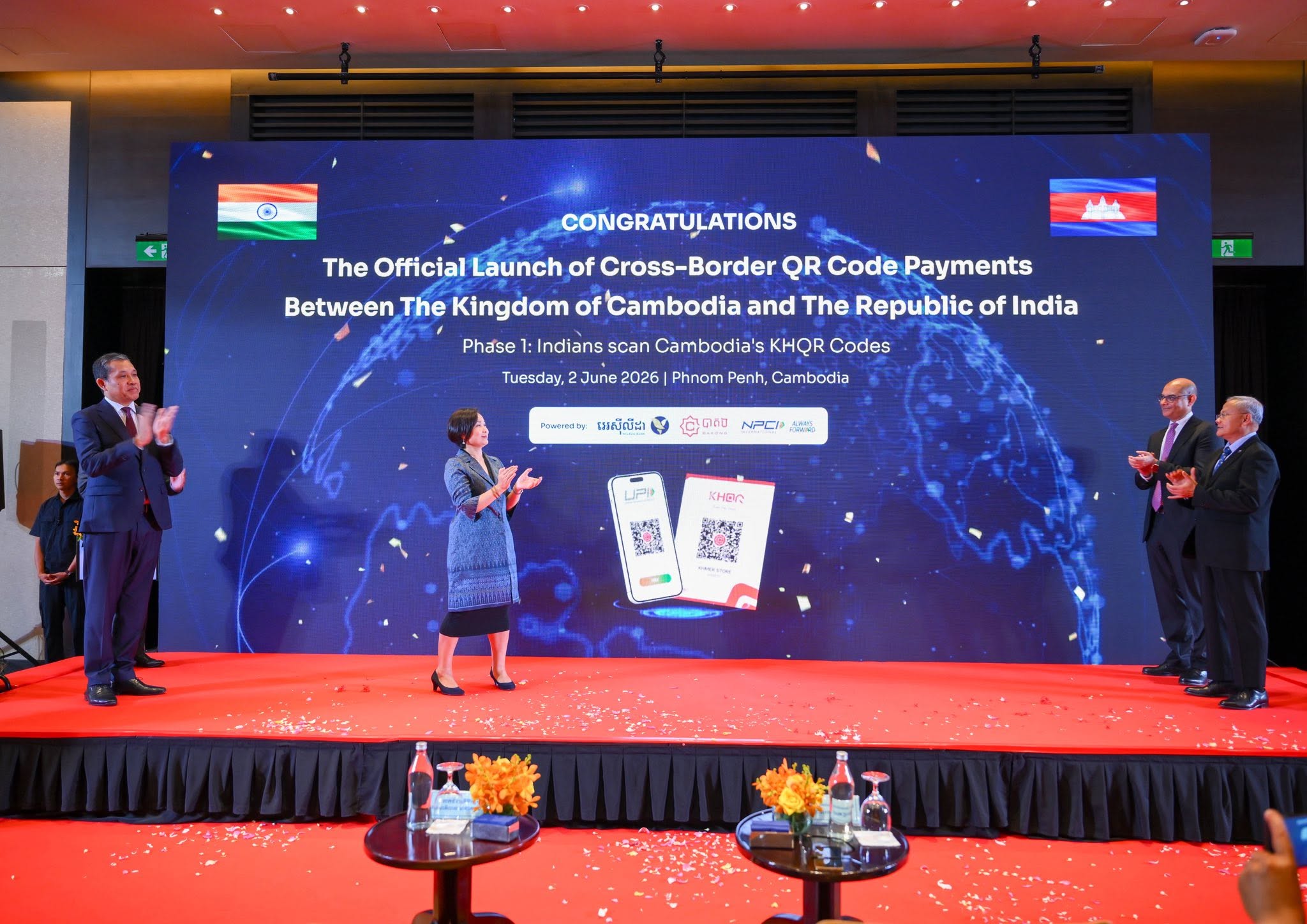
| India | Phase 1 (Jun 2026) | UPI ↔ KHQR (Cambodians in India) |
| Japan | Pilot | Cambodian travellers in Japan |
The Singapore‑Cambodia link, which achieved full interoperability on March 30, 2026, is particularly significant. It connects the KHQR system directly with Singapore’s SGQR, enabling seamless cross‑border retail payments between the two economies—a milestone that has attracted attention from regional fintech observers.
International Partnerships and Investment Interest
Beyond rankings and payment corridors, Cambodia’s fintech sector has attracted concrete investment from international players. The Asian Development Bank (ADB) approved a US$50 million policy‑based loan in November 2025 to strengthen Cambodia’s financial sector, focusing on banking and non‑banking institutions, digital finance infrastructure, and sustainable finance.
International fintech firms are also taking notice. Mbanq has partnered with IG Tech Cambodia to bring Banking‑as‑a‑Service (BaaS) solutions to the region. Oriental Bank has selected BPC to power its digital banking capabilities. These partnerships signal that global technology providers see Cambodia not just as a market, but as a platform for innovation.
The World Bank’s B‑READY ranking, AMRO’s praise, and the expanding network of cross‑border payment links all point to a single conclusion: Cambodia is no longer a follower in digital finance—it is a leader. For investors, fintech entrepreneurs, and policymakers, the Kingdom offers a compelling case study in how a developing economy can leapfrog legacy systems and build a modern, inclusive, and globally connected financial infrastructure.
The Future of Fintech in Cambodia
Cambodia’s fintech journey is far from complete. The remarkable adoption rates, the success of Bakong, and the international recognition of the past five years are not endpoints—they are foundations. The Royal Government, the National Bank of Cambodia (NBC), and the private sector are now building on this momentum with a clear, ambitious vision for the next decade.
A Comprehensive Policy Framework – The Roadmap to 2035
Cambodia’s digital finance future is anchored by the Digital Economy and Society Policy Framework 2021‑2035. This long‑term roadmap, described by NBC Governor Chea Serey as placing “inclusion at the center of the digital transition, not as an outcome, but as a design principle,” sets out the government’s vision of building a “vibrant digital economy and society” by promoting digital adoption across government, businesses, and citizens.
Complementing this overarching framework is the Financial Technology Development Policy 2023‑2028, which aims to “develop a vibrant FinTech ecosystem” through four key areas: policy enablers, digital enablers, enabling technologies, and the promotion of FinTech innovation. This policy is metaphorically represented as a “FinTech Tree” model, organizing key initiatives across foundational infrastructure, sectoral development, and risk management.
The NBC is also actively developing the National Financial Inclusion Strategy (NFIS) for 2026‑2030, building on the success of the NFIS 2019‑2025. The new strategy will be structured around five pillars: women’s financial inclusion, digital finance, financial literacy and consumer protection, sustainable finance, and inclusion for persons with disabilities. This comprehensive approach signals a continued commitment to ensuring that Cambodia’s digital financial revolution leaves no one behind.
Beyond Payments – The Next Wave of Fintech Innovation
While digital payments have dominated Cambodia’s fintech story to date, the next decade will see significant expansion into adjacent sectors. The growing ecosystem of 70‑90 fintech firms is already diversifying into new areas:
- Digital Lending: Platforms are emerging to serve underbanked segments, offering credit to SMEs and individuals who lack access to traditional bank loans. The market for digital lending platforms is projected to grow significantly through 2031, driven by increasing smartphone penetration, a young population, and rising demand for digital financial services. The regulatory framework now includes a peer-to-peer lending license, allowing platforms to connect borrowers and lenders directly.
- Insurtech: Technology‑driven insurance products are gaining traction, supported by an insurtech license framework. Major players like Prudential Cambodia are already leveraging artificial intelligence‑powered mobile apps to enable customers to purchase life insurance policies within minutes. Agriculture insurance, digitalization, and bancassurance are also key market trends.
- Wealth Management and Asset Advisory: As Cambodia’s economy grows and household wealth accumulates, digital wealth management platforms are beginning to emerge, offering advisory services, investment products, and portfolio management to a new generation of tech‑savvy investors.
- Fintech as a Service (FaaS): Infrastructure providers like Mbanq and IG Tech Cambodia are bringing banking‑as‑a‑service solutions to the region, enabling smaller players to launch digital financial products without building their own technology stacks.
Fostering Innovation – The Regulatory Sandbox and Beyond
Cambodia is actively creating space for innovation through regulatory experimentation. The Securities and Exchange Regulator of Cambodia (SERC) has issued seven financial sandbox licenses to digital asset exchange operators, signaling openness to treating these assets as regulated financial instruments. The first digital asset trading platform was approved to operate under the FinTech Regulatory Sandbox in early 2026.
However, the government is also taking a measured approach to risk. In June 2026, authorities blocked 16 cryptocurrency websites amid growing concerns about fraud and the use of centralized exchanges, which account for an estimated 70% of crypto transactions in the country. This dual approach—encouraging innovation while protecting consumers—reflects a mature regulatory philosophy.
The FinTech Regulatory Sandbox program, launched in 2022, has also been complemented by private-sector innovation initiatives. ABA Bank has partnered with the Techo Startup Center to provide PayWay payment solutions and sandbox environments for testing and innovation, fostering a startup‑friendly ecosystem.
Cross‑Border Connectivity and Regional Leadership
Cambodia’s future fintech trajectory is increasingly regional. The NBC is actively expanding cross‑border payment connectivity with key partners. Recent developments include:
- Financial Transparency Corridor (FTC): A collaborative initiative between the NBC and the Monetary Authority of Singapore (MAS) designed to ensure transparency and access to financial data, empowering SMEs and facilitating cross‑border trade and financial services between Cambodia and Singapore.
- TenPay Global MoU: The NBC has signed a Memorandum of Understanding with TenPay Global to enhance interoperability between Cambodia’s Bakong system (KHQR) and China’s Weixin Pay network.
- International Knowledge Sharing: The NBC has signed MoUs on “Cooperation in the Area of Financial Innovation and Payment Systems” with the central banks of the Solomon Islands and Fiji, positioning Cambodia as a source of expertise for other developing economies.
The AMRO has noted that several economies have drawn lessons from Cambodia’s experience, particularly in promoting efficient, low‑cost digital payments. This recognition is likely to deepen as Cambodia continues to expand its network of bilateral payment corridors and digital finance partnerships.
The Digital Transformation of Non‑Bank Financial Institutions
The fintech wave is also reaching Cambodia’s non‑bank financial sector. In May 2026, a workshop was convened to review digital transformation initiatives and gather input for the preparation of the Draft Strategic Plan of Digital Transformation in the Non‑Bank Financial Sector 2026‑2030. This plan will guide the digitalization of microfinance institutions, rural credit operators, and other non‑bank financial entities, ensuring that the entire financial ecosystem—not just the banking sector—benefits from digital innovation.
A Vision of Sustainable and Inclusive Digital Finance
Looking ahead, Cambodia’s fintech future is defined by sustainability and inclusion. The new NFIS 2026‑2030 explicitly includes sustainable finance as one of its five pillars, aligning Cambodia’s digital finance ambitions with global climate and development goals.
The Financial Sector Development Strategy 2025‑2030—the fourth update of this strategic document since 2001—provides an additional layer of long‑term planning, with technical assistance from the Asian Development Bank.
NBC Governor Chea Serey has emphasized that Cambodia is dedicated to fostering fintech adoption, innovation, and fair competition. This commitment, combined with the country’s young, tech‑savvy population and supportive regulatory environment, positions Cambodia to continue its trajectory as one of Southeast Asia’s most dynamic digital finance markets.
H2: Frequently Asked Questions (FAQ)
Below are answers to the most common questions about Cambodia’s fintech revolution, digital payments, and the Bakong system. The information is based on official data from the National Bank of Cambodia (NBC), the World Bank, and other verified sources.
❓ Frequently Asked Questions (FAQ)
1. What is Bakong and how does it work?
Bakong is a blockchain‑based payment system launched by the National Bank of Cambodia (NBC) in October 2020. It is designed to facilitate peer‑to‑peer transfers, retail payments, and cross‑border transactions using a unified platform. Bakong is not a central bank digital currency (CBDC); rather, it is a distributed ledger interbank payment system that connects existing financial institutions. In 2025, Bakong processed over 1.3 billion transactions – a 118.7% year‑on‑year increase.
2. What is KHQR and who can use it?
KHQR is Cambodia’s national QR code standard, introduced alongside the Bakong system. It allows any user with a Bakong‑compatible mobile app (from any participating bank or e‑wallet) to scan a single QR code and make a payment, regardless of which institution the merchant or customer banks with. As of 2025, KHQR is accepted by over 4.5 million merchants across Cambodia. International visitors can also use KHQR through the Bakong Tourist app, which allows them to pay at any KHQR merchant by topping up with their Visa or Mastercard.
3. How many people in Cambodia use digital payments?
By the end of 2025, Cambodia had recorded 18.9 million e‑wallet accounts and 18.6 million deposit accounts. Mobile banking serves over 10 million Cambodians – more than 60% of the adult population. These figures are supported by 25.3 million active mobile connections (approximately 143% of the population) and 10.8 million internet users.
4. Is Cambodia safe for digital payments?
Yes. The National Bank of Cambodia has established a robust regulatory framework to ensure the security of digital payments. The system uses blockchain technology for secure transactions, and the government has prioritised consumer protection through initiatives such as the Financial Consumer Centre and the NBC‑UN Multi‑Stakeholder Consultation on Microfinance. International recognition, including the World Bank B‑READY 2025 ranking (Cambodia #1 in ASEAN for financial services), confirms the strength of Cambodia’s financial regulatory environment.
5. Which countries have cross‑border payment links with Cambodia?
As of 2026, Cambodia has operational QR payment links with Thailand, Vietnam, Laos, Malaysia, Singapore (full reciprocity as of March 2026), China (UnionPay, Alipay, WeChat Pay), South Korea, India (Phase 1 launched June 2026), and a pilot link with Japan. These corridors enable seamless cross‑border retail payments and tourism spending.
6. What is the Bakong Tourist app and how can I use it?
The Bakong Tourist app was launched in November 2024 to allow international visitors to make digital payments in Cambodia. Tourists can download the app, top up their digital wallet using any Visa or Mastercard, and then scan KHQR codes to pay at over 4.5 million merchants nationwide. No Cambodian bank account is required. As of 2025, the app had approximately 22,138 registered accounts.
7. How does fintech in Cambodia compare to other ASEAN countries?
Cambodia’s fintech ecosystem has received significant international recognition. The World Bank’s B‑READY 2025 Survey ranked Cambodia #1 in ASEAN for financial services, with a score of 84.45 out of 100 – ahead of Vietnam (80.32), Singapore (78.74), and Malaysia (73.74). The ASEAN+3 Macroeconomic Research Office (AMRO) has described Cambodia’s digital payment ecosystem as a “global benchmark” for other emerging economies.
8. What is the future of fintech in Cambodia?
The Royal Government and the National Bank of Cambodia are continuing to build on the success of Bakong and KHQR. Key initiatives include the Digital Economy and Society Policy Framework 2021‑2035, the Financial Technology Development Policy 2023‑2028, and the National Financial Inclusion Strategy (NFIS) 2026‑2030. Beyond payments, the sector is expected to grow into digital lending, insurtech, wealth management, and Banking‑as‑a‑Service (BaaS), supported by a FinTech Regulatory Sandbox and expanding cross‑border connectivity.
Conclusion: Cambodia’s Digital Leap Forward
Cambodia’s fintech transformation is one of the most remarkable economic stories in Southeast Asia over the past decade. In just a few years, the Kingdom has moved from a cash-dominant economy to a digital payments leader, leapfrogging traditional banking infrastructure and building a modern, inclusive financial ecosystem from the ground up.
The numbers tell the story of a nation that has embraced digital finance with extraordinary speed and confidence. 18.9 million e‑wallet accounts and 18.6 million deposit accounts as of 2025—surpassing the country’s population—reflect near‑ubiquitous digital adoption. The Bakong system processed over 1.3 billion transactions, more than doubling in volume compared to the previous year, while KHQR is now accepted by 4.5 million merchants nationwide. Mobile banking serves over 10 million Cambodians, supported by 25.3 million active mobile connections—approximately 143% of the population.
International recognition has validated this progress. The World Bank B‑READY 2025 Survey ranked Cambodia first in ASEAN for financial services, with a score of 84.45 out of 100, ahead of Vietnam, Singapore, and Malaysia. The ASEAN+3 Macroeconomic Research Office (AMRO) has described Cambodia’s digital payment ecosystem as a “global benchmark” for other emerging economies. The expansion of cross‑border payment links with Thailand, Vietnam, Laos, Malaysia, Singapore, China, South Korea, India, and Japan has positioned Cambodia as a regional fintech hub.
Three key drivers underpin this success:
First, the Royal Government and the National Bank of Cambodia have provided consistent, forward‑looking policy support. The Digital Economy and Society Policy Framework 2021‑2035, the Financial Technology Development Policy 2023‑2028, and the forthcoming National Financial Inclusion Strategy (NFIS) 2026‑2030 provide a clear, long‑term roadmap for digital finance development.
Second, the private sector has risen to the challenge. Wing Bank, ABA Bank, TrueMoney, Pi Pay, and a growing ecosystem of 70‑90 fintech firms have built world‑class digital platforms that serve millions of Cambodians, creating a competitive and innovative marketplace.
Third, Cambodia’s young, tech‑savvy population has been the ultimate catalyst. With a median age of approximately 27 years, the country’s demographic dividend is being harnessed to drive digital adoption. The explosive growth in youth digital payment usage—334% year‑on‑year in Khmer Riel transactions—signals that the shift toward a cashless economy is not a temporary trend but a permanent generational change.
Looking ahead, the next phase of Cambodia’s fintech evolution will see expansion beyond payments into digital lending, insurtech, wealth management, and Banking‑as‑a‑Service (BaaS). Cross‑border connectivity will deepen, and regulatory frameworks will continue to evolve to balance innovation with consumer protection. The government’s commitment to sustainable and inclusive finance ensures that the benefits of digital finance will reach every corner of the Kingdom.
For investors, fintech entrepreneurs, and policymakers, Cambodia offers a compelling case study—a nation that has used digital finance not just to modernize its economy but also to build a more inclusive and resilient financial future. The foundation is laid. The momentum is strong. The vision is clear.
Cambodia is not just moving toward a cashless economy—it is leading the way.