
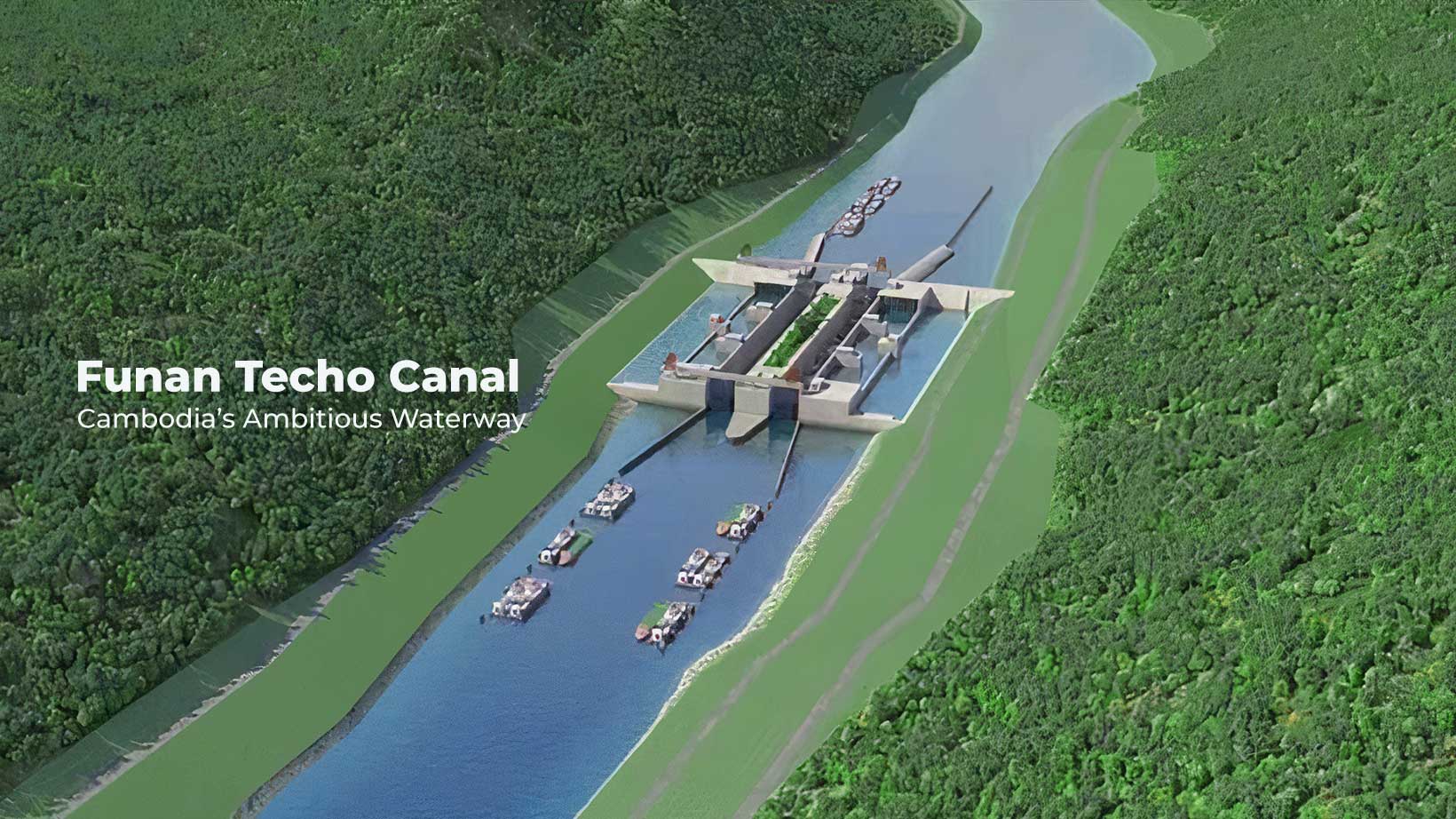
Introduction: A Strategic Analysis
For decades, Cambodia’s maritime logistics have been shaped by a single geographical reality: access to international waters flows almost exclusively through the Mekong River delta via Vietnam. This arrangement, while functional, has imposed structural costs on the Cambodian economy—transit fees, customs delays, and a persistent vulnerability to external disruptions. Recognising these constraints, the Royal Government has pursued a strategy of logistical diversification to enhance the Kingdom’s economic sovereignty and supply chain resilience.
The Funan Techo Canal is the centrepiece of that strategy. First studied in the early 2000s and formally launched in August 2024, this 172.6‑kilometre engineered waterway will connect the Mekong River near Phnom Penh directly to the Gulf of Thailand in Kep province. With a total investment of approximately US$1.17 billion, the project represents a landmark in Cambodian waterway engineering—a first‑of‑its‑kind, large‑scale navigation channel designed to complement existing transport corridors, not replace them.
When fully operational in 2028, the canal is expected to significantly reduce domestic shipping costs, stimulate the development of industrial and special economic zones (SEZs) along its banks, and provide Cambodian exporters with an alternative route to international markets—thereby strengthening the Kingdom’s strategic autonomy in regional trade.
This article provides a technical and economic analysis of the Funan Techo Canal: its engineering specifications, construction progress, projected economic benefits, and long‑term implications for Cambodia’s position within the Mekong subregion.
📌 Key Takeaways: Funan Techo Canal – Cambodia’s Logistics Game‑Changer
- 172.6 km total length – Section I (21km) started August 2024; Section II (151.6km) launched April 2026.
- US$1.17 billion investment – Construction period of approximately 36 months (target completion: 2028).
- Technical specifications (Section II) – Depth 4.7m, width 60m, two navigation lanes, designed for 3,000 DWT (dry season) to 5,000 DWT (rainy season).
- Geographic reach – Passes through 4 provinces: Kandal (33km), Takeo (53km), Kampot (48.7km), Kep (16.9km).
- Logistical impact – Direct waterway from Phnom Penh to the sea (Kep province), reducing shipping times and domestic logistics costs.
- Government commitment – Overseen by a special committee led by Prime Minister Hun Manet, with 5 signed agreements with China during President Xi’s visit (April 2025).
- Strategic autonomy – Enhances Cambodia’s supply chain resilience, providing an alternative route to international markets.
Technical Blueprint: A Modern Marvel of Logistics
The Funan Techo Canal is not merely a ditch—it is a precisely engineered waterway designed to Cambodian specifications and international standards. The project draws on ancient historical water routes while applying contemporary engineering to create a reliable, year‑round navigation channel.
Project Breakdown: Section I & Section II
The total waterway stretches 172.6 kilometres, divided into two construction phases.
- Section I: 21 kilometres, launched in August 2024, connecting the Prek Po waterway (Kampong Cham province) – a distributary of the Mekong River – to the ancient watercourse in Kandal province.
- Section II: 151.6 kilometres, officially launched on 11 April 2026, extending from Prek Po in Kampong Cham province all the way to the sea in Kep province. The waterway passes through four provinces: Kandal (33km), Takeo (53km), Kampot (48.7km), and Kep (16.9km).
The entire canal is largely aligned with natural and historic watercourses that have existed since the Funan Empire, reducing the need for massive earthworks while restoring a centuries‑old navigation route.
Specifications at a Glance: Depth, Width, and Capacity
The technical parameters of Section II have been publicly disclosed by the Royal Government and confirm the canal’s ability to handle significant commercial traffic.
| Parameter | Specification |
|---|---|
| Length (Section II) | 151.6 km |
| Water depth | 4.7 metres |
| Channel width | 60 metres |
| Navigation lanes | 2 lanes (allowing two‑way traffic and safe passing) |
| Minimum turning radius | 580 metres |
| Vessel capacity (dry season) | Up to 3,000 DWT (China‑standard vessels) |
| Vessel capacity (rainy season) | Up to 5,000 DWT (China‑standard vessels) |
| Construction period | Approximately 36 months |
| Target completion | 2028 |
The Economic Payoff: More Than Just a Canal
A canal that moves ships must also move economies. For Cambodia, the Funan Techo Canal is designed not simply as a waterway, but as the backbone of a new southern economic corridor—a unified logistics chain connecting the capital’s manufacturing base to the Gulf of Thailand. By aligning the Mekong River directly with the sea, the project promises to reshape domestic trade patterns, attract new industries, and anchor the country’s long‑term goal of achieving upper‑middle‑income status by 2030.
Catalysing National Growth: More Than Just a Waterway
In official statements, the royal government has consistently framed the canal as a strategic infrastructure asset, one that will “boost the nation’s economic growth, waterway transport, and logistics capacity” as its primary mission. Along the 172.6‑kilometre route, the project is expected to transform the surrounding areas into a continuum of industrial parks, commercial hubs, agro‑industrial zones, logistics centres, and special economic zones (SEZs), while also creating new tourist attractions.
The direct economic projections are significant. The canal is projected to generate approximately US$88 million in its first year of operation, eventually rising to around US$570 million annually by 2050 as the full economic corridor matures. More importantly, the project delivers immediate, tangible savings: by providing a direct connection to Cambodia’s own coast, it cuts out transit fees and simplifies the export route, which experts expect to “significantly reduce domestic shipping costs”.
Economists note that the new corridor will integrate Phnom Penh’s manufacturing belt, the agricultural heartlands along the Mekong, and the tourism and port potential of the southwestern coast into one cohesive economic zone. According to Thong Mengdavid, Deputy Director of the China‑ASEAN Studies Centre at CamTech University, the project is “a long‑term strategic infrastructure project aimed at strengthening Cambodia’s logistics capacity, regional connectivity, and economic resilience”, and its importance goes far beyond a single engineering feat.
Creating a Generation of Opportunity: Jobs and Investment
A canal of this size serves as a powerful engine for job creation. Cambodian authorities have projected that the Funan Techo project will generate up to 50,000 direct and indirect jobs, providing employment not only during construction but across the logistics, industrial, and service sectors that will grow up around the completed waterway.
The project’s employment impact is already visible. The groundbreaking of Section II in April 2026 has already created thousands of jobs for local workers and engineers while also catalyzing real estate development in previously quiet provinces, transforming them into emerging residential and commercial clusters.
Investor confidence in the project and its surrounding corridor has been tangible. In October 2025 alone, the Council for the Development of Cambodia (CDC) approved 29 new investment projects with a total capital of approximately US$1.4 billion, expected to create roughly 25,000 jobs across the country. These approvals included the construction and operation of the Funan Techo Canal itself, which accounted for US$1.2 billion of that investment and an estimated 3,199 jobs.
The 2025 surge in approvals is part of a broader trend: from January to October 2025, the CDC approved 575 projects worth a combined US$9.2 billion—a 66 percent increase in project numbers and a 67 percent increase in investment value compared to the same period in 2024. The CDC has stated that this growth demonstrates “the continued confidence of foreign and local investors in Cambodia’s stable political environment, strategic geographic location, and pro‑business policies.”
Independence and Autonomy: Strengthening Cambodia’s Supply Chains
Beyond the economic projections and job creation figures lies a more fundamental strategic objective: logistical diversification. For decades, Cambodia’s export‑oriented economy has depended on a single primary route—the Mekong River corridor through Vietnam—to reach international markets. While this relationship remains cooperative, any single‑route dependency carries structural risk. The Funan Techo Canal directly addresses this vulnerability by creating an alternative, nationally controlled waterway to the sea.
Cutting Costs and Reducing Reliance on Foreign Ports
The canal’s most immediate impact will be on freight economics. By shortening the distance from Phnom Penh’s industrial belt to a Cambodian coastal outlet, the waterway is expected to significantly reduce domestic shipping costs. Vessels using the canal will avoid transit fees, customs delays, and the indirect costs associated with navigating through foreign ports.
The savings accrue not only to exporters but also to importers of bulk commodities—construction materials, fuel, fertilizer, and raw industrial inputs—that currently enter Cambodia through Vietnamese or Thai ports before being trucked inland. A direct water route to the southern provinces of Kampot, Kep, and Takeo will lower the landed cost of these goods, improving the competitiveness of Cambodian manufacturers.
Crucially, the canal is designed to complement, not replace, existing transport corridors. The Royal Government has consistently framed the project as a diversification tool rather than a competitive threat. Prime Minister Hun Manet has emphasized that Cambodia remains committed to regional cooperation and that the canal will integrate seamlessly with ASEAN’s broader logistics network, including the planned ASEAN Power Grid and existing cross‑border trade agreements.
A New Regional Logistics Hub for the Mekong Subregion
With the canal in place, Cambodia gains the infrastructure to become a logistics hub for the lower Mekong subregion. The waterway will connect to existing and planned SEZs, industrial parks, and transport corridors, creating a multimodal network that links road, rail (future), and sea.
Analysts at the China‑ASEAN Studies Centre have noted that the canal positions Cambodia to capture value‑added logistics activities—warehousing, transshipment, and container consolidation—that currently flow through neighboring hubs. For logistics operators, this translates into new opportunities: establishing distribution centers along the canal, offering barge services between Phnom Penh and the coast, or providing last‑mile trucking from the canal’s terminal ports.
The strategic autonomy gained is not about isolation but about resilience. In a world of supply chain disruptions—whether from climate events, geopolitical tensions, or pandemics—having an alternative route to market is a competitive advantage. The Funan Techo Canal delivers that advantage.
On the Ground: Construction Progress and Government Commitment
An ambitious infrastructure project requires more than a groundbreaking ceremony; it needs sustained political will, a clear execution plan, and mechanisms to manage the social consequences. The Royal Government has put all three in place, establishing a dedicated management structure, adhering to a strict timeline, and building a framework to address the impact on affected communities.
Timeline and Current Status
The Royal Government is executing the Funan Techo Canal according to a clear, phased timeline. The project is divided into two phases: Section I (21 km), which broke ground on 5 August 2024, and Section II (151.6 km), launched on 11 April 2026 under the chairmanship of Prime Minister Hun Manet. The entire waterway is on track for completion by 2028.
To drive the project forward, the government has established a special committee tasked with accelerating the planning and implementation of the canal. This committee is chaired by Deputy Prime Minister Sun Chanthol, who also chairs the subcommittee responsible for evaluating feasibility studies and negotiating the public-private partnership (PPP) contract. The Ministry of Public Works and Transport serves as the committee’s secretariat, ensuring technical oversight and coordination among all relevant ministries.
In total, the special committee has the authority to create four subcommittees to manage different work streams, including engineering, resettlement, environmental impact, and financial arrangements. This institutional structure ensures that the project benefits from focused expertise and that no critical aspect is overlooked.
Voices of Support and Management of Community Impact
The government has also taken proactive steps to manage the project’s social impact. Detailed studies indicate that 2,305 households, covering 180 hectares, will be affected by the canal. Of these, 400 homes will be fully impacted, while 1,905 will experience partial damage. Additionally, 3,469 hectares of agricultural land (2,775 hectares of rice fields and 555 hectares of other crops) and 43 public assets will be affected.
To address these concerns, the government has strengthened the Impact Solution Committee, which conducts consultations with affected residents to ensure transparency and build trust. This process has already received praise and support from local communities. The government is committed to providing legal and appropriate solutions for all affected parties, with compensation and resettlement processes being handled by the General Department of Resettlement under the Ministry of Economy and Finance.
This structured approach – combining clear timelines, dedicated oversight, and a focus on community engagement – demonstrates the government’s determination to see the Funan Techo Canal through to completion as a strategic asset for Cambodia’s long-term prosperity.
❓ Frequently Asked Questions (FAQ)
1. What is the total length of the Funan Techo Canal?
The canal stretches 172.6 kilometres in total, divided into Section I (21 km, launched August 2024) and Section II (151.6 km, launched April 2026). It connects the Prek Po waterway (a distributary of the Mekong River in Kampong Cham province) to the sea in Kep province.
2. How much does the canal cost and when will it be completed?
Total investment is approximately US$1.17 billion. The construction period is approximately 36 months, with target completion scheduled for 2028.
3. What types of vessels can use the canal?
The canal is designed for China‑standard vessels with capacities of up to 3,000 DWT (deadweight tonnes) during the dry season and 5,000 DWT during the rainy season. The water depth is 4.7 metres, channel width 60 metres, with two navigation lanes allowing two‑way traffic.
4. How many people and how much land will be affected by the canal?
According to the Ministry of Public Works and Transport, the project will affect 2,305 households (400 fully impacted, 1,905 partially impacted), 3,469 hectares of agricultural land (2,775 hectares of rice fields, 555 hectares of other crops), and 43 public assets. The government has established compensation and resettlement processes through the General Department of Resettlement.
5. What are the expected economic benefits of the canal?
The canal is projected to generate approximately US$88 million in its first year of operation, rising to about US$570 million annually by 2050. It is expected to create up to 50,000 direct and indirect jobs and significantly reduce domestic shipping costs by providing an alternative route to international markets.
6. Who is managing the construction of the canal?
The Royal Government established a special committee chaired by Deputy Prime Minister Sun Chanthol to accelerate planning and implementation. The committee works with the Ministry of Public Works and Transport and has the authority to coordinate across multiple ministries. A public‑private partnership (PPP) framework governs the project’s financing and operation.
7. Will the canal replace existing trade routes through Vietnam?
No. The canal is designed to complement, not replace, existing transport corridors. The Royal Government has consistently framed the project as a logistical diversification tool that enhances Cambodia’s supply chain resilience while maintaining full cooperation with regional neighbours under ASEAN frameworks.
Conclusion: A Cornerstone of Cambodia’s Long-Term Growth
The Funan Techo Canal is more than an engineering project. It is a declaration of Cambodia’s intent to take control of its own logistics destiny. By connecting the Mekong River system directly to the Gulf of Thailand, the canal addresses a structural vulnerability that has constrained the Cambodian economy for decades: dependence on a single foreign‑controlled export route.
When completed in 2028, the waterway will deliver tangible, lasting benefits. Shipping times will fall. Logistics costs will drop. A new industrial corridor will emerge along its 172.6‑kilometer length, attracting investment in SEZs, agro‑processing, manufacturing, and logistics services. Up to 50,000 jobs will be created. And Cambodia will gain the infrastructure to become a logistics hub for the lower Mekong subregion.
Importantly, the canal is not a zero‑sum project. The Royal Government has framed it as a complement to existing trade routes—a diversification tool that strengthens resilience without undermining regional cooperation. The engineering aligns with ASEAN connectivity goals, and the waterway is designed to integrate with Cambodia’s broader transport network, including expressways, ports, and future rail links.
The numbers—US$1.17 billion in investment, 151.6 kilometers of new navigation channel, 4.7 meters of depth, and 3,000–5,000 DWT vessel capacity—are impressive. But the real story is one of strategic autonomy. For the first time, Cambodia will have a direct, nationally controlled water link to international waters.
The canal’s name invokes the ancient Funan Empire, a civilization that thrived on maritime trade. In that spirit, the Funan Techo Canal looks forward—not backward—to a future where Cambodia is not merely connected to global supply chains but is an active, confident participant in shaping them.
For investors, logistics operators, and development partners, the message is clear: Cambodia is building the infrastructure of sovereignty, and the Funan Techo Canal is its cornerstone.