
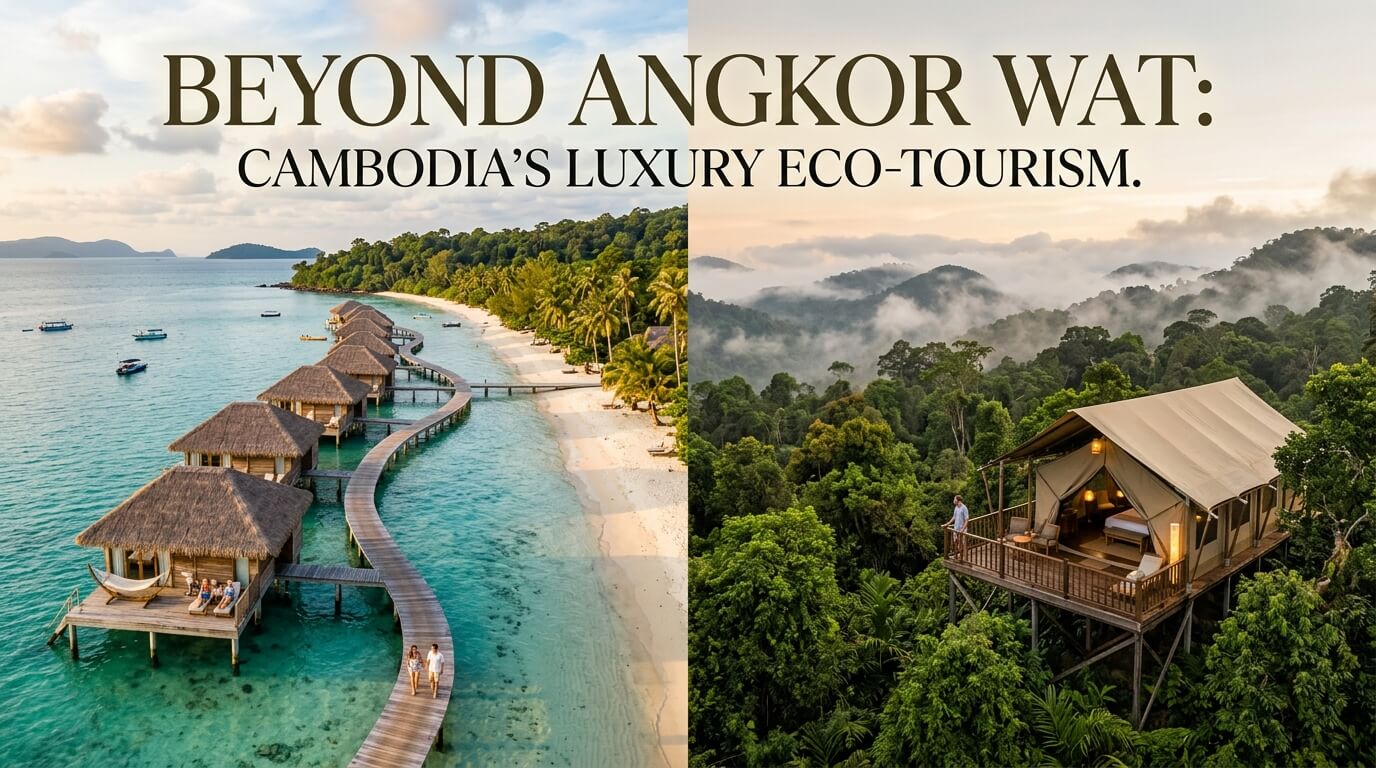
For decades, the narrative of Cambodian tourism began and ended with Angkor Wat. The majestic temples of Siem Reap have rightfully earned their place as a bucket‑list destination, drawing millions of visitors each year. But that story is changing.
Today, a new generation of travellers – affluent, conscious, and experience‑driven – is discovering Cambodia beyond the temple complex. They are flying into the new US$2.3 billion Techo International Airport and heading not to the northwest, but south and southwest. Their destinations: the turquoise waters of the Koh Rong archipelago, the mist‑shrouded rainforests of the Cardamom Mountains, the quiet French‑colonial charm of Kep and Kampot, and a growing collection of world‑class sustainable luxury resorts that rival anything in Southeast Asia.
Cambodia is quietly reinventing itself as a luxury eco‑tourism hub. In 2025, the country welcomed 5.57 million international tourists, generating US$3.878 billion in revenue. More importantly, the government’s “Sacred Tourism 2025–2035” policy explicitly targets over 2 million “special tourists” – high-net-worth visitors seeking wellness, nature, and authentic cultural encounters – out of a projected 15 million annual arrivals by 2035.
This article takes you beyond Angkor Wat. We explore the private islands, the wellness sanctuaries, the conservation‑driven tented camps, and the coastal hideaways that are putting Cambodia on the global luxury travel map. Whether you are a travel advisor curating bespoke itineraries, an investor eyeing the premium tourism sector, or an adventurer with a taste for sustainable luxury, this guide is your starting point.
📌 Key Takeaways: Beyond Angkor – Cambodia’s Luxury Eco‑Tourism
- Cambodia welcomed 5.57M international tourists in 2025, generating US$3.878B – with a structural shift toward high‑net‑worth visitors.
- Song Saa Private Island (Koh Rong) – 24 overwater/jungle villas in Cambodia’s first marine protected area; a global sustainable luxury icon.
- Samanea Wellness Resort (Cardamom Mountains) – opened Feb 2026, 32 private villas, 35,000 sq‑m organic farm, rare wildlife encounters.
- Port Yves Palace (Koh Rong Sanloem) – 150‑room luxury apart‑hotel breaking ground Oct 2025, completion 2027.
- Sacred Tourism 2025‑2035 policy targets 2M+ “special tourists” (luxury, wellness, eco) out of 15M arrivals by 2035.
- New Techo International Airport (Sept 2025) and coastal road upgrades are unlocking remote luxury destinations.
The Rise of Sustainable Luxury in Cambodia
For years, Cambodia’s tourism story was defined by volume: how many millions of visitors passed through the gates of Angkor Wat. But beneath that headline figure, a quieter – and more significant – transformation has been unfolding. The Kingdom is shifting its focus from mass arrivals to meaningful stays, from backpacker hostels to private pool villas, and from generic sightseeing to curated, immersive experiences.
From Mass Tourism to High-End Experiences
The numbers reflect this strategic pivot. In 2025, Cambodia welcomed 5.57 million international tourists—a 16.9% decline from the previous year. The Ministry of Tourism had targeted between 7.2 and 7.5 million for the full year, but external headwinds including border tensions and regional uncertainties affected arrivals. Despite the drop in visitor numbers, tourism revenue increased by 6.6% to US$3.878 billion—a clear indicator of the shift toward higher‑spending visitors.
A study by Marriott International, released in mid‑2025 as part of their Luxury Group’s 2025 Trend Report, found that Cambodia is now listed among the emerging destinations drawing intense interest from Ultra High Net Worth (UHNW) and High Net Worth (HNW) travellers. The country was also cited as a preferred destination for ‘venture travelists’ and ‘luxury travellers seeking timeless adventures’. The country was also cited as a preferred destination for “venture travelists” and “luxury travellers seeking timeless adventures”.
The study revealed a broader shift in luxury travel preferences. Over 90 percent of affluent travellers now expect a personalised experience, and more than 60 percent plan every detail of their trips in advance. Nature-driven experiences are rising rapidly: 28 per cent of HNW travellers are now planning rural escapes – a marked increase from 19 per cent the previous year – and over 92 per cent state that being close to nature is a key priority.
Mr. Oriol Montal, Marriott’s Regional Vice President of Luxury for Asia Pacific, captured the moment well: ‘Luxury travellers are now more intentional than ever before. They are seeking journeys that align with their values, enhance their wellbeing, and deliver profound personal meaning’.
Cambodia is uniquely positioned to meet this demand. Its “second wave” destinations – beyond the temple complex – remain relatively undiscovered compared to neighbouring Thailand, offering a sense of exclusivity and authenticity that high-end travellers increasingly prize. As Melita Koulmandas, CEO and founder of Song Saa Private Island, puts it, “Cambodia offers the next frontier: An emerging destination with deep cultural roots, untouched natural beauty, and a more exclusive, off-the-beaten-path feel.”
The Sacred Tourism 2025-2035 Policy
The Cambodian government has codified this shift into a decade-long master plan. In February 2025, the National Tourism Development Committee (NTDC) announced the Sacred Tourism 2025–2035 policy—a bold initiative to transform designated areas into high‑end tourism destinations.
The policy’s headline target is unambiguous: to attract over 2 million “special tourists”—defined as business tourists, second‑home buyers, retirees with financial means, and other high‑value visitor categories—out of a projected 15 million international arrivals by 2035. These “special tourists” will receive authorized entry and residence in sacred tourism areas, along with privileges related to investment and business opportunities under Cambodia’s legal framework.
Sacred tourism destinations are not located in border areas or high‑risk locations; they are strategically chosen based on their potential to attract high‑value visitors while ensuring safety and sustainability. These areas will be equipped with top‑tier services: high‑quality accommodations, restaurants, healthcare, financial services, telecommunications, and recreational facilities—all designed to meet international standards.
Beyond infrastructure, the Sacred Tourism initiative is part of a broader effort to diversify Cambodia’s tourism sector into niche markets. The government is actively promoting eco‑tourism, agro‑tourism, wellness tourism, and community‑based tourism as complementary pillars. In early 2026, the Ministry of Tourism signed an MoU with the Ministry of Cult and Religion to bolster religious tourism, including the “Pagoda Tourism” initiative, which opens Cambodia’s living Buddhist heritage to international visitors seeking spiritual retreats, meditation, and wellness experiences.
Crucially, the government is pursuing this shift while maintaining a “community-first” approach to ecotourism development. Prime Minister Hun Manet has set a national policy requiring that natural ecotourism sites prioritize benefits for local communities before opening to external investment—ensuring that conservation and development reinforce each other.
For luxury travelers, the message is clear: Cambodia is no longer just a place to see temples. It is a place to linger, to explore, and to invest in experiences that matter.
Koh Rong Archipelago – Cambodia’s Island Paradise
No discussion of Cambodia’s luxury eco‑tourism evolution is complete without the Koh Rong archipelago. Located a short ferry ride off the coast of Sihanoukville, this cluster of over two dozen tropical islands is home to some of Southeast Asia’s most pristine white‑sand beaches, turquoise waters, and vibrant marine ecosystems.
For years, Koh Rong was known primarily as a backpacker destination. That reputation is rapidly changing. A wave of high-end, sustainability-focused developments is transforming the archipelago into a legitimate competitor to Thailand’s Koh Samui or Vietnam’s Phu Quoc—but with a distinctly Cambodian sense of quiet discovery.
Song Saa Private Island – A Marine‑Positive Sanctuary
At the forefront of this transformation is Song Saa Private Island, Cambodia’s most celebrated luxury resort and a global benchmark for regenerative travel. Set across two small islands locally known as the “Sweethearts”—Koh Ouen and Koh Bong—Song Saa offers 24 overwater, ocean‑view, and jungle villas, each built with sustainably sourced materials that respect the integrity of the island environment. All accommodations feature private pools, open‑plan living spaces, and panoramic views of the turquoise sea and lush green forest.
What truly sets Song Saa apart is its conservation mission. When Australian founder Melita Koulmandas purchased the islands in 2005, they were “knee‑deep in rubbish,” and the surrounding marine life had been decimated by overfishing. Through the work of the Song Saa Foundation, the resort spearheaded the establishment of Cambodia’s first Marine Protected Area between 2005 and 2007. This effort later contributed to the creation of the 524 km² Koh Rong Marine National Park. The foundation’s projects now include a coral nursery, a house reef surveying programme, and a tropical marine monitoring programme —creating a rare convergence of high‑end hospitality and active ecological stewardship.
Today, guests can experience the results directly. A 200‑meter protection zone encircles the islands, strictly restricting fishing and allowing coral restoration projects to flourish. A resident marine scientist leads snorkeling and diving excursions, revealing reef systems that now rank among the most biodiverse in Cambodia. Guests can also kayak through mangroves, hike to jungle waterfalls, participate in coral restoration workshops, or witness bioluminescence during guided night swims.
In early 2026, Song Saa unveiled Saraan Sanctuaries, a new well-being concept that reimagines wellness as a nature‑rooted journey guided by Khmer wisdom and the island’s ocean setting. Offerings include salt room sound therapy, herbal steam rituals, floating sound healing, Shirodhara oil treatments, Buddhist blessings, and curated journeys such as Digital Detox, Sacred Sleep, and Couple Connection – delivered across jungle sanctuaries, overwater salas, and open-air pavilions.
Port Yves Palace – Koh Rong’s Emerging Luxury Hub
Song Saa may be the pioneer, but it will soon be joined by a major new player. In October 2025, Cambodia broke ground on Port Yves Palace, a nine‑storey, 150‑room luxury apart‑hotel on Koh Toch Beach, Koh Rong Sanloem. Scheduled for completion in 2027, the US$39 million project is positioned as a “catalyst for sustainable and high‑end tourism” in Preah Sihanouk Province.
The development will feature a five‑star hotel, exclusive residences, rooftop lounges, a 90‑metre private white‑sand beach, restaurants, VIP venues, and an upscale retail promenade. Notably, the project offers 100% freehold ownership for foreign buyers—a rare feature in regional resort developments—with projected annual returns of up to 12.8%. It is designed to bridge European luxury standards with Khmer‑inspired elegance. Port Yves Palace is expected to create approximately 350 permanent jobs and employ 500 local workers during construction.
Speaking at the groundbreaking ceremony, Deputy Prime Minister Say Samal endorsed the project as “a model for sustainable island development in Cambodia,” aligning with the government’s vision of balancing coastal ecosystem protection with economic growth.
Other Koh Rong Luxury Options
For travellers seeking alternatives to private‑island seclusion, Koh Rong offers a growing selection of upscale but accessible resorts:
- The Royal Sands Koh Rong – widely regarded as the pinnacle of luxury on the island, offering a five‑star beachfront experience on Long Set Beach, often called “4K Beach” for its stretch of white sand that rivals the world’s finest.
- Long Set Resort – a beachfront property with 33 rooms, an outdoor pool, a fitness centre, and a stated mission to prioritise protection of marine ecosystems and lush jungles as a “pioneer in sustainable tourism”.
- The Secret Garden Koh Rong – a nature‑inspired beachfront accommodation blending relaxed luxury with an eco‑conscious ethos, set on one of the island’s quietest shores.
Beyond the resorts, the Koh Rong Marine National Park also offers community‑based eco‑tourism experiences. The Prek Kongkang Mangrove Forest, a 40‑hectare protected area managed by the Prek Kongkang Koh Rong Ecotourism Community, was established in April 2021. The community welcomes 70 to 100 visitors on weekdays—and more on weekends—who can paddle a 1.3‑kilometre waterway through the mangroves, sample local crab and mangrove coffee, and experience conservation in action.
The Cardamom Mountains – Wellness and Wilderness
If the Koh Rong archipelago represents Cambodia’s coastal luxury, the Cardamom Mountains are its wild heart. Often called the “Amazon of Asia”, this vast rainforest ecosystem spans over 1.5 million hectares across southwestern Cambodia, sheltering threatened species like the clouded leopard, dhole, Sunda pangolin, white-eared night heron, and the critically endangered Siamese crocodile. It is one of South-east Asia’s last great wildernesses — and an emerging hub for conservation-driven luxury ecotourism.
The Cardamoms offer an altogether different luxury experience: one measured not in private infinity pools but in riverfront tented camps, guided anti‑poaching patrols, and wellness programmes woven into the rhythm of the rainforest. Below are three distinct properties that define this emerging landscape.
Samanea Wellness Resort – Cambodia’s First Mountain Wellness Sanctuary
In February 2026, the Samanea Group opened Samanea Wellness Resort in Pursat Province, marking Cambodia’s first luxury wellness retreat purpose‑built for the mountains. The resort lies across 40 hectares of pristine natural landscape, making it currently the only high‑end property located deep within the Cardamoms.
What sets it apart: Rather than chasing adventure thrills, Samanea is designed for guests who come to slow down. Its philosophy rests on three pillars—wellness, nutrition, and sustainability—delivered through 32 private villas, a fitness house, an ozone pool, a dedicated wellness sanctuary, and a signature restaurant that draws from an onsite 35,000‑square‑meter organic river farm.
Wellness offerings: Spa journeys incorporate authentic Khmer healing traditions, breathwork, energy therapies, and indigenous wisdom, alongside curated nutrition programs that celebrate mindful dining. Guests sleep on sustainably produced Getha mattresses, chosen to promote physical recovery and deep relaxation.
Sustainability commitment: According to the resort’s sustainability commitments, approximately 30% of the property’s energy is supplied by solar power, and a mandatory 1% guest contribution supports community and environmental CSR projects. Beyond the resort, curated excursions include jungle trekking, eco‑motorbike trails, village immersions, boat fishing, and guided wildlife encounters—including a rare Siamese crocodile night watch at a nearby sanctuary.
As Chief Resort Officer Tristan de la Porte du Theil puts it: ‘True hospitality goes beyond beautiful spaces. We hope to shape Samanea into one of Cambodia’s leading wellness destinations, offering purposeful luxury rooted in wellness, nutrition, and sustainability.
Shinta Mani Wild – Conservation-Driven Tented Luxury
If Samanea is about restoration, Shinta Mani Wild is about adventure with purpose. Conceived by visionary designer Bill Bensley and opened in 2018, this ultra‑luxury tented camp is perched 1.5 kilometres above a waterfall within a private nature sanctuary in the Kampong Seila district.
The arrival: Guests reach the resort not by road but by zipline — launching from a 98‑step tower and soaring 320 metres across the Tmor Rung River valley directly into the camp’s “Landing Zone Bar”.
Accommodation and pricing: Just 15 safari‑style luxury tents are set along the river, each featuring vintage-inspired interiors, grand outdoor bathtubs, and private decks overlooking the rainforest. Rates start from US$1,500 per person per night in the low season (April–October) and US$2,000 in the high season (November–March) , placing Shinta Mani Wild among the most exclusive—and expensive—conservation‑driven resorts in Southeast Asia.
The conservation model: The resort’s raison d’être is protection. Shinta Mani Wild funds the Wildlife Alliance, contributing to forest, wildlife and natural resource conservation across its 300‑hectare territory and beyond. A “stat board” at the camp records confiscated chainsaws, animal traps, and snares, alongside numbers of wildlife rescued and released, including Malayan sun bears and countless turtles. Guests can join anti‑poaching patrols alongside rangers, investigating forest boundaries for illegal logging camps, stashed equipment, and poaching evidence.
Activities: Beyond conservation, guests enjoy sunrise yoga next to roaring waterfalls; foraging expeditions with the chef (for that evening’s dinner ingredients); Tenkara fly-fishing; tubing down the Tmor Rung River; birdwatching boat trips; and the “Boulders Spa” — an open‑air treetop treatment pavilion.
Shinta Mani Wild employs over 100 local residents, including award‑winning “Adventure Butlers” who accompany guests on each activity. The resort is a final demonstration that luxury and conservation can not only coexist — but also amplify each other.
Cardamom Tented Camp – Glamping with Purpose
For travellers seeking a more accessible yet equally meaningful eco‑experience, Cardamom Tented Camp offers a compelling alternative. Nestled within Botum Sakor National Park — Cambodia’s largest national park, covering over 180,000 hectares — this 12‑tent ecolodge is accessible only by a 45‑minute boat ride upriver, immediately signalling your departure from the ordinary.
The model: The camp operates on a simple, powerful principle: “Your stay keeps the forest standing.” A percentage of every guest stay directly funds conservation activities, managed in partnership with operator YAANA Ventures, the Minor Group, and Wildlife Alliance. The camp’s concession protects 18,073 hectares of native forest habitat within the national park.
Measurable impact (2025 Impact Report):
- 620 ranger patrols covering over 7,700 kilometres on foot through lowland indigenous forest
- 819 snares removed, 15 illegal incursion camps dismantled, and 22 chainsaws confiscated
- 15 illegal incursion camps dismantled
- Two endangered Sunda pangolins rescued
- 35% reduction in diesel use year‑on‑year, supported by 13,816 kWh of solar energy
- Significant wildlife sightings recorded, including the rare marbled cat and the critically endangered white‑eared night heron
Guest experience: The camp offers just nine or twelve safari‑style glamping tents (sources vary), each with hot‑water rain showers and private verandahs. There is no Wi-Fi, no air-conditioning, and no distractions — just the sounds of the forest. The signature experience is an early‑morning kayak along the river at dawn, followed by joining rangers on a guided hike through the jungle, learning about plants, insects, and conservation efforts firsthand. All meals are included, with a daily set menu of Khmer dishes.
Awards and recognition: In June 2025, Cardamom Tented Camp won a gold award in the ICRT Southeast Asia Responsible Tourism Awards (“Nature Positive” category) and was recognised in the Travel+Leisure Luxury Awards Asia Pacific. The following November, it was named a finalist at the ICRT Global Responsible Tourism Awards in London.
Allan Michaud, conservationist, wildlife photographer, and camp manager, summed it up: “We strive to deliver a genuine ecotourism experience in a setting we are proud to protect.”
Southern Coastal Gems – Kep and Kampot
South of the Cardamom Mountains, along Cambodia’s southern coastline, two neighbouring provinces offer a quieter, more languid luxury experience. Kep and Kampot have long been favourites of expatriates and discerning local travellers, known for their French‑colonial architecture, pepper plantations, crab markets, and riverine landscapes. Now, they are stepping onto the international luxury map with new infrastructure and carefully curated hospitality.
Kep’s Quiet Renaissance – The Lighthouse and Beach Club
Kep’s charm has always been understatement. Unlike the dramatic cliffs of Vietnam’s Ha Long Bay or the party beaches of Thailand, Kep offers a gentle arc of coastline, a national park rising behind the town, and a famous Crab Market where visitors choose their seafood from wooden boats. Luxury here is not about ostentation – it is about privacy, authenticity, and unhurried pace.
The Lighthouse (part of the Kep West development) is the province’s most significant new landmark. Perched on a hilltop overlooking the Gulf of Thailand, the lighthouse itself has stood for decades, but the surrounding area is being redeveloped as an exclusive eco‑tourism and residential enclave. Development is set to begin in early 2026, with openings planned for the 2027-2028 season.
Knai Bang Chatt by Kep West – a restored 1960s modernist villa that has been welcoming guests for over two decades – sits directly on the water, offering minimalist rooms, a saltwater pool, and a beachfront restaurant that serves the region’s famed crab in green pepper sauce. The resort has recently undergone a major transformation and rebranded as part of the Kep West development.
Samanea Beach Resort & Spa offers 43 garden and ocean‑view rooms, a private beach, and a spa integrating Khmer healing traditions. The resort celebrated a grand reopening in September 2025 following a significant renovation, and emphasises slow travel – think kayaking through mangroves, cycling to pepper farms, and cooking classes using ingredients from the onsite garden.
Kampot International Tourism Port – Gateway to the South
Kampot, Kep’s neighbour across the river, is undergoing a more dramatic transformation. The Kampot International Tourism Port – a US$10 million, 4.5‑hectare development financed by the Asian Development Bank – broke ground in August 2018, was completed in June 2022, and was officially inaugurated on 21 April 2025. Located in Teuk Chhou district, the port features a 300‑metre pier capable of accommodating vessels carrying up to 300 passengers, with customs and immigration facilities for international arrivals. Located in Kampong Bay commune, the port will feature:
- A 300‑metre passenger pier capable of accommodating 500‑passenger ferries
- Two 100‑metre ferry berths for smaller vessels
- A 500‑metre riverfront commercial promenade with retail outlets, restaurants, and tourism information centres
- Parking for 300 cars and 100 buses
- Customs, immigration, and quarantine facilities (CIQ) for international arrivals
Strategic importance: The port is designed to connect Kampot directly with Vietnam’s Phu Quoc Island and other regional maritime destinations, bypassing the need to travel through Sihanoukville. It will also serve as a southern gateway for visitors arriving via the future Funan Techo Canal (completion 2028), which will link Phnom Penh to the sea near Kampot.
For luxury travellers, the port will dramatically reduce travel time from Ho Chi Minh City (under two hours by speedboat) and create new opportunities for multi‑destination itineraries combining Kampot’s heritage, Kep’s coastal calm, and the islands of the Gulf.
Where to Stay in Kampot – Riverside Elegance
Kampot’s luxury offering is centred on its riverfront. The Kampot River Residence offers private pool villas with direct river access, blending Khmer and French‑colonial architecture. The Villa Vedici – a restored 1940s mansion – provides just four suites, each uniquely decorated, with a riverside infinity pool that catches the sunset behind Bokor Mountain. For wellness travellers, Sabay Beach is a boutique eco‑resort set on a quiet stretch of the river, offering just 9 rooms, scenic sunset views over Bokor National Park, and a peaceful, nature‑focused retreat.
Bokor Mountain: Above Kampot, the abandoned French hill station of Bokor has seen a controversial but significant luxury development – the Le Bokor Palace (part of the Thansur Bokor Highland Resort). Restored from the original 1920s hotel, it offers 80 rooms, a casino, and panoramic views of the coast. However, the development has faced environmental criticism, and discerning travellers may prefer the quieter, low‑impact options in the town below.
What makes Kep and Kampot unique: Unlike the private islands and tented camps of the Cardamoms, Kep and Kampot offer accessible luxury – places where travellers can experience authentic Cambodian coastal life without sacrificing comfort. The pepper farms (Kampot pepper is internationally protected as a geographical indication), the crab markets, the salt fields, and the riverside sunsets create a slower, more immersive experience that appeals to travellers seeking not just relaxation but cultural connection.
⚠️ Controversial development · Environmental concerns
Beyond Angkor – Siem Reap’s Sustainable Luxury Evolution
It would be incomplete to discuss Cambodian luxury without acknowledging Siem Reap. The temple complex remains the kingdom’s crown jewel, attracting over 2.5 million international visitors annually. But what has changed is how these visitors experience Siem Reap. The days of rushed day trips from crowded hotels are giving way to extended stays at boutique eco‑residences, where sustainability is woven into every detail.
Siem Reap’s luxury evolution is perhaps the most mature of any Cambodian destination, offering a blueprint for how heritage tourism and eco‑consciousness can coexist.
Jaya House River Park – Plastic-Free Pioneer
No property embodies Siem Reap’s sustainable luxury transformation better than Jaya House River Park. Located on the banks of the Siem Reap River, this 36‑suite boutique hotel has been a trailblazer since its opening. It was Cambodia’s first luxury hotel to ban single‑use plastic—a decision that extended across all operations, from drinking water (provided in reusable glass bottles) to laundry bags and bathroom amenities.
Why it matters: Jaya House proved that eliminating plastic does not compromise luxury—it enhances it. Guests receive a reusable bamboo water bottle upon arrival, complimentary daily laundry (reducing the need for excess packing), and a dedicated “refill station” on every floor. The hotel also operates its own water filtration plant, eliminating the need for plastic bottles entirely.
Guest experience: Each of the 36 suites is designed around a central courtyard garden, with private plunge pools, indoor‑outdoor bathrooms, and locally sourced furnishings. The service is legendary—staff remember names, dietary preferences, and travel histories. The rooftop bar offers sunset views over the river and beyond to the distant temples.
Community impact: Jaya House actively supports local schools and environmental cleanup initiatives. The hotel’s sister property, Jaya House Angkor, continues the same philosophy with a focus on Khmer heritage and artisan partnerships.
Zannier Phum Baitang – A Decade of Eco‑Luxury
Celebrating its 10th anniversary in 2026, Phum Baitang (meaning “green village” in Khmer) remains the benchmark for rice‑paddy luxury. Set across eight hectares of lush gardens and working rice fields, the resort comprises 45 wooden villas—each raised on stilts, traditionally built, and finished with natural materials.
The concept: Phum Baitang was designed to evoke a Cambodian farming village, complete with a central lotus pond, a vegetable garden supplying the restaurant, and water buffalo wandering through the paddies. Yet the interiors are unmistakably luxurious—private pools, deep soaking tubs, four‑poster beds draped in fine cotton, and outdoor rain showers.
Sustainability practices: The resort grows its own rice, herbs, and vegetables; operates a water bottling plant; composts organic waste; and employs over 200 local staff trained in traditional hospitality. The Spa Temple uses hand‑harvested ingredients from the garden and follows Khmer healing rituals.
What guests love: The sense of space and authenticity. Villas are deliberately low‑density, with no two facing each other directly. Breakfast is served overlooking the paddies, where farmers plant and harvest according to the season. It is luxury that feels grounded—not transplanted from a Western template.
Siempang Forest Lodge – New Glamping Getaway
For travellers seeking a wilderness escape, Siempang Forest Lodge opened in November 2025 as a glamping retreat in the heart of the Siempang Wildlife Sanctuary in northeastern Cambodia. Located approximately 250 kilometres from Siem Reap, the lodge offers an alternative to traditional temple‑town stays. Just 15 luxury safari‑style tents are set within a protected forest, offering an immersive nature experience.
The experience: Tents feature king‑size beds, en‑suite bathrooms with rain showers, and private decks overlooking a seasonal lake. The lodge operates on solar power, uses rainwater harvesting, and employs local villagers as guides and cooks. Night safaris (using red‑light torches to avoid disturbing wildlife) reveal civets, slow lorises, and the occasional leopard cat.
Access to temples: The lodge arranges early‑morning temple tours that start before sunrise, allowing guests to experience Angkor Wat’s most famous view – the sun rising behind the central spires – without the crowds. Afternoon returns include stops at lesser‑known temples like Banteay Srei (known for its pink sandstone carvings) and Ta Prohm (where trees have overtaken the ruins).
Sustainable Dining and Artisan Heritage
Siem Reap’s luxury ecosystem extends beyond accommodation. The city now boasts several world‑class restaurants focused on Cambodia’s culinary heritage:
- Cuisine Wat Damnak—Cambodia’s first restaurant to win a place on Asia’s 50 Best Restaurants list, serving five-course tasting menus based on seasonal, locally foraged ingredients.
- Malis Siem Reap – A celebrated restaurant specialising in ‘Living Cambodian Cuisine’ , a modern revival of traditional Khmer recipes lost during the Khmer Rouge era. Set in a stunning garden setting, Malis offers breakfast, lunch, and dinner menus featuring dishes like young bamboo soup with smoked fish and herbal notes.
- Embassy – An intimate, reservation‑only dining room offering a modern interpretation of royal Khmer cuisine. Run by the acclaimed Kimsan Twins, the restaurant serves exquisite, refined Khmer dishes prepared with local and seasonal ingredients in a luxurious setting.
Artisan partnerships: Luxury travelers increasingly seek authentic souvenirs. Siem Reap’s Artisans Angkor – a social enterprise training rural youth in traditional crafts – offers workshops in stone carving, woodworking, silk weaving, and lacquerware. Phare, The Cambodian Circus, combines acrobatics and storytelling to share contemporary Khmer narratives; VIP seating includes a pre‑show dinner and artist meet‑and‑greet.
Why Siem Reap still matters: For all the excitement around coastal and mountain destinations, Siem Reap remains Cambodia’s luxury anchor. Its combination of world heritage temples, mature hospitality infrastructure, and now a growing commitment to sustainability makes it the ideal entry point—or final indulgence—for any luxury traveler’s Cambodian itinerary.
Planning Your Luxury Eco‑Escape to Cambodia
With a clear picture of Cambodia’s emerging luxury destinations, the next question is practical: when to go, how to get there, and how to weave these experiences into a coherent itinerary. Below is a planning guide tailored to the discerning traveller.
Best Time to Visit – The Green Season Advantage
Cambodia has two primary seasons: the dry season (November to April) and the green season (May to October). Most tourists flock to the dry months, when skies are clear and temperatures are high. But luxury travellers in the know are increasingly choosing the green season for compelling reasons:
- Fewer crowds – Angkor Wat, Koh Rong, and the Cardamom resorts see dramatically lower occupancy, offering near‑private experiences.
- Lush landscapes – The rainforests are at their most vibrant, waterfalls are full, and rice paddies are emerald green.
- Lower rates – Many luxury properties offer green‑season discounts of 20‑40% while maintaining full service.
- Spectacular storms – Afternoon tropical downpours are brief, dramatic, and followed by fresh, clear air.
That said, the dry season (particularly December to February) offers the most reliable weather for island hopping and sunrise temple viewing. The choice depends on priorities: perfect weather or perfect solitude.
Getting There – Techo International Airport & Beyond
The September 2025 opening of Techo International Airport (KTI) has transformed access to Cambodia’s luxury destinations. Located 20 kilometres south of Phnom Penh, this US$2.3 billion, 4F‑rated airport can handle the world’s largest aircraft – including non‑stop flights from Europe and the Middle East – with North American routes expected to follow following the June 2026 Open Skies Agreement with the United States.
Direct flight routes (as of 2026):
- From Singapore – Multiple daily flights via Singapore Airlines, Jetstar Asia, and Cambodia Airways (under 2 hours)
- From Bangkok – Hourly flights, including business‑class options on Bangkok Airways and Thai Airways
- From Kuala Lumpur – Daily direct flights on Malaysia Airlines and AirAsia
- From Seoul and Tokyo – Direct seasonal and charter services (expanding)
- From China – Frequent flights to major hubs (Beijing, Shanghai, Guangzhou, Chengdu) on China Southern, China Eastern, and Cambodian carriers
From the airport to luxury destinations:
- Phnom Penh to Siem Reap – 45‑minute flight on Cambodia Angkor Air (private charters available) or 5‑hour luxury minibus transfer
- Phnom Penh to Sihanoukville – 2‑hour expressway drive (E4) via private car (US$80‑120)
- Sihanoukville to Koh Rong – 45‑minute speedboat transfer (resort‑arranged, private speedboat available from US$120‑200 return; shared speedboat from US$20‑45 per person return)
- Phnom Penh to Cardamom Mountains – 3‑4 hour private car transfer to Shinta Mani Wild’s river entry point or Samanea’s helipad (helicopter charters available from US$2,500 one‑way)
- Phnom Penh to Kampot/Kep – 2.5‑3 hour private car transfer
Helicopter charters: For ultra‑high‑net‑worth travellers, several operators offer helicopter connections between KTI, Siem Reap, Sihanoukville, and the Cardamom resorts. A typical Phnom Penh‑Siem Reap‑Sihanoukville‑Phnom Penh loop costs approximately US$10,000‑15,000 for up to six passengers – expensive, but saves two full days of driving.
Sample Luxury Itineraries
7 Days: Classic Intro to Cambodian Luxury
- Days 1‑3: Siem Reap – Jaya House River Park or Phum Baitang. Sunrise at Angkor Wat, private guided temple tours (avoiding crowds), dinner at Cuisine Wat Damnak, and sunset drinks at the rooftop bar.
- Days 4‑5: Phnom Penh – Raffles Hotel Le Royal. Royal Palace, National Museum, Silver Pagoda, sunset river cruise, dinner at Topaz (French‑Khmer fine dining).
- Days 6‑7: Koh Rong – The Royal Sands or Song Saa Private Island. Beach, snorkelling, spa, and sunset sailing.
- Best for: First‑time visitors wanting the highlights without rushing.
10 Days: Wellness & Wilderness Immersion
- Days 1‑3: Siem Reap – Zannier Phum Baitang. Temple touring, but also cooking class, spa treatments, and a day trip to the floating villages of Tonle Sap.
- Days 4‑6: Cardamom Mountains – Samanea Wellness Resort or Shinta Mani Wild. Daily wellness sessions, jungle treks, river kayaking, anti‑poaching patrol (Shinta Mani), and rainforest spa.
- Days 7‑9: Koh Rong – Song Saa Private Island. Marine snorkelling, coral planting, bioluminescence night swims, and yoga over the water.
- Day 10: Return to Phnom Penh for departure.
- Best for: Travellers prioritising health, nature, and meaningful experiences over sightseeing checklists.
14 Days: The Grand Cambodian Odyssey
- Days 1‑3: Siem Reap – as above. For travellers seeking a wilderness extension, consider a separate 2‑3 day excursion to Siempang Forest Lodge in northeastern Cambodia, which can be accessed via a domestic flight to Stung Treng or a long‑distance private car transfer.
- Days 4‑5: Phnom Penh – including a day trip to Silk Island (Koh Dach) and a sunset cruise on the Mekong.
- Days 6‑7: Cardamom Mountains – Samanea Wellness Resort or Shinta Mani Wild (choose based on budget and adventure level).
- Days 8‑9: Kampot & Kep – Villa Vedici or Knai Bang Chatt. Pepper farm tour, crab market lunch, Bokor Mountain drive, kayaking on the Kampot River.
- Days 10‑12: Koh Rong – Song Saa Private Island or Port Yves Palace (when open).
- Days 13‑14: Return to Phnom Penh for shopping (vintage silk at Rosy’s Boutique, contemporary Khmer art at Java Gallery) and departure.
- Best for: Discerning travellers with time and budget for a comprehensive, multi‑faceted luxury experience.
Practical Considerations for Luxury Travellers
- Visa: E‑visa available online (US$36, 3‑day processing) or visa on arrival at KTI (US$30, plus photo). Luxury travel advisors typically arrange airport fast‑track service (US$40‑60 per person) for expedited immigration.
- Currency: The US dollar is widely accepted alongside the Khmer Riel. ATMs dispense USD, and major hotels accept credit cards. However, carry small USD bills (US$1, US$5, and US$10) for markets and tuk‑tuks.
- Health: No mandatory vaccinations, but Hepatitis A, typhoid, and tetanus are recommended. Malaria risk is low in cities but exists in the Cardamom Mountains; consult a travel doctor.
- Connectivity: Major luxury resorts offer high‑speed Wi‑Fi. Remote properties (Cardamom Tented Camp and Shinta Mani Wild) have limited connectivity—intentionally.
- Packing: Lightweight, breathable fabrics; modest clothing for temple visits (shoulders and knees covered); reef‑safe sunscreen; insect repellent; a reusable water bottle; and a headlamp for green‑season evening walks.
Responsible travel note: Cambodia’s luxury ecotourism sector is still maturing. Choose properties with verified sustainability credentials (GSTC‑certified, 1% for the Planet, or transparent impact reporting). Avoid establishments that exploit wildlife (elephant rides, tiger selfies) or displace local communities. The best luxury experiences in Cambodia are those that leave the destination better than they found it.
Fewer crowds · Lush landscapes
20‑40% discounts
Direct flights from Europe & Middle East
VOA: US$30 + photo
Fast‑track: US$40‑60
Sihanoukville ↔ Koh Rong: 45 min speedboat
Phnom Penh ↔ Cardamoms: 3‑4 hrs by car
Helicopter charters available
Reef‑safe sunscreen · Reusable bottle
Headlamp · Insect repellent
GSTC‑certified · 1% for the Planet · Transparent impact reporting
Avoid wildlife exploitation & community displacement
❓ Frequently Asked Questions (FAQ)
1. What is the best time of year to visit Cambodia for luxury eco‑tourism?
The green season (May to October) offers fewer crowds, lush landscapes, lower rates (20‑40% discounts), and dramatic afternoon storms that clear into fresh evenings. However, the dry season (November to April) provides more reliable weather for island hopping and sunrise temple viewing. Luxury travellers increasingly prefer the green season for exclusivity.
2. Which Cambodian luxury resorts are truly sustainable?
Several properties lead in sustainability: Song Saa Private Island (Cambodia’s first marine protected area), Shinta Mani Wild (funds Wildlife Alliance anti‑poaching patrols), Cardamom Tented Camp (100% of profits support forest rangers), Jaya House River Park (plastic‑free since opening), and Samanea Wellness Resort (30% solar power, 1% guest contribution to community projects). Always look for verifiable third‑party certifications or impact reports.
3. How do I get to Koh Rong’s luxury resorts from Phnom Penh?
Fly or drive to Sihanoukville (2‑hour expressway via private car). From Sihanoukville’s port, speedboat transfers take 45‑60 minutes. Most luxury resorts (Song Saa, The Royal Sands, Long Set Resort) arrange private speedboat transfers for guests, costing approximately US$500‑800 return for up to six passengers. Shared speedboats are available from US$25 per person each way but require coordination with resort pick‑ups.
4. Is Cambodia safe for luxury travellers?
Yes. Cambodia has low rates of violent crime against tourists. Petty theft (bag snatching, pickpocketing) can occur in crowded areas of Phnom Penh and Siem Reap, but luxury resorts and private transfers eliminate most risks. The Cardamom Mountains and Koh Rong islands are extremely safe. Use hotel‑arranged transport, avoid unlicensed guides, and keep valuables in your accommodation safe. The political environment is stable, and tourism police are present at major sites.
5. What is the approximate cost of a luxury eco‑tourism trip to Cambodia?
Costs vary widely. A mid‑range luxury trip (boutique hotels, private tours, shared speedboats) averages US$250‑400 per person per night. A high‑end luxury trip (private villas, helicopter transfers, ultra‑luxury resorts like Shinta Mani Wild) averages US$800‑2,500+ per person per night. For a 10‑day high‑end trip for two, including flights from Singapore, internal transport, luxury accommodation, meals, and activities, budget US$15,000‑25,000. Off‑season rates and early booking discounts can reduce costs by 20‑40%.
6. Can I combine Angkor Wat with Koh Rong and the Cardamom Mountains in one trip?
Absolutely. A 14‑day itinerary (outlined above) comfortably covers all three. Fly into Siem Reap (3‑4 days), then fly to Phnom Penh (1‑2 days), drive to Cardamom Mountains (2‑3 days), drive to Kampot/Kep (2 days), then drive to Sihanoukville and ferry to Koh Rong (3‑4 days), and finally return to Phnom Penh for departure. Private drivers and domestic flights make the logistics seamless. Avoid rushing – each destination rewards extended stays.
7. Do I need a visa to enter Cambodia as a luxury traveller?
Most nationalities require a visa. The easiest option is the e‑visa (apply online at evisa.gov.kh, US$36, processing 3 business days). Alternatively, visa on arrival is available at Phnom Penh (KTI), Siem Reap (SAI), and Sihanoukville airports for US$30 (plus one passport photo). Many luxury travel advisors include airport fast‑track service (US$40‑60) where an agent meets you at the jet bridge, handles immigration, and escorts you to your driver – highly recommended for peak season arrivals.
Conclusion: Cambodia’s Quiet Luxury Revolution
Cambodia is not trying to compete with Thailand’s mass‑market beaches or Bali’s overcrowded villas. It is charting a different path – one defined by space, authenticity, and purpose. For the discerning traveller, this is precisely the point.
The destinations profiled in this guide share a common thread: they are not easy to reach, nor are they designed for the Instagram drive-by. Song Saa Private Island requires a speedboat journey into a protected marine reserve. Shinta Mani Wild demands a zipline arrival over a waterfall. Cardamom Tented Camp is accessible only by river. Samanea Wellness Resort sits deep in the mountains, surrounded by jungle and the calls of endangered crocodiles. Even Siem Reap’s finest properties – Jaya House and Phum Baitang – deliberately limit their room counts, prioritising privacy over volume. Meanwhile, remote properties like Siempang Forest Lodge in northeastern Cambodia offer an entirely different kind of seclusion – deep in a protected wildlife sanctuary.
This is intentional. Cambodia’s emerging luxury ecotourism sector has learnt from the overdevelopment of neighbouring destinations. The government’s Sacred Tourism 2025–2035 policy explicitly targets high-value, low-impact visitors – not headcounts. New projects like Port Yves Palace are being evaluated for environmental and community impact before approval. The message from Phnom Penh is clear: growth must be sustainable, or it will not happen at all.
For travellers, this means Cambodia offers something increasingly rare in Southeast Asia: genuine discovery. The Cardamom Mountains remain one of the continent’s last great rainforests, and the resorts there are actively protecting it. Koh Rong’s marine park is a sanctuary where coral is returning and fish populations are rebounding. Even Angkor Wat, for all its fame, can still be experienced in near‑solitude at sunrise with a knowledgeable guide who knows which temples to visit when.
For investors and developers, the opportunity is equally compelling. Luxury ecotourism in Cambodia is still in its early innings. The infrastructure – new airports, upgraded roads, and the Funan Techo Canal – is arriving just as global demand for sustainable travel is accelerating. Early movers who prioritise genuine conservation, community benefit, and architectural excellence will capture a loyal, high‑spending clientele – and secure a competitive advantage in a market that is set to expand significantly as global demand for sustainable travel accelerates.
For the traveller reading this guide, the invitation is simple: come before the secret gets out. Visit Song Saa while the marine park still feels like your private discovery. Trek the Cardamoms while the rangers’ patrol logs are still new. Watch the sunrise at Angkor Wat, then spend the afternoon learning to weave silk in a village that benefits directly from your stay.
Cambodia’s temples will always draw the crowds. But its future – its quiet, confident, sustainable future – lies beyond Angkor Wat. In the turquoise waters of Koh Rong. In the mist of the Cardamoms. In the pepper fields of Kampot. In the conservation success stories that luxury travel is making possible.
That is the Cambodia worth discovering. And it is waiting for you now. Whether you are a traveller seeking authenticity, an investor eyeing sustainable opportunities, or a policymaker shaping the future of tourism, the invitation is open – and the time to act is now.
Marine protected area
Conservation‑led
Sustainable heritage
High‑value · Low‑impact · Sustainable
Funan Techo Canal
Trek the Cardamoms while the rangers’ patrol logs are still new.”