
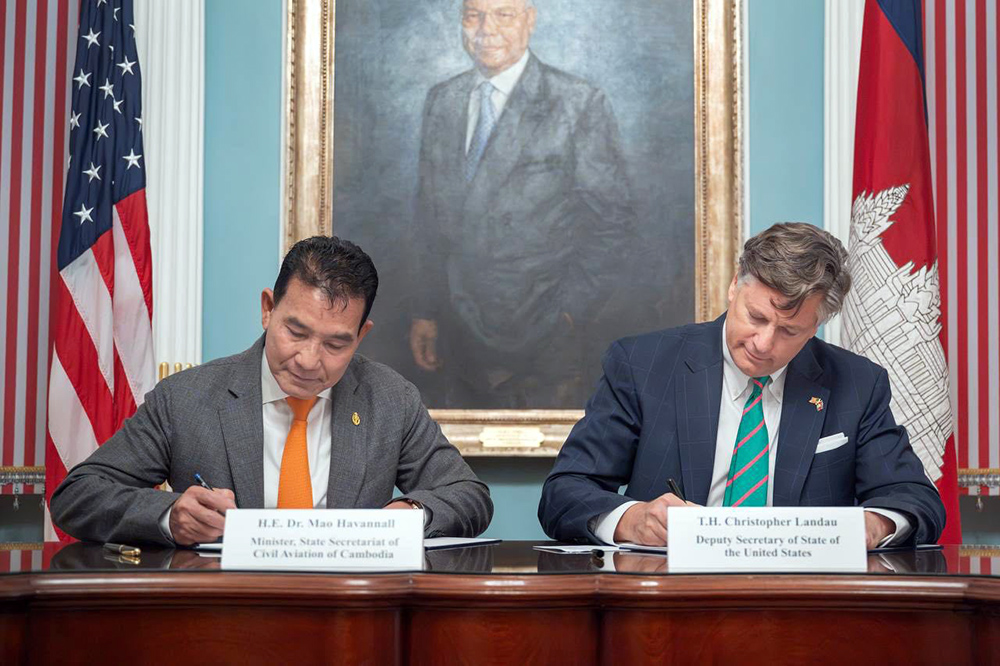
On June 30, 2026, Cambodia and the United States officially codified a historic Open Skies Air Transport Agreement in Washington, D.C.. Signed by H.E. Dr. Mao Havannall, Cambodia’s Minister-in-Charge of the State Secretariat of Civil Aviation (SSCA), and U.S. Deputy Secretary of State H.E. Christopher Landau, this first-ever bilateral air transport framework modernizes civil aviation ties and establishes high-standard commercial benchmarks between the two nations.
While political commentators may view this through the lens of pure diplomacy, a rigorous macroeconomic audit reveals a far more strategic architecture. This framework functions as a sovereign trade pipeline, fundamentally transforming Cambodia’s international logistics sector at a time when regional supply chains are actively diversifying.
The Technical Catalyst: “Seventh-Freedom” All-Cargo Rights
The operational core of this agreement lies in a highly specialized provision: the granting of all-cargo seventh-freedom traffic rights.
What are Seventh-Freedom Cargo Rights?
This legal mechanism permits air carriers to operate standalone cargo flights between the United States and a third country (e.g., routing from the US to Singapore or Vietnam) without any legal requirement to touch down or route the flight through a primary hub in Cambodia.
For international logistics conglomerates and asset-heavy freight carriers, this eliminates regulatory bottlenecks, lowers operational costs, and grants unprecedented route flexibility. It effectively integrates Cambodia’s aviation authority into global network planning, providing a strong baseline of structural predictability.
Data Visualization: The 2026 Aviation Divergence
The timing of this agreement corresponds precisely with a major macroeconomic shift occurring within Cambodia’s borders. Official SSCA data covering the first five months of 2026 highlights a striking divergence between passenger numbers and industrial freight operations.
| Aviation Sector Metric (Jan-May 2026) | Volume / Performance | Year-over-Year (YoY) Change |
| Total Air Passengers | 2.87 Million Travelers | 📉 Decreased by 6% |
| Air Cargo Freight | 38,951 Tonnes | 📈 Increased by 34% |
This 34% surge in air freight underscores a booming regional demand for high-value cargo logistics. As electronics manufacturing, specialized agricultural exports, and e-commerce fulfillment hubs scale up across Cambodia, the open skies framework provides the legal infrastructure necessary to absorb and accelerate this transpacific trade volume.
Financing Global Hubs: The Capital Connection
The Open Skies framework is not a standalone policy; it acts in lockstep with significant cross-border capital deployment. The agreement closely follows a recent US$100 million Letter of Intent approved by the U.S. International Development Finance Corporation (DFC) to co-finance Cambodia’s flagship Techo International Airport (KTI) in Phnom Penh.
Under the leadership of Prime Minister Samdech Moha Borvor Thipadei Hun Manet, Cambodia is aggressively pivoting toward infrastructure modernization. The civil aviation network currently spans 35 operating airlines—including 31 international carriers—connecting the country to ASEAN, East Asia, South Asia, and the Middle East. By binding this expanding ecosystem (comprising Techo International Airport, Siem Reap Angkor International Airport, and Sihanouk International Airport) to US standards, the Kingdom positions its primary hubs as highly competitive alternative nodes in regional supply-chain webs.
❓ Frequently Asked Questions (FAQ)
1. What makes the US-Cambodia Open Skies agreement a “historic” milestone?
It is the first bilateral air transport agreement ever established between Cambodia and the United States. It replaces ad-hoc diplomatic permissions with a permanent, legally binding framework that meets modern global aviation standards.
2. How does the 34% surge in air cargo impact local exporters?
The surge reflects robust industrial demand. With the new agreement providing flexible, affordable cargo routes and seventh-freedom rights, Cambodian exporters of high-value goods (like electronics and precision components) can secure faster, more direct access to lucrative Western markets.
3. Does the Open Skies framework apply to all airports in Cambodia?
The new framework applies exclusively to Cambodia’s network of active international hubs: Techo International Airport (KTI) in Phnom Penh, Siem Reap Angkor International Airport (SAI), and Sihanouk International Airport (KOS). Dara Sakor International Airport currently remains restricted to domestic operations.
Recommended Reading
- Cambodia’s Investment Surge in 2026: A Breakdown of New Projects
- Why Singaporean Investors Are Eyeing Cambodia’s Special Economic Zones (SEZs) in 2026