
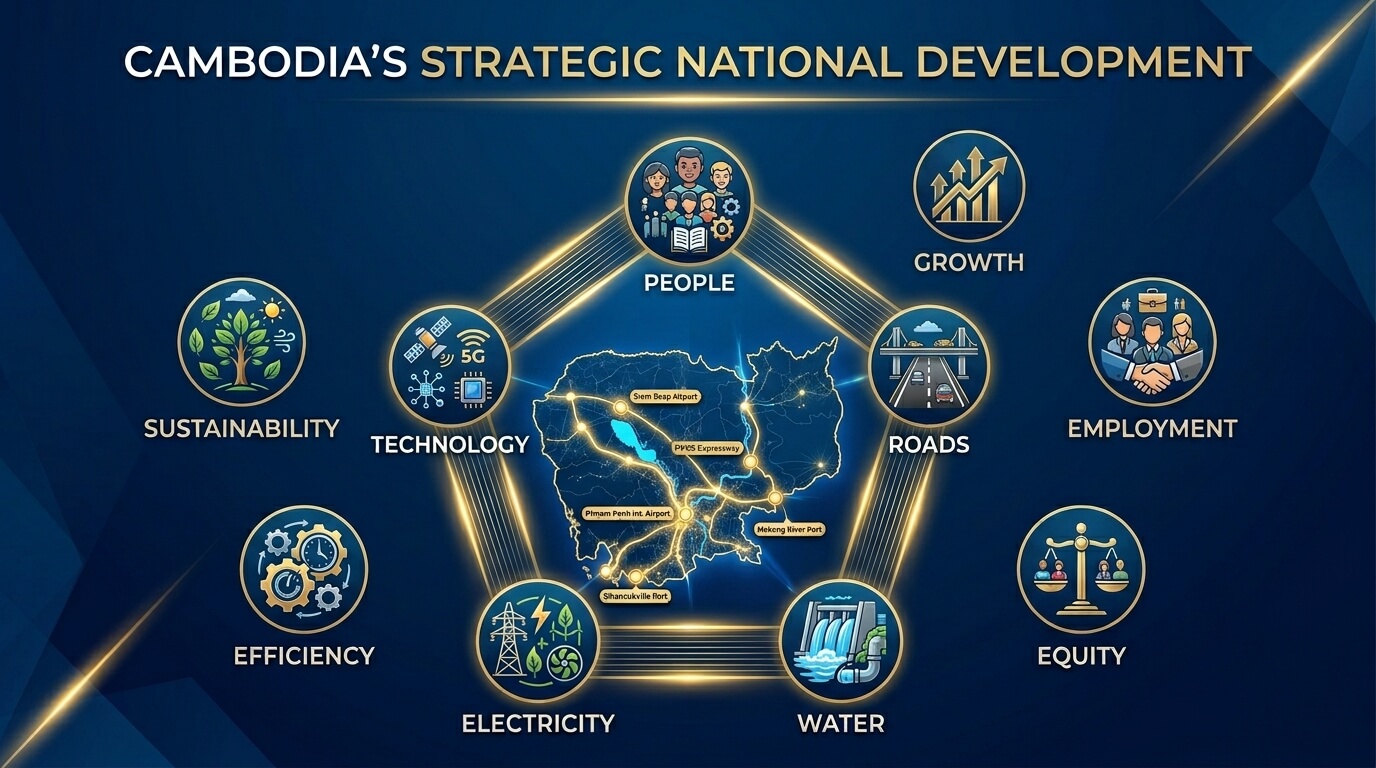
For decades, Cambodia’s development journey has been guided by a succession of strategic frameworks—from the Triangular Strategy to the Rectangular Strategy—each building on the last to lift the Kingdom from post‑conflict fragility to sustained economic growth. In August 2023, the Royal Government of the seventh mandate, under the leadership of Prime Minister Samdech Moha Borvor Thipadei Hun Manet, unveiled the next chapter in this evolution: the Pentagonal Strategy – Phase I (2023–2028).
This is not merely a rebranding of past policies. The Pentagonal Strategy adds a fifth strategic priority—technology—to the four pillars of the Rectangular Strategy, reflecting Cambodia’s determination to leapfrog into the digital age. With five key priorities (People, Roads, Water, Electricity, and Technology), five guiding mottos (Growth, Employment, Equity, Efficiency, and Sustainability), six priority policy programmes, and five key reform measures, the strategy provides a comprehensive, actionable roadmap for national development.
The stakes are high and the vision is clear. The Pentagonal Strategy is the vehicle for achieving Cambodia Vision 2050—the ambition to become an upper‑middle‑income country by 2030 and a high‑income nation by 2050. It is a strategy rooted in peace, driven by human capital development, and supported by a 2026 national budget projected at approximately US$10.1 billion—an increase of 7.8% from 2025, equivalent to 18.85% of GDP.
For investors, policymakers, and development partners, understanding this framework is essential to appreciating Cambodia’s long‑term trajectory and the opportunities that lie ahead. The Pentagonal Strategy is not just a policy document; it is the absolute bedrock of Cambodia’s development, anchored in the political stability and peace that provide the predictable policy continuity required for long‑term capital investment.
📌 Key Takeaways: Cambodia’s Pentagonal Strategy
- Phase I (2023–2028): The first phase of the Pentagonal Strategy, launched by Prime Minister Hun Manet in August 2023, builds on previous development frameworks while adding technology as a fifth strategic priority.
- Five Key Priorities: People, Roads, Water, Electricity, and Technology – the five pillars of national development under the strategy.
- Five Guiding Mottos: Growth, Employment, Equity, Efficiency, and Sustainability – the principles guiding all policy implementation.
- Six Priority Policy Programmes & Five Key Reform Measures: The strategy is operationalised through six priority policy programmes and five key reform measures, driving progress across all five strategic priorities.
- Vision 2030 & 2050: The strategy aims to achieve upper‑middle‑income status by 2030 and high‑income nation status by 2050.
- National Budget 2026: US$10.1 billion – an 7.8% increase from 2025, equivalent to 18.85% of GDP, allocated to advance the Pentagonal Strategy’s six priority programmes and five key reform measures.
- Human Capital Development: Identified as the top priority under the strategy, with technical and vocational education and training (TVET) serving as a key pillar.
- International Recognition: The World Bank is supporting the preparation of the Cambodia Vision 2050 report, and the EU has aligned its Global Gateway Strategy with the Pentagonal Strategy.
- Peace & Stability as the Absolute Bedrock: The strategy is anchored in Cambodia’s hard‑won peace and political stability, ensuring the predictable policy continuity that global investors demand for long‑term capital commitments.
What is the Pentagonal Strategy? – A Framework for National Development
The Pentagonal Strategy represents the culmination of decades of strategic planning in Cambodia. It is not a document created in isolation but the latest iteration of a continuous process of national development thinking that has evolved alongside the Kingdom’s remarkable transformation.
From Triangular to Rectangular to Pentagonal – The Evolution of Cambodia’s Development Planning
Cambodia’s journey of strategic planning began with the Triangular Strategy, which focused on three core priorities: agriculture, private sector development, and employment. This framework laid the foundation for economic recovery and growth in the immediate post‑conflict era.
The Rectangular Strategy expanded this vision into four pillars—growth, employment, equity, and efficiency—each supported by multiple strategic priorities. Implemented across four phases, this framework guided Cambodia through a period of sustained economic expansion:
In August 2023, the Royal Government of the seventh mandate, under the leadership of Prime Minister Samdech Moha Borvor Thipadei Hun Manet, launched the Pentagonal Strategy – Phase I (2023–2028) . This new framework adds a fifth strategic pillar—technology—to the four priorities of the Rectangular Strategy, reflecting Cambodia’s determination to embrace the digital economy and position itself for 21st‑century competitiveness.
The Pentagonal Strategy is explicitly designed to advance the Cambodia Vision 2050, the nation’s long‑term aspiration to become an upper‑middle‑income country by 2030 and a high‑income nation by 2050. It is a strategy that builds on the gains of the past while setting a course for a future defined by digital transformation, human capital development, and sustainable growth.
The Five Mottos: Growth, Employment, Equity, Efficiency, and Sustainability
At the heart of the Pentagonal Strategy are five guiding mottos that serve as the principles for all policy implementation:
1. Growth
Sustained, inclusive economic growth remains the foundation of Cambodia’s development. According to the Ministry of Economy and Finance’s Medium‑Term Fiscal Framework, the strategy targets GDP growth of approximately 5.0% in 2026, building on the 5.2% achieved in 2025. This growth is driven by industrial expansion, a rebound in services, and continued investment in infrastructure.
2. Employment
Creating quality jobs for Cambodia’s young and growing workforce is a central priority. With a median age of approximately 27 and 65% of the population under 30, Cambodia’s demographic dividend must be harnessed through education, skills training, and private sector development. The strategy aims to create formal employment opportunities that absorb new entrants into the labour market while improving working conditions and productivity.
3. Equity
Reducing inequality and ensuring that the benefits of growth reach all Cambodians is a core principle. The strategy prioritises rural development, social protection, and access to essential services—education, healthcare, and clean water—to bridge the gap between urban and rural communities.
4. Efficiency
Improving the efficiency of public services, infrastructure, and institutions is essential for competitiveness. The strategy includes reforms to enhance the ease of doing business, reduce logistics costs, and strengthen public financial management. A key instrument for achieving this is the Comprehensive Intermodal Transport and Logistics System (CITLS) Master Plan 2023–2033, approved by the Royal Government on 2 August 2023 and officially launched in February 2024. The master plan identifies 174 hard and soft infrastructure projects with an estimated investment of US$36.6 billion over ten years, including 94 road projects, 8 railway projects, 23 river transport projects, 20 maritime projects, and 10 aviation projects. Its four major objectives are: expanding transport infrastructure capacity, improving efficiency and effectiveness of transport services, reducing logistics costs, and supporting national development policies.
5. Sustainability
Environmental sustainability and climate resilience are integrated into the strategy’s framework. Cambodia is committed to sustainable development that balances economic growth with environmental protection, recognising that long‑term prosperity depends on the health of its natural resources.
These five mottos are not abstract ideals—they are measurable objectives that guide policy formulation, budget allocation, and programme implementation across all ministries and levels of government.
The Absolute Bedrock – Peace and Political Stability
Underpinning the entire Pentagonal Strategy is Cambodia’s hard‑won peace and political stability. This is not merely a favourable condition; it is the absolute bedrock upon which the strategy is built. As Prime Minister Hun Manet has consistently emphasised, peace is the prerequisite for all socio‑economic development.
For investors, this commitment to stability translates into predictable policy continuity—the assurance that the rules of engagement will not shift unpredictably with political cycles. The Pentagonal Strategy is not a short‑term plan but a long‑term commitment, backed by the political will of a government that has demonstrated its capacity to implement successive strategic frameworks over two decades.
The strategy is rooted in Cambodia’s constitutional commitment to neutrality and its active engagement with ASEAN and the international community. It is a framework that welcomes foreign investment, encourages private sector development, and provides the stable environment that long‑term capital requires.
Phase 1 (2023–2028) – Laying the Foundation
The Pentagonal Strategy – Phase I is structured as a comprehensive, multi‑sectoral policy document that translates the government’s vision into actionable programmes and measurable outcomes. It is built around five key priorities, six priority policy programmes, and five key reform measures—a coherent framework designed to build resilience across five priority sectors: public sector, economic sector, financial sector, human and social capital sector, and the environmental sector.
The Five Strategic Priorities: People, Roads, Water, Electricity, and Technology
At the core of the Pentagonal Strategy are five key priorities: People, Roads, Water, Electricity, and Technology. These priorities are not merely a list of sectors—they represent the foundational pillars upon which Cambodia’s long‑term development is built.
1. Human Capital Development (“People”)
“People” is the first and most important priority of the Pentagonal Strategy. This reflects the government’s recognition that Cambodia’s greatest asset is its human capital. The strategy focuses on:
- Enhancement of the quality of education, sports, science, and technology
- Technical skills training to meet the demands of a modern economy
- Improvements to people’s health and well‑being
- Strengthening of the social protection system and food system
- Strengthening the quality of citizenship in a highly civilised society with morality, equity, and inclusiveness
The government has designated 15 June as National Technical and Vocational Education and Training (TVET) Day, reflecting the priority placed on skills development. TVET is positioned as a key pillar of human capital development under the strategy, equipping Cambodians with the skills needed for a rapidly evolving job market.
2. Roads
Infrastructure development sits squarely within the Pentagonal Strategy’s five priorities and plays a decisive role in reducing business costs, improving market access, and strengthening Cambodia’s integration into regional and global supply chains. The priority on roads encompasses the expansion and modernisation of Cambodia’s transport network, including the national road system, expressways, and rural connectivity.
3. Water
Water resources management is critical for both agricultural productivity and climate resilience. The strategy prioritises irrigation infrastructure, water security, and sustainable management of Cambodia’s waterways—including major projects such as the Funan Techo Canal, which will enhance water transport and logistics capacity. The canal, officially launched in August 2024 with Section II breaking ground in April 2026, is a major strategic waterway connecting Phnom Penh to the sea. Its main goal is to boost the nation’s economic growth, waterway transport, and logistics capacity. The project will transform the areas along the canal into industrial, commercial, agro‑industrial, logistics, and special economic zones, as well as tourist attractions. This integration of water infrastructure with economic development exemplifies the multi‑sectoral approach of the Pentagonal Strategy, creating synergies between water management, transport connectivity, and industrial growth.
4. Electricity
Energy security and access to affordable, reliable electricity are fundamental to industrial development and improving living standards. The strategy focuses on expanding electricity generation capacity, improving grid connectivity, and promoting renewable energy sources to support economic growth and reduce dependency on imported energy.
5. Technology
Technology—particularly digital technology—is the new addition to the strategic framework, added to address the Fourth Industrial Revolution and accelerate the digital transformation of Cambodia’s economy and society. The strategy emphasises building digital government and digital citizens; developing the digital economy, digital business, e‑commerce, and digital innovation systems; building and developing digital infrastructure; building trustworthiness in the digital system; and developing financial technology. This priority reflects Cambodia’s determination to leapfrog into the digital age and position itself as a competitive player in the 21st‑century economy.
Five Priority Areas Driving Implementation
The five key priorities are operationalised through five priority areas, each with specific tasks to be accomplished:
- Human Capital Development – focusing on education quality, technical skills training, health improvements, social protection, and citizenship strengthening
- Economic Diversification and Competitiveness Enhancement – focusing on developing key sectors and new sources of growth; enhancing connectivity and efficiency in transport, logistics, energy, water, and digital sectors; improving the business and investment environment; strengthening SEZs and industrial parks; and innovating financing mechanisms
- Development of Private Sector and Employment – focusing on labour market development; promoting MSMEs, startups, and the informal economy; strengthening public‑private partnerships; promoting competition; and strengthening the banking system and non‑bank financial sector
- Resilient, Sustainable and Inclusive Development – focusing on optimising demographic dividends; sustainable management of natural resources, cultural heritage, and tourism; promoting agriculture and rural development; strengthening urban management; and ensuring environmental sustainability and climate resilience
- Development of Digital Economy and Society – focusing on building digital government and citizens; developing digital economy, e‑commerce, and innovation systems; building digital infrastructure; building trustworthiness in digital systems; and developing financial technology.
Six Priority Policy Programmes and Five Key Reform Measures
The strategy is implemented through six priority policy programmes and five key reform measures. The six priority policy programmes were launched in 2023 to improve citizens’ living standards through building resilience and ensuring sustainable growth. The 2026 national budget allocates funds specifically to advance these six priority programmes, five key reform measures, and five core objectives.
The Six Priority Policy Programmes:
- Expand healthcare services towards achieving universal health coverage
- Provide vocational and technical training for poor and vulnerable youth
- Institutionalise the national social assistance programme for poor households, vulnerable people, and at‑risk households during economic crises and emergencies
- Formulate and accelerate the implementation of the Informal Economy Development Strategy to support the shift to the formal economy and participation in the formal social protection system
- Introduce a coordinating mechanism and financing programme for agricultural products’ production, market access, and price stability at a reasonable level
- Deploy agricultural technical officers to all communes and Sangkats with agricultural activities and form farmers’ associations in rural areas
- Public Administration Reform – improving the efficiency and effectiveness of government institutions and strengthening institutional capacity
- Education and Human Resource Reform – improving the quality of education and skills training to meet the demands of a modern economy
- Judicial and Legal Reform – strengthening the rule of law and the legal framework to protect citizens and investors
- Anti‑Corruption Measures – strengthening the fight against corruption through enhanced enforcement and institutional mechanisms
- Public Financial Management Reform – ensuring that public resources are used efficiently and effectively to deliver the strategy’s priorities.
Human Capital Development – The First Priority
Human capital development is not just one of five priorities—it is the top priority of the Pentagonal Strategy. As the government has repeatedly emphasised, Cambodia’s people are the nation’s most valuable resource. The strategy’s focus on human capital includes:
- Education reform – improving the quality of education at all levels, with a focus on science, technology, and innovation
- TVET expansion – providing technical and vocational training to equip young Cambodians with employable skills
- Health system strengthening – improving healthcare access and quality, and working towards Universal Health Coverage
- Social protection – expanding the social protection system to cover vulnerable populations
- Citizenship and social values – building a civilised society grounded in morality, equity, and inclusiveness
The career roadmap drafted in April 2026, identifying 96 distinct occupational roles across hospitality, travel services, wellness, and MICE, is a direct manifestation of this priority.
The Institutional Framework – Governance as the Backbone
Good governance is the backbone of the Pentagonal Strategy. The strategy emphasises strengthening capacity, governance, and the quality of public institutions as essential to achieving its objectives. This includes:
- Public administration reform – improving the efficiency and effectiveness of government institutions
- Digital government – leveraging technology to improve service delivery and transparency
- Rule of law and anti‑corruption – strengthening the legal and regulatory framework to protect citizens and investors
- Public financial management – ensuring that public resources are used efficiently and effectively to deliver the strategy’s priorities
The strategy’s success depends not only on the policies themselves but on the quality of their implementation. As the government has acknowledged, strengthening institutional capacity and governance is essential to bridging the gap between policy and results.
Financing the Vision – The 2026 National Budget
The Pentagonal Strategy is not merely a document of intent—it is backed by a substantial and growing fiscal commitment. The 2026 national budget, approved by the Council of Ministers on 24 October 2025 and subsequently enacted into law, provides the financial foundation for implementing the strategy’s six priority policy programmes, five key reform measures, and five strategic priorities.
US$10.1 Billion – A Commitment to the Pentagonal Strategy
The Law on Finance for Management 2026 authorises total government spending of 40,913 billion riels (approximately US$10.16 billion) , equivalent to 18.85% of GDP. This represents a 7.8% increase compared to the 2025 Financial Management Law.
The budget is structured to support the implementation of the Pentagonal Strategy Phase I across six chapters and fifteen articles. Key priorities include:
- Strengthening national sovereignty and territorial integrity
- Ensuring the continuity of government institutions’ operations
- Supporting the implementation of major policy priorities
- Continuing key and practical reform measures
Five Main Priorities of the 2026 Budget
Speaking at a parliamentary workshop on 10 November 2025, H.E. Dr. Aun Pornmoniroth, Deputy Prime Minister and Minister of Economy and Finance, outlined the five main priorities of the 2026 budget, directly aligned with the Pentagonal Strategy:
- Safeguarding sovereignty and peace while maintaining macroeconomic stability
- Accelerating human resource and institutional development
- Promoting competitiveness through innovation and digital transformation
- Improving fiscal efficiency through better revenue and expenditure management
- Expanding social protection for vulnerable groups
These priorities reflect the government’s commitment to implementing key reforms in public administration, education, health, local governance, and the judiciary under the Pentagonal Strategy – Phase I.
Fiscal Discipline and Macroeconomic Stability
The 2026 budget is designed to balance ambitious investment in the Pentagonal Strategy with prudent fiscal management. The government’s Medium-Term Fiscal Framework targets a gradual reduction in the fiscal deficit from 3.08% of GDP in 2025 to 2.19% in 2026, ensuring fiscal sustainability while supporting long-term economic resilience.
International financial institutions have provided positive assessments of Cambodia’s fiscal trajectory. The Ministry of Economy and Finance projects GDP growth of 5.2% in 2025 and 5.0% in 2026, driven by solid performance in the industry, services, and agriculture sectors. GDP per capita is forecast to reach US$3,020 in 2026, up from US$2,858 in 2025.
The budget framework reflects Cambodia’s commitment to consolidating macroeconomic stability, promoting sustainable development, and enhancing public sector efficiency in line with the nation’s long-term vision for inclusive growth.
As H.E. Dr. Aun Pornmoniroth stated: “The national budget is not only a financial document but also a roadmap for Cambodia’s sustainable and inclusive growth. With sound fiscal management and continued reforms, Cambodia will stay on course toward lasting peace and prosperity”.
The Social Sector Commitment – Education, Health, and Social Affairs
The 2026 budget maintains the government’s commitment to social sector investment, with education and health spending protected from cuts. Prime Minister Hun Manet has confirmed that between 2024 and 2026, the budget allocated to the social affairs, education, and health sectors increased by more than US$2.6 billion, representing an average annual increase of 7%. Under the 2026 national budget law, education spending was approved at 4.474 trillion riel, exceeding the initial negotiation ceiling.
This sustained investment in human capital reflects the government’s recognition that “People” is the first and most important priority of the Pentagonal Strategy, and that investing in education, health, and social protection is essential to achieving Cambodia’s vision of becoming an upper-middle-income country by 2030 and a high-income nation by 2050.
International Recognition and Partnership
The Pentagonal Strategy has attracted significant international attention and endorsement from multilateral institutions, development partners, and regional neighbours. This external validation reinforces the credibility of Cambodia’s long‑term development vision and provides tangible support for its implementation.
World Bank Support for Vision 2050
The World Bank has emerged as a key partner in advancing Cambodia’s Vision 2050, actively supporting the preparation of the Vision 2050 report and aligning its engagement with the Pentagonal Strategy.
In October 2025, the World Bank reaffirmed its support for Cambodia’s development toward Vision 2050, commending Cambodia’s “clear and ambitious pathway” and highlighting its resilience amid global uncertainties. This commitment was further strengthened in March 2026, when the World Bank pledged enhanced support for Cambodia’s 2050 high‑income vision. The meeting underscored a “deepening alignment between Cambodia’s Pentagonal Strategy and the World Bank’s regional development goals” as the country navigates its transition toward advanced economy status over the next two decades.
The World Bank’s support is operationalised through the Country Partnership Framework (CPF 2025–2029) between the Royal Government and the Bank. This framework aligns with Phase I of the Pentagonal Strategy, the National Strategic Development Plan, and Cambodia’s priority needs. The World Bank reiterated its readiness to continue collaborating with Cambodia to advance the nation’s future goals.
As Prime Minister Hun Manet noted, the Pentagonal Strategy Phase I serves as “an essential foundation for the preparation of Cambodia Vision 2050,” building upon “the achievements of peace and development over the past 25 years, made possible by the win‑win policy of former Prime Minister and current Senate President Hun Sen”.
EU Alignment and Global Gateway – The Team Europe Partnership
The European Union has explicitly aligned its development cooperation with Cambodia’s Pentagonal Strategy, providing both policy endorsement and financial commitment through the Global Gateway framework and the Joint European Strategy (JES) 2021–2027.
In February 2026, the EU and Cambodia held their 13th Joint Committee Meeting in Phnom Penh, where both sides reaffirmed the alignment between Cambodia’s Pentagonal Strategy – Phase I and the EU’s Global Gateway Strategy. They committed to mobilising investments in quality infrastructure under Global Gateway and Team Europe, particularly in the energy and clean water sectors.
The alignment extends beyond infrastructure. The EU’s Global Gateway Strategy complements the JES by mobilising sustainable investments aligned with Cambodia’s development priorities. Focused on energy, infrastructure, skills development, green agribusiness, factories, and job creation, the Team Europe Initiatives (TEIs) advance Cambodia’s Pentagonal Strategy goals.
Two Global Gateway Flagships are already being implemented:
1. Bakheng Water Treatment Plant: A flagship project supported by France through AFD, with a combined EU investment of over €600 million across three phases. Phases 1 and 2 have a combined production capacity of 390,000 m³/day, significantly improving access to clean water for over 2 million residents in Phnom Penh and Ta Khmau City. Phase 3 will further expand access to clean water for industry and the urban population.
2. Partnership in Education for Green and Digital Jobs: A collaborative initiative to equip Cambodia’s workforce with the skills needed for the green and digital transitions.
The Team Europe Joint Co‑financing Architecture—bringing together the EU, its Member States, and European financial institutions—provides the concrete financial mechanism through which these investments are delivered. As one official noted, these frameworks “not only align closely with Cambodia’s Pentagonal Strategy but also demonstrate shared commitment to inclusive growth, human development, and environmental sustainability”. Through the JES and Global Gateway, the EU aims to align European know‑how and financing in support of Cambodia’s sustainable growth, institutional resilience, and inclusive prosperity.
Regional Endorsement from ASEAN Partners
Cambodia’s Pentagonal Strategy has also received strong endorsement from ASEAN neighbours, reinforcing the Kingdom’s regional integration and credibility.
During Prime Minister Hun Manet’s first official visit to Vietnam in December 2023—his first visit to an ASEAN country since taking office in August 2023—Vietnamese Prime Minister Pham Minh Chinh expressed confidence that Cambodia, under its decisive governance, would complete Phase I of its Pentagonal Strategy and achieve its goals of becoming an upper‑middle‑income country by 2030 and a high‑income country by 2050. Both sides pledged to expand education and training cooperation, improve workforce quality, and raise public awareness—particularly among younger generations—regarding close neighbourly relations. This strategic endorsement has been reaffirmed through subsequent high‑level engagements, including the 3rd ASEAN Future Forum (AFF) in Hanoi in June 2024, where Prime Minister Hun Manet participated and further strengthened bilateral ties.
Cambodia has also shared its Pentagonal Strategy vision within broader ASEAN forums. At regional meetings, Prime Minister Hun Manet has briefed ASEAN partners about the strategy, which envisions Cambodia becoming a high‑income country by 2050, and affirmed Cambodia’s commitment to working closely with all ASEAN member states and the private sector to foster inclusivity, peace, and prosperity in the region.
International Partnerships Across Key Sectors
Beyond the World Bank, EU, and ASEAN, Cambodia is cultivating a wide network of international partnerships aligned with the Pentagonal Strategy:
- Japan: Cambodia and Japan are deepening cooperation in water and sewerage technology. Aligned with the Pentagonal Strategy Phase I, Cambodia has set a national goal of universal access to clean water by 2030 as a foundation for Vision 2050.
- Australia: Australia has expressed support for the launch of the Pentagonal Strategy – Phase 1, which will promote resilient and sustainable economic development in Cambodia. Australia is also strengthening cooperation with Cambodia in technical and vocational training, directly supporting the strategy’s human capital priority.
- South Korea: Through KOICA, South Korea has launched a US$11.7 million project to boost governance reform in Cambodia, strategically aligned with the Pentagonal Strategy – Phase I and long‑term Vision 2050, particularly in the priority areas of human capital and digital transformation.
- United Arab Emirates: Cambodia and the UAE are strengthening ties in industry and innovation, with human resource development in science and technology highlighted as a key priority. As one Cambodian minister noted: “Human resource development in science and technology is critical, as technology is the fifth pillar of our Pentagonal Strategy”.
- China: The Pentagonal Strategy is aligned with China’s Belt and Road Initiative. As one analyst noted, “This is not just a framework—it is a blueprint for long‑term strategic alignment, linking China’s Belt and Road Initiative with Cambodia’s Pentagonal Strategy”.
- United Nations: The UN system, through over 10 agencies including WHO, is supporting Cambodia’s strategic roadmap as the country prepares to graduate from Least Developed Country (LDC) status.
LDC Graduation – A Global Confidence Indicator
Cambodia’s progress toward graduating from Least Developed Country (LDC) status by 2029 serves as a powerful Global Confidence Indicator—a tangible signal to international investors that Cambodia is transitioning to a new tier of economic maturity.
In April 2026, a UN Under‑Secretary‑General reaffirmed the United Nations’ commitment to supporting Cambodia’s graduation process, noting that a dedicated UN task force has been established to assist in the transition. She further highlighted that Cambodia has already met the criteria for graduation from the LDC category in two previous assessments and remains on track for graduation by 2029.
This UN endorsement is not merely symbolic. It reflects Cambodia’s demonstrated capacity to meet rigorous international development benchmarks and signals to investors that the Kingdom is moving decisively toward upper‑middle‑income status by 2030 and high‑income nation status by 2050. The UN’s confidence in Cambodia’s trajectory is reinforced by the Country Partnership Framework, the Joint European Strategy, and the alignment of the Pentagonal Strategy with the Sustainable Development Goals (SDGs).
A Strategy Backed by Global Confidence
The breadth and depth of international endorsement for Cambodia’s Pentagonal Strategy send a clear signal: the global community recognises Cambodia’s long‑term vision as credible, ambitious, and worthy of support. From the World Bank’s Country Partnership Framework to the EU’s Global Gateway and Team Europe co‑financing, from ASEAN neighbourly endorsement to bilateral partnerships with Japan, Australia, South Korea, the UAE, and China, the Pentagonal Strategy has attracted a level of international engagement that reflects genuine confidence in Cambodia’s trajectory.
For investors, this international recognition provides an additional layer of assurance: the Pentagonal Strategy is not merely a domestic policy document but a framework that has been scrutinised, validated, and supported by the world’s leading development institutions and Cambodia’s key partners. It is a strategy with global backing—and global expectations.
The Road to 2030 and 2050 – Ambitious but Achievable
The Pentagonal Strategy is not an end in itself—it is the vehicle for realising Cambodia’s most ambitious national aspirations: upper‑middle‑income status by 2030 and high‑income nation status by 2050. These are not abstract targets; they are concrete milestones that, if achieved, would represent one of the most sustained economic transformations in modern history. Yet, the arithmetic is demanding, and the path is strewn with both opportunities and obstacles.
Upper‑Middle‑Income Status by 2030 – A Daunting Arithmetic
According to World Bank classifications, upper‑middle‑income status for the 2026 fiscal year requires a Gross National Income (GNI) per capita between $4,496 and $13,935. Cambodia had a GNI per capita of approximately $2,390 in 2023. To reach the threshold by 2030, the government must maintain an average annual economic growth of at least 6.77% over the next seven years.
This is a formidable challenge. The government’s own Medium‑Term Public Financial Framework (2027–2029) has revised the 2026 growth forecast downward from 5.0% to 4.2%, citing external pressures including the Middle East conflict, US tariff measures, and the lingering impacts of the border dispute. International financial institutions have similarly adjusted their projections: the World Bank now forecasts 3.9% growth in 2026 (down from earlier projections), recovering to 4.9% in 2027, while the IMF projects 4.0% in 2026.
The gap between the required 6.77% growth and the projected 4.0–4.2% is significant. Variations in income levels are not merely figures—they reflect the productive capacity of the entire nation. Cambodia needs a structural economic shift from reliance on low‑value‑added sectors—such as garments and traditional agriculture—toward high‑value‑added and knowledge‑based sectors.
High‑Income Nation by 2050 – An Even Steeper Ascent
The 2050 vision demands even more. To achieve high‑income status, Cambodia must raise its GNI per capita to the World Bank threshold of $13,935. This requires productivity growth to exceed 2% per year for the next 25 years—a performance benchmark that, globally, has only been achieved by South Korea.
Cambodia’s current productivity growth stands at approximately 0.8%. Closing this gap will require a transition from growth driven by factor accumulation to growth anchored in efficiency, innovation, and formal sector expansion.
The AmCham Business Outlook 2026 Survey warns that Cambodia is not on track to achieve the required annual GDP growth rate of 6.4% for the purpose, noting that when population growth is factored in (approximately 2% annually), GDP would need to grow by more than 8% each year to stay on course. Regulatory bottlenecks—particularly licensing requirements—stand out as a key obstacle to productivity and investment.
The “Middle‑Income Trap” – A Real and Present Danger
A deep analysis of macroeconomic aspects, institutional structures, and human capital reveals weaknesses that demand vigorous and genuine reform. Although the Pentagonal Strategy – Phase I focuses on five priority areas—”People, Roads, Water, Electricity, and Technology”—many critics have pointed to the gap between policy introduction and actual implementation results.
The primary issue lies in “Governance and Institutional Capacity,” which is considered the core of the strategy but is also the area where Cambodia is weakest. The public administration system was established in a post‑war context that focused heavily on centralisation of power and ensuring political stability through the provision of state framework jobs. This structure has created a strict hierarchical system within the civil service that often values “loyalty” over “competence and innovation” . Officials with high technical knowledge often lack decision‑making power, leading to a lag in responding to the rapid economic changes of the Industrial Revolution 4.0.
Another major gap is the weakness of inter‑ministerial coordination. Development work to reach upper‑middle‑income status requires close collaboration between many institutions. However, efforts often encounter the problem of “siloed” work, where each ministry focuses only on its own plan without considering systemic impacts. For example, promoting the agro‑industrial sector requires coordination between the Ministry of Agriculture, the Ministry of Commerce, the Ministry of Economy, and the Ministry of Public Works; yet, the lack of a shared data system and clear accountability mechanisms has caused many projects to stall. Furthermore, limitations in statistical data and delays in releasing key economic data have made risk assessment a matter of guesswork rather than evidence‑based planning.
The Cross‑Sectoral Reform Mandate – Breaking the Silos
Recognising these institutional weaknesses, the Royal Government has embedded within the Pentagonal Strategy a Cross‑Sectoral Reform Mandate—a deliberate effort to break down the “siloed” work culture that has historically hindered policy implementation. This mandate is anchored in the strategy’s fifth pillar—good governance as the backbone—and is operationalised through several mechanisms:
1. National Reform Leadership Committee: The government has established a high‑level national committee to oversee and coordinate cross‑sectoral reforms, ensuring that ministries work collaboratively toward shared objectives rather than in isolation. This committee is empowered to resolve inter‑ministerial conflicts and drive accountability across the public sector.
2. Digital Government and Data Integration: The strategy prioritises the development of digital government infrastructure to enable seamless data sharing across ministries. This includes the expansion of the National Single Window system, which integrates the CDC, Ministry of Commerce, General Department of Taxation, Ministry of Labour, Ministry of Interior, and Ministry of Economy and Finance into a unified online portal for investment registration and licensing. By breaking down data silos, this system reduces bureaucratic duplication and improves policy coherence.
3. Performance‑Based Accountability: The government is shifting from process‑based to performance‑based accountability frameworks, linking budget allocations to measurable outcomes. The 2026 national budget is explicitly structured to support the six priority policy programmes and five key reform measures, with clear targets for each ministry.
4. Public Financial Management Reform: As one of the five key reform measures, PFM reform is designed to ensure that public resources are allocated efficiently across sectors, rather than being locked into ministry‑specific silos. This includes the Medium‑Term Fiscal Framework, which aligns budget planning with the strategy’s priorities.
The Pentagonal Strategy’s emphasis on good governance as the backbone of implementation reflects the government’s recognition that institutional fragmentation is a binding constraint on development. While progress is gradual, the establishment of cross‑sectoral coordination mechanisms and the digitalisation of government services represent concrete steps toward breaking the silos that have historically hindered effective policy implementation.
Opportunities – The Bright Spots
Despite the challenges, Cambodia possesses significant strengths that can be leveraged for sustained growth:
1. A Young and Growing Workforce
With the working‑age population share projected to peak around 2043, the next 15 to 20 years are decisive for Cambodia’s future. Investing in people—in education, in jobs, in new engines of growth—is what will turn Cambodia’s demographic window into its greatest competitive advantage.
2. Resilient FDI and Strong Exports
Foreign direct investment reached $5.1 billion in 2025, helping to create an estimated 400,000 formal jobs. Goods exports also remain strong, growing by 17.7% in the first quarter of 2026.
3. A Clear Policy Framework with International Backing
The Pentagonal Strategy – Phase I has attracted support from the World Bank, the EU, the UN, and regional partners. The World Bank’s Country Partnership Framework (CPF 2025–2029) aligns with the strategy, and the EU has aligned its Global Gateway Strategy with Cambodia’s development priorities.
4. LDC Graduation – A Global Confidence Indicator
Cambodia has already met the criteria for graduation from the Least Developed Country (LDC) category in two previous assessments and remains on track for graduation by 2029. A dedicated UN task force has been established to assist in the transition.
5. Emerging Knowledge‑Based Economy
The Ministry of Industry, Science, Technology and Innovation (MISTI) has unveiled a strategic research framework outlining the infrastructure needed to transform Cambodia into a knowledge‑based economy. The Cambodia STI Roadmap 2030 targets total STI investment of at least 1% of GDP by 2030—a critical investment in the nation’s future.
The Path Forward – What Must Be Done
The World Bank’s June 2026 Economic Update recommends a multi‑pronged policy response focused on protecting livelihoods and supporting job creation while pursuing structural reforms that strengthen competitiveness and productivity. Key recommendations include:
- Productivity Growth: Cambodia must close the gap between current productivity growth (0.8%) and the 2% annual growth needed for high‑income status by 2050.
- Human Capital Investment: Building human capital, boosting productivity, and supporting sectors with strong employment potential remain key priorities.
- Structural Reforms: Continued structural reforms to promote economic diversification, enhance competitiveness, and build socio‑economic resilience are essential.
- Formalisation of the Informal Economy: With 41% of informal enterprises classified as subsistence enterprises and 44% as potential enterprises, carefully targeted reforms—including social protection, incentives to formalise, and improved business registration processes—are critical.
- Short‑Term Support: Targeted, time‑bound cash transfers to vulnerable households, mobilising domestic revenue to sustain essential investments in health and education, and fast‑tracking fertilizer imports to support farmers.
The Verdict – Ambitious but Achievable
Cambodia’s vision of becoming an upper‑middle‑income country by 2030 and a high‑income nation by 2050 is among the most ambitious development targets in Southeast Asia. The arithmetic is daunting: 6.77% annual growth for the next seven years, followed by 8%+ annual growth for the next two decades. Yet Cambodia has demonstrated resilience in the face of simultaneous shocks.
The gap between policy and implementation is real, and the structural challenges—governance capacity, inter‑ministerial coordination, regulatory bottlenecks—must be addressed with urgency. But the opportunities are equally significant: a young workforce, strong FDI, international backing, and a clear policy framework that has attracted global confidence.
As the World Bank’s Country Manager noted: “Cambodia’s economy is holding in the face of simultaneous shocks, demonstrating a resilience that can be sustained through targeted policy action to protect jobs and livelihoods” . With sound fiscal management, continued reforms, and a commitment to implementation, Cambodia can stay on course toward lasting peace and prosperity. The road to 2030 and 2050 is long, steep, and fraught with obstacles—but it is not impassable.
❓ Frequently Asked Questions (FAQ)
1. What is the Pentagonal Strategy?
The Pentagonal Strategy is Cambodia’s national development roadmap for 2023–2050, launched by Prime Minister Hun Manet in August 2023. It is a 25‑year commitment structured in five successive phases, with Phase I covering 2023–2028. The strategy aims to transform Cambodia into an upper‑middle‑income country by 2030 and a high‑income nation by 2050.
2. What are the five key priorities of the Pentagonal Strategy?
The strategy adopts five key priorities: People, Roads, Water, Electricity, and Technology. These five pillars form the foundation of Cambodia’s long‑term development. “People” is the first and most important priority, focusing on human capital development, education, health, and social protection.
3. What are the five mottos of the Pentagonal Strategy?
The strategy is guided by five mottos: Growth, Employment, Equity, Efficiency, and Sustainability. These principles guide all policy formulation, budget allocation, and programme implementation across all ministries and levels of government.
4. What is Phase I of the Pentagonal Strategy?
Phase I (2023–2028) is the first phase of the strategy. It serves as the foundation for long‑term transformation, emphasising critical reforms, infrastructure expansion, and investment in human capital. The phase is operationalised through six priority policy programmes and five key reform measures, covering public administration reform, education and human resource reform, judicial and legal reform, anti‑corruption measures, and public financial management reform.
5. How is the Pentagonal Strategy funded?
The strategy is backed by a substantial fiscal commitment. The 2026 national budget authorises total government spending of 40,913 billion riels (approximately US$10.16 billion), equivalent to 18.85% of GDP—a 7.8% increase from 2025. The budget is structured to support the implementation of the strategy’s six priority policy programmes, five key reform measures, and five strategic priorities. The government’s Medium‑Term Fiscal Framework targets a gradual reduction in the fiscal deficit from 3.08% of GDP in 2025 to 2.19% in 2026.
6. What is the connection between the Pentagonal Strategy and the Cambodia Vision 2050?
The Pentagonal Strategy is the vehicle for achieving Cambodia Vision 2050—the nation’s long‑term aspiration to become an upper‑middle‑income country by 2030 and a high‑income nation by 2050. The strategy’s Phase I serves as “an essential foundation for the preparation of Cambodia Vision 2050,” building upon the achievements of peace and development over the past 25 years.
7. Why is human capital development the top priority?
Human capital development is the first and most important priority of the Pentagonal Strategy because Cambodia’s greatest asset is its people. The strategy focuses on enhancing the quality of education, technical and vocational training (TVET), health improvements, social protection, and citizenship strengthening. The government has designated 15 June as National TVET Day, reflecting the priority placed on skills development to equip Cambodians for a rapidly evolving job market.
8. What role does technology play in the Pentagonal Strategy?
Technology is the new addition to the strategic framework, added to address the Fourth Industrial Revolution and accelerate Cambodia’s digital transformation. The strategy emphasises building digital government and digital citizens; developing the digital economy, e‑commerce, and digital innovation systems; building and developing digital infrastructure; building trustworthiness in the digital system; and developing financial technology. This priority reflects Cambodia’s determination to leapfrog into the digital age.
9. What is the “middle‑income trap” and is Cambodia at risk?
The “middle‑income trap” refers to the risk that a developing economy reaches middle‑income status but then fails to transition to high‑income status due to structural weaknesses in governance, innovation, and productivity. Cambodia faces this risk due to gaps between policy and implementation, weak inter‑ministerial coordination, and a public administration system that often values loyalty over competence. However, the Pentagonal Strategy’s emphasis on good governance as the backbone and the establishment of cross‑sectoral reform mechanisms are concrete steps to address these challenges.
10. How does the international community support the Pentagonal Strategy?
The Pentagonal Strategy has attracted significant international endorsement. The World Bank is actively supporting the preparation of the Cambodia Vision 2050 report through its Country Partnership Framework (CPF 2025–2029). The European Union has aligned its Global Gateway Strategy with Cambodia’s development priorities, with two Global Gateway Flagships already being implemented: the Bakheng Water Treatment Plant (over €600 million) and the Partnership in Education for Green and Digital Jobs. Regional partners including Vietnam, Japan, Australia, South Korea, and China have also expressed strong support. The United Nations has established a dedicated task force to assist Cambodia’s transition from LDC status by 2029.
Conclusion: The Pentagonal Strategy – A Risk‑Adjusted Roadmap for Cambodia’s Long‑Term Transformation
Cambodia’s Pentagonal Strategy represents a defining moment in the Kingdom’s development journey. It is not merely a policy document but a comprehensive, multi‑sectoral framework that translates national ambition into actionable programmes, measurable outcomes, and accountable governance. From the corridors of Phnom Penh’s ministries to the conference rooms of international financial institutions, the Pentagonal Strategy has established itself as a credible, transparent roadmap for Cambodia’s long‑term prosperity—but a roadmap that must navigate significant and growing headwinds.
The strategy is anchored in a clear and ambitious vision: upper‑middle‑income status by 2030 and high‑income nation status by 2050. It is built on five key priorities—People, Roads, Water, Electricity, and Technology—and guided by five mottos—Growth, Employment, Equity, Efficiency, and Sustainability. Phase I (2023–2028) is operationalised through six priority policy programmes and five key reform measures, backed by a national budget of over US$10.16 billion in 2026—a 7.8% increase from the previous year, equivalent to 18.85% of GDP.
Yet the arithmetic is unyielding. To achieve upper‑middle‑income status by 2030, Cambodia must sustain average annual growth of 6.77% over the next seven years. Current projections tell a different story: the government’s Medium‑Term Fiscal Framework forecasts 4.2% growth in 2026, while the World Bank projects 3.9% and the IMF 4.0%. The gap between ambition and current trajectory is not merely a statistical curiosity—it is a binding constraint that demands urgent and sustained policy action.
The Risk‑Adjusted Reality:
The “middle‑income trap” is not a distant threat but a present danger. Governance capacity remains the weakest link in the strategy’s implementation chain. Inter‑ministerial coordination is hindered by “siloed” working cultures, and the public administration system often values loyalty over competence and innovation. Regulatory bottlenecks and licensing requirements stifle productivity and investment. These are not abstract criticisms—they are binding constraints that must be addressed if Cambodia is to close the growth gap.
The Mitigation Mechanisms:
To its credit, the government has embedded within the Pentagonal Strategy explicit mechanisms to address these challenges:
- The Five Key Reform Measures—public administration reform, education and human resource reform, judicial and legal reform, anti‑corruption measures, and public financial management reform—provide a structured framework for institutional strengthening.
- The Cross‑Sectoral Reform Mandate—operationalised through the National Reform Leadership Committee—is designed to break down inter‑ministerial silos and drive accountability.
- Digital Government Integration—including the expansion of the National Single Window system—aims to reduce bureaucratic duplication and improve policy coherence.
- Performance‑Based Accountability—linking budget allocations to measurable outcomes—represents a shift from process‑based to results‑based governance.
- International Partnerships—with the World Bank, the EU (Global Gateway), the UN, and bilateral partners—provide technical assistance, policy advice, and financial support for the reform agenda.
The Global Confidence Indicators:
Despite the challenges, Cambodia possesses significant strengths. FDI reached $5.1 billion in 2025, and the CDC approved 630 projects worth over $10 billion—a record in its 30‑year history. International reserves stand at $27.5 billion, covering approximately eight months of imports. Cambodia has met the criteria for LDC graduation in two previous assessments and remains on track for graduation by 2029, with a dedicated UN task force established to assist the transition. The World Bank has noted that “Cambodia’s economy is holding in the face of simultaneous shocks, demonstrating a resilience that can be sustained through targeted policy action.”
The Verdict:
The Pentagonal Strategy is a credible, transparent, and ambitious roadmap. It is backed by substantial fiscal commitment, international endorsement, and a clear institutional framework. But it is not a guarantee. The gap between policy and implementation remains real, and the structural challenges—governance capacity, inter‑ministerial coordination, regulatory bottlenecks—must be addressed with urgency and political will.
For investors, the Pentagonal Strategy provides a credible framework for understanding Cambodia’s long‑term trajectory—but one that must be evaluated with a clear-eyed assessment of both opportunities and risks. It offers the assurance of predictable policy continuity, but also requires vigilance in monitoring implementation progress. The strategy is rooted in peace, backed by international partners, and committed to sustainable development. But its success ultimately depends on the quality of its execution.
The foundation is laid. The vision is clear. The challenges are real. The commitment is unwavering. Cambodia is on the path to 2030 and 2050—a path that is ambitious, challenging, and fraught with obstacles, but ultimately achievable through sustained reform and determined implementation. The Pentagonal Strategy is not just a roadmap for Cambodia’s transformation; it is an invitation to the world to partner in that transformation, with a clear-eyed understanding of both the opportunities and the risks.
Now is the time to partner with Cambodia—with ambition, but also with realism.