
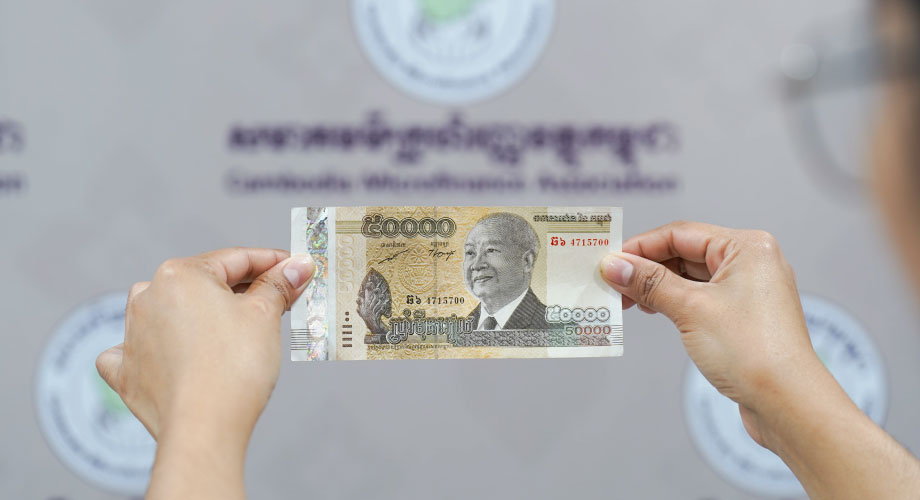
In a world of volatile currencies, trade wars, and geopolitical uncertainty, the Cambodian Riel has emerged as a quiet beacon of stability. While major global currencies have experienced dramatic swings in recent years, the Riel has maintained an extraordinary record of predictability—trading within a narrow band of 4,000–4,100 Riel per US dollar for nearly a decade. In 2025, the Riel actually appreciated by 1.5%, averaging 4,011 KHR/USD.
This stability is not an accident. It is the result of a deliberate, sophisticated monetary policy framework maintained by the National Bank of Cambodia (NBC), a framework built on multiple pillars: substantial foreign exchange reserves, prudent monetary management, the strategic use of a dual-currency system, and the growing influence of digital financial infrastructure—particularly the Bakong system—which has become a critical channel for promoting Riel usage and enhancing monetary transmission.
The numbers are compelling. By the end of 2025, Cambodia’s foreign exchange reserves had reached a record US$27.5 billion, a 22.3% increase from 2024, sufficient to cover approximately eight months of imports. Inflation was contained at 2.5% in 2025, with projections to moderate to 2.3% in 2026. The Riel’s stability has been recognized internationally: on 1 September 2025, the Riel was officially listed on Travelex’s foreign exchange trading board in Melbourne, Australia—a powerful symbol of growing global confidence in Cambodia’s national currency.
This article explores the dynamics behind the Cambodian Riel’s remarkable stability: the dual-currency system that underpins it, the monetary policy framework that sustains it, the strategic role of the Bakong system in promoting Riel usage, and the vision of the National Bank of Cambodia to strengthen monetary sovereignty through gradual de-dollarization. For investors, the Riel’s stability is not merely a statistic—it is a tangible assurance that Cambodia offers a predictable, resilient environment for long-term capital.
📌 Key Takeaways: The Stability of the Cambodian Riel
- The Riel appreciated by 1.5% in 2025 – averaging 4,011 KHR/USD, trading within a narrow 4,000–4,100 band for nearly a decade.
- Foreign exchange reserves reached a record US$27.5 billion in 2025 – a 22.3% increase from 2024, covering approximately eight months of imports.
- Inflation was contained at 2.5% in 2025 (NBC figure), projected to moderate to 2.3% in 2026.
- The Riel was listed on Travelex’s foreign exchange board in Melbourne, Australia, on 1 September 2025 – a powerful symbol of growing international recognition.
- Total banking and financial system assets grew to US$101.8 billion in 2025 – demonstrating the scale and sophistication of the financial system backing the currency.
- The dual-currency system – the US dollar and Riel coexist in a pragmatic, mutually reinforcing relationship that underpins economic resilience.
- De-dollarisation is a strategic priority – the NBC is actively promoting the use of the Riel to strengthen monetary sovereignty, with Riel transactions rising significantly through the Bakong system.
The Riel’s Record of Stability – A Data-Driven Overview
The Cambodian Riel’s stability is not a recent phenomenon—it is the product of decades of prudent monetary management. The data tells a clear story of a currency that has defied the volatility experienced by many emerging market peers, earning the confidence of investors, businesses, and international financial institutions alike.
Exchange Rate Performance: A 1.5% Appreciation in 2025
In 2025, the Riel demonstrated its strength by appreciating by 1.5% against the US dollar, averaging 4,011 KHR/USD for the year. This appreciation occurred despite a challenging global environment characterized by a strong US dollar, rising interest rates, and geopolitical uncertainties that have pressured many emerging market currencies.
By the end of 2025, the exchange rate had strengthened further to 4,007 KHR/USD—a clear signal of the Riel’s underlying strength and the effectiveness of the National Bank of Cambodia’s (NBC) monetary policy framework.
Controlled Market Alignment – The 2026 Exchange Rate Dynamic
In June 2026, the exchange rate traded at approximately 4,055 KHR/USD. While this represents a marginal depreciation from the end-2025 level of 4,007 KHR/USD, it is essential to interpret this movement correctly. This is not a sign of currency weakness or a reversal of the Riel’s stable trajectory. Rather, it reflects a “Controlled Market Alignment” —a deliberate, managed adjustment facilitated by the NBC to maintain export competitiveness in response to regional currency dynamics.
Throughout 2025 and into 2026, several regional currencies—including the Thai Baht and Vietnamese Dong—experienced significant depreciation pressures. By allowing the Riel to adjust modestly within its established corridor, the NBC is ensuring that Cambodian exports remain competitively priced in regional markets. This is not a departure from the Riel’s stability; it is a demonstration of the NBC’s sophisticated and flexible approach to monetary management.
The exchange rate remains firmly within the historic 4,000–4,100 KHR/USD corridor, a band that has defined the Riel’s performance for nearly a decade. The marginal adjustment to 4,055 KHR/USD is well within this range and reflects the NBC’s commitment to stability while responding to evolving economic conditions.
The “4,000–4,100 Corridor”: A Decade of Predictability and a Sovereign FX Volatility Shield
Perhaps the most compelling evidence of the Riel’s stability is its long-term trading pattern. For nearly a decade, the Riel has traded within a remarkably narrow band of 4,000 to 4,100 Riel per US dollar. This corridor has become a defining feature of Cambodia’s monetary landscape, providing businesses and investors with a level of predictability that is rare among emerging market currencies.
This stability is maintained through a combination of active foreign exchange intervention by the National Bank of Cambodia and prudent monetary management. The NBC intervenes in the market as needed to smooth excessive volatility and ensure the exchange rate remains aligned with economic fundamentals. However, the central bank does not target a fixed exchange rate—rather, it allows market forces to determine the rate while intervening to prevent disruptive swings.
For multinational corporations and institutional investors, the Riel’s stable corridor functions as a “Sovereign FX Volatility Shield” —a predictable currency environment that significantly reduces the need for costly hedging instruments. This stability translates directly into Corporate Hedging Mitigation, allowing businesses operating in Cambodia to plan long-term investments without the uncertainty of significant exchange rate fluctuations.
The narrow trading band has significant practical implications for investors and businesses:
- Reduced currency risk: Companies can plan long-term investments without the uncertainty of significant exchange rate fluctuations.
- Predictable import costs: Businesses that rely on imported raw materials can better forecast their costs and pricing.
- Confidence in the financial system: The stability of the Riel reinforces confidence in Cambodia’s broader financial sector, encouraging both domestic savings and foreign investment.
- Lower hedging costs: The predictable exchange rate environment reduces the need for expensive currency hedging instruments, improving corporate profitability.
Comparative Performance – Outperforming Regional Peers
When compared to other currencies in the region, the Riel’s performance stands out. While many Southeast Asian currencies experienced significant volatility in 2025 due to global monetary tightening and geopolitical tensions, the Riel remained remarkably stable.
The Thai Baht, for example, fluctuated more widely against the US dollar, driven by tourism-dependent economic pressures and political uncertainty. The Vietnamese Dong experienced gradual depreciation pressure as Vietnam’s central bank sought to maintain export competitiveness. The Indonesian Rupiah and Malaysian Ringgit also saw notable volatility.
The Riel’s relative stability reflects Cambodia’s specific economic circumstances: a dollarised economy where the US dollar circulates alongside the national currency, providing a natural anchor for the Riel’s value. This dual-currency arrangement, while presenting its own challenges, has contributed to the Riel’s remarkable predictability and its role as a reliable store of value in the region.
A Currency Built on Institutional Credibility
The Riel’s stability is not an accident—it is the product of a deliberate, institutionalised commitment to monetary discipline. The National Bank of Cambodia has built a framework that combines:
- Substantial foreign exchange reserves (US$27.5 billion in 2025) providing a robust buffer against external shocks.
- Active but measured intervention to smooth excessive volatility while allowing market forces to operate.
- A dual-currency system that leverages the US dollar’s global role while gradually strengthening the Riel’s position.
- Digital financial infrastructure—particularly the Bakong system—that enhances monetary transmission and promotes Riel usage.
This institutional credibility is the foundation of the Riel’s stability and the reason why investors, businesses, and international financial institutions continue to view Cambodia’s currency with confidence.
The Bakong System – Digital Infrastructure as a Stabilising Force
The introduction of the Bakong payment system in 2020 has fundamentally altered the dynamics of Cambodia’s dual-currency system. Developed by the NBC as a blockchain-based platform, Bakong integrates banks, mobile wallets, and payment service providers into a seamless digital network. It has become a critical channel for monetary transmission and a powerful tool for promoting Riel usage.
The data is striking. In 2025, Bakong processed 771.2 million Riel transactions, a 1.6-fold increase from 2024, with a total value of 285.9 trillion Riel (approximately US$73 billion), a 59.4% year-on-year increase. US dollar transactions also grew significantly, reaching 554.5 million transactions with a total value of US$152.8 billion, a 49.3% increase.
To understand this growth trajectory, it is useful to examine the Digital Liquidity Velocity Framework—the acceleration of transaction volume and value driven by digital infrastructure expansion. In the first half of 2025 alone, Bakong recorded 303 million Riel transactions with a total value of 128.6 trillion KHR, a twofold increase compared to the same period in 2024. The acceleration in the second half of 2025—approximately 468 million Riel transactions and 157.3 trillion KHR in value—reflects the compounding effect of cross-border QR integrations that came online during the year.
What drove the H2 2025 surge? The second-half acceleration was driven by several key developments:
- March 2025: The official launch of Phase 2: Bakong Outward Cross-Border Payment (Bakong scans UnionPay) , enabling Cambodian users to make cross-border payments by scanning UnionPay QR codes in China and other countries. This was followed by the enablement of Bakong wallets on WeChat Pay’s QR merchant network in China.
- Growing bilateral QR corridors: Throughout 2025, Cambodia expanded its network of cross-border QR links with Thailand, Vietnam, Laos, Malaysia, and Singapore, each adding new transaction volumes to the Bakong system.
- Increased merchant adoption: The number of KHQR merchant touchpoints grew to over 4.5 million, providing more opportunities for Riel transactions in everyday commerce.
Riel transaction volumes grew significantly faster than US dollar transactions—a clear signal of the Riel’s rising role in the digital economy. As Governor Chea Serey has emphasised, “the surge in Riel transactions is a significant achievement for Cambodia” . By making Riel transactions as convenient—and often more cost-effective—than dollar transactions, Bakong is shifting the preferences of both consumers and businesses. The system has also extended financial services to rural areas, where the Riel is already more widely used, further accelerating the currency’s adoption.
The Path to Strengthening Monetary Sovereignty – A Pragmatic, Incentive-Driven Approach
The NBC has been actively pursuing policies to promote the use of the Riel, reducing the country’s reliance on the US dollar in a strategic effort to enhance monetary sovereignty. However, Governor Chea Serey has been clear about the central bank’s philosophical approach: she does not favour the term “de-dollarization” , preferring instead to frame the strategy as “expanding the use of the national currency”.
As she articulated in a 2025 interview with Nikkei, the goal is a long-term multipolar system focused on national currencies—not the elimination of the dollar, but the creation of a more balanced monetary ecosystem where the Riel is a confident, competitive choice. This is a pragmatic, incentive-driven mechanism rather than an aggressive mandatory policy.
The NBC’s strategy is multi-pronged:
- Differentiated reserve requirements: The NBC has imposed higher reserve requirements on US dollar deposits (12.5%) than on Riel deposits (8%), incentivising financial institutions to increase Riel lending.
- Riel-denominated government bonds: The government has issued Riel-denominated bonds, providing an investment avenue in the local currency and reinforcing its credibility in financial markets.
- Public sector mandates: Government agencies and public service providers are now required to price goods and services in Riel. Certain businesses and government employees are encouraged or required to receive salaries in Riel.
- Financial literacy programmes: The NBC has introduced financial education programmes in schools, educating young generations on the benefits of using the local currency.
- Digital infrastructure as a catalyst: The Bakong system has become the most powerful tool for promoting Riel usage—not through coercion, but by making Riel transactions more convenient, accessible, and cost-effective than dollar transactions.
Governor Chea Serey’s philosophy is clear: “Our policy principle is: if the public wants to use the national currency, we support it; but we never force it. Because when you force people to use a currency they don’t want to accept, it can create a large black market” . This non-coercive approach—focusing on making the Riel more convenient rather than mandating its use—has been central to the NBC’s strategy.
The ultimate goal is a Sovereign Monetary Coexistence—a dual-currency system where the US dollar and the Riel coexist in a stable, mutually reinforcing relationship, but with the Riel gradually gaining ground as the preferred currency for everyday transactions, savings, and investment. While the Riel’s journey is far from complete—dollarisation remains deeply entrenched, with foreign currency deposits accounting for more than 89% of all deposits as of August 2025—the direction is clear. The combination of digital innovation, policy incentives, and growing public confidence is gradually reshaping Cambodia’s monetary landscape.
International Confidence – A Currency Gaining Global Recognition
The Cambodian Riel’s stability and the institutional credibility of the National Bank of Cambodia (NBC) have not gone unnoticed by the international community. Since 2023, the Riel has achieved a series of milestones that signal growing global confidence in Cambodia’s national currency—transforming it from a domestic unit of account into a recognised currency on the international stage.
From Melbourne to Tokyo – The Riel’s Expanding Global Footprint
The Riel’s journey to international recognition has been steady, marked by a series of strategic collaborations between the NBC and Travelex, a global leader in foreign exchange.
- 2023 – Singapore Changi Airport: The Riel was first listed for trading at Singapore’s Changi Airport, a major gateway to Asia.
- April 2024 – Tokyo Haneda Airport: In a significant milestone, the Riel was listed at Tokyo’s Haneda International Airport. The ribbon-cutting ceremony was presided over by H.E. Kimty Kormoly, Director General of the NBC’s Central Banking Operation. This marked the currency’s debut in Japan, making it available to Japanese tourists.
- November 2024 – Chongqing Jiangbei International Airport: The Riel was launched at Chongqing Jiangbei International Airport in China. This was the third collaboration between the NBC and Travelex, following the listings in Singapore and Tokyo.
- 1 September 2025 – Melbourne Airport, Australia: The Riel was officially listed on Travelex’s foreign exchange board in Melbourne, marking its first appearance in the Pacific region. The official ceremony was attended by H.E. Ly Sideth, Deputy Governor and General Cashier of the National Bank of Cambodia, alongside Mr. Adam Nezval, Head of Wholesale Banknotes and Cash Operations for Australia and New Zealand at Travelex. Melbourne was the fourth international location for the Riel’s trading.
What International Listings Mean for Investor Confidence
For investors and financial institutions, the Riel’s growing presence on international exchange boards is more than a symbolic achievement. It reflects several underlying developments that reinforce confidence in Cambodia’s monetary policy and economic resilience:
- Institutional credibility: The NBC’s willingness to expand the Riel’s international footprint signals confidence in the currency’s stability and the central bank’s ability to manage monetary policy effectively. The exchange rate’s consistent performance—averaging 4,011 KHR/USD in 2025—provides the foundation for this international expansion.
- Reduced transaction costs for international investors: The availability of the Riel at major international airports simplifies currency conversion for investors and tourists, reducing transaction costs and frictional barriers to cross‑border commerce.
- A signal of economic maturity: The listing of a national currency on international exchange boards is typically associated with economies that have achieved a certain level of stability and institutional development. Cambodia’s inclusion alongside major global currencies signals the Kingdom’s growing economic maturity.
- Increased visibility and awareness: Each new international listing introduces the Riel to a broader audience, raising awareness of Cambodia as an investment destination and facilitating greater economic integration.
A Currency Backed by Institutional Strength
The Riel’s growing international recognition is underpinned by the institutional strength of the National Bank of Cambodia and the country’s robust macroeconomic fundamentals. By the end of 2025, Cambodia’s foreign exchange reserves had reached a record US$27.5 billion, a 22.3% increase from 2024, sufficient to cover approximately eight months of imports. The NBC has maintained the Riel’s stability for more than two decades, a fact consistently highlighted in official statements regarding its international listings. The NBC has stated it will continue to pursue opportunities to expand riel trading at other international hubs worldwide.
❓ Frequently Asked Questions (FAQ)
1. How stable is the Cambodian Riel against the US dollar?
The Cambodian Riel has maintained remarkable stability for nearly a decade, trading within a narrow band of 4,000–4,100 KHR/USD. In 2025, the Riel appreciated by 1.5% to an average exchange rate of 4,011 KHR/USD. As of June 2026, the exchange rate traded at approximately 4,055 KHR/USD, remaining firmly within its historic corridor. This stability is maintained through the National Bank of Cambodia’s active but measured foreign exchange interventions and prudent monetary management.
2. Why does Cambodia use both the US dollar and the Riel?
Cambodia operates a dual-currency system where both the US dollar and the Riel are legal tender. This arrangement dates back to the post-war reconstruction era of the 1990s, when the UNTAC mission injected approximately US$1.6 billion into the economy. The dollar’s dominance—accounting for more than 89% of all deposits as of August 2025—provides stability and investor confidence, while the Riel serves as a symbol of monetary sovereignty. The National Bank of Cambodia is gradually promoting the use of the Riel through digital infrastructure, policy incentives, and financial literacy programmes.
3. What is the National Bank of Cambodia’s policy on de-dollarisation?
The National Bank of Cambodia (NBC) does not favour the term “de-dollarisation” and does not pursue coercive policies to eliminate the US dollar. Instead, Governor Chea Serey advocates for a “Sovereign Monetary Coexistence”—a long-term multipolar system focused on national currencies. The NBC’s approach is incentive-driven: making the Riel more convenient through digital infrastructure (the Bakong system), differentiated reserve requirements, Riel-denominated government bonds, and public sector mandates, rather than forcing its use through administrative measures.
4. What are Cambodia’s foreign exchange reserves?
Cambodia’s foreign exchange reserves reached a record US$27.5 billion in 2025, a 22.3% increase from 2024. This is sufficient to cover approximately eight months of imports, providing a strong buffer against external shocks and reinforcing investor confidence. In the first half of 2025 alone, reserves rose to US$24.8 billion, marking a 10.4% increase from the end of December 2024.
5. Has the Cambodian Riel been recognised internationally?
Yes. The Riel has been listed on Travelex’s foreign exchange boards at five international locations: Singapore Changi Airport (2023), Tokyo Haneda Airport (April 2024), Chongqing Jiangbei International Airport (November 2024), Melbourne Airport, Australia (September 2025), and Tokyo Haneda Airport again (May 2026) as part of an expanded partnership. Travelex has announced plans to expand this initiative to other major financial centers worldwide.
6. What role does the Bakong system play in the Riel’s stability?
The Bakong payment system, launched by the NBC in 2020, has become a critical channel for promoting Riel usage and enhancing monetary transmission. In 2025, Bakong processed 771.2 million Riel transactions with a total value of 285.9 trillion KHR (approximately US$73 billion), a 59.4% year-on-year increase. Riel transaction volumes grew significantly faster than US dollar transactions, reflecting the Riel’s rising role in the digital economy.
7. What is Cambodia’s inflation outlook?
Cambodia’s inflation was contained at 2.5% in 2025 (NBC figure), with projections to moderate to 2.3% in 2026. However, external risks—particularly higher global oil prices—have prompted upward revisions from some institutions, with AMRO projecting a potential rise to 3.9% in 2026 in an upside risk scenario. The National Bank of Cambodia remains committed to maintaining price stability through prudent monetary management.
8. Is the Cambodian Riel a safe currency for investment?
The Cambodian Riel’s remarkable stability—trading within a narrow 4,000–4,100 band for nearly a decade—provides a predictable environment for investors. The currency is backed by US$27.5 billion in foreign exchange reserves, low public debt (approximately 18–19% of GDP), and the institutional credibility of the National Bank of Cambodia. While the Riel is not a major global reserve currency, its stability and the government’s commitment to monetary discipline make it a reliable currency for businesses and investors operating in Cambodia.
Conclusion: The Riel – A Symbol of Cambodia’s Economic Resilience and Sovereign Ambition
The Cambodian Riel’s remarkable journey from a post‑conflict currency to an internationally recognised unit of exchange is a testament to the Kingdom’s economic transformation and the institutional credibility of the National Bank of Cambodia. In a world of volatile currencies, trade wars, and geopolitical uncertainty, the Riel has stood as a quiet beacon of stability—trading within a narrow 4,000–4,100 KHR/USD corridor for nearly a decade, appreciating by 1.5% in 2025, and earning a place on international exchange boards from Singapore to Melbourne.
This stability is not an accident. It is the result of a deliberate, sophisticated monetary policy framework built on multiple pillars: substantial foreign exchange reserves of US$27.5 billion, covering approximately eight months of imports; prudent monetary management that has contained inflation at 2.5% in 2025; a pragmatic dual-currency system that leverages the US dollar’s global role while gradually strengthening the Riel’s position; and digital financial infrastructure—particularly the Bakong system—which has become a critical channel for promoting Riel usage and enhancing monetary transmission.
For multinational corporations and institutional investors, the Riel’s stable corridor provides a “Predictable Capital Horizon” —a currency environment that enables long-term planning without the uncertainty of significant exchange rate fluctuations. This predictability translates directly into a “Sovereign Risk Mitigation Matrix” , reducing the need for costly hedging instruments and improving corporate profitability. The Riel is not merely a domestic currency; it is a macroeconomic asset that offers stability, transparency, and institutional credibility in a region where currency volatility is often the norm.
The Riel’s growing international recognition, marked by its listing on Travelex’s foreign exchange boards in Singapore, Tokyo, Chongqing, and Melbourne, signals growing global confidence in Cambodia’s monetary policy and economic resilience. As the National Bank of Cambodia continues to expand the Riel’s global footprint—with plans for further listings in other major financial centres—the currency’s role in regional and international finance is set to grow.
Yet, the Riel’s journey is far from complete. Dollarisation remains deeply entrenched, with foreign currency deposits accounting for more than 89% of all deposits as of August 2025. The National Bank of Cambodia, under the leadership of Governor Chea Serey, is pursuing a pragmatic, incentive‑driven strategy to strengthen monetary sovereignty—not through coercion, but by making the Riel more convenient, accessible, and cost‑effective than the dollar. This is a long‑term vision of “Sovereign Monetary Coexistence” —a dual‑currency system where the US dollar and the Riel coexist in a stable, mutually reinforcing relationship, but with the Riel gradually gaining ground as the preferred currency for everyday transactions, savings, and investment.
For investors, the Riel’s stability is not merely a statistic—it is a tangible assurance that Cambodia offers a predictable, resilient environment for long‑term capital. The currency is backed by strong institutional fundamentals: a stable political environment, a young and growing workforce, a robust external position, and a government committed to structural reform under the Pentagonal Strategy – Phase I.
The Riel’s story is Cambodia’s story—a narrative of resilience, pragmatism, and ambition. From a currency once shunned by its own people to one now traded on international exchange boards, the Riel has come a long way. Its future, like Cambodia’s, is one of continued progress and growing global integration.
The foundation is strong. The vision is clear. The Riel is ready for its next chapter.