
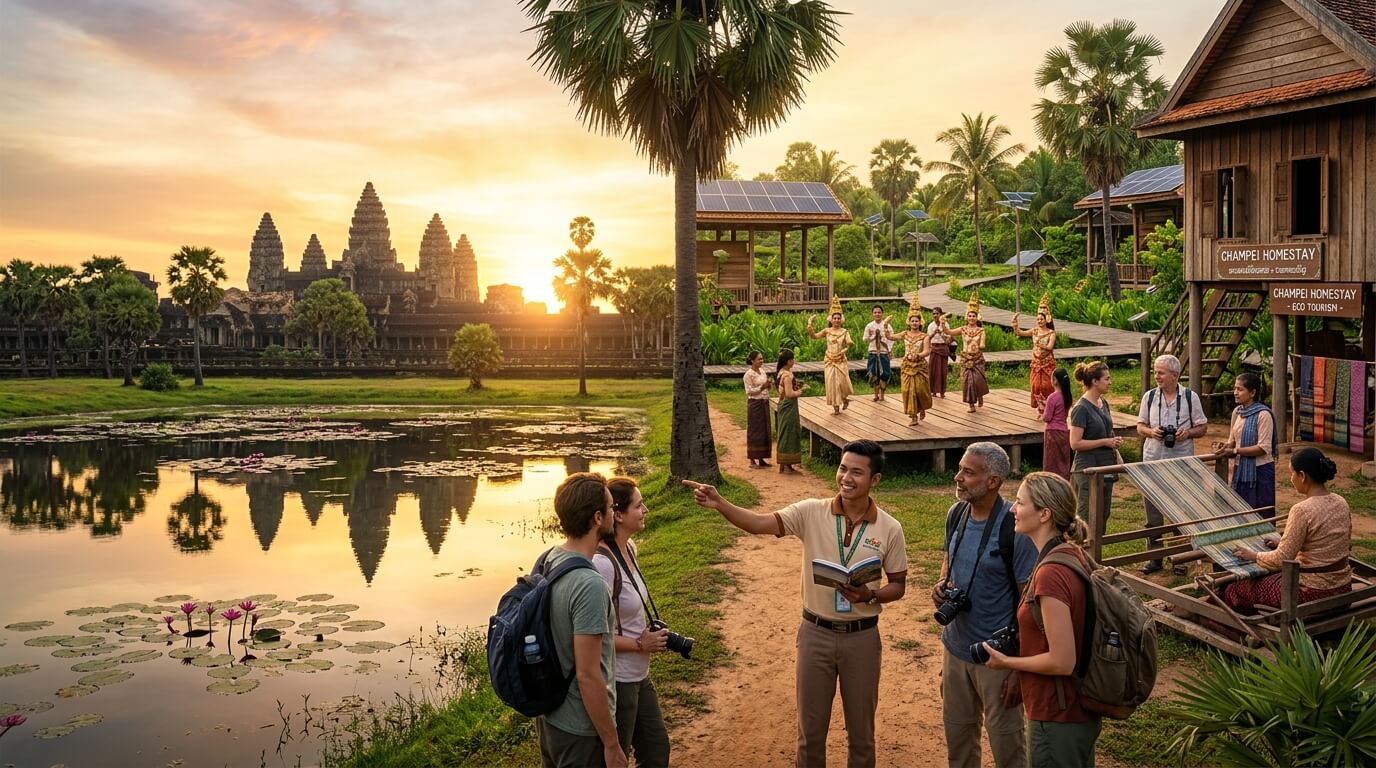
Cambodia’s identity is inseparable from its heritage. The soaring spires of Angkor Wat, the jungle‑cloaked temples of Sambor Prei Kuk, and the clifftop majesty of Preah Vihear are not merely monuments to a glorious past—they are living assets that sustain communities, drive economic growth, and anchor the nation’s aspirations for a prosperous future.
For decades, people primarily viewed the preservation of Cambodia’s cultural heritage as a moral and historical obligation. Today, it is increasingly understood as a strategic economic imperative. Heritage sites are the bedrock of Cambodia’s tourism industry, which generated US$3.87 billion in revenue in 2025—a 6.6% increase from the previous year, despite a 16.9% drop in international arrivals. The sector is one of four pillars supporting the national economy, and its resilience is a testament to the enduring appeal of Cambodia’s cultural treasures.
The numbers are compelling. In 2025 alone, Angkor Archaeological Park welcomed 955,131 international tourists, generating US$44.7 million in ticket revenue. Domestic tourism surged 53% to 17.2 million visitors in the first eight months of the year, demonstrating that heritage is not only an international draw but a source of national pride and economic activity for Cambodians themselves.
Yet the true story of Cambodia’s heritage lies beyond the ticket booths. It is found in the villages surrounding Angkor Thom, where community‑based tourism projects are creating new livelihoods. It is visible in the women artisans trained by UNESCO in lacquerware, ceramics, and silk weaving. It is reflected in the Sacred Tourism strategy, which aims to bring in 2 million wealthy visitors—especially those looking for eco-friendly and sustainable travel experiences—over the next ten years, and in the Pagoda Tourism initiative, which invites spiritual travelers to explore Cambodia’s living Buddhist heritage for wellness and cultural experiences.
This article explores the business of culture—how Cambodia’s heritage sites are not only preserved but leveraged as engines of sustainable development, community empowerment, and long‑term prosperity. For investors, policymakers, and travelers alike, the message is clear: Cambodia’s past is the foundation of its future.
📌 Key Takeaways: Heritage as a Driver of Sustainable Development
- 5 UNESCO World Heritage Sites – Angkor, Preah Vihear, Koh Ker, Sambor Prei Kuk, and Memorial Sites (inscribed in 2025).[reference:5]
- Angkor generated US$44.7 million in ticket revenue in 2025 from 955,131 international visitors.[reference:6]
- Tourism sector revenue reached US$3.87 billion in 2025, up 6.6% year‑on‑year, with domestic tourism surging 53% in the first eight months.[reference:7]
- Sacred Tourism strategy targets 2 million high‑value visitors annually within a decade, including High‑net‑worth individuals (HNWIs) seeking eco‑luxury and regenerative travel experiences.
- Pagoda Tourism initiative – opening living Buddhist pagodas to attract spiritual and wellness travellers.
- Community‑Based Tourism (CBT) – villages near heritage sites offering homestays, guided tours, and handicrafts, with profits returning to community development.
- UNESCO supports training for vulnerable groups – women artisans in lacquerware, ceramics, silk weaving, and silver plating.
- Kampong Thom Tourism Development Plan 2026‑2030 – focuses on cultural tourism, religious tourism, and night‑time economy zones around Sambor Prei Kuk.
Cambodia’s Heritage – A Global Treasure
Cambodia’s cultural inheritance is not merely a matter of national pride—it is a globally recognised asset of outstanding universal value. With five UNESCO World Heritage Sites, the Kingdom ranks among Southeast Asia’s most heritage-rich nations, and its commitment to preserving these treasures has drawn international acclaim and investment for decades.
Five UNESCO World Heritage Sites and Counting
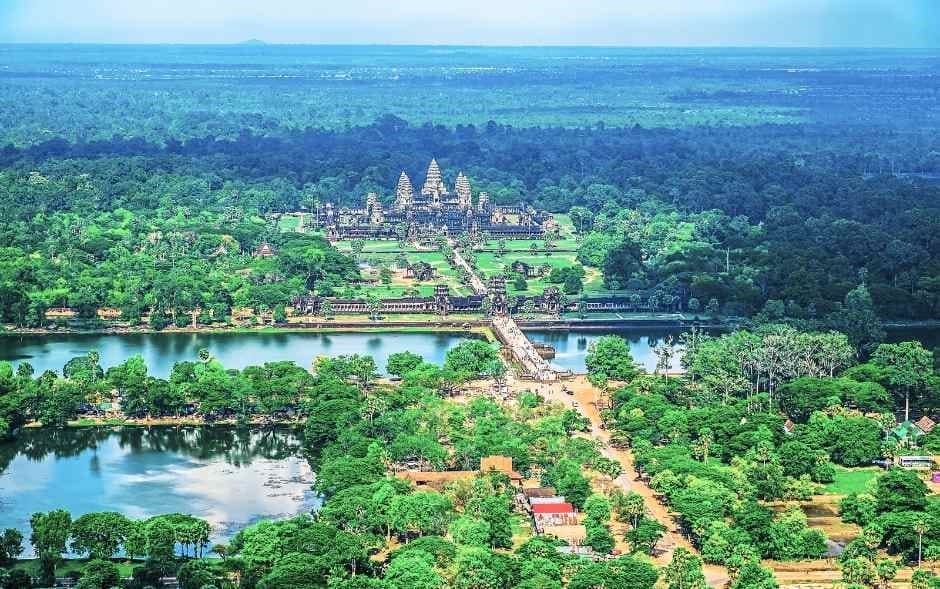
For years, Cambodia was known for four UNESCO World Heritage Sites: the Angkor Archaeological Park (inscribed 1992), the Temple of Preah Vihear (2008), the Temple Zone of Sambor Prei Kuk (2017), and the Koh Ker Archaeological Site (2023).
In July 2025, this prestigious list grew to five with the inscription of the Cambodian Memorial Sites during the 47th session of the UNESCO World Heritage Committee. This new site comprises a series of locations that bear witness to the country’s tragic history under the Khmer Rouge movement and regime from 1971 to 1979. The Cambodian memorial sites include the former M-13 prison (established in 1971), the Tuol Sleng Genocide Museum (S-21), and the Choeung Ek Genocidal Center. Their inscription as places “of peace and reflection” reflects Cambodia’s journey from a dark past toward healing and national reconciliation.
Beyond these inscribed sites, Cambodia is actively working to expand its UNESCO portfolio. The Ministry of Culture and Fine Arts is currently preparing nominations for additional ancient temples, including Phnom Da in Takeo province. The government is also pursuing recognition for intangible cultural heritage, with plans to submit Cambodian Songkran, the traditional woven scarf Krama, and Khmer wedding traditions for UNESCO listing.
The Economic Weight of Angkor – US$44.7 Million in 2025
While all five UNESCO sites contribute to Cambodia’s cultural standing, it is Angkor Archaeological Park that remains the undisputed economic engine of heritage tourism. In 2025, the park attracted 955,131 international tourists from 197 countries and regions, generating US$44.71 million in ticket revenue. Despite a 6.7% year‑on‑year decline in visitor numbers and a 6.5% drop in revenue, Angkor’s enduring appeal remains unmatched. Entrance fees are set at US$37 for a one‑day pass, US$62 for a three‑day pass, and US$72 for a week‑long pass.
The scale of Angkor’s economic contribution extends far beyond ticket sales. The park sustains thousands of jobs in hospitality, transport, guiding services, and handicraft production. It anchors the broader tourism economy of Siem Reap province, which in turn supports national revenue and foreign exchange earnings. As a cornerstone of Cambodia’s tourism sector—one of the four pillars of the national economy—Angkor’s performance is a bellwether for the industry as a whole.
Cambodia’s heritage is not a static relic of the past; it is a living, breathing economic and cultural force. From the soaring spires of Angkor Wat to the solemn memorials of Phnom Penh, these sites tell the story of a nation’s resilience and ambition. They are the foundation upon which a sustainable, community‑centred tourism economy is being built—and their value, both cultural and commercial, continues to grow.
From Preservation to Prosperity – The Heritage Economy
The connection between heritage preservation and economic prosperity in Cambodia is not theoretical—it is measurable, tangible, and growing. While the temples of Angkor remain the crown jewel, the economic impact of heritage tourism extends across the entire kingdom, from the ancient capitals of the Khmer Empire to the living Buddhist pagodas that dot the modern landscape.
Tourism Revenue – US$3.87 Billion and Rising
Cambodia’s tourism sector generated US$3.87 billion in revenue in 2025, a 6.6% increase from the previous year’s US$3.63 billion. This growth occurred despite a 16.9% decline in international arrivals, underscoring a critical shift in the sector’s dynamics: higher spending per visitor is offsetting lower visitor numbers. The average length of stay remained stable at approximately 7 days, consistent with 2024’s 7.1 days, while average daily expenditure rose, contributing to the overall revenue increase.
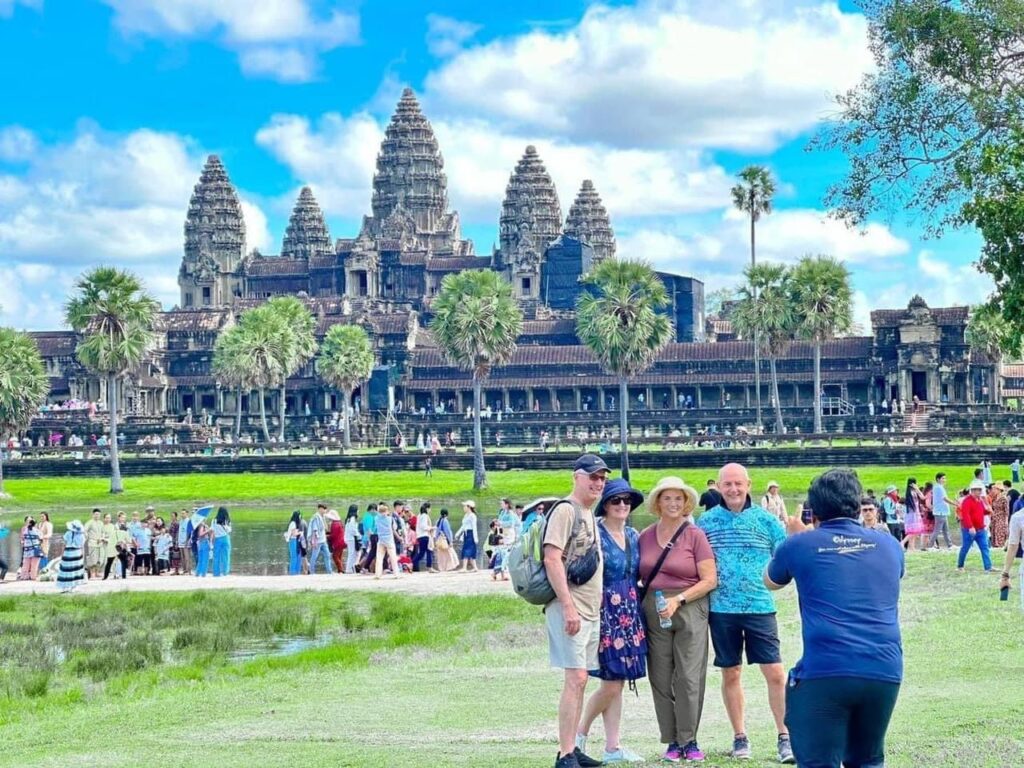
This trend reflects a deliberate policy shift toward attracting higher‑value travelers—those who stay longer, spend more, and seek authentic cultural experiences. The Sacred Tourism strategy is central to this pivot, targeting 2 million high‑value visitors annually within a decade. These visitors—including high‑net‑worth individuals (HNWIs) seeking eco‑luxury and regenerative travel experiences—are precisely the demographic that sustains premium hospitality, boutique tour operators, and artisanal crafts.
The tourism sector is one of four pillars supporting Cambodia’s national economy, alongside agriculture, manufacturing, and construction. Its resilience in the face of external shocks—whether pandemics, global economic uncertainty, or regional competition—is a testament to the enduring appeal of Cambodia’s cultural and natural assets.
Domestic Tourism – A Resilient Pillar of Growth
While international arrivals have fluctuated, domestic tourism has surged. In the first eight months of 2025, domestic tourist numbers reached 17.2 million, a 53% increase year‑on‑year. This remarkable growth reflects several factors: rising disposable incomes among Cambodians, improved road infrastructure connecting provinces, and a growing sense of national pride in exploring the Kingdom’s heritage.
Domestic tourists now account for a significant share of visitation to heritage sites. At Angkor Archaeological Park, Cambodian nationals enjoy free entry, making the temples accessible to families, students, and pilgrims. This policy not only fosters cultural connection but also generates indirect economic benefits through spending on transport, food, and accommodation in surrounding communities.
The domestic tourism boom has also stimulated the development of community-based tourism (CBT) initiatives near heritage sites. Villages surrounding Angkor Thom, Sambor Prei Kuk, and Banteay Chhmar now offer homestays, guided tours, and handicraft workshops, with profits returning directly to community development funds. These initiatives create sustainable livelihoods while preserving traditional crafts and knowledge.
The Heritage Multiplier Effect – Jobs, Skills, and Local Economies
The economic impact of heritage tourism extends far beyond ticket sales. For every dollar spent on heritage site admission, an estimated US$3 to US$5 is generated in the broader local economy through accommodation, food, transport, and souvenirs.
At Angkor alone, the park sustains an estimated 20,000 to 30,000 direct jobs—guides, drivers, hospitality staff, artisans, and conservation workers—and many more indirect jobs in the wider Siem Reap economy. Heritage tourism supports a complex ecosystem of small and medium enterprises: restaurants, hotels, souvenir shops, transport providers, and cultural performance troupes.
UNESCO has played a pivotal role in building local capacity. Through training programs targeting vulnerable groups, UNESCO has supported women artisans in lacquerware, ceramics, silk weaving, and silver plating. These programs not only preserve traditional crafts but also create sustainable livelihoods, particularly for rural women who might otherwise lack economic opportunities.
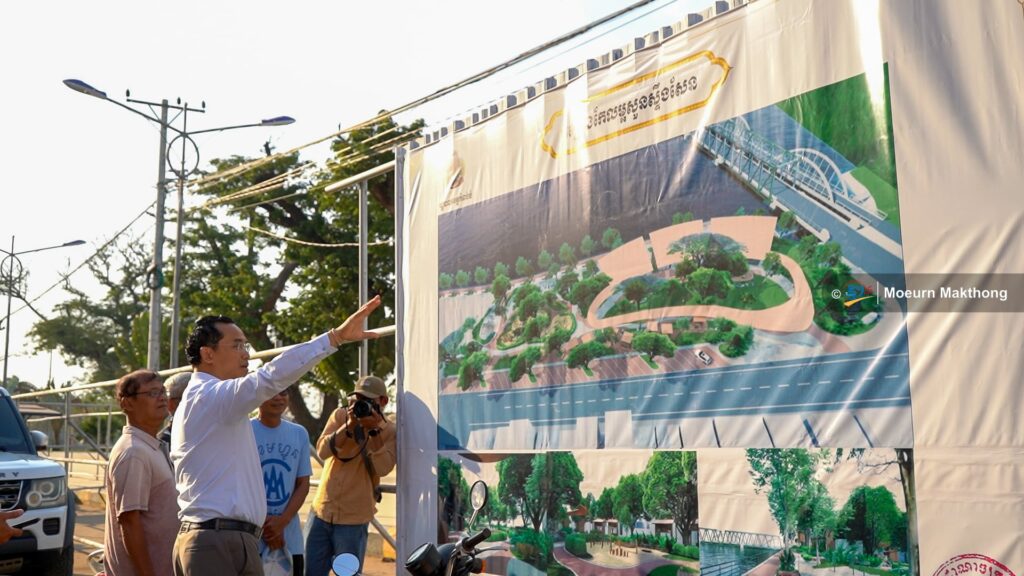
The Kampong Thom Tourism Development Plan 2026‑2030, centered on Sambor Prei Kuk, exemplifies this integrated approach. The plan focuses on three major tourism economy poles: cultural tourism centered on the Sambor Prei Kuk temple and its connecting sites; religious and crafted tourism at Phnom Santuk; and a nighttime economy zone along the Stung Sen River, as outlined by the Ministry of Tourism. By extending the visitor experience beyond daylight hours, the plan aims to increase length of stay and average expenditure, creating more jobs and business opportunities for local communities.
Community‑Based Tourism – Heritage That Empowers
The most transformative aspect of Cambodia’s heritage economy is not visible in ticket revenues or international arrival statistics. It is found in the villages surrounding the temples, where communities are reclaiming their heritage as a source of sustainable livelihoods. Across the kingdom, Community‑Based Tourism (CBT) initiatives are demonstrating that heritage conservation and community empowerment are not competing priorities—they are mutually reinforcing pillars of sustainable development.
These models involve local communities managing tourism initiatives to promote conservation, generate income, and offer authentic cultural experiences. The result is a virtuous cycle: heritage sites are preserved, local economies are strengthened, and visitors gain deeper, more meaningful connections to Cambodia’s living culture.
Angkor Thom Community Tourism Project – A New Model for Sustainable Tourism
Launched in 2025 by Cambodian Youth Action (CYA), in partnership with the Cambodian National Youth Center and Leang Dai Commune, the Angkor Thom Community Tourism Project (ACTP) is creating a new model for sustainable, community‑based tourism near the iconic Angkor Thom heritage site. In its first year, the project welcomed volunteers from around the world to help develop guided tours, promote ecotourism activities, and support local artisans.
Together, volunteers and local residents created new tourism experiences—ranging from cultural village tours and cooking classes to handcrafted souvenir products. Volunteers also engaged in educational programs for children at the community kindergarten, offering English lessons, creative workshops, and games.
The project’s impact is already visible in the community. As one local artisan, Mr. Piseth, reflected: “Before this project, we had no idea how to welcome visitors. Now, we proudly share our traditions and earn income to support our families.” Volunteers work side by side with local residents to co‑create meaningful change in tourism, education, and community livelihood.
The ACTP offers visitors authentic cultural experiences, including guided tours, ecotourism activities, and locally made handicrafts. It provides a unique opportunity to immerse oneself in Cambodian culture, contribute to community development, and support the growth of a sustainable local economy.
Sambor Prei Kuk – Livelihoods Through Conservation
At the UNESCO‑inscribed temple zone of Sambor Prei Kuk, a community‑based tourism initiative has been steadily growing, employing local guides, organising activities, and setting up homestays. The site, originally called Isanapura, served as the capital of Upper Chenla during the reign of the early 7th‑century King Isanavarman. It encompasses more than 100 mainly brick temples scattered through the forest, making it Cambodia’s most impressive group of pre‑Angkorian monuments.
The National Authority for Sambor Prei Kuk aims to support the local community by building capacity for the different values and livelihood opportunities related to this World Heritage Site, promoting local products, and conserving traditional skills to enhance visitor engagement and sustainable tourism.
The project has partnered with public and private sector organisations, including local schools and tourism operators, to integrate the Sambor community as a key element for sustainable tourism at the site. Its initiatives—raising awareness among local youth about the significance of their heritage, employing local craftspeople and artisans for site maintenance, and facilitating intergenerational knowledge and skills transfer—all revolve around the Sambor community. As a result, local people’s income is sustainably increased through their traditional lifestyle and heritage‑related skills and products, including farming, fishing, weaving, and handicrafts.
The community-based organisation Isanborei runs an excellent homestay programme and manages the guides, with half‑day and full‑day tours available for US$6 and US$10, respectively. It also offers cooking courses, bicycle rentals (US$2 per day), and ox‑cart rides. World Heritage listing has provided a significant boost for conservation and community‑based tourism in this rural area.
Banteay Chhmar – A Community‑Led Heritage Success
In the remote northwest of Cambodia, Banteay Chhmar stands as one of the largest Angkorian‑era complexes, a remarkable collection of 12th‑century sacred stone structures decorated with fine carvings. Built during the reign of Jayavarman VII, it is a Buddhist temple dedicated to the crown prince Indravarman.
What makes Banteay Chhmar exceptional is its community‑led management. The site’s community‑based tourism initiative was formally initiated in 2007 by the French NGO Agir pour le Cambodge (APLC), building on earlier feasibility work. Today, Banteay Chhmar is managed by Community‑Based Tourism (CBT), with technical and financial support from the Global Heritage Fund (GHF) for temple restoration and community strengthening.
The CBT initiative offers a range of authentic experiences: homestays, ox‑cart trips, bicycle and koyun rentals, picnics inside the temples or along the baray prepared by a trained women’s group, performances of traditional music, a rice show, and English‑speaking local guides. The temples are surrounded by lush, untamed jungle, offering a serene atmosphere far from the crowds. The community-based homestay and tourism program provides an opportunity to delve into Cambodian rural life and spend quality time amid a temple complex far from the crowds. Rooms are in private homes and come with mosquito nets and fans.
The Broader Impact – A Model for Sustainable Development
These three case studies represent a broader movement across Cambodia. In rural Cambodia, booming community‑based tourism models involve local communities managing tourism initiatives to promote conservation, generate income, and offer authentic cultural experiences. The Cambodian government is actively tackling overtourism through a multi‑pronged approach that focuses on diversifying tourist destinations, implementing site‑specific management strategies, and promoting sustainable tourism practices.
Initiatives like the Angkor Thom Community Tourism Project, Sambor Prei Kuk, and Banteay Chhmar demonstrate that heritage tourism can be a powerful engine for community empowerment. They create jobs, preserve traditional crafts, keep young people in their villages, and ensure that the benefits of tourism flow directly to the communities that are the true custodians of Cambodia’s cultural heritage.
The Sacred Tourism Strategy – A New Chapter for High‑Value Visitors
Cambodia’s heritage economy is entering a new phase. While Angkor Wat and the country’s other UNESCO sites will always anchor the nation’s tourism offering, the Royal Government is pursuing a bold, complementary strategy: Sacred Tourism. This long-term policy aims to attract a new generation of high-value travellers—those who seek not just sightseeing but spiritual enrichment, cultural immersion, and authentic engagement with Cambodia’s living Buddhist traditions.
The Sacred Tourism Policy 2025‑2035 – A Decade‑Long Vision
The Sacred Tourism Policy 2025‑2035 is being developed by the National Tourism Development Committee (NTDC) to transform designated areas across Cambodia into high‑end sacred tourism destinations. A consultation on the draft policy was held on 18 February 2025 at the Council of Ministers, chaired by Senior Minister Thong Khon, Chairman of the NTDC, with key stakeholders including Minister of Tourism Huot Hak and Minister of Information Neth Pheaktra.
Senior Minister Thong Khon stated that the Royal Government has launched the Sacred Tourism 2025‑2035 initiative to enhance Cambodia’s reputation as a premier tourism destination. The policy prioritises sustainable growth and cultural preservation while attracting high‑quality visitors.
The policy aims to develop high‑priority tourism products and services aligned with emerging global trends, attracting high‑quality visitors who contribute meaningfully to Cambodia’s economic growth and social development. Sacred tourism destinations are identified as areas with high tourism potential, which will be equipped with world-class infrastructure: accommodation, food and beverage, recreational centres, healthcare facilities, financial services, and telecommunications that meet international standards.
Crucially, sacred tourism areas cannot be established in border regions or high‑risk locations. They are designed to be secure, welcoming, and fully integrated into Cambodia’s legal framework, with development led by the Royal Government, private sector entities, or public‑private partnerships (PPPs).
Pagoda Tourism – Opening Living Buddhist Heritage
At the heart of the Sacred Tourism strategy is the Pagoda Tourism initiative. In November 2025, the Royal Government officially endorsed this programme, which builds on efforts already underway by industry groups and Buddhist communities. The Ministry of Cult and Religion is now actively developing new infrastructure and improving religious practices in pagodas to serve both national and international visitors.
The initiative seeks to move Cambodia’s tourism offering beyond ruins, bars, and beaches by opening the country’s living Buddhist pagodas to travellers seeking spiritual retreats, meditation, and wellness experiences. As Chhay Sivlin, President of the Cambodian Association of Travel Agents (CATA), explains:
“Cambodia is a living Buddhist culture which will offer tourists an authentic experience of a ‘lived religion’ that extends beyond ancient ruins and into daily life, community arrangement, and spiritual practices… This is a perfect time for us to immerse ourselves in this category of tourism as global travellers increasingly seek spiritual retreats, meditation, and wellness experiences.”
The flagship site for Pagoda Tourism is Wat Unnalom in Phnom Penh, a 600‑year‑old pagoda chosen for its rich history and its 600‑year‑old relic stupa, which is deemed to play a huge role in the Buddhist experience for international travellers.
The initiative is already showing results. Siem Reap province is home to at least nine tourism pagodas, serving as a successful proof of concept that validates the government’s broader strategy. These pagodas demonstrate that there is genuine demand for Buddhist‑focused tourism and that it can be managed in a way that provides sustainable economic benefits directly to the pagodas and the immediate communities surrounding them.
Targeting High‑Value Visitors – Business, Second‑Home, and Retired Tourists
The Sacred Tourism strategy sets an ambitious target: attracting over 2 million “special tourists” out of a projected 15 million international visitors to Cambodia by 2035. These are not mass‑market travellers. The policy defines ‘special tourists’ as high‑value visitor categories, including business tourists, second‑home tourists, and retired tourists with significant financial means—individuals who can contribute to the economy through extended stays, property investment, and business activities.
The target is part of a broader government strategy to reduce reliance on mass tourism and diversify the tourism base by attracting big‑spending visitors from different regions. As the Ministry of Cult and Religion stated, the goal is to draw an additional two million visitors annually within the next decade, helping to boost Cambodia’s economy and preserve its cultural traditions.
A Niche but Extremely Valuable Market
Religious and spiritual tourism is a niche segment, but it is extremely valuable—not just financially, but for sharing Cambodia’s unique Buddhist culture with the world. The CATA has noted that the private sector had already begun promoting this concept, but results remained limited due to a lack of widespread promotion and insufficient development around religious tourism.
The government’s endorsement is changing that. The Pagoda Tourism initiative is expected to create new revenue streams for pagodas and local communities, with tourist contributions providing much-needed funding for the maintenance and preservation of sacred sites, which are often a heavy burden for local communities.
The strategy aligns with global trends: travellers are increasingly seeking meaningful experiences that go beyond the ordinary, and Cambodia is positioning itself as a destination where spirituality and culture intersect, offering a rich, immersive experience. As CATA’s president noted, the initiative taps into a growing global interest in spiritual travel, wellness retreats, and meditation‑focused tourism, making Cambodia an attractive destination for those seeking peace and rejuvenation.
Conservation in Action – Restoring Cambodia’s Ancient Heritage
Preserving a heritage as vast and ancient as Cambodia’s is a monumental, unending task. The temples of Angkor and beyond are not static relics; they are living structures that require constant care, technical expertise, and significant financial resources. This work is carried out by a dedicated network of national and international experts, ensuring that these treasures remain standing for future generations.
APSARA’s Restoration Work – Phnom Krom and Beyond
The APSARA National Authority (ANA) is at the forefront of this effort, leading numerous concurrent restoration projects across the Angkor Archaeological Park. These initiatives, often in partnership with international teams, demonstrate a commitment to preserving the site’s integrity for future generations.
- Phnom Krom Temple: In early 2025, APSARA announced the completion of the restoration of a more than 1,000-year-old brick temple located on the north side of Phnom Krom Temple. The team reinforced the structure from the foundation to the roof, sealing bricks with mortar to prevent water infiltration and weed growth.
- Baksei Chamkrong Temple: The emergency stabilisation and restoration of this early 10th-century temple began in October 2025 and concluded in May 2026. The team reinforced the temple’s most vulnerable sections, including the roof and inner walls of the upper sanctuary. The 29.2-metre-tall Hindu temple was at risk of collapse after stones fell twice during the previous rainy season. The project demonstrates the growing capability of Cambodian conservation specialists.
- Ta Prohm’s South Gate: In a major collaboration between the APSARA National Authority and the Archaeological Survey of India (ASI), the restoration of the South Gate of the centuries-old Ta Prohm temple is expected to be completed by the end of 2026. Using the anastylosis technique—dismantling and reassembling the structure with its original materials—the project has reached 75% completion. The gate had completely collapsed, with many stones displaced, and approximately 15% of the original stones were damaged, broken, or missing.
- Phnom Bakheng Temple: Restoration work on the western section of Phnom Bakheng Temple, a collaboration between the ANA and the World Monuments Fund, is ongoing. The project includes the reassembly of walls, floors, stairways, and two small shrines. Approximately 75% of the overall restoration of Phnom Bakheng Temple has now been completed, with the western section accounting for about 25% of that work. The entire project is expected to be completed in 2029.
- Angkor Wat’s Bakan Tower: A project to restore the northeast corner of Angkor Wat’s Bakan Tower began in 2025, following a year of research, and is expected to be completed by the end of 2026. The restoration is a collaboration between the APSARA National Authority and the Korean Heritage Agency.
- Other Major Projects: Additional significant restoration efforts include the ongoing work on Pre Rup temple’s brick tower, the restoration of the 5th brick tower of Bakong temple, and the restoration of Banteay Samre temple’s front terrace. In July 2025, Cambodia and China inaugurated the restored Eastern Causeway of Beng Mealea Temple, funded by the Mekong-Lancang Special Fund.
International Cooperation – A Global Effort for a Global Treasure
The scale of conservation work at Angkor requires international collaboration. The International Coordinating Committee for the Safeguarding and Development of the Historic Site of Angkor and Sambor Prei Kuk (ICC-Angkor/Sambor Prei Kuk) plays a pivotal role in coordinating these efforts.
At its 42nd Technical Session in June 2026, participants expressed strong satisfaction with the progress of the West Mebon Temple conservation and restoration project. After 14 years of implementation and French financial support totaling 12 million euros, the restoration project is expected to be completed in November 2026. The session also recognized France’s continued contribution to a comprehensive master plan for water management within the Angkor site.
UNESCO’s Role – Training, Capacity‑Building, and Safeguarding
Beyond the physical restoration of temples, UNESCO’s work in Cambodia extends to building local capacity for heritage conservation, safeguarding intangible cultural heritage, and supporting community-based preservation efforts.
- Training and Capacity Building: UNESCO has implemented global capacity-building programmes aimed at building sustainable frameworks for safeguarding intangible cultural heritage. The National Museum of Asian Art, with a grant from the Henry Luce Foundation, is designing a specialised training programme to build the capacity of Cambodia’s museum sector.
- Intangible Cultural Heritage: In December 2024, the traditional Cambodian scarf, Krama, was officially inscribed on UNESCO’s Representative List of the Intangible Cultural Heritage of Humanity. Cambodia celebrated the first anniversary of this inscription in December 2025. The Royal Ballet of Cambodia (inscribed in 2003) and the Chapei Dang Veng (inscribed in 2016 as an intangible cultural heritage in need of urgent safeguarding) are also recognised.
- Partnerships with Vulnerable Groups: UNESCO supports training for vulnerable groups, including women artisans in lacquerware, ceramics, silk weaving, and silver plating. These programmes provide sustainable livelihoods while preserving traditional Khmer crafts.
Balancing Growth and Conservation
As Cambodia’s tourism sector continues to grow, the challenge of balancing visitor access with conservation becomes increasingly urgent. The royal government is actively tackling overtourism through a multipronged approach that focuses on diversifying tourist destinations, implementing site‑specific management strategies, and promoting sustainable tourism practices. Key initiatives include:
- Diversifying Tourist Destinations: By promoting sites beyond Angkor—such as Sambor Prei Kuk, Banteay Chhmar, and the emerging sacred tourism destinations—the government aims to reduce pressure on the main Angkor complex. This approach was highlighted by Senior Minister Thong Khon at the consultation on the Sacred Tourism Policy in February 2025.
- Site-Specific Management: The government has established a “No Plastic” policy at Angkor to reduce environmental impact. The development of comprehensive master plans for land use, urban planning, and construction management across all villages of the Angkor World Heritage Site is also a priority.
- Sustainable Tourism Practices: The government is actively promoting community‑based tourism initiatives that spread economic benefits to local communities while fostering a sense of shared responsibility for heritage preservation. The Kampong Thom Tourism Development Plan 2026‑2030 and the Pagoda Tourism initiative are examples of this approach.
Cambodia’s heritage is its most precious asset. The ongoing restoration work, international cooperation, and capacity-building efforts demonstrate a deep commitment to preserving these treasures for future generations, ensuring that they remain a source of national pride, economic prosperity, and global inspiration.
The Road Ahead – Heritage as a Driver of Sustainable Development
Cambodia’s heritage is not a static relic of the past—it is a dynamic asset that will shape the nation’s future. The Royal Government’s strategic vision, embodied in the Sacred Tourism Policy 2025‑2035, the Kampong Thom Tourism Development Plan 2026‑2030, and the ongoing conservation work at Angkor and beyond, points toward a future where heritage is the engine of sustainable, community‑centered development. This vision aligns with broader macroeconomic objectives of spatial diversification, capital deployment, and institutional de‑risking—creating a resilient and inclusive tourism economy.
Kampong Thom Tourism Development Plan 2026‑2030 – A Blueprint for Spatial Diversification
The Kampong Thom Tourism Development Plan 2026‑2030 is a flagship initiative that exemplifies the government’s integrated approach to heritage‑led development. Centred on the UNESCO‑inscribed Sambor Prei Kuk temple zone, the plan aims to transform Kampong Thom province into a premier cultural and eco‑tourism destination through strategic spatial diversification of the tourism asset base.
The plan focuses on three major tourism economy poles:
- Cultural Tourism – Centred on the Sambor Prei Kuk temple and its connecting archaeological sites, with investment in visitor infrastructure, interpretation centres, and community-based tourism experiences.
- Religious and Crafted Tourism – Centred on Phnom Santuk, a sacred mountain with religious significance, promoting pilgrimage tourism, craft workshops, and cultural performances.
- Night‑Time Economy Zone – Along the Stung Sen River, developing a riverside promenade with restaurants, cultural performances, and night markets to extend the visitor experience beyond daylight hours.
The plan includes significant investment in skills development, with a focus on training local guides, hospitality workers, and artisans to meet international standards. This human capital investment ensures that the benefits of tourism growth are captured by local communities, reducing socio‑economic inequality and strengthening the institutional framework for sustainable development.
Balancing Growth and Conservation – A Delicate Equilibrium
As Cambodia’s tourism sector continues to grow, the challenge of balancing visitor access with conservation becomes increasingly urgent. The royal government is actively tackling overtourism through a multipronged approach that emphasises institutional de-risking and capital deployment in sustainable infrastructure:
- Diversifying Tourist Destinations: By promoting sites beyond Angkor—such as Sambor Prei Kuk, Banteay Chhmar, and the emerging sacred tourism destinations—the government aims to reduce pressure on the main Angkor complex, creating a more resilient and geographically balanced tourism economy.
- Site‑Specific Management: The government has established a “No Plastic” policy at Angkor to reduce environmental impact. The development of comprehensive master plans for land use, urban planning, and construction management across all villages of the Angkor World Heritage Site is also a priority, ensuring that capital deployment in the sector is aligned with long‑term conservation goals.
- Sustainable Tourism Practices: The government is actively promoting community‑based tourism initiatives that spread economic benefits to local communities while fostering a sense of shared responsibility for heritage preservation. This approach creates a virtuous cycle of conservation, economic empowerment, and institutional resilience.
The Economic Contribution of Heritage – A Decade of Growth
The economic contribution of heritage tourism to Cambodia’s national income is significant and growing. The tourism sector is one of four pillars supporting the national economy, alongside agriculture, manufacturing, and construction. In 2025, the sector generated US$3.87 billion in revenue, a 6.6% increase from the previous year.
Looking ahead, the target is ambitious: attracting over 2 million high‑value visitors annually within a decade through the Sacred Tourism strategy. These visitors—business tourists, second‑home buyers, and retired tourists with significant financial means—will contribute not only through tourism spending but also through long‑term capital deployment in property, businesses, and community development. This influx of high‑value visitors represents a structural shift in Cambodia’s tourism economy, moving toward a more sustainable and resilient model.
Cambodia’s Vision – Heritage as the Foundation of Sustainable Prosperity
The long‑term vision is clear: Cambodia’s heritage is not merely a tourist attraction—it is the foundation of a sustainable, inclusive, and prosperous future. By preserving its ancient temples, promoting its living Buddhist traditions, and empowering its communities, Cambodia is building an economy that honours its past while embracing its future.
For investors, this represents a unique opportunity for strategic capital deployment in a sector with strong growth fundamentals. The government’s commitment to heritage‑led development, combined with its pro‑business policies and focus on institutional de‑risking, creates a favourable environment for investment in hospitality, infrastructure, and community‑based tourism enterprises. The combination of spatial diversification, cultural authenticity, and regulatory clarity positions Cambodia as a compelling destination for ESG‑aligned investment.
For travellers, it offers an authentic, enriching experience that goes beyond sightseeing—an opportunity to connect with a living culture and contribute to its preservation. Cambodia’s heritage is its greatest asset. By investing in its preservation and leveraging it for sustainable development, the Kingdom is ensuring that this asset continues to generate value for generations to come.
❓ Frequently Asked Questions (FAQ)
1. How many UNESCO World Heritage Sites does Cambodia have?
Cambodia has five UNESCO World Heritage Sites: the Angkor Archaeological Park (inscribed 1992), the Temple of Preah Vihear (2008), the Temple Zone of Sambor Prei Kuk (2017), the Koh Ker Archaeological Site (2023), and the Cambodian Memorial Sites (inscribed in July 2025). The government is also preparing nominations for additional sites, including Phnom Da in Takeo province.
2. How much revenue did Angkor Wat generate in 2025?
In 2025, Angkor Archaeological Park attracted 955,131 international tourists from 197 countries, generating US$44.71 million in ticket revenue. Entrance fees are set at US$37 for a one‑day pass, US$62 for a three‑day pass, and US$72 for a week‑long pass.
3. What is the Sacred Tourism Policy 2025‑2035?
The Sacred Tourism Policy 2025‑2035 is a long‑term government strategy to develop designated areas across Cambodia into high‑end sacred tourism destinations. It aims to attract over 2 million high‑value visitors annually within a decade—including business tourists, second‑home tourists, and retired tourists with significant financial means—by offering world‑class infrastructure and authentic spiritual and cultural experiences.
4. What is the Pagoda Tourism initiative?
The Pagoda Tourism initiative, officially endorsed by the Royal Government in November 2025, aims to open Cambodia’s living Buddhist pagodas to travellers seeking spiritual retreats, meditation, and wellness experiences. The flagship site is Wat Unnalom in Phnom Penh, a 600‑year‑old pagoda. Siem Reap province is home to at least nine tourism pagodas serving as a successful proof‑of‑concept.
5. What is Community‑Based Tourism (CBT) in Cambodia?
Community‑Based Tourism (CBT) is a model where local communities manage tourism initiatives to promote conservation, generate income, and offer authentic cultural experiences. Notable examples include the Angkor Thom Community Tourism Project (launched 2025), Sambor Prei Kuk (managed by the Isanborei community organisation), and Banteay Chhmar (initiated in 2007 with support from the Global Heritage Fund). These initiatives offer homestays, guided tours, handicraft workshops, and cultural performances, with profits returning to community development.
6. How does heritage tourism contribute to Cambodia’s economy?
Cambodia’s tourism sector generated US$3.87 billion in revenue in 2025, a 6.6% increase from the previous year. The sector is one of four pillars of the national economy, alongside agriculture, manufacturing, and construction. Heritage tourism creates jobs, supports small and medium enterprises, and generates significant foreign exchange earnings. The government’s Sacred Tourism strategy aims to further increase this contribution by attracting high‑value visitors.
7. What conservation work is being done at Angkor?
The APSARA National Authority leads numerous restoration projects across the Angkor Archaeological Park. Recent and ongoing projects include the restoration of Phnom Krom (completed 2025), Baksei Chamkrong (completed May 2026), Ta Prohm’s South Gate (expected completion 2026), Phnom Bakheng (ongoing, 75% complete), and Angkor Wat’s Bakan Tower (ongoing). The International Coordinating Committee (ICC-Angkor/Sambor Prei Kuk) coordinates international efforts, with significant contributions from France, India, South Korea, and China.
8. What is the Kampong Thom Tourism Development Plan 2026‑2030?
The Kampong Thom Tourism Development Plan 2026‑2030 is a flagship initiative centred on the UNESCO‑inscribed Sambor Prei Kuk temple zone. The plan focuses on three major tourism economy poles: cultural tourism at Sambor Prei Kuk, religious tourism at Phnom Santuk, and a night‑time economy zone along the Stung Sen River. It includes significant investment in skills development, training local guides, hospitality workers, and artisans to meet international standards.
Conclusion: Heritage as Cambodia’s Enduring Foundation for Sustainable Prosperity
Cambodia’s heritage is far more than a collection of ancient stones and sacred traditions—it is the living, breathing foundation of the nation’s identity and its most powerful engine for sustainable development. From the soaring spires of Angkor Wat to the jungle‑cloaked temples of Sambor Prei Kuk, from the solemn memorials of Phnom Penh to the living Buddhist pagodas that dot the modern landscape, Cambodia’s cultural assets are not relics of a distant past. They are dynamic economic drivers, community anchors, and sources of national pride that continue to shape the Kingdom’s future.
The numbers tell a compelling story. Cambodia’s tourism sector generated US$3.87 billion in revenue in 2025, a 6.6% increase from the previous year, despite a decline in international arrivals. Angkor Archaeological Park alone welcomed over 955,000 international visitors, contributing US$44.7 million in ticket revenue. Domestic tourism surged 53% to 17.2 million visitors, demonstrating that heritage is not only an international draw but also a source of economic activity for Cambodians themselves.
But the true story lies beyond the statistics. It is found in the villages surrounding Angkor Thom, where the Angkor Thom Community Tourism Project is creating new livelihoods and empowering local communities. It is visible in the women artisans trained by UNESCO in lacquerware, ceramics, silk weaving, and silver plating—preserving traditional crafts while building sustainable futures. It is embodied in the Sacred Tourism Policy 2025‑2035, which aims to attract 2 million high‑value visitors annually within a decade, and in the Pagoda Tourism initiative, which opens Cambodia’s living Buddhist heritage to spiritual travelers seeking wellness and cultural immersion.
The vision is clear. The Royal Government’s commitment to spatial diversification, capital deployment, and institutional resilience is transforming heritage tourism from a mass‑market activity into a sustainable, high‑value economic pillar. The Kampong Thom Tourism Development Plan 2026‑2030, centered on Sambor Prei Kuk, exemplifies this integrated approach—creating a blueprint for heritage‑led development that balances conservation with community empowerment.
For investors, Cambodia’s heritage economy offers a unique opportunity for strategic capital deployment in a sector with strong growth fundamentals. The combination of cultural authenticity, regulatory clarity, and government commitment to sustainable development positions Cambodia as a compelling destination for ESG‑aligned investment in hospitality, infrastructure, and community‑based tourism enterprises.
For travelers, Cambodia offers an authentic, enriching experience that goes beyond sightseeing—an opportunity to connect with a living culture, explore ancient wonders, and contribute to their preservation. From the temples of Angkor to the homestays of Banteay Chhmar, every visit supports local communities and helps ensure that Cambodia’s heritage endures for generations to come.
For Cambodians, heritage is not merely a source of income—it is a source of identity, pride, and hope. It is the foundation upon which the Kingdom is building a future of sustainable prosperity, inclusive growth, and cultural resilience.
Cambodia’s past is its greatest asset. By preserving it, promoting it, and leveraging it for sustainable development, the Kingdom is ensuring that this asset continues to generate value—cultural, social, and economic—for generations to come.
Cambodia’s heritage is not just a treasure to be admired. It is a foundation to be built upon.