
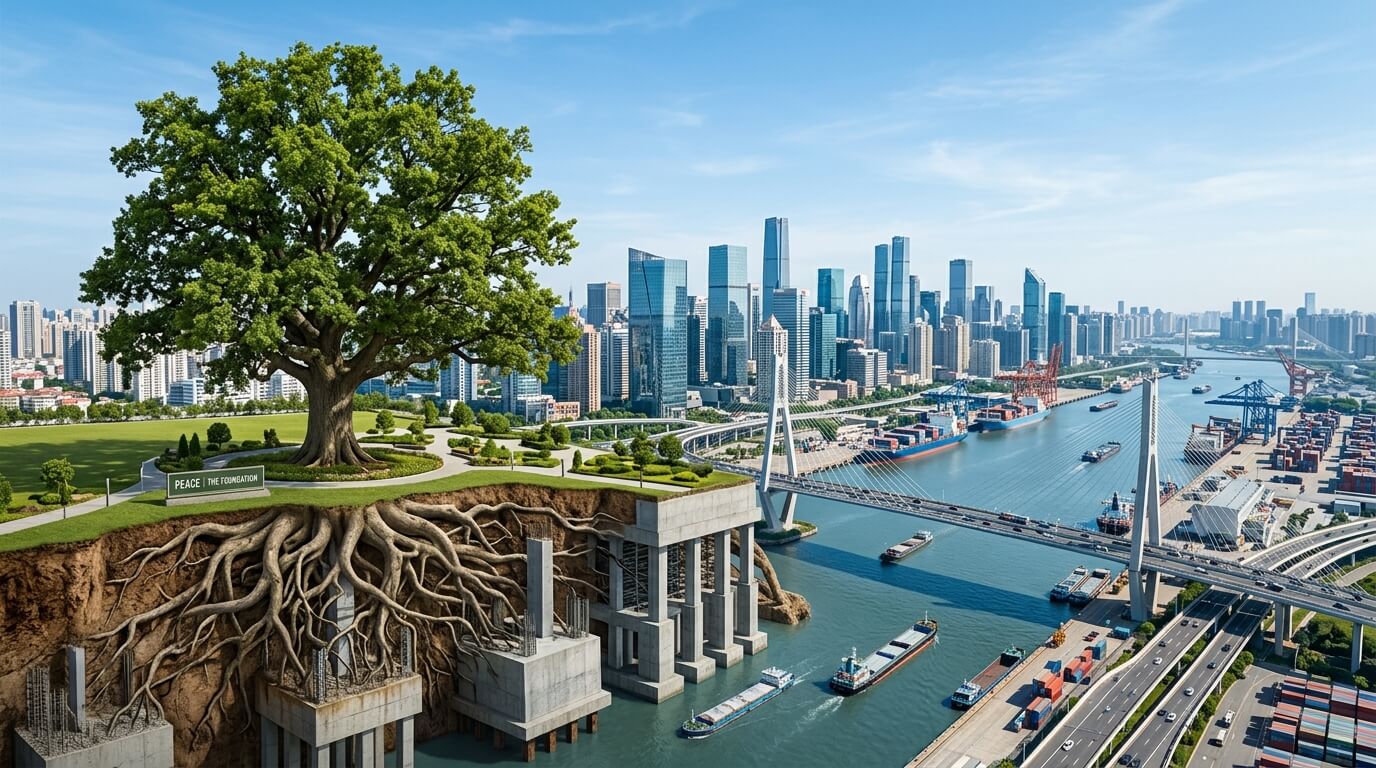
For any nation seeking sustained economic transformation, one precondition stands above all others: peace. Without it, infrastructure crumbles, investment flees, and human potential remains untapped. With it, we can lay the foundations of prosperity brick by brick, year after year.
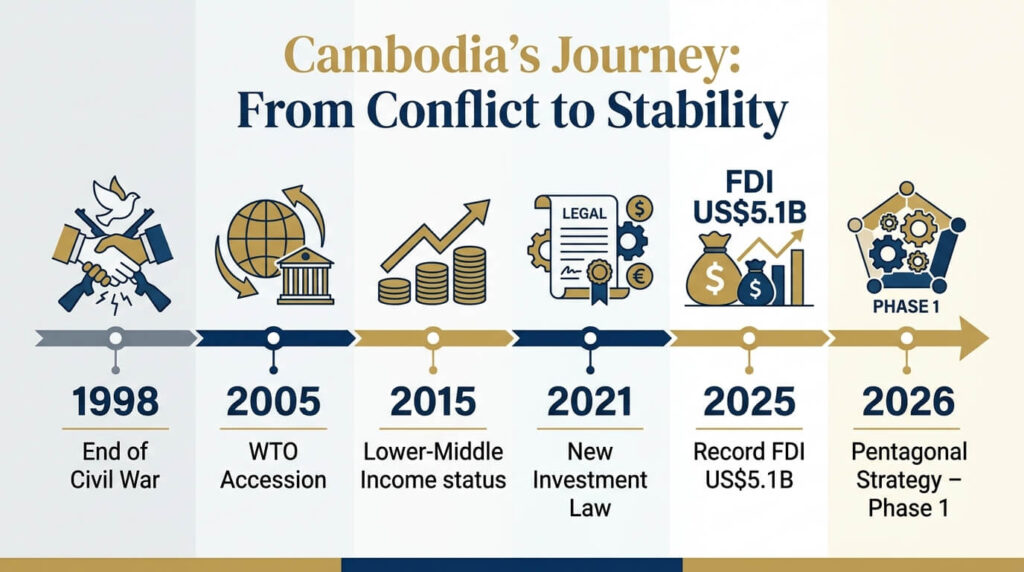
Cambodia is a living testament to this truth. The kingdom has now secured more than two decades of unbroken peace and political stability—a hard-won achievement that its leaders have repeatedly described as the “ultimate foundation” for all socio-economic development. This period of calm has enabled Cambodia to transform from a war-torn nation into one of Southeast Asia’s fastest-growing economies, a reliable destination for foreign direct investment, and a country with a clear and ambitious vision for its future.
The numbers are not abstract. In 2025 alone, the Council for the Development of Cambodia (CDC) approved over 600 investment projects worth more than US$10 billion—a record in its 30‑year history. Economic growth is on a steady upward trajectory, with GDP per capita expected to reach US$3,020 by 2026, up from US$2,858 in the previous year. Behind every statistic lies a singular driver: the confidence that Cambodia’s political environment is predictable, secure, and committed to the long term.
This article explores how peace and political stability serve as the bedrock of Cambodia’s success. We examine the government’s consistent policy framework, the record‑breaking investment surge, and the major infrastructure projects that would be impossible without enduring calm. For global investors, the message is unequivocal: Cambodia is open, stable, and ready for partnership.
📌 Key Takeaways: Why Political Stability is Cambodia’s Ultimate Asset
- Over two decades of unbroken peace – the foundation for all socio‑economic development, consistently reaffirmed by Cambodia’s leadership.
- Record investment surge (2025): CDC approved 600+ projects worth US$10 billion+ – a 30‑year record, creating over 400,000 projected jobs.
- Steady economic growth: GDP growth targeted at ~5% in 2026; GDP per capita expected to reach US$3,020 (up from US$2,858 in 2025).
- Strong legal foundation: The Law on Investment (2021) guarantees non‑discrimination, profit repatriation, and protection against expropriation.
- Mega‑projects as proof: Funan Techo Canal, new airports, expressways, and port expansions – all underway because of long‑term stability.
- Clear vision for 2030 & 2050: Cambodia aims for upper‑middle‑income status by 2030 and high‑income by 2050, with political stability as the non‑negotiable anchor.
From Conflict to Confidence: A Legacy of Hard-Won Peace
The story of modern Cambodia is one of resilience, determination, and ultimately, triumph over adversity. From the ashes of decades of conflict, the kingdom has emerged not merely stable but confidently forward-looking. This transformation was not accidental. It was the product of deliberate policy choices, unwavering political will, and a national consensus that peace is the indispensable foundation for all other ambitions.
A Nation Transformed After More Than Two Decades of Stability
The numbers tell only part of the story. Cambodia has secured more than two decades of uninterrupted peace—a period long enough to rebuild institutions, restore investor confidence, and lay the groundwork for sustained economic expansion. The royal government has consistently placed the safeguarding of this hard-won peace at the very center of its national strategy.
Speaking at the 3rd ASEAN Future Forum in Hanoi on June 9, 2026, Prime Minister Samdech Moha Borvor Thipadei Hun Manet underscored three key national priorities: peace, economic cooperation, and the well-being of the people. Reflecting on ASEAN’s own journey, the Prime Minister noted that Southeast Asia was once defined by conflict, mistrust, and poverty, but through dialogue, confidence-building, and respect for sovereignty, the region has become one of the most stable and dynamic in the world. “This transformation did not happen by chance,” he said. “It was the result of deliberate choices by our leaders and peoples to choose dialogue over confrontation, cooperation over division, and shared progress over rivalry.”
These principles are not abstract ideals. Cambodia’s own experience proves their tangible value. The 2026 national budget, approved at over US$10 billion, explicitly lists “safeguarding sovereignty and peace while maintaining macroeconomic stability” as its first priority. The budget represents 18.85 percent of GDP and reflects a 7.8 percent increase over the previous year—a clear signal that the government is investing in stability as a strategic asset.
Deputy Prime Minister and Minister of Economy and Finance H.E. Dr. Aun Pornmoniroth reaffirmed this commitment, stating that the government will carry out key reforms under the Pentagonal Strategy – Phase 1, led by Prime Minister Hun Manet, to achieve Cambodia’s vision of becoming an upper-middle-income country by 2030 and a high-income nation by 2050. “With sound fiscal management and continued reforms,” he said, “Cambodia will stay on course toward lasting peace and prosperity.”
The Pillars of Stability: Political Will and Predictable Governance
Peace alone is not enough. It must be supported by predictable governance, strong institutions, and a legal framework that protects both citizens and investors. Cambodia has systematically built these pillars over the past two decades.
The Cambodian Investment Board (CIB) explicitly lists “Peace, Political and Macroeconomic Stability” as the first and most fundamental reason to invest in the Kingdom. This is not marketing rhetoric; it is a statement of policy backed by demonstrable results. The government’s commitment to a predictable business environment is reflected in manageable inflation, a stable exchange rate, and low unemployment—all of which contribute to a low-risk operating environment for long-term business operations.
On the diplomatic front, Cambodia has consistently chosen dialogue over confrontation. Following the December 2025 ceasefire agreement with Thailand, the government has adhered strictly to the terms of the joint statement, actively working to transform the current ceasefire into a lasting peace. Prime Minister Hun Manet has reiterated that Cambodia remains committed to a peaceful resolution while making clear that “borders and sovereignty must never be altered by force or through a fait accompli.” This principled stance has earned Cambodia international recognition as a rational, responsible actor committed to regional stability.
Deputy Prime Minister Sun Chanthol, speaking in a January 2026 interview with Nikkei Asia, emphasized that Cambodia’s political stability and flexible legal framework offer attractive incentive packages aimed at maximizing foreign direct investment. He also noted Cambodia’s strategic shift toward higher-value sectors such as electronics assembly, food processing, and automotive manufacturing—all made possible by the secure environment that stability provides.
For investors, the message is unambiguous. Cambodia’s political leadership has not only secured peace but has institutionalized it—embedding stability into budgeting, policy-making, and diplomatic engagement. This is the foundation upon which all other achievements rest.
The Peace Dividend: Record‑Breaking Economic & Investment Growth
Cambodia’s economic performance provides the most tangible proof of its political stability. Two decades of uninterrupted peace have created the conditions for a remarkable transformation—one now accelerating faster than at any time since the post‑conflict recovery began. From the Council for the Development of Cambodia to the World Bank, the data tells an unambiguous story: stability breeds confidence, and confidence breeds growth.
A Macroeconomic Success Story: GDP Growth & Rising Prosperity
Cambodia entered 2026 on solid footing. According to the World Bank’s June 2026 economic update, real GDP growth is projected at 3.9 per cent in 2026 before recovering to 4.9 per cent in 2027. This moderation reflects global headwinds—rising energy prices and trade uncertainty—not domestic weakness. Indeed, the World Bank notes that Cambodia’s economy is “holding in the face of simultaneous shocks, demonstrating a resilience that can be sustained through targeted policy action.”
The International Monetary Fund has maintained its growth projection at 4.0 percent for 2026, unchanged from its October 2025 forecast, underscoring the Kingdom’s resilience despite mounting global challenges.
More importantly, the benefits of stability are reaching ordinary Cambodians. GDP per capita is estimated to have risen to US$2,858 in 2025 and is projected to reach US$3,020 in 2026—steady progress that reflects sustained economic expansion. International reserves are also strengthening, projected at US$25 billion in 2025 and nearly US$28 billion in 2026, providing a robust buffer against external shocks.
Minister of Industry, Science, Technology, and Innovation Hem Vanndy has attributed this performance to the Royal Government’s consistent focus on the industrial sector, which is expected to expand by approximately 7.2 percent—the primary engine driving Cambodia’s economic and social growth under the Pentagonal Strategy‑Phase 1.
A Historic Surge: CDC Approves Over 630 Projects Worth US$10 Billion
If there is a single statistic that captures investor confidence in Cambodia’s stability, it is the Council for the Development of Cambodia’s (CDC) approval record for 2025. In a historic achievement unprecedented in its 30-year history, the CDC approved 630 investment projects with total registered capital exceeding US$10 billion—a 45 percent increase in capital compared to 2024.
The scale of acceleration is striking. In 2023, the CDC approved 268 projects. In 2024, that number rose to 414. In 2025, it surged to 630. This is not incremental growth—it is a flood of confidence, directly attributable to the kingdom’s peace, political stability, and favorable investment climate.
Sun Chanthol, CDC’s first vice chairman, described the achievement as reflecting “the positive business and investment environment in Cambodia, as well as the expanding scope of Cambodia’s export markets.” He also noted a critical reassurance for investors: Cambodia was the first country in the world to secure reciprocal trade agreements with the United States at a tariff rate of 19 percent, providing “such clarity and a high level of confidence for investors exporting products to the vast US market.”
Of the 630 projects, 387 are located outside Special Economic Zones, while 243 are situated within SEZs—demonstrating that investor interest now extends across the entire economy, not merely within designated zones.
Jobs, FDI, and the Road to High‑Income Status
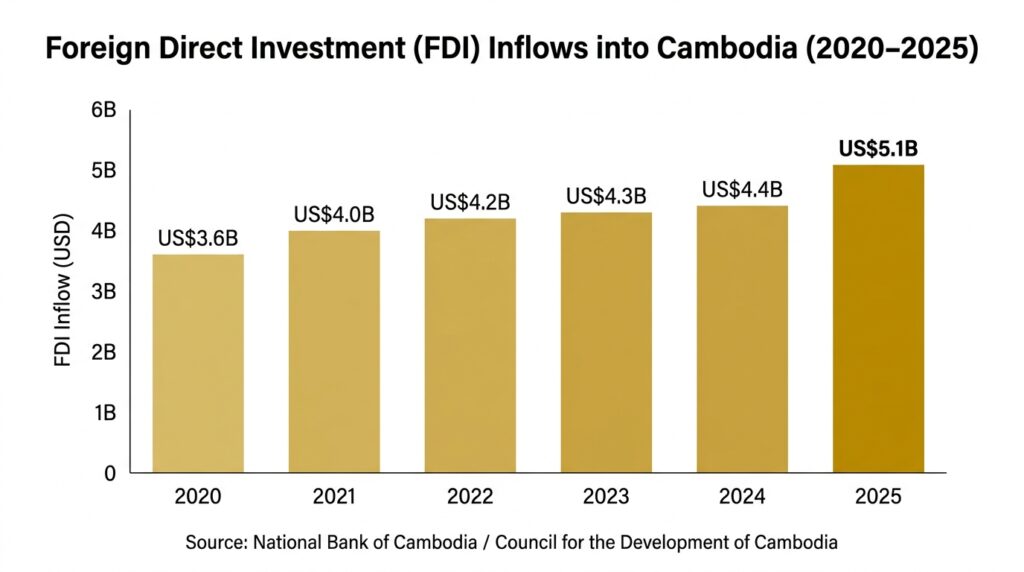
Behind every investment project are real jobs. The CDC’s 2025 approvals are expected to create over 400,000 formal jobs for Cambodians. The World Bank’s June 2026 economic update confirmed that foreign direct investment reached US$5.1 billion in 2025, helping to create an estimated 400,000 formal jobs while offering critical employment opportunities for workers moving from agriculture and returning migrants.
Goods exports remain exceptionally strong, growing by 17.7 percent in the first quarter of 2026—evidence that internationally traded sectors are thriving within Cambodia’s stable environment.
The pipeline of new investment extends across diverse sectors: agricultural plantations, fruit processing facilities, cattle farms, cement manufacturing, textile and yarn factories, automobile assembly plants, hotel construction, power generation, and—notably—automobile tire manufacturing. The CDC approved four tire projects in 2025 alone, representing nearly US$780 million in investment capital. These reflect a strategic shift toward higher‑value manufacturing, precisely the type of diversification Cambodia needs to achieve its long‑term aspirations.
For global investors, the message is unmistakable. Peace and political stability have transformed Cambodia from a post‑conflict nation into one of Southeast Asia’s most dynamic investment destinations. The government has not only secured stability but has also leveraged it to attract record‑breaking capital, create hundreds of thousands of jobs, and position the Kingdom firmly on the path toward its Vision 2050 of becoming a high‑income country.
From Reassurances to Reality: The Policy Framework Underpinning Stability
Peace may be the foundation, but policy is the architecture that turns stability into prosperity. Cambodia’s leadership has systematically codified its commitment to predictability into law, creating an investment environment where rules are clear, protections are enforceable, and governance is continuously modernised. For global investors, this framework transforms political stability from a subjective promise into an objective guarantee.
The Law on Investment (2021): A Modern, Investor‑First Legal Foundation
On 15 October 2021, Cambodia promulgated a new Law on Investment—the most comprehensive overhaul of the Kingdom’s investment legal framework in nearly two decades. The law was designed with a singular objective: to replace the legacy framework of 1993 (amended 2003) with a regime that is open, transparent, predictable, and fully aligned with ASEAN best practices.
The law’s core guarantees are unambiguous. Chapter 5 explicitly protects investors against arbitrary expropriation, guarantees national treatment (non‑discrimination between foreign and domestic investors), and ensures unrestricted profit repatriation in any hard currency. Article 19 guarantees the freedom to purchase foreign currencies and repatriate funds for any financial obligation associated with an investment—including capital contributions, dividends, royalties, loan repayments, and dispute settlement awards. For investors, these are not aspirational statements; they are legally enforceable protections.
Incentives are equally structured. The law establishes a three‑tier regime: basic incentives (tax holidays of 3–9 years for qualified investment projects), additional incentives (duty‑free imports of production equipment and materials), and special incentives for priority sectors such as high‑tech industries involving innovation or R&D. Nineteen priority sectors are explicitly identified for enhanced support, providing clarity for investors seeking to align with national development goals.
Administrative procedures were also streamlined. Article 12 mandates that relevant ministries must review and decide on investment applications submitted through the online one‑stop portal within 20 working days. This codified timeline replaces the opaque, open‑ended processes of the past with a predictable, enforceable standard.
The result is a legal framework that has been widely recognised as a model for emerging economies. The Association of Southeast Asian Nations (ASEAN) Business and Investment Summit has repeatedly cited Cambodia’s investment laws as a benchmark for regional best practice—a direct outcome of the Kingdom’s commitment to institutionalising its political stability into tangible investor protections.
Empowering the Private Sector: Governance Reforms & Anti‑Corruption Efforts
Laws alone are insufficient. They require implementation, monitoring, and continuous refinement. Cambodia has pursued a multipronged strategy to embed predictability into daily governance, addressing the concerns that investors historically raised about administrative friction, regulatory uncertainty, and the corrosive effects of discretionary decision‑making.
The most visible reform is the National Single Window system, launched in 2020. This digital platform integrates the CDC, Ministry of Commerce, General Department of Taxation, Ministry of Labour, Ministry of Interior, and Ministry of Economy and Finance into a unified online portal for investment registration and licensing. Where approval once required up to three months, processing has been compressed to eight working days for standard applications. The Single Window mechanism now routinely processes approvals for multiple projects in a single session. At its 18th session in December 2025, for example, the CDC used the system to approve 13 new projects worth approximately US$323 million across industrial sectors spanning cosmetics to wind power generation.
Complementing administrative reform is a structured approach to labour dispute resolution. Cambodia established the Arbitration Council—a national, legally empowered body dedicated to deciding labour disputes concerning the interpretation and enforcement of Cambodian labour laws. The Council offers an alternative to court litigation, providing binding arbitration that is faster and less adversarial. For employers, this means predictable outcomes and reduced operational disruption. For workers, it means access to justice without lengthy court processes. The Council continues to conduct training programmes for HR managers, compliance officers, and union representatives, ensuring that all parties understand the process. This institutionalised mechanism has significantly reduced the incidence of labour‑related investment disputes escalating into operational crises, providing another layer of stability for foreign businesses.
Anti‑corruption efforts have also been formalised. The Anti‑Corruption Unit (ACU) has signed 106 memoranda of understanding covering more than 1,000 companies since 2013. The ACU MoU Club requires members to implement mechanisms to prevent corruption, support education, and submit regular reports on clean operations, while the ACU reviews these reports and collaborates on compliance improvements. In January 2026, the ACU signed an MoU with Charles River Laboratories, a publicly listed US company that had acquired a Cambodian operation for US$510 million and employs more than 200 locals in Kampong Thom province. The acting president of the ACU described the MoU Club as a “key priority” that “serves as a model to attract investors”. The ACU’s message is explicit: “They can do business in Cambodia with transparency, accountability and integrity.”
Consistent Messaging from the Top: Leadership Commitment to Peace
Institutional reforms gain their credibility from consistent political endorsement. Cambodia’s leadership has never treated stability as a passive condition; it is an active, daily commitment renewed in every major policy address.
Prime Minister Hun Manet has repeatedly framed peace as a deliberate choice with tangible consequences. At the ASEAN Business and Investment Summit, he explicitly articulated that peace, political stability, and security are “a prerequisite and the core of socio-economic and human development, without which basic rights and freedom of the people cannot be protected, much less prosperity and development”. This is not abstract rhetoric. He anchored his argument in Cambodia’s lived experience: the transformation of a war‑torn nation into one that sustained seven per cent annual economic growth before the pandemic. For investors, the Prime Minister’s message is unequivocal: “Cambodia stands ready to welcome all prospective investors to the Kingdom, where opportunities are abundant.”
This commitment is institutionalised in the Pentagonal Strategy – Phase 1, the government’s flagship policy under Prime Minister Hun Manet. The strategy explicitly prioritises strengthening internal stability, national unity, and resilience while expanding external relations and respecting international law to promote peace at the national, regional, and global levels. It envisions Cambodia becoming an upper-middle-income country by 2030 and a high-income nation by 2050—ambitions that are unthinkable without the political stability that leadership has repeatedly guaranteed.
Governor Chea Serey of the National Bank of Cambodia has reinforced this message from a financial stability perspective, emphasising that monetary policy confidence is itself a product of political predictability. Deputy Prime Minister Sun Chanthol has similarly credited the CDC’s record‑breaking investment approvals to “the positive business and investment environment in Cambodia” directly attributable to political stability.
The cumulative effect is a governance ecosystem where stability is not merely maintained but projected—consistently, credibly, and with measurable results. Every legal reform, every administrative upgrade, and every leadership address reinforces the same core proposition: Cambodia’s political stability is not a temporary advantage but a permanent feature of its economic model. For investors conducting long‑term due diligence, this is the assurance that ultimately outweighs all other considerations.
Investing in the Future: Mega‑Projects as a Testament to Stability
If peace and policy are the foundation, megaprojects are the visible superstructure. Cambodia’s current pipeline of transformative infrastructure would be impossible without the secure investment climate that political stability provides. These projects are not merely about concrete and steel—they are physical expressions of national confidence, long‑term planning, and a government that delivers on its commitments.
The Funan Techo Canal: A National Strategic Priority
The Funan Techo Canal is Cambodia’s most ambitious infrastructure undertaking and a powerful symbol of the kingdom’s forward‑looking vision. Officially launched on 5 August 2024, this 172.6‑kilometer waterway connects the Mekong River system near Phnom Penh directly to the sea in Kep province. The project is divided into two sections: Section I (21 kilometers) broke ground in August 2024, and Section II (151.6 kilometers) launched construction in April 2026, with a total investment of approximately US$1.17 billion. The complete project is expected to be finished by 2028.
Critics have questioned its viability, but the government’s resolve has not wavered. Deputy Prime Minister Sun Chanthol has repeatedly affirmed that despite rising fuel costs, the working group will open 11 excavation sites after the rainy season to ensure the project remains on track. At the groundbreaking ceremony for Section II, Prime Minister Hun Manet described the canal as a “major strategic waterway” linking Phnom Penh to the sea, with the goal of enhancing national economic growth, water transport capacity, and logistics. He further stated that the project would transform the areas along the canal into industrial, commercial, agro‑industrial, logistics, and special economic zones, as well as tourist attractions.
By directly linking the Mekong to the Gulf of Thailand, the canal is expected to significantly reduce transportation costs, strengthen Cambodia’s connectivity with global supply chains, and reduce dependence on foreign ports. For investors, the government’s unwavering commitment to this complex, long‑duration project is the ultimate signal that political stability is not a temporary condition but a permanent feature of Cambodia’s economic landscape.
Connecting the Kingdom: Airports, Expressways, and Ports
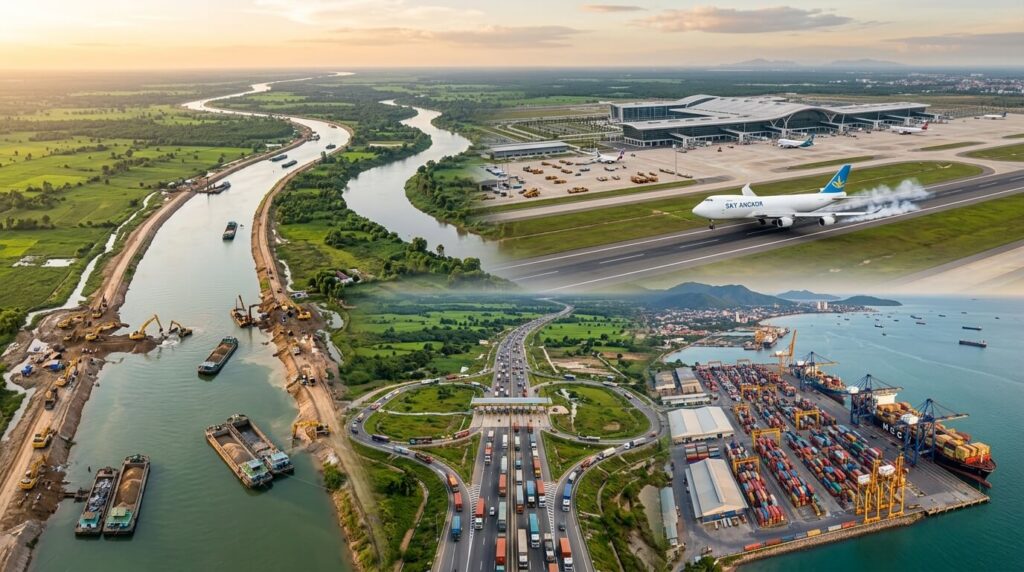
The Funan Techo Canal is only one part of a broader infrastructure revolution. Across the country, multiple megaprojects are simultaneously under construction or recently completed—each reinforcing the message that Cambodia’s political stability translates into tangible, bankable assets.
At the ASEAN Business and Investment Summit, Prime Minister Hun Manet explicitly cited the country’s “political stability,” expanding market access through free trade agreements, and continued regulatory reforms as the key attractions for investors—and then pointed to major infrastructure projects, including the Funan Techo Canal and the new international airport in Phnom Penh, as evidence of strengthening export capacity. Similarly, Deputy Prime Minister Sun Chanthol has highlighted political stability as a core competitive advantage when presenting the progress of Cambodia’s strategic infrastructure developments, including the canal and the Sihanoukville deep-sea port expansion.
Other major projects include:
- Techo International Airport (Phnom Penh): A US$2.3 billion, 4F‑rated airport opened in September 2025, enabling direct long‑haul flights and dedicated air cargo facilities.
- Phnom Penh–Sihanoukville Expressway (E4): Operational since 2022, this 190‑kilometer expressway slashes travel time from the capital to the main deep‑sea port to under two hours.
- Phnom Penh–Bavet Expressway (E1): A US$1.6 billion, 138‑kilometer expressway under construction, targeting 2027 completion and directly linking Cambodia to Vietnam’s expressway network.
- Sihanoukville Autonomous Port Expansion: A new 14.5‑meter deep container terminal (US$350 million, JICA‑financed), expected to be operational by early 2027, allowing direct calls by large ocean vessels.
Deputy Prime Minister Sun Chanthol has specifically noted that these large‑scale projects, including the canal, the new airports, and the port expansion, will “effectively reduce logistics costs and strengthen the country’s connection with global supply chains.” Their mere existence—much less their active construction—would be impossible without the enduring political stability that Cambodia has cultivated over more than two decades.
H3: What the Pipeline Proves to Global Investors
For global investors conducting due diligence, Cambodia’s mega‑project pipeline offers more than economic opportunity. It offers proof of execution. In many emerging markets, grand infrastructure plans remain on paper—victims of political turnover, regulatory reversals, or fiscal dysfunction. Cambodia’s record demonstrates the opposite. Projects that were announced are being built. Timelines, while ambitious, are being met. The government has shown that it can mobilize financing, manage complex construction, and maintain focus across multiple simultaneous initiatives.
This capacity for execution is itself a product of political stability. Long‑term infrastructure requires long‑term planning—beyond electoral cycles, beyond ministerial reshuffles, beyond short‑term budget pressures. Cambodia’s leadership has demonstrated that kind of consistency. The Pentagonal Strategy—Phase 1, the government’s flagship policy under Prime Minister Hun Manet, explicitly prioritizes infrastructure development as a core pillar of economic diversification and resilience. The strategy has been refined to enhance competitiveness and accelerate growth, with clear alignment between policy and project implementation.
For infrastructure investors—whether in construction, engineering, logistics, or financing—Cambodia’s political stability translates directly into reduced risk premiums. The certainty that a project approved today will still be supported five years from now is not a small advantage. It is the difference between investment and hesitation, between partnership and waiting.
The megaprojects rising across Cambodia are not just concrete and steel. They are monuments to a government that has delivered peace and used it to build. For investors willing to partner with a stable, confident nation, the foundation has never been stronger.
❓ Frequently Asked Questions (FAQ)
1. Is Cambodia politically stable for long‑term investment?
Yes. Cambodia has enjoyed over two decades of unbroken peace and political stability. The Royal Government consistently prioritises stability as the foundation for all socio‑economic development. International financial institutions, including the World Bank and IMF, have noted Cambodia’s resilience and predictable policy environment. Record FDI inflows – over US$5.1 billion in 2025 – confirm that global investors share this confidence.
2. What legal protections exist for foreign investors?
The Law on Investment (2021) provides robust protections, including: (i) national treatment (non‑discrimination between foreign and domestic investors), (ii) protection against expropriation without fair compensation, and (iii) unrestricted profit and capital repatriation in any hard currency. Cambodia has also signed bilateral investment treaties with over 25 countries, including Singapore, China, Japan, and South Korea.
3. How does the government ensure policy consistency across administrations?
Cambodia’s political leadership has demonstrated exceptional continuity. The Pentagonal Strategy – Phase 1, led by Prime Minister Hun Manet, provides a clear, multi‑year roadmap for economic development. Key institutions – including the Council for the Development of Cambodia (CDC), the Ministry of Economy and Finance, and the National Bank of Cambodia – operate with institutional independence and long‑standing professional leadership, ensuring that policies survive beyond electoral or ministerial changes.
4. What is the government’s track record on anti‑corruption?
The Anti‑Corruption Unit (ACU) has signed MOUs with over 1,000 companies through its MoU Club, requiring members to implement transparent practices and submit regular compliance reports. The ACU continues to expand this initiative, most recently partnering with US‑based Charles River Laboratories in January 2026. The government has also digitalised key administrative processes through the National Single Window, reducing discretionary decision‑making and opportunities for rent‑seeking.
5. Can I repatriate profits and capital freely?
Yes, with strong protections. The Law on Investment (2021), Article 19, guarantees the freedom to purchase foreign currencies and repatriate funds for any financial obligation – including capital contributions, royalties, loan repayments, and the proceeds from the sale or liquidation of an investment. Investors should note that dividends paid to foreign shareholders are subject to a withholding tax (14% standard, reduced to 10% under applicable Double Taxation Agreements). However, Qualified Investment Projects (QIPs) benefit from a corporate income tax holiday of up to 9 years, during which the tax base for such dividends is significantly reduced or eliminated. This legal framework provides one of the most open capital regimes in ASEAN.
6. How does Cambodia compare to other ASEAN countries for political risk?
Cambodia’s political risk profile is competitive within ASEAN. The Kingdom has maintained uninterrupted stability since 1998, a track record longer than several regional peers. The government’s consistent pro‑investment stance, combined with a young workforce and improving infrastructure, has attracted record FDI. While no country is without risk, Cambodia’s political leadership has demonstrated a clear, sustained commitment to predictability – a factor increasingly valued by global investors seeking alternatives to more volatile or saturated markets.
7. What is Cambodia’s long‑term vision?
Under the Pentagonal Strategy – Phase 1, Cambodia aims to become an upper‑middle‑income country by 2030 and a high‑income nation by 2050. The strategy prioritises economic diversification, infrastructure development, digital transformation, and human capital formation – all built on the foundation of continued peace and political stability. Every major policy address by Prime Minister Hun Manet reaffirms this trajectory.
Conclusion: A Future Built on an Unshakeable Foundation (Corrected)
Cambodia’s journey over the past two decades offers a powerful lesson for the world: peace is not merely the absence of conflict—it is the active, deliberate foundation upon which prosperity is built. The Kingdom has transformed itself from a post‑conflict nation into one of Southeast Asia’s most stable and dynamic investment destinations, and this transformation is no accident. It is the direct result of consistent political will, sound governance, and an unwavering commitment to putting stability at the centre of national strategy.
The evidence is everywhere. Foreign direct investment (FDI) reached over US$5.1 billion in 2025—a clear signal of global investor confidence. In total, the Council for the Development of Cambodia approved more than 630 investment projects in a single year, the highest in its three‑decade history, with a combined approved registered capital exceeding US$10 billion (including both foreign and domestic contributions). Steady GDP growth, rising per‑capita income, and a pipeline of mega‑projects—from the Funan Techo Canal to the new international airport to deep‑sea port expansions—are all actively under construction. These are not abstract promises. They are tangible results of a government that has prioritised peace and then leveraged it to attract capital, create jobs, and build infrastructure.
For global investors, the calculus is straightforward. Cambodia offers a legal framework—the Law on Investment (2021)—that guarantees national treatment, protection against expropriation, and the freedom to repatriate capital. It offers a predictable policy environment anchored by the Pentagonal Strategy – Phase 1 and reinforced by consistent leadership messaging. It offers a young, increasingly skilled workforce and improving logistics. And above all, it offers something increasingly rare in a volatile world: enduring political stability, proven over more than two decades and actively maintained every day.
No nation is immune to global headwinds. Cambodia faces the same challenges of rising energy costs, trade uncertainty, and climate pressures as its neighbours. But what sets the Kingdom apart is its resilience—a resilience built on the unshakeable foundation of peace. The World Bank has noted it. The IMF has confirmed it. And thousands of investors, from Singapore to China to the United States, have voted with their capital.
The vision ahead is clear. By 2030, Cambodia aims to become an upper‑middle‑income country. By 2050, a high‑income nation. These are ambitious targets, but they rest on a foundation that has already proven its strength. For investors willing to look beyond short-term headlines and see the long-term trajectory, Cambodia stands ready—open, stable, and confident in its future.
The peace has been won. The policies are in place. The projects are rising. Now is the time to partner with Cambodia.