
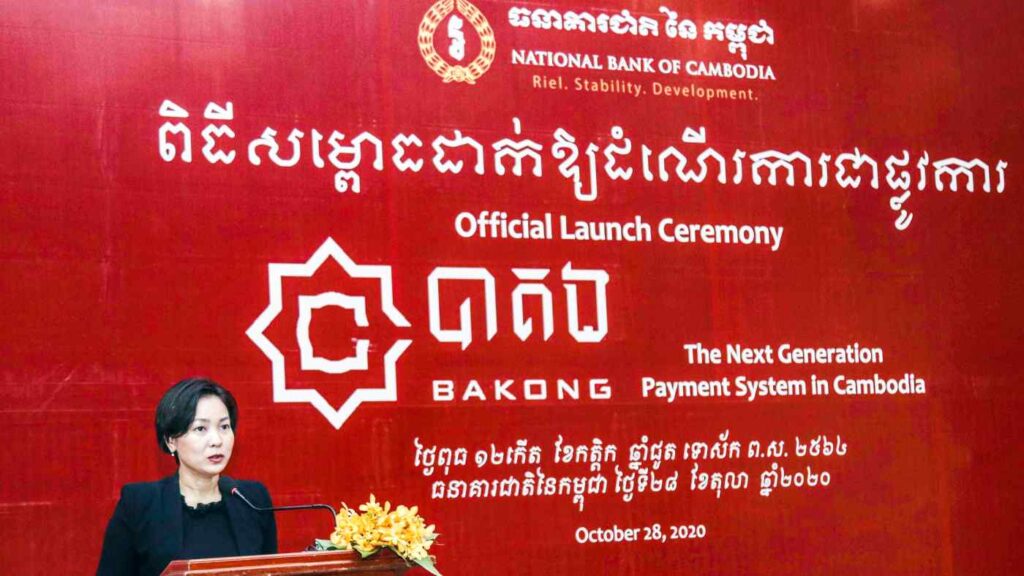
When the National Bank of Cambodia (NBC) launched the Bakong payment system in late 2020, few outside the Kingdom predicted it would become a regional benchmark for central bank‑led digital payments. Conceived as a blockchain‑based, peer‑to‑peer transfer platform, Bakong was initially designed to address two domestic challenges: reducing the country’s heavy reliance on US dollars and bringing the unbanked into the formal financial system.
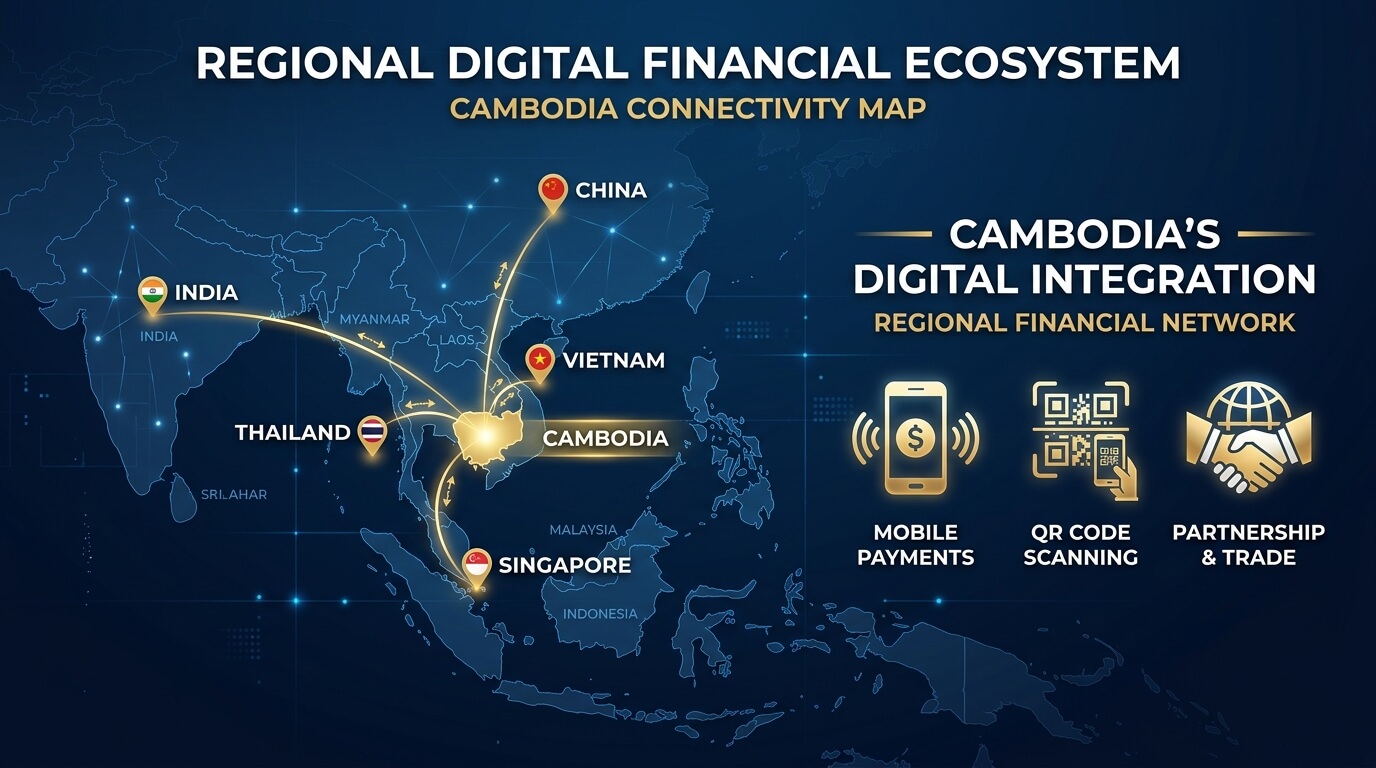
Fast forward to 2026, and Bakong has evolved far beyond its original mandate. Today, it is the beating heart of Cambodia’s cross-border payment strategy—a growing web of bilateral QR code linkages that connects Cambodian consumers and merchants directly with counterparts in Thailand, Vietnam, Laos, Malaysia, China (UnionPay, Alipay, and WeChat Pay), India, South Korea, Japan, and soon Singapore (fully operational two‑way link as of March 2026).
The numbers speak for themselves. In 2025 alone, the Bakong system processed over 1.3 billion transactions (1,325.65 million) with a total value of US$224 billion—a 20% increase in transaction volume year‑on‑year. 63 financial institutions are now official members, with an additional seven institutions in the process of system integration, and the Bakong Tourist app—launched in August 2024—is opening seamless digital payments to international visitors, with approximately 22,138 accounts registered in 2025 and access to over 4.5 million KHQR merchant touchpoints nationwide.
This article explores how Cambodia’s Bakong system is revolutionizing cross-border payments across ASEAN and beyond. We will break down the key bilateral corridors, examine the strategic goals of financial inclusion and de-dollarization, and show why fintech professionals and global investors cannot afford to ignore Cambodia’s digital finance transformation.
📌 Key Takeaways: Cambodia’s Bakong Cross-Border Revolution
- 1.3 billion transactions processed in 2025 (771M KHR + 554M USD), valued at ~US$224 billion – up 20% YoY.
- 63 member institutions and 18.9 million e-wallet accounts – exceeding Cambodia’s population.
- Cross-border QR links operational with Thailand, Vietnam, Laos, Malaysia, Singapore (March 2026), China (Alipay, WeChat, UnionPay), South Korea, and India (Phase 1, June 2026). Pilot with Japan.
- Bakong Tourist app allows international visitors to pay at 4.5 million KHQR merchants using their own cards – no local bank account needed.
- De-dollarisation in action: Khmer Riel transaction volume grew 317% over five years, with Riel growth outpacing USD.
- Global recognition: Ranked #1 in ASEAN for financial services (World Bank B‑READY 2025), and #2 retail CBDC-style project globally (PwC 2021).
Inside the Numbers: Bakong’s Meteoric Rise in 2025
For any fintech platform, credibility rests on data. By that measure, Bakong’s performance in 2025 cements its status as a genuine ASEAN success story. The National Bank of Cambodia’s (NBC) annual report reveals a system operating at an extraordinary scale—and accelerating.
1.3 Billion Transactions and US$224 Billion in Value
The headline figures are staggering: Bakong processed 1.325 billion transactions in 2025—a 20% increase (1.2‑fold) from the previous year. This volume includes transactions in both Khmer Riel (KHR) and US dollars, reflecting the platform’s central role in Cambodia’s dual‑currency economy.
Breaking it down by currency reveals accelerating momentum across the board:
Khmer Riel (KHR) Transactions:
- Transaction count: 771 million, 1.6 times higher than in 2024
- Total value: 285.9 trillion KHR (approximately US$73 billion), a 59.4% year‑on‑year increase
Note: The US$224 billion figure is the combined total of both KHR and USD transactions, not the KHR value alone. The article correctly presents this later, but the phrasing in this specific line could be clearer.
US Dollar (USD) Transactions:
- Transaction count: 554 million, a 79.7% year‑on‑year increase
- Total value: US$152.8 billion, up 49.3% from 2024
Combined Totals:
- Total transaction count: 1.325 billion
- Total combined value: KHR 285.9 trillion + USD 152.8 billion ≈ US$224 billion
Key Insight: While Bakong handles both KHR and USD volumes, the growth rates for Khmer Riel transactions—both in count and value—are outpacing those for US dollars. This alignment with the NBC’s de-dollarization strategy demonstrates that government-backed digital payments can succeed where regulatory measures alone may struggle.
Additional context: These figures imply that Bakong’s annual transaction value now exceeds Cambodia’s GDP by a factor of approximately 3.3 times—a ratio reminiscent of advanced digital finance economies like Thailand and Singapore.
63 Member Institutions and 18.9 Million E‑Wallet Accounts
Transaction volume is one metric; adoption is another. Here too, Bakong shows remarkable penetration.
Member Institutions:
- As of the 2025 annual report, Bakong has 63 official member institutions in active operation.
- An additional seven members are currently undergoing system integration.
These members span the full range of Cambodia’s financial ecosystem: major commercial banks (ACLEDA, ABA, and Maybank), specialised banks; microfinance institutions (AMK and PRASAC); and payment service providers (Wing and SpeedPay). By bringing these diverse players onto a single interoperable platform, Bakong has effectively created a unified digital payments layer for the entire nation.
E‑Wallet Accounts:
The broader shift toward digital finance is equally impressive. Cambodia recorded 18.9 million e‑wallet accounts in 2025.
To put that number in perspective: Cambodia’s population is approximately 17 million. The number of e‑wallet accounts exceeds the country’s total population—a signal that many Cambodians hold multiple e‑wallets or that foreign workers and tourists contribute to the total. Either way, it points to near‑ubiquitous digital payment adoption among the adult population.
Quick comparison: By contrast, Thailand—a much larger economy with a population over 70 million—reported approximately 78 million e‑wallet accounts as of 2024. On a per‑capita basis, Cambodia’s penetration rate is highly competitive within ASEAN.
Bakong Tourists App:
The NBC also launched the dedicated Bakong Tourists app in late 2024. This app allows international visitors to link their Mastercard or Visa cards and pay using KHQR codes at thousands of merchants nationwide. While specific user figures for the tourist app were not disclosed in the 2025 annual report, its existence signals a strategic push to capture inbound tourist spending—a sector that generated over US$3.5 billion in revenue in 2025—and funnel it through the domestic digital payments infrastructure.
Summary Table: Key Bakong 2025 Metrics
| Metric | Khmer Riel (KHR) | US Dollar (USD) | Total / Combined |
|---|---|---|---|
| Transaction Count (2025) | 771 million | 554 million | 1.325 billion |
| YoY Growth | +60% (1.6x) | +79.7% | +20% |
| Transaction Value (2025) | 285.9 trillion KHR (~US$224B) | US$152.8 billion | ~US$224B combined |
| YoY Growth | +59.4% | +49.3% | — |
| Member Institutions | — | — | 63 active + 7 integrating |
| E‑wallet Accounts (2025) | — | — | 18.9 million |
4.5M+ KHQR merchants · Visa & Mastercard linked
The ASEAN Network: A Web of Cross-Border QR Connectivity
The domestic success of Bakong was always intended as a prelude to regional expansion. Today, that ambition has become reality. Cambodia has quietly built one of Southeast Asia’s most connected retail payment networks, with operational QR links to Thailand, Laos, Vietnam, Malaysia, Singapore, China, South Korea, and India—and more in active development.
What makes this network remarkable is not just its breadth but also its depth. The National Bank of Cambodia (NBC) has moved decisively from one-way arrangements (Cambodians paying abroad) to fully reciprocal two-way corridors that allow foreign visitors to pay seamlessly in Cambodia using their own home banking apps.
Below, we break down each major corridor—the status, the technology, and the strategic significance.
The Two-Way Singapore-Cambodia Corridor (March 2026)
The link with Singapore is arguably the most strategically important for attracting high-value investment and tourism. The two countries achieved full interoperability on March 30, 2026, completing a two-phase rollout.
- Phase 1 (November 2025): Enabled Cambodian travellers to scan SGQR codes in Singapore using Bakong-linked Khmer Riel accounts.
- Phase 2 (March 2026): Enabled Singaporean travellers to scan KHQR codes across Cambodia using their home mobile payment apps connected to Liquid Group’s RoamQR network.
What this means for users:
- Singaporean visitors can now pay at over 4.5 million merchant touchpoints across Cambodia by scanning KHQR codes.
- Cambodian travellers can reciprocally pay at RoamQR merchants in Singapore, promoting the use of the Khmer Riel across ASEAN.
- Participating apps include LiquidPay and other mobile payment apps connected to the RoamQR network, with additional banks and wallet partners progressively enabled. The corridor is supported by intermediary banks including United Overseas Bank Limited and DBS Bank Ltd. in Singapore”.
Who makes it work? The corridor is enabled through collaboration with ACLEDA Bank Plc and Phillip Bank Cambodia Plc, which facilitate settlement and interoperability between Bakong and the RoamQR network, operated by Liquid Group.
Fully Reciprocal Links with Thailand, Laos & Vietnam
Cambodia’s immediate neighbours are its most natural payment partners. All three corridors have now achieved full two-way interoperability, enabling seamless travel and trade across the Mekong subregion.
Thailand:
The Cambodia-Thailand QR link is one of the most mature in the network. Thai tourists can use their mobile banking apps to scan KHQR codes at merchants throughout Cambodia, while Cambodian travellers can similarly use Bakong-linked apps to scan PromptPay QR codes in Thailand. From the Thai side, the system is integrated into the broader “Cross Border QR Payment” framework, which now covers nine countries – including Cambodia, Laos, Vietnam, Malaysia, and Singapore.
Laos:
The Cambodia-Laos corridor reached full reciprocity in December 2025, when the NBC and the Bank of the Lao PDR officially launched Phase 2 in Phnom Penh.
- Phase 1 (August 2023): Enabled Cambodian users with Khmer Riel accounts to pay merchants in Laos by scanning Lao QR codes.
- Phase 2 (December 2025): Enabled Lao citizens travelling in Cambodia to pay for goods and services nationwide by scanning KHQR codes via mobile banking applications issued by Lao banks — with zero transaction fees.
Vietnam:
The Cambodia-Vietnam corridor operates on a similar reciprocal basis. Bilateral arrangements already promote payments in Khmer Riel and Vietnamese Dong, aligning with ASEAN’s broader push toward local currency settlement and reducing dependence on the US dollar for cross-border trade.
The Malaysia-Cambodia Link (April 2025)
The Malaysia-Cambodia corridor, launched in April 2025, is another fully operational two-way system. The initiative connects Cambodia’s Bakong app with Malaysia’s PayNet DuitNow QR system, benefiting over five million merchants across both countries.
- Phase 1: Cambodian visitors can use their apps to pay at over two million Malaysian merchants, with transactions processed in Khmer Riel.
- Phase 2 (expected): Malaysian users will be able to scan KHQR codes at Cambodian merchants, completing the two-way loop.
Strategic significance: This corridor directly supports the growing trade and tourism flows between Cambodia and Malaysia. It also demonstrates Cambodia’s ability to integrate with a sophisticated, well-established payment system like DuitNow, which serves as a benchmark for regional interoperability.
The China-Cambodia Connection — Full Integration with UnionPay & Alipay
China is Cambodia’s largest trading partner and source of foreign direct investment. Unsurprisingly, the Bakong system is deeply integrated with Chinese payment platforms.
Cambodia has operational QR payment links with China’s UnionPay and Alipay. In early 2026, the Bank of China Phnom Penh Branch received official approval from the NBC to serve as the designated clearing bank for the Bakong-WeChat QR cross-border interoperability initiative, following nearly three years of sustained effort.
What this means for users:
- Chinese tourists and business travelers can pay at KHQR merchants across Cambodia using Alipay, WeChat Pay, and UnionPay apps—seamlessly, without cash.
- Cambodian users gain access to China’s massive consumer market for cross-border e-commerce and tourism-related payments.
The India-Cambodia Link — Connecting KHQR to UPI
India’s Unified Payments Interface (UPI) is the world’s most successful real-time payment system. Cambodia is now connected to it.
In June 2026, NPCI International (NIPL), the global arm of India’s National Payments Corporation of India (NPCI), launched Phase 1 of the cross-border QR payment linkage between Cambodia and India.
- Phase 1 (June 2026): Enables Indian travellers visiting Cambodia to scan KHQR codes at over 4.5 million merchant touchpoints using their UPI‑enabled apps. Future Phase (expected): Will enable Cambodian citizens visiting India to scan UPI QR codes, completing the two‑way corridor.
- Future Phase (expected): Will enable Indian tourists and business travelers to pay at KHQR merchants in Cambodia, completing the two-way corridor.
This partnership is particularly significant because UPI processes over 13 billion transactions per month in India. Any linkage to that network opens a vast new user base for Cambodia’s tourism and digital commerce sectors.
The ASEAN Network — Visual Summary
| Partner Country | Status as of June 2026 | Key Features |
|---|---|---|
| Thailand | Fully reciprocal | PromptPay ↔ KHQR |
| Laos | Fully reciprocal (Phase 2, Dec 2025) | Zero transaction fees for Lao users |
| Vietnam | Fully reciprocal | VN Dong ↔ Khmer Riel settlement |
| Malaysia | Fully reciprocal (Phase 2 launched Apr 2025) | Covers 5M+ merchants |
| Singapore | Fully reciprocal (Mar 30, 2026) | Links KHQR with SGQR via RoamQR |
| China | Operational (UnionPay, Alipay, WeChat Pay) | Dedicated clearing bank (Bank of China, Phnom Penh) |
| India | Phase 1 launched (June 2026) | UPI ↔ KHQR |
| South Korea | Operational | Supports cross-border retail payments |
| Japan | Pilot stage (Cambodian travellers only) | JPQR via KHQR-compatible apps |
Beyond ASEAN: Bakong’s Expanding Global Footprint
While ASEAN remains the primary focus for the Bakong system, the National Bank of Cambodia (NBC) has deliberately set its sights beyond the region. The goal is to position Cambodia as a digital payment hub that connects not only its immediate neighbours but also major Asian economies – and eventually global markets.
Full Integration with China’s Alipay, WeChat Pay, and UnionPay
China is not merely a bilateral partner; it is an ecosystem. Cambodia has achieved what few smaller economies have: full integration with all three of China’s dominant payment platforms.
- UnionPay: The linkage with UnionPay International allows Chinese tourists and business travellers to pay directly using UnionPay mobile apps at KHQR merchant locations across Cambodia. Conversely, Cambodian travellers can use Bakong‑linked apps to pay at UnionPay QR merchants in China.
- Alipay: The Alipay connection has been operational since 2025, enabling seamless payments for the hundreds of thousands of Chinese tourists who visit Cambodia annually.
- WeChat Pay: In early 2026, the Bank of China Phnom Penh Branch received formal approval from the NBC to serve as the designated clearing bank for the Bakong‑WeChat QR cross‑border interoperability initiative. This approval followed nearly three years of sustained effort and positions WeChat Pay as the third major Chinese platform to integrate fully with KHQR.
Why this matters: China is Cambodia’s largest source of tourists (pre‑pandemic levels exceeded 2 million annually (with over 2.36 million Chinese visitors recorded in 2019, making China a critical source market for Cambodia’s tourism sector), and its largest trading partner. Giving Chinese visitors and businesspeople the ability to pay with the apps they already use at home eliminates a major friction point and encourages higher spending.
Opening a New Corridor with India’s UPI (Phase 1, June 2026)
India’s Unified Payments Interface (UPI) processes over 23 billion transactions per month – making it the world’s largest real‑time payment system by volume. In May 2026 alone, UPI recorded a record 23.41 billion transactions.
Phase 1 (launched June 2, 2026): Enables Indian travellers visiting Cambodia to use their UPI‑enabled apps to scan KHQR codes at over 4.5 million merchant touchpoints across Cambodia. This covers everything from street food vendors to major retailers.
Phase 2 (expected): The reciprocal arrangement – Cambodian citizens travelling to India scanning UPI QR codes – is under active negotiation. Once completed, this will give Cambodian travellers access to India’s vast UPI merchant network. Once completed, this will open Cambodia’s 4.5 million KHQR merchants to India’s massive outbound tourism market (over 15 million Indian travellers abroad annually).
Strategic partner: The initiative is implemented by NPCI International (NIPL), the global arm of India’s National Payments Corporation of India, in collaboration with Cambodian financial institutions.
Forging Links with Japan and South Korea
Cambodia has not neglected Northeast Asia. Both Japan and South Korea are at different stages of integration.
South Korea – Operational: Supports cross‑border retail payments, with Cambodian travellers able to use Bakong‑linked apps to scan QR codes in South Korea. South Korean tourists can use their domestic payment apps to scan KHQR codes at merchants in Cambodia, while Cambodian travelers can reciprocate in South Korea. This corridor supports the growing number of South Korean investors, expatriates, and tourists in Cambodia.
Japan (pilot stage): The Cambodia‑Japan link is currently operational for Cambodian travelers only—they can use Bakong‑linked apps to pay at JPQR merchants in Japan. The reciprocal arrangement (Japanese tourists paying in Cambodia) is still in development. Given Japan’s status as a major aid donor and investor in Cambodia, a full two‑way corridor is a high priority for the NBC.
The Road Ahead: Europe and the Middle East?
While not yet publicly announced, the NBC has signalled ambitions to extend Bakong connectivity beyond Asia. In multiple speeches and annual report statements, the central bank has emphasised a long‑term vision of the following:
- Connecting with Gulf Cooperation Council (GCC) countries – leveraging Cambodia’s growing labour exports to the Middle East.
- Exploring partnerships with European payment schemes – potentially through the European Payments Initiative (EPI) or bilateral arrangements with individual countries.
For now, these remain aspirations. But the pace of Bakong’s expansion over the past 24 months suggests that further geographic leaps are likely before 2030.
Visual Summary: Bakong’s Global Footprint (as of June 2026)
| Country/Region | Status | Key Feature |
|---|---|---|
| China | Fully operational | UnionPay, Alipay, WeChat Pay (clearing bank approved) |
| India | Phase 1 live (June 2026) | Cambodians can pay via UPI; Phase 2 (Indians in Cambodia) pending |
| South Korea | Operational | Two‑way corridor live |
| Japan | Pilot (Cambodia → Japan only) | Reciprocal arrangement under negotiation |
| Europe | Not yet | Long‑term aspiration |
| GCC / Middle East | Not yet | Long‑term aspiration |
Cambodia’s KHQR connection to UPI opens a vast new user base for tourism and digital commerce.
More Than Payments: The Strategic Goals of the Bakong System
Bakong is often framed as a payment success story — and with over a billion annual transactions, that framing is justified. But reducing it to a mere payment rail misses the point. For the National Bank of Cambodia (NBC), Bakong is a strategic instrument deployed to achieve three interconnected national objectives: financial inclusion, de‑dollarisation, and the modernisation of Cambodia’s entire financial infrastructure.
Driving Financial Inclusion for Cambodia’s Unbanked
Before Bakong, Cambodia’s financial inclusion landscape was defined by a stubborn paradox: high mobile phone penetration coexisted with low formal banking access, especially in rural areas. Bakong was explicitly designed to bridge that gap — not by replacing banks, but by connecting them into a single interoperable framework that even remote communities could access through basic smartphones.
The results are tangible. By the end of 2025, Cambodia had recorded 18.6 million depositors and 4.3 million credit users, with women accounting for the majority in both the banking and microfinance sectors. Central to this progress was rapid digitisation driven by the Bakong system, which by early 2026 supported more than 44 million accounts and extended essential financial services to previously underserved rural communities.
The NBC’s commitment to inclusion is now being codified into formal policy. In April 2026, the central bank formally commenced the process of updating Cambodia’s National Financial Inclusion Strategy (NFIS) for 2026‑2030, building on the digital infrastructure that Bakong has put in place. At the same time, initiatives like Bakong Junior — a dedicated app launched in partnership with the Ministry of Education — are embedding financial literacy into the school curriculum, ensuring that the next generation grows up comfortable with digital finance.
The De‑dollarisation Agenda: Promoting the Khmer Riel
Cambodia’s economy remains heavily dollarised. The US dollar circulates alongside the Khmer Riel in daily transactions, wage payments, and even bank deposits — a legacy of post‑conflict stabilisation that limits the NBC’s monetary policy autonomy. Bakong has emerged as the central bank’s most practical tool for tilting the balance back toward the national currency.
The data shows momentum. In 2025, Khmer Riel in circulation reached 18.7 trillion KHR, reflecting an average annual growth of 6% over the previous five years. More strikingly, the volume of Khmer Riel transactions through Bakong grew by 317.3% over the same five‑year period, and their value increased by 174.9%. In the first half of 2025 alone, Riel transaction volumes more than doubled year‑on‑year, reaching 303 million transactions with a total value of 128.6 trillion KHR (approximately US$32 billion), while Riel transaction growth continued to significantly outpace that in US dollars.
These figures are not accidental. The ASEAN Economic Community (AEC) has released a Strategic Plan (2026‑2030) to promote the use of local currencies — including the Khmer Riel — for cross‑border transactions, and Cambodia is actively aligning its bilateral QR corridors with this framework. Cambodians can now make cross‑border payments in Thailand, Vietnam, Laos and Malaysia by scanning QR codes in Khmer Riel, without having to convert to US dollars first.
On the domestic front, the de‑dollarisation effort is gaining institutional traction. In March 2026, the NBC and the United Nations Development Programme (UNDP) jointly launched a policy brief examining dollarisation in Cambodia’s garment, footwear, and travel goods sectors — the country’s largest export industries. The brief calls for a coordinated shift toward wage payments in Riel. The banking sector has responded: the Association of Banks in Cambodia has announced a target for 25% of bank employees to be paid in Riel by the end of 2026, following a policy brief jointly launched by the NBC and UNDP in March 2026 examining dollarisation in Cambodia’s garment, footwear, and travel goods sectors.
For NBC Governor Chea Serey, the logic is clear: digitalisation accelerates what regulatory measures alone could not. “With digitalisation, many things can be advanced quickly, and Cambodia knows how to use it to achieve leapfrog development,” she has stated. The goal is not to eliminate the dollar overnight but to create a genuinely dual‑currency economy where the Riel is a confident, competitive choice — not a reluctant default.
A Global Benchmark for Central Bank‑Led Digital Systems
One of the most unexpected outcomes of the Bakong project has been its elevation as a global benchmark for central bank‑led digital payment systems. The NBC has been careful to clarify that Bakong is not a retail central bank digital currency (CBDC)—it is a distributed ledger‑based interbank payment system that connects existing financial institutions. As NBC Governor Chea Serey explained: ‘Bakong is not a digital currency — it’s a foundational payment infrastructure that empowers users to transact securely and efficiently’ . Nevertheless, its success has drawn international recognition.
In 2021, PwC ranked Bakong first in Asia and second in the world among retail CBDC‑style projects, behind only the Bahamas’ Sand Dollar. More recently, the World Bank’s 2025 Business Ready (B‑READY) survey ranked Cambodia first in ASEAN for financial services, citing Bakong as a primary driver of the country’s digital financial transformation.
The ASEAN+3 Macroeconomic Research Office (AMRO) has been particularly effusive. In its ASEAN+3 Financial Stability Report 2025, AMRO observed that Bakong has improved cross-border payment efficiency, lowered transaction costs, and reduced dependence on the US dollar in everyday commerce—precisely the objectives the NBC set out to achieve. AMRO also noted that the infrastructure is now in place and that “the next phase is inclusion”—a challenge Cambodia is already addressing through its updated NFIS and digital literacy initiatives.
For policymakers in other emerging economies—particularly those struggling with dollarization, low financial inclusion, or fragmented payment systems—the Bakong model offers a replicable blueprint. Build an interoperable layer on top of existing institutions, prioritize cross‑border connectivity from the outset, and use digital rails to advance monetary policy goals without disrupting the broader economy. Cambodia has demonstrated that a small, open economy can leapfrog legacy payment infrastructure and become a regional pioneer.
Launched Oct 2025
The User Experience: How KHQR is Transforming Travel & Commerce
Behind the statistics and strategic goals lies a simpler question: what does Bakong actually feel like for the people who use it every day? For tourists, small business owners, and cross‑border travellers, the answer is a seamless, low‑friction experience that is rapidly changing how money moves in and out of Cambodia.
For Tourists: Seamless Payments at 4.5 Million Merchants
Cambodia welcomed 5.57 million international visitors in 2025, with tourism revenues reaching US$3.87 billion — a 6.6% increase from the previous year. Historically, those visitors faced a familiar inconvenience: exchanging cash, dealing with unfamiliar ATMs, or carrying large amounts of foreign currency. Bakong has eliminated much of that friction.
The Bakong Tourist App—launched in November 2024—allows international visitors to download the app, load funds from their home‑issued Mastercard or Visa cards (in any currency), and immediately begin scanning KHQR codes to pay at over 4.5 million merchant touchpoints across Cambodia. No Cambodian bank account is required. No local SIM card is necessary. The app works entirely on the visitor’s existing card network and mobile device.
What this means in practice:
- A Singaporean tourist can land at Siem Reap, open the Bakong Tourist app, top up US$200 using their DBS Visa card, and pay for a meal, a tuk‑tuk ride, or a souvenir at the Angkor Archaeological Park—all by scanning a simple QR code.
- The merchant receives the funds instantly in Khmer Riel (or US dollars, depending on their account settings), and the tourist avoids ATM fees, currency exchange spreads, and the risk of carrying large amounts of cash.
Adoption data: While specific transaction figures for the tourist app were not disclosed in the NBC’s 2025 annual report, early indications suggest strong uptake, particularly among visitors from Singapore, Thailand, China, and South Korea—all countries with existing QR corridors.
Future enhancements: The NBC has indicated plans to expand the Tourist app’s functionality to include peer‑to‑peer transfers and integration with ride‑hailing and food delivery apps—turning it from a payment tool into a full travel companion.
For Businesses: Access to Regional Markets
For Cambodian merchants—from a Phnom Penh coffee shop to a Sihanoukville hotel—KHQR has transformed the customer base. Previously, accepting digital payments meant supporting multiple apps, each with different QR codes and settlement processes. Bakong’s single interoperable KHQR standard means one QR code works for all Bakong‑linked apps, regardless of the customer’s bank or wallet provider.
Domestic benefits:
- Reduced cash handling costs (security, transport, counting, storage)
- Faster settlement (real‑time or near‑real‑time, versus overnight for cash deposits)
- Digital transaction records that simplify accounting and tax compliance
Cross‑border benefits:
The real game‑changer is international. A merchant displaying a KHQR code can now receive payments from:
- Thai tourists using their local banking apps (via the Cambodia‑Thailand QR link)
- Malaysian visitors using DuitNow QR
- Singaporean travelers using RoamQR
- Chinese tourists using Alipay, WeChat Pay, or UnionPay
- Indian visitors (via the UPI corridor, which launched Phase 1 in June 2026 enabling Indian travellers to scan KHQR codes in Cambodia)
Revenue impact: For a Siem Reap restaurant catering to international tourists, this means capturing customers who previously walked away because they lacked local cash. For a Phnom Penh boutique selling to regional business travelers, it means faster, more convenient checkouts and higher average transaction values.
Small merchant adoption: The NBC has actively promoted KHQR adoption among micro‑enterprises—street vendors, market stalls, and rural shops—often through partnerships with member banks that provide zero‑fee QR code setup and subsidized point‑of‑sale materials. This grassroots approach has been critical to reaching the 4.5 million merchant milestone.
For Cambodian Travellers Abroad: Spending Khmer Riel Directly
The reciprocal side of the equation is equally important. Cambodian tourists, business travellers, and overseas workers can now use their Bakong‑linked apps to pay in Thailand, Vietnam, Laos, Malaysia, Singapore, South Korea, Japan (pilot), and India (Phase 1) – all without converting to US dollars first.
Real‑world example: A Cambodian student studying in Bangkok can use their ACLEDA Bank app (linked to Bakong) to scan a PromptPay QR code at a 7‑Eleven, paying directly from their Khmer Riel account at the real‑time exchange rate. No need to open a Thai bank account, no ATM withdrawal fees, no currency exchange counter.
Overseas workers: Cambodia has an estimated 1.2 million citizens working abroad (primarily in Thailand, South Korea, Japan, and Malaysia), many of whom send remittances home regularly, primarily in Thailand, South Korea, Japan, and Malaysia. Many send remittances home regularly. Bakong’s cross-border corridors not only allow them to spend locally but also create a pathway for lower-cost remittances – a key strategic priority for the NBC.
The Visual Simplicity of KHQR
One of Bakong’s most underappreciated strengths is its simplicity. The KHQR code standard, based on the EMVCo Merchant Presented QR (MPQR) specification, is visually uniform across all participating banks and payment service providers. A customer never needs to ask, “Which QR code should I scan?” – any KHQR code works with any Bakong‑compatible app.
Merchant benefits:
- Single QR code for all payment types (domestic and cross‑border)
- No need to maintain multiple QR stickers or terminal devices
- Real‑time transaction notifications (SMS or in‑app)
Customer benefits:
- Consistent scanning experience across thousands of merchants
- Instant confirmation with no “pending” uncertainty
- Transaction history automatically stored in the app
❓ Frequently Asked Questions (FAQ)
1. Is Bakong a central bank digital currency (CBDC)?
No. The National Bank of Cambodia has repeatedly clarified that Bakong is not a retail CBDC. It is a blockchain‑based, distributed ledger interbank payment system that connects existing financial institutions. Unlike a CBDC, Bakong does not create a direct claim on the central bank for retail users; rather, it facilitates transactions between accounts held at licensed banks and payment service providers.
2. Which countries are linked to Cambodia’s Bakong system for cross-border payments?
As of June 2026, Bakong has operational cross-border QR payment links with Thailand, Vietnam, Laos, Malaysia, Singapore, China (UnionPay, Alipay, WeChat Pay), South Korea, and India (Phase 1). A pilot link with Japan (Cambodian travellers only) is also active, with full reciprocity under negotiation. Cambodia is actively exploring additional corridors with other ASEAN members and beyond.
3. How can a tourist use Bakong in Cambodia?
International visitors can download the Bakong Tourist app (available for iOS and Android), register using their passport, and top up funds using any Mastercard or Visa card. Once loaded, the app allows them to scan KHQR codes at over 4.5 million merchants across Cambodia – from street stalls to luxury hotels – and pay directly without cash. No Cambodian bank account is required.
4. Can I use my home country’s banking app to pay in Cambodia?
Yes, if your country has a reciprocal agreement. Citizens of Thailand, Vietnam, Laos, Malaysia, and Singapore can use their own local banking apps to scan KHQR codes in Cambodia and pay directly in their home currency. For example, a Thai tourist can use their Bangkok Bank app (which supports PromptPay QR) to scan a KHQR code in Phnom Penh. Chinese tourists can use Alipay, WeChat Pay, or UnionPay apps. Indian travellers will be able to do the same once Phase 2 of the India-Cambodia link is completed.
5. How many transactions does Bakong process annually?
In 2025, Bakong processed a total of 1.325 billion transactions (771 million in Khmer Riel and 554 million in US dollars), with a combined estimated value of US$224 billion. This represents a 20% year‑on‑year increase in transaction count.
6. Is Bakong only for Khmer Riel transactions?
No. Bakong supports both Khmer Riel (KHR) and US dollars (USD). Cambodia has a dual‑currency economy, and the system processes a significant volume of USD transactions. However, the NBC is actively using Bakong to promote the use of the Khmer Riel, and KHR transaction volumes have been growing faster than USD volumes in recent years.
7. Is Bakong safe and secure?
Yes. Bakong operates on a permissioned blockchain with security protocols overseen by the National Bank of Cambodia. All transactions are encrypted and settled through licensed financial institutions. The system has been audited by international partners and has not suffered any major security breach since its launch in 2020.
Conclusion: Cambodia’s Digital Leap Forward
The Bakong system has transformed from a domestic experiment into one of ASEAN’s most ambitious cross‑border payment networks. In just six years, Cambodia has moved from cash dominance to a future where a single KHQR code connects merchants and consumers across nine economies—from Singapore to Seoul, from Mumbai to Shanghai—and the network continues to grow.
The numbers are no longer experimental. Over 1.3 billion transactions in 2025, US$224 billion in value, 63 member institutions, and 4.5 million merchant touchpoints – these are the metrics of a system that has achieved critical mass. More importantly, the growth trajectory remains steep. Transaction volumes grew 20% year‑on‑year in 2025, and cross‑border linkages are being added at a faster pace than any other time in Bakong’s history.
What this means for Cambodia:
First, Bakong has given the National Bank of Cambodia a practical tool for de-dollarization—not through regulation alone, but by making the Khmer Riel a convenient, competitive choice for everyday payments and cross-border transactions. The 317% five‑year growth in Riel transaction volume through Bakong is evidence that digital rails can achieve what policy measures could not.
Second, Bakong has positioned Cambodia as a fintech pioneer within ASEAN. The World Bank’s 2025 B‑READY survey ranking Cambodia first in the region for financial services is not an accident. It reflects years of deliberate investment in interoperable, low‑cost payment infrastructure—a model that other emerging economies are now studying.
Third, the system has become a catalyst for tourism and commerce. International visitors no longer need to navigate Cambodia’s cash economy with anxiety. A Singaporean tourist, a Chinese business traveler, or an Indian shopper can pay seamlessly using the apps they already trust. That convenience translates directly into higher spending, smoother operations for small merchants, and a more welcoming environment for foreign investment.
What this means for the region:
Bakong’s network of bilateral QR corridors is a proof of concept for ASEAN’s broader vision of regional payment integration. The ASEAN Economic Community has long promoted interoperability, but progress has been uneven. Cambodia has demonstrated that a small, open economy can move faster—not by waiting for a unified regional system, but by aggressively signing bilateral agreements and ensuring they are technically interoperable.
The Singapore‑Cambodia link (March 2026) is particularly significant. It connects two systems – Bakong and SGQR – that are among the most advanced in Southeast Asia. The India‑Cambodia link (June 2026) opens a corridor to the world’s largest real‑time payment network. Together, these partnerships suggest a future where payment corridors are no longer the exception but the norm.
The road ahead:
Challenges remain. The Bakong Tourist app is still relatively new, and full adoption among international visitors will take time. The cost structure for cross-border transactions—while lower than traditional methods—has not been fully disclosed, and transparency will be important for building trust. And the NBC must continue to invest in financial literacy, particularly in rural areas, to ensure that digital inclusion reaches every corner of the country.
Nevertheless, the direction is clear. Cambodia has built a digital payment infrastructure that is open, connected, and scalable. The foundation is laid. The network is expanding. And for a country once defined by post‑conflict reconstruction, Bakong represents something more than technology—it represents a confident, forward‑looking vision of what a small nation can achieve when it embraces digital finance as a strategic priority.
For fintech professionals, global investors, and policymakers, the message is unambiguous: Cambodia is no longer following the region’s digital finance leaders. It is setting the pace. The question is no longer whether to engage with Cambodia’s digital economy—it is how soon.