
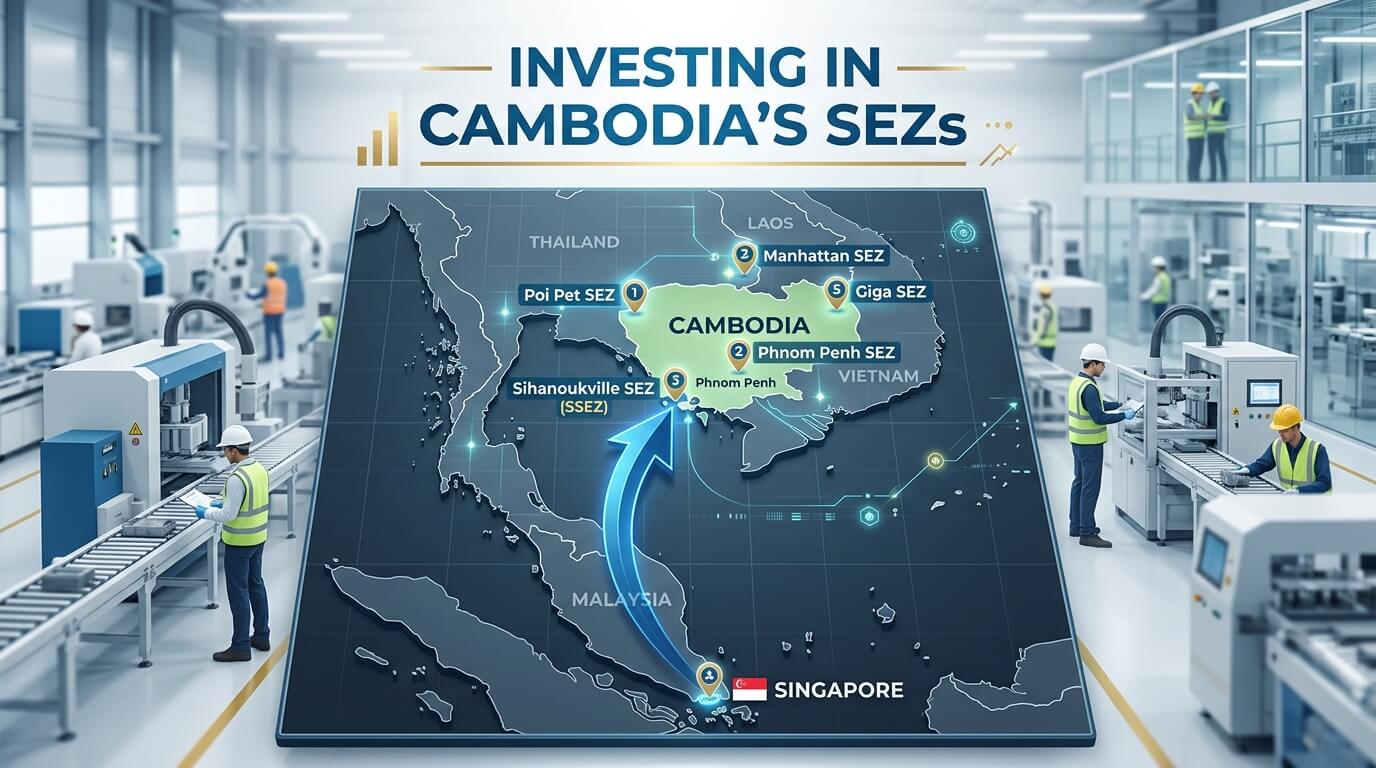
For decades, Singapore has been the undisputed manufacturing and logistics hub of Southeast Asia. But as labor costs rise and supply chains seek geographic diversification, a new frontier is capturing the attention of Lion City investors: Cambodia’s Special Economic Zones (SEZs).
Once viewed primarily as a low‑cost garment producer, Cambodia has transformed into a multi‑sector manufacturing powerhouse. The catalyst is a network of 57 SEZs and industrial parks—including 34 designated SEZs—concentrated along the borders with Vietnam and Thailand and near the deep-sea port of Sihanoukville—offering a compelling mix of tax holidays, duty-free imports, and 100% foreign ownership.
For Singaporean businesses, the calculus is increasingly attractive. The Cambodia‑Singapore bilateral trade surged nearly 200% year‑on‑year in the first quarter of 2026, and Singapore ranked as a top‑three foreign investor in Cambodia by approved capital in 2025. Companies that once looked only to Vietnam or Indonesia are now conducting serious due diligence on Svay Rieng, Bavet, and the Manhattan SEZ—a zone built with visible Singaporean DNA.
This article provides a data‑driven roadmap for Singaporean investors considering Cambodia’s SEZs. We will examine the tax incentives that make these zones stand out, profile a successful Singapore‑backed SEZ, and walk you through the step‑by‑step setup process. If your company is exploring ASEAN supply chain alternatives, Cambodia’s SEZs deserve a closer look.
Key Statistics: Why Singapore is Already Deeply Invested
The numbers tell a compelling story. Singapore’s economic footprint in Cambodia has expanded dramatically over the past 18 months, driven by shifting regional supply chains, Cambodia’s attractive investment incentives, and the growing maturity of its SEZ ecosystem.
FDI Rankings: In 2025, Cambodia attracted US$5.1 billion in foreign direct investment (FDI), a 16% increase from 2024. China remained the dominant source (US$3.76 billion, 73.7% of total FDI), but Singapore ranked second with US$347 million, accounting for 6.8% of total inflows. Other sources rank Singapore’s share slightly lower depending on methodology, but the consensus is clear: Singapore is Cambodia’s second-largest foreign investor and a rapidly growing source of capital.
Trade Explosion: Bilateral trade between Cambodia and Singapore surged by 89% in 2025, reaching US$2.34 billion. Cambodian exports to Singapore more than doubled (up over 200%), while Singaporean imports to Cambodia grew by 50.5%. The momentum has accelerated further in 2026: trade in the first three months alone reached US$555 million, a 191% year-on-year increase. According to the General Department of Customs and Excise, trade during the first four months of 2026 totalled US$775.54 million, up 220.8% compared to the same period in 2025.
SEZ Growth: By the end of 2025, Cambodia had 57 operational SEZs and industrial parks—a 14% increase from 2024. Of these, 34 are designated SEZs. Svay Rieng province leads with 12 SEZs, followed by Preah Sihanouk province with six. SEZs collectively account for an estimated 60-70% of Cambodia’s total exports, producing goods ranging from car tires and bicycles to electronic components and automotive parts.
Employment and Projects: As of early 2025, hundreds of investment projects had been implemented within Cambodia’s SEZs. By September 2025, these zones had attracted 1,021 investment projects with cumulative capital of US$12.9 billion, directly creating over 230,000 jobs.
The data confirms what investors are seeing on the ground: the Cambodia-Singapore economic corridor is not a distant prospect—it is already in motion.
📌 Key Takeaways: Why Singapore is Eyeing Cambodia’s SEZs
- Singapore is Cambodia’s #2 foreign investor – US$347 million in FDI in 2025, accounting for 6.8% of total inflows.
- Bilateral trade exploded 191% YoY in Q1 2026, reaching US$555 million in just three months.
- 57 SEZs now operational (up 14% from 2024), driving 60-70% of Cambodia’s total exports.
- 1,021 investment projects have been implemented in SEZs, creating over 230,000 direct jobs.
- Tax incentives are the anchor – up to 9 years of corporate tax holidays, duty‑free imports, and 100% foreign ownership.
The Top 5 Tax Incentives in Cambodia’s SEZs
For Singaporean investors comparing regional manufacturing destinations, Cambodia’s SEZ incentives consistently rank among the most generous in ASEAN. The 2021 Law on Investment, combined with SEZ‑specific regulations, creates a compelling fiscal package that directly improves bottom lines.
Below are the five most valuable tax incentives available to investors who locate within a registered SEZ and obtain Qualified Investment Project (QIP) status from the Council for the Development of Cambodia (CDC).
1. Corporate Income Tax Exemption (Up to 9 Years)
The flagship incentive. QIPs receive a tax holiday ranging from 3 to 9 years, depending on the project’s investment capital, technology level, and export orientation. During this period, the standard 20% corporate income tax rate is waived entirely.
- Typical duration: 6‑9 years for manufacturing and high‑tech projects
- What happens after: A graduated 50% reduction on tax owed for another 6 years, then full 20% thereafter
For a Singaporean manufacturer exporting US$10 million annually, this exemption can save over US$1.5 million in taxes during the first six years alone.
2. Duty‑Free Import of Equipment & Materials
SEZ‑based manufacturers can import the following 100% duty‑free:
- Production equipment and machinery
- Construction materials (for factory buildout)
- Raw materials, components, and spare parts
- Lubricants, chemicals, and packaging materials
Cambodia’s customs duty rates typically range from 7% to 35% on imported goods. Eliminating these duties directly lowers production costs and improves export competitiveness.
3. 100% Foreign Ownership Allowed
Unlike some neighbouring countries that require local joint ventures or phased divestment, Cambodia permits 100% foreign ownership in SEZs. Singaporean investors can wholly own their factories, control management decisions, and repatriate all profits without restriction.
4. Simplified Export/Import Procedures
SEZs operate as bonded zones with on‑site customs offices. This means:
- No separate import/export permits for each shipment
- Reduced inspection times – typically hours instead of days
- Single‑window clearance through the CDC for both investment registration and customs
For logistics‑intensive operations, the time saved translates directly into lower inventory holding costs and faster order fulfilment.
5. Unrestricted Capital Repatriation
Profits, interest, royalties, and technical fees can be freely transferred out of Cambodia in any hard currency (USD, SGD, EUR). There are no exchange controls and no restrictions on capital repatriation. Dividends paid to non‑resident shareholders are subject to a 14% withholding tax, which may be reduced to 10% (or lower) under Cambodia’s Double Taxation Agreements (DTAs) —including the Cambodia‑Singapore DTA. For Singaporean CFOs managing group cash flow, the combination of free capital movement and treaty‑protected withholding rates provides substantial certainty.
For Singaporean CFOs managing group cash flow, this certainty is invaluable.
Summary Table of Incentives:
| Incentive | Benefit | Typical Duration |
|---|---|---|
| Corporate Tax Holiday | 0% CIT (vs. 20% standard) | 3‑9 years |
| Duty‑Free Imports | 0% on machinery, materials, parts | Entire QIP period |
| Foreign Ownership | 100% allowed | Permanent |
| Simplified Customs | On‑site clearance | Ongoing |
| Capital Repatriation | No restrictions, no withholding tax | Permanent |
(vs. 20% standard rate)
Equipment · Materials · Machinery
Full management control
Hours instead of days
Note: 14% withholding tax on dividends to non‑residents
Reduced to 10% under Cambodia‑Singapore DTA
Spotlight: Manhattan SEZ – A Model of Singaporean Collaboration
Among Cambodia’s 57 SEZs, one stands out as a direct testament to successful Singaporean investment: the Manhattan Special Economic Zone (MSEZ) in Svay Rieng province.
What makes Manhattan SEZ different?
Unlike many SEZs developed by Chinese or Cambodian conglomerates, the Manhattan SEZ a zone developed with significant Singaporean collaboration and retains strong operational ties to the Lion City. The zone was established in 2005 and has since grown into one of Cambodia’s most successful industrial estates.
Key facts about Manhattan SEZ:
- Location: Bavet town, Svay Rieng province – directly on the Cambodian-Vietnamese border, less than two hours from Ho Chi Minh City
- Size: Approximately 400 hectares
- Tenants: Over 50 factories, including major names in apparel, footwear, electronics, and automotive components
- Employment: Approximately 40,000 workers
- Exports: Goods manufactured in MSEZ are exported primarily to the US, Europe, Japan, and ASEAN markets.
✅ Turnkey solutions · ✅ On-site customs · ✅ Reliable power & water
Why Singaporean investors should take note:
- Proven model – Manhattan SEZ has operated profitably for nearly two decades, demonstrating that Singaporean management and compliance standards work in Cambodia.
- Strategic location – The zone sits adjacent to National Road 1 and the future Phnom Penh–Bavet Expressway (E1). Once the expressway is completed in 2027, travel time to Phnom Penh will drop to 1.5 hours, and container movement to Sihanoukville Port will become significantly faster.
- Turnkey solutions—Manhattan SEZ offers ready‑built factories, on‑site customs clearance, logistics support, and utilities—reducing the setup burden for new investors.
- Singaporean management culture—The zone is managed with Singaporean operational standards, including transparent accounting, reliable power and water supply, and professional labor relations.
What this means for your business:
Manhattan SEZ proves that the Cambodia‑Singapore investment corridor works in practice, not just on paper. For a Singaporean manufacturer looking to diversify out of China or even out of Vietnam, Manhattan offers a low-risk entry point—with the added comfort of dealing with familiar management practices and English-fluent administration.
If Manhattan SEZ is already at capacity (which it frequently is), the message remains clear: the model works, and opportunities exist in other SEZs across Svay Rieng, Sihanoukville, and beyond.
A Step-by-Step Guide to Setting Up in a Cambodian SEZ
For Singaporean investors ready to move beyond due diligence, the actual setup process in a Cambodian SEZ is more straightforward than many expect. The government has deliberately streamlined procedures to attract foreign capital. Below is a practical, four‑step roadmap.
Step 1: Choose Your SEZ
Not all SEZs are equal. Your choice should align with your industry, logistics needs, and labour supply.
- For export‑oriented manufacturing near Vietnam: Svay Rieng province (Manhattan SEZ, Giga Resource SEZ, Tai Seng Bavet SEZ) – ideal for garments, electronics, and light assembly.
- For heavy industry or bulk cargo: Sihanoukville province (Sihanoukville SEZ, SPP SEZ) – close to the deep-sea port.
- For proximity to Phnom Penh’s labour pool: Kandal province (Phnom Penh SEZ) – good for higher‑value assembly or just‑in‑time production.
Action: Shortlist 2‑3 zones, request investor packages (land lease rates, utility costs, available factory shells), and if possible, schedule a site visit.
Step 2: Apply for QIP Status with the CDC
The Qualified Investment Project (QIP) status is the gateway to all tax incentives. Applications are submitted to the Council for the Development of Cambodia (CDC) via its online system.
Required documents typically include:
- Completed QIP application form
- Feasibility study or business plan
- Environmental impact assessment (for certain industries)
- Proof of capital (bank statements, commitment letters)
- Lease or land ownership agreement within the SEZ
Processing time: 20 working days (official processing time) for standard manufacturing projects.
CDC Registration Fee: The CDC charges a registration fee of KHR 15,000,000 (approximately US$3,750) for new industrial, tourism, infrastructure, agriculture, or mining projects.
Online Portal: Applications can be submitted online via the cdcIPM portal at https://qip.cdc.gov.kh/login.
Tip: Engage a local law firm or consultancy with CDC experience. Many Singaporean firms partner with Phnom Penh‑based advisors who handle the entire process for a fixed fee (typically US$2,000‑5,000).
Step 3: Submit Your Investment Proposal
The QIP application doubles as your investment proposal. The CDC will evaluate:
- Total investment capital (generally a minimum of US$500,000 for CDC‑registered QIPs. Note: Under the Special Programme to Promote Investment in the Four Northeastern Provinces (SPIN), projects in Kratie, Stung Treng, Ratanakkiri, and Mondulkiri may qualify with a minimum of US$100,000).
- Job creation targets
- Export percentage (most SEZ projects export >80% of output)
- Technology and environmental standards
Once approved, you receive a Final Registration Certificate (FRC) – your official license to operate with full incentives.
Step 4: Land Lease & Construction
SEZs offer two primary models:
- Lease only: You lease land (typically 30‑50 years, renewable) and build your own factory. This gives you full control but requires higher upfront capital and 12‑18 months for construction.
- Build‑to‑suit or ready‑built: The SEZ developer constructs a factory to your specifications and leases it to you. Faster (3‑6 months to operations), lower upfront cost, but higher monthly lease rates.
Permits: Your SEZ developer usually assists with construction permits, fire safety approvals, and utility connections.
Total timeline from initial inquiry to production: Typically 6‑12 months for a ready‑built factory and 12‑24 months for a custom build.
Navigating New Compliance: Cambodia’s 2025-2026 Tax Updates
For any Singaporean investor, understanding tax compliance is just as critical as maximising incentives. Cambodia’s tax landscape has seen significant changes in 2025 and 2026. While existing QIP and SEZ incentives remain intact, new obligations—particularly the long-awaited Capital Gains Tax (CGT)—are now in effect.
Being aware of these updates demonstrates credibility and helps your board plan accurate financial models.
The New 20% Capital Gains Tax (Phased Implementation)
After several years of delay, Cambodia formally enacted its CGT regime under Prakas No. 496 MEF.PRK, issued on 18 July 2025. The tax applies to gains realised from the sale or transfer of six categories of “capital assets”:
Asset Category Effective Date: Leases, investment assets (shares, bonds), goodwill, intellectual property, foreign currency 1 September 2025 Immovable property (land, buildings, constructions) 1 January 2026
The key details for your financial planning are as follows.
- Rate: Capital gains are taxed at a flat 20% on the realised gain (selling price less deductible expenses).
- Calculation Method: For immovable property, taxpayers may deduct either actual documented costs or a standard 80% deduction of the sale price. For all other assets, only the actual-cost method is available.
- Exemptions: CGT does not apply to the sale of one’s primary residence (held for at least five years), transfers between close relatives, or agricultural land actively used for cultivation by Cambodian citizens.
Double Taxation Agreements (DTAs) Provide Relief
Singaporean investors benefit from the Singapore-Cambodia Double Taxation Agreement (DTA). Under the DTA, certain categories of capital gains may be taxable only in Singapore, not in Cambodia. For example, gains from the sale of shares of a Cambodian company may be exempt from Cambodian CGT if the company’s assets do not consist primarily of immovable property located in Cambodia.
To claim DTA benefits, you will need to submit an application letter through the General Department of Taxation’s (GDT) online platform. This requires proper documentation, so early engagement with a tax advisor is recommended.
Other 2025-2026 Tax Updates for Investors
Beyond CGT, several other developments affect the investment climate:
- 2026 Minimum Wage: Effective 1 January 2026, the minimum wage for the garment, textile, footwear, and travel goods sectors increased to US$210 per month (probationary workers US$208). The modest US$2 increase (approximately 1%) reflects the government’s commitment to gradual, predictable adjustments, giving manufacturers a rare degree of labour‑cost predictability. Employers should also note that the statutory minimum wage is not the full labour cost—additional statutory allowances (attendance, transport, housing, meals) and NSSF contributions (currently ~5.4%) apply.
- Transfer Pricing Rules: Cambodia is strengthening its transfer pricing enforcement under Prakas 574, effective from 1 January 2025. Taxpayers engaged in related‑party transactions are required to prepare and retain Local File transfer pricing documentation on an annual basis. A 10% penalty may apply on transfer pricing adjustments. However, certain exemptions exist, including for related‑party loans under specific thresholds and for newly incorporated entities during a three‑year grace period. Investors must align intercompany transactions with arm’s length principles and maintain contemporaneous documentation to avoid audit friction.
- QIP Incentives Unchanged: The core incentives for Qualified Investment Projects (QIPs) remain intact, including tax holidays of 3-9 years, duty-free imports, and enhanced deductions for training and capital equipment.
A Note for Singaporean Investors
The introduction of CGT places Cambodia alongside regional peers such as Vietnam and Thailand that already tax asset gains. While the 20% rate is significant, careful structuring and treaty planning can materially reduce exposure. For example, under the Cambodia‑Singapore DTA, withholding tax on dividends, interest, and royalties is capped at 10% (down from Cambodia’s standard 14% rate). However, treaty benefits require a formal application with supporting evidence, and anti‑abuse provisions such as the Principal Purpose Test (PPT) may apply. For manufacturing investors focused on SEZ operations, the direct impact is limited, as CGT primarily affects real estate and share transactions. However, for investors planning eventual exits or holding Cambodian property, professional tax advice is essential.
6 asset categories
Leases/Shares/IP: 1 Sept 2025
Real Estate: 1 Jan 2026
Treaty relief available
Formal application required
Probationary: US$208
+ allowances (~US$17–27)
NSSF: ~5.4%
Local File documentation required
10% penalty for adjustments
✅ Core incentives remain intact for SEZ investors
Why the Singapore-Cambodia Investment Corridor is Poised for Growth
The current wave of Singaporean interest in Cambodia’s SEZs is not a short‑term trend. Several structural factors point toward sustained – and accelerating – capital flows over the next five to ten years.
ASEAN Supply Chain Diversification & RCEP
The “China + 1” strategy has moved from boardroom discussion to active implementation. Multinational corporations are systematically reducing their concentration risk by adding alternative manufacturing bases in Southeast Asia. Cambodia is a direct beneficiary.
- RCEP advantages: As a member of the Regional Comprehensive Economic Partnership (RCEP), Cambodia offers tariff‑free or reduced‑tariff access to China, Japan, South Korea, Australia, New Zealand, and the other ASEAN nations. Goods manufactured in a Cambodian SEZ can enter these markets under preferential terms.
- US and EU access: Cambodia currently enjoys duty‑free, quota‑free access to the EU market under the Everything But Arms (EBA) scheme and similar GSP programs. However, the EU has partially suspended these preferences, and as Cambodia approaches LDC graduation in 2029, these duty‑free channels will gradually be replaced by standard Most‑Favoured‑Nation (MFN) tariffs. For now, garment and travel goods continue to benefit, but investors should plan for this transition.
For a Singaporean company that already has regional distribution hubs, adding a Cambodian production line diversifies supply chain risk while maintaining competitive export advantages.
Infrastructure Boom – Direct Link to Your Competitive Advantage
Cambodia’s ongoing infrastructure transformation directly benefits SEZ investors. The previous article on this site documented the mega projects reshaping logistics. Here is how they connect to SEZ operations:
| Infrastructure Project | SEZ Impact |
|---|---|
| Phnom Penh–Bavet Expressway (E1) – completion 2027 | Slashes travel time from Svay Rieng SEZs to Phnom Penh to 1.5 hours; faster container movement to Sihanoukville Port. |
| Funan Techo Canal – completion 2028 | Provides an alternative water route from Phnom Penh to the sea, reducing logistics costs for SEZs near the Mekong. |
| Sihanoukville Port expansion – deep‑water terminal | Allows direct loading of large vessels at Sihanoukville, eliminating transshipment for SEZs in Preah Sihanouk province. |
| Techo International Airport – operational | Adds dedicated air cargo capacity for high‑value, time‑sensitive exports from SEZs near Phnom Penh. |
For a logistics‑intensive manufacturer, these projects translate directly into lower freight costs and faster delivery times – a genuine competitive edge.
+18.5% year‑on‑year[reference:25]
Tariff‑free access to China, Japan, Korea
Funan Techo Canal: 2028
Deep‑sea port expansion
KTI Air Cargo Hub
~65% under 30
Min wage: US$210/month[reference:28]
Skilled: US$300‑500
BITs with 24 countries[reference:29]
100% foreign ownership[reference:30]
MIGA political risk insurance
Bilateral trade more than doubled year‑on‑year in early 2026.
Manhattan SEZ and other zones at high occupancy — early movers win.
Young, Competitive Workforce
Cambodia’s demographic profile is an underappreciated asset. The median age is approximately 26–27 years, with around 65% of the population under 30 — a demographic profile that provides a young, trainable workforce for manufacturers. Labour costs remain competitive:
- Garment sector minimum wage: US$210 per month (2026)
- Skilled technician wages: US$300‑500 per month
- Engineers and managers: US$600‑1,200 per month
Compared to Singapore’s minimum wage equivalents (indirectly, via foreign worker levies) and Vietnam’s rising labour costs (averaging US$300‑350 for factory workers), Cambodia offers meaningful savings without sacrificing trainability. English proficiency is improving, and technical training programs – many sponsored by SEZ developers and international NGOs – are expanding.
Political Stability and Investment Protection
Cambodia has maintained political stability since the 1998 end of civil conflict. The ruling party’s long-term vision is codified in the Rectangular Strategy and the National Strategic Development Plan (NSDP) 2024-2028, both of which prioritise SEZ development and foreign investment attraction.
Investor protections include:
- Law on Investment (2021): Guarantees national treatment, non‑expropriation (or fair compensation if expropriated), and Unrestricted capital repatriation (note: dividends to non‑residents are subject to 14% withholding tax, reduced to 10% under the Cambodia‑Singapore DTA).
- Bilateral Investment Treaties (BITs): Cambodia has BITs with 24 countries, including Singapore (signed 24 February 2000). Cambodia and Singapore also signed a Double Taxation Agreement (DTA) in 2019, which provides relief from double taxation and reduces withholding tax rates.
- Multilateral guarantees: Cambodia is a member of the World Bank’s Multilateral Investment Guarantee Agency (MIGA), which provides political risk insurance.
For Singaporean institutional investors, these protections reduce the perceived risk premium and make Cambodia a viable long‑term manufacturing base.
The Verdict
The Singapore‑Cambodia investment corridor is not speculative—it is already delivering results. Singapore is the second‑largest foreign investor in Cambodia. Bilateral trade more than doubled year‑on‑year in early 2026. Manhattan SEZ and other zones are operating at high occupancy, and new zones are being developed to meet demand.
For Singaporean manufacturers, logistics providers, and institutional investors, the window of opportunity is wide open. Early movers are capturing first‑mover advantages in land leases, labor recruitment, and supply chain positioning. Those who wait risk higher costs and limited options as Cambodia’s SEZ ecosystem matures.
❓ Frequently Asked Questions (FAQ)
1. Can a Singaporean company own 100% of a factory in a Cambodian SEZ?
Yes. Cambodia’s Law on Investment permits 100% foreign ownership in SEZs. No local joint venture partner is required. You may also repatriate all profits and capital freely in any hard currency (USD, SGD, EUR).
2. How many years of tax holiday can I expect?
Qualified Investment Projects (QIPs) located in SEZs typically receive a corporate income tax holiday of 3 to 9 years, depending on investment capital, technology level, and export orientation. After that, a 50% tax reduction applies for another 6 years, then the full 20% rate.
3. What is the minimum investment required for QIP status?
The official minimum is US$500,000 for QIP status. However, some SEZs may accommodate smaller projects (e.g., US$200,000‑300,000) on a case‑by‑case basis, especially if they are labour‑intensive or export‑oriented. Always confirm with the specific SEZ developer.
4. Are there any restrictions on hiring foreign workers?
SEZ factories may hire foreign managers, technicians, and specialists. However, the government encourages local employment. The general rule is that for every foreign employee, the company must employ at least 10 Cambodian nationals (waivers possible for highly specialised roles). Work permits are required and are typically arranged by the SEZ developer or a local law firm.
5. How does the new Capital Gains Tax (CGT) affect SEZ investors?
CGT applies to gains from the sale of real estate, shares, leases, intellectual property, and goodwill at a 20% rate (effective for real estate from 1 January 2026, for other assets from September 2025). For a manufacturing company operating in an SEZ, CGT primarily matters when you sell your factory building or shares in the Cambodian entity. Profits from regular business operations remain subject only to corporate income tax (not CGT). The Singapore‑Cambodia Double Taxation Agreement may provide relief on certain share sales. Consult a tax advisor for structuring advice.
6. How long does the entire setup process take?
From initial inquiry to production: 6‑12 months if you choose a ready‑built factory within an existing SEZ. If you require a custom‑built factory on leased land, allow 12‑24 months for design, permitting, and construction. The QIP registration with the CDC typically takes 15‑30 business days.
Conclusion
Cambodia’s Special Economic Zones have matured from a niche experiment into a mainstream manufacturing destination. For Singaporean investors, the proposition is no longer hypothetical—it is already delivering results for early movers.
The case for Cambodia’s SEZs rests on four pillars:
- Competitive incentives – Up to 9 years of corporate tax holiday, duty‑free imports, 100% foreign ownership, and unrestricted capital repatriation.
- Proven track record – Singapore is already the second‑largest foreign investor in Cambodia, with bilateral trade surging 191% year‑on‑year in early 2026. The Manhattan SEZ demonstrates that Singaporean management and operational standards work profitably in Cambodia.
- Infrastructure tailwinds—New expressways (E1), a deep-sea port expansion at Sihanoukville, the Funan Techo Canal, and Techo International Airport are all actively under construction or recently completed. These projects will directly lower logistics costs for SEZ‑based manufacturers.
- Structural demand – Global supply chains are diversifying away from single‑country concentration. Cambodia offers a compelling combination of low labor costs, Trade preferences (RCEP membership, with EU GSP/EBA preferences currently partially suspended and set to expire upon LDC graduation in 2029), and political stability.
What Singaporean investors should do now:
- Conduct site visits – Svay Rieng, Sihanoukville, and Phnom Penh SEZs each offer different advantages. Contact the Council for the Development of Cambodia (CDC) or the Cambodia Investment Board (CIB) to arrange site visits and investor briefings.
- Engage local expertise—A reputable law firm or consultancy with CDC experience will streamline QIP registration and ensure compliance with Cambodia’s 2025-2026 tax updates (including the new Capital Gains Tax).
- Act before the window tightens—As more investors enter, land lease rates will rise, labor markets will tighten, and the best locations will fill up.
The bottom line:
Cambodia is not a frontier market anymore—it is a rapidly maturing manufacturing hub with clear advantages for ASEAN investors. For Singaporean companies looking to diversify supply chains, reduce production costs, or gain preferential access to global markets, Cambodia’s SEZs deserve a prominent place on your investment shortlist.
The data is clear. The incentives are real. The infrastructure is coming. The question is no longer ‘Why Cambodia?’—it is ‘How soon can you start?’ For Singaporean investors ready to act, the window of opportunity is open”.